ABC and partners work to restore the soaring forests with mature, tall trees, understories of young trees and shrubs, and open forest floor that represent ideal habitat for breeding Wood Thrushes.

Our Impact

Bold action leads to lasting results for birds and their habitats.
ABC and partners conserve the Wood Thrush, a sentinel of summer in forests of the eastern U.S. and Canada, throughout its full annual cycle through agroforestry and restoring habitat.
ABC and partners work to restore the soaring forests with mature, tall trees, understories of young trees and shrubs, and open forest floor that represent ideal habitat for breeding Wood Thrushes. Photo by John C. Mittermeier.
John C. Mittermeier

American Bird Conservancy Gets Results

Every conservation action we take is aimed at the goal of getting results for birds. The habitat and the species may change, but the strategy that guides our work remains the same: We work to prevent extinctions, reverse bird population declines, reduce threats to all birds, and build the bird conservation movement. That’s because it’s a strategy that works.


With our partners, we have helped pull species back from the edge of extinction, conserving land, restoring habitat, and engaging communities to create a more hopeful future for 80 of the world’s most endangered species, like the Indigo Macaw, Pale-headed Brushfinch, and Yellow-eared Parrot. An ABC-supported network of more than 100 reserves totaling 1.1 million acres across 15 countries in Latin America protects habitat for 3,000 species — nearly one-third of all the world’s bird species.

8+

Million Trees and Shrubs Planted

3000+

Bird Species Conserved

10+

Million Acres Conserved

30+ years of speaking up for birds and their habitats.

For over 30 years, American Bird Conservancy has stayed true to our mission to conserve birds and their habitats throughout the Americas. We’re proud of our bird conservation results.


And we’re just getting started.

Partnerships + Inclusion

Along with our partners in Birds, Not Mosquitoes, we have implemented bold and innovative solutions to stop the spread of avian malaria and prevent the extinction of Hawai’i’s 17 remaining honeycreeper species, like the Kiwikiu and ʻĀkohekohe on Maui and the ʻAkikiki on Kauaʻi. Many have written off Hawai‘i — the “extinction capital of the world” — but we won’t give up on these and other imperiled species found across the Hawaiian islands.

Seabirds — the most endangered group of birds — are benefiting from a 5,600-foot-long predator-proof conservation fence at the Mokio Preserve on Hawai‘i’s Moloka‘i Island. There, ABC support and work with partners are giving vulnerable seabirds, including the Mōlī (Laysan Albatross) and Ka‘upu (Black-footed Albatross), a chance to replenish their populations inside the nearly 100-acre elevated wildlife sanctuary, safe from sea level rise and invasive predators that prey upon their breeding colonies.

The author and her husband are dwarfed by the sheer size of a Laysan and Black-footed Albatross colony on Sand Island within the Midway Atoll. Photo by Craig Thomas.
Laysan and Black-footed Albatross colony on Sand Island within the Midway Atoll. Photo by Craig Thomas.

We’ve worked with the Migratory Bird Joint Ventures to improve bird habitat across more than 9.3 million acres, focusing on declining migratory bird species like the Kirtland’s Warbler and Wood Thrush and helping to conserve the vast landscapes they need across their full life cycles. From the U.S. to Peru, more than 8 million trees and shrubs have been planted in priority habitats. They do more than improve habitat: They aid in our work to address climate change by sequestering carbon, support water conservation, and some, like coffee plants, can even create economic opportunities for local communities.

A Brighter Future for Birds

Bicknell's Thrush on tree stump. Photo by Jacob Spendelow.
Bicknell’s Thrush. Photo by Jacob Spendelow.

We’re envisioning a brighter future for birds — one where birds have the habitats they need to thrive and where they no longer face threats that currently lead to population declines. Research, technological advances, outreach, and advocacy are helping us make that vision a reality.

And we’re making progress: 24 states and municipalities have put bird-friendly building guidelines in place thanks to ABC’s Collisions team and other advocates, reducing a threat that kills more than a billion birds in the U.S. each year. Advocacy and outreach by ABC, our partners, and supporters have helped restrict or cancel 15 toxic chemicals that can kill birds and poison habitats.

The need is great, but so is our resolve to continue taking bold action for birds. The best news of all? We’re just getting started!

Our Latest Impact Report

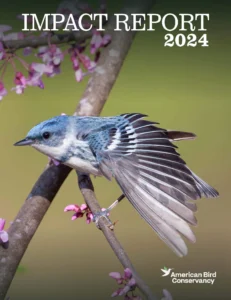
Impact Report 2024 Cover with a bird opening it's wing.At ABC, we take bold action for birds across the Americas — and we get results. We’re proud to share highlights from our work each year in our Impact Reports, along with our gratitude to the many partners and supporters who work with us to achieve mutual conservation goals. Our biannual Conservation Impact Scorecards offer an “at-a-glance” summary of our cumulative conservation actions and results.

Download 2024 Annual Report (PDF) | See Previous Years