Overview
About
The majestic Bald Eagle is the only eagle species found solely in North America. It is well-known, even to non-birders, as the national symbol of the United States, an honor granted in 1782 and made official in 2024. The Bald Eagle’s remarkable comeback after decades of population declines has also made it a symbol of the power of conservation and the Endangered Species Act.
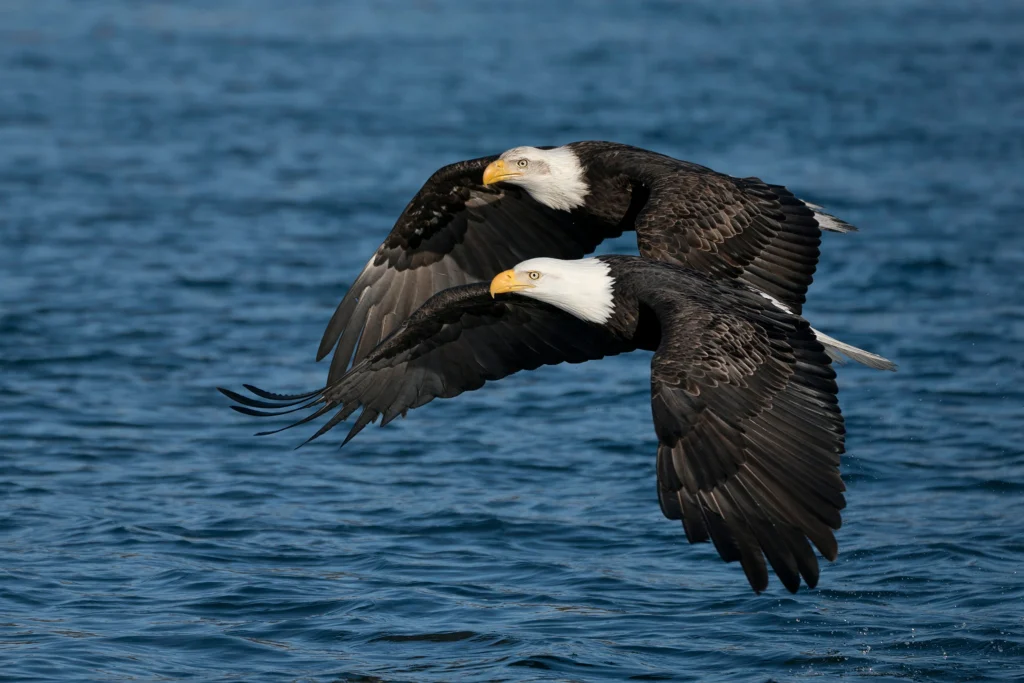
The Bald Eagle’s Latin name accurately reflects its appearance and habits: Hali and aiētos mean “sea eagle,” and leuco and cephalos mean “white head.” The use of the word “bald” in its English name does not mean hairless; rather, it derives from the Middle English word “balde,” which means shining white. This distinctive white head and matching white tail make adult Bald Eagles easy to identify, even from a distance.
The Bald Eagle belongs to a group of fish- and carrion-eating raptors known as sea- (or fish-) eagles. Sea-eagles are always found close to water; their large, arched beaks, bare lower legs, and roughened toe pads help them snatch fish from the water as they hunt. Sea-eagles are also adept kleptoparasites, stealing the catches of other birds such as the Osprey.
Threats
Today, Bald Eagle populations are on the rise, but that hasn’t always been the case. By the early 1960s, only an estimated 417 breeding pairs remained in the lower 48 states. The once-abundant birds had been laid low by DDT, a pesticide whose tragic impacts on birds inspired Rachel Carson’s Silent Spring. The Bald Eagle has become one of the greatest success stories of the Endangered Species Act, and though its population continues to grow, these powerful raptors face ongoing threats.
Habitat Loss
Bald Eagles may abandon shoreline nesting, roosting, and foraging sites due to excessive human building and activity. Hydroelectric dams and clearcutting of forests may also decrease habitat availability.
Collisions
Collision with human-made structures such as poorly sited towers, powerlines, and wind turbines is one of the leading causes of Bald Eagle mortality. Its habit of scavenging roadkill makes it especially susceptible to fatal collisions with motor vehicles.
Pesticides & Toxins
Although Bald Eagle populations began to rebound after pesticides such as DDT were banned in the 1970s, a new generation of equally dangerous toxins like carbofuran poses ongoing threats.
Bald Eagles readily scavenge game animal remains left by human hunters. These remains often contain fragments of lead ammunition, which the eagles accidentally ingest. Even small amounts of lead can be enough to poison, and eventually kill, an eagle.
Conservation Strategies & Projects
Birds need our help to overcome the threats they face. At ABC, we continue to address continuing challenges to Bald Eagles and other raptors. Bald Eagles are protected under the Bald and Golden Eagle Protection Act, which prohibits the taking or possession of these raptors and their feathers, eggs, and nests. Its populations have recovered so significantly that the Bald Eagle was delisted in 2007, and its populations continue to increase. Post-delisting monitoring plans are in place to track this positive trend.
Rethink Wind Turbines
ABC’s Bird-Smart Wind Energy campaign works to protect eagles and other birds from the threat of poorly sited wind turbines. We provide resources to help wind energy project planners identify the safest places to site their turbines to prevent collisions.
Avoiding Pesticides & Toxins
ABC continues to fight the worst pesticides and toxins, including encouraging the U.S. Environmental Protection Agency to require more review of dangerous chemicals and more accountability for pesticide manufacturers. We work at the state and federal levels to advance policies that address harmful pesticides and toxins in the environment.
Support Petitions & Advocacy
Bad Eagles are protected under the Bald and Golden Eagle Protection Act, which prohibits the taking or possession of these raptors and their feathers, eggs, and nests. The Endangered Species Act of 1973 helped stabilize plummeting Bald Eagle populations and reverse their declines. ABC defends critical legislation protecting birds and advocates for policies that benefit birds, habitats, and people. Learn about urgent issues and take action with us.
Bird Gallery
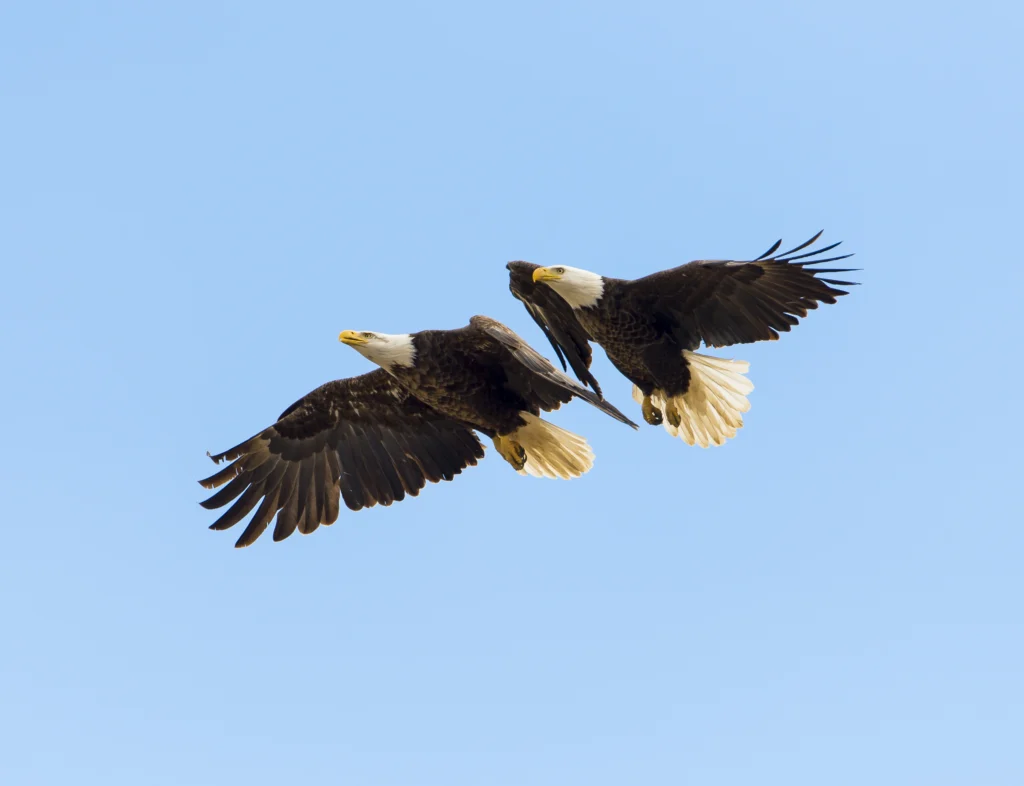
The adult Bald Eagle is a huge, blackish-brown raptor with a distinctive white head and tail and yellow bill, eye, and legs. It usually attains complete adult plumage by its fifth year. In flight, the Bald Eagle soars with its long, broad wings (often described as plank-like) held flat.
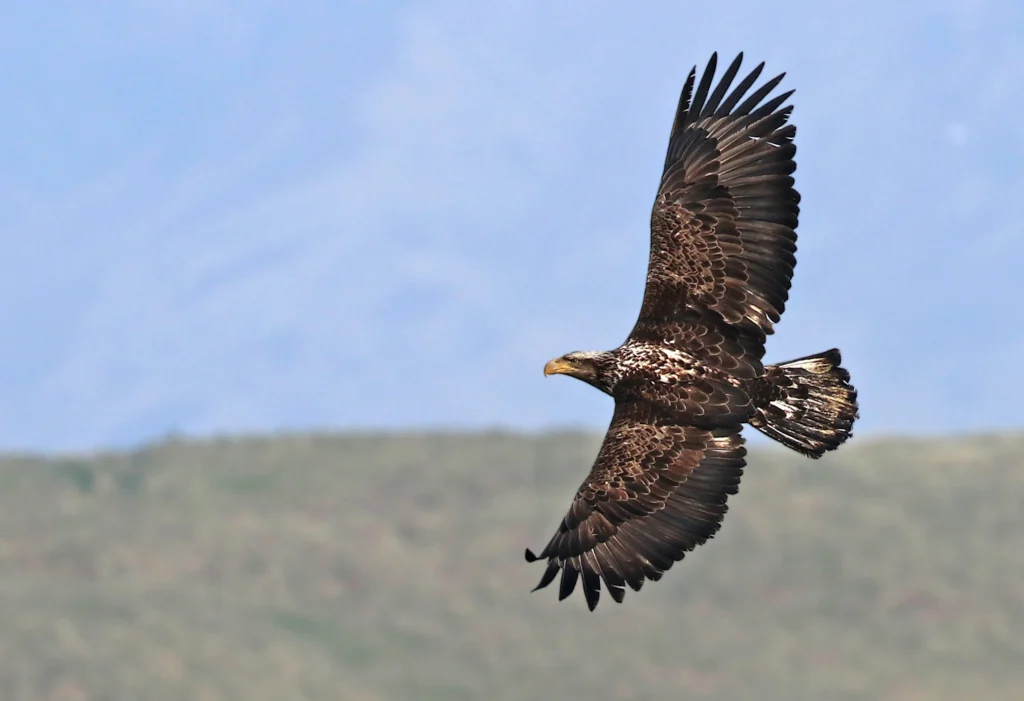
Juvenile Bald Eagles (birds younger than five years old) are mottled with varying degrees of brown and white, and are sometimes confused with the Golden Eagle. The Bald Eagle can be told from the Golden Eagle by its more massive bill and unfeathered lower legs.
Bird Sounds
The Bald Eagle’s call is a decidedly un-regal, high-pitched squeaking sound. In TV shows and movies, the loud, low scream of the Red-tailed Hawk, which presumably sounds more majestic or fearsome, is often dubbed over the on-screen image of an eagle.
Paul Marvin, XC150215. Accessible at www.xeno-canto.org/150215.
Peter Ward and Ken Hall, XC603734. Accessible at www.xeno-canto.org/603734.
Habitat
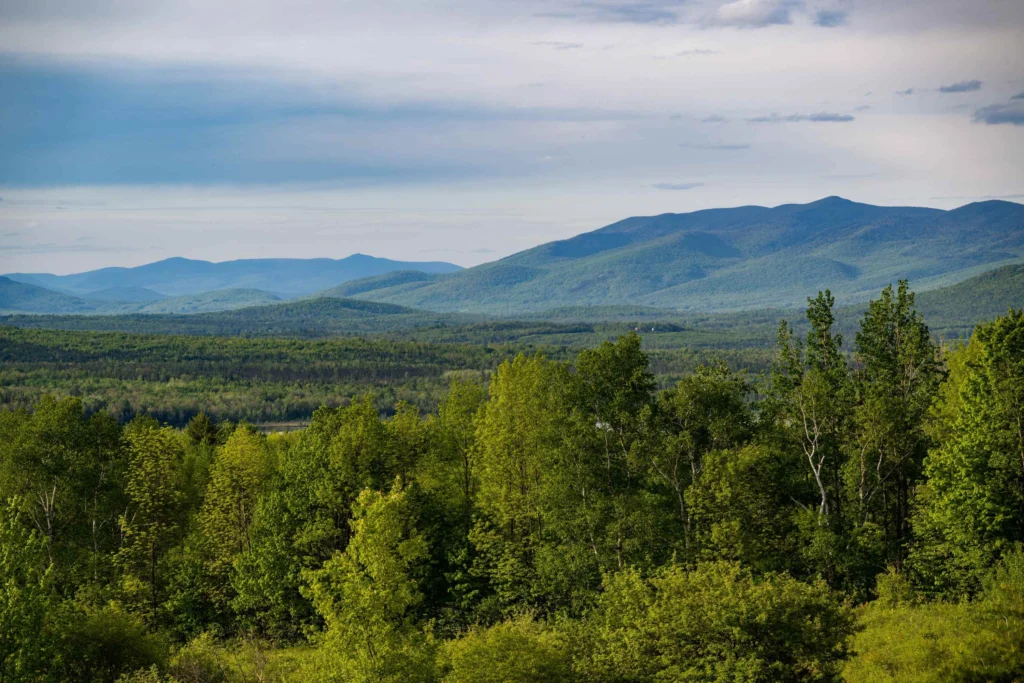
The Bald Eagle requires forests and edges with large trees near water throughout the year. It needs protected roost sites during the nonbreeding season.
- Breeds in a variety of old-growth and mature forests near lakes, reservoirs, rivers, marshes, and coasts
- Breeds in open prairies and pastureland with scattered tall trees
- Breeds in riparian corridors in mature cottonwoods, sycamores, or tall pines
- Winters in open habitats near water with large trees and sheltered areas for roosting
Range & Region
Specific Area
Canada, United States, and Mexico
Range Detail
The Bald Eagle is a North American specialty, found from Alaska through Canada into the lower 48 U.S. states, even moving as far south as northern Mexico during the winter.
Did you know?
The Bald Eagle is considered a partial migrant — individuals in the northern parts of its range often move south during extremely cold weather, as this species needs open water to hunt.
Life History
During the fall and winter, the Bald Eagle can become surprisingly social, congregating in large groups sometimes numbering hundreds of birds. This communal gathering often occurs in response to a superabundance of easy prey — during annual salmon runs, for example.
Diet
True to its nickname of Fish Eagle, the Bald Eagle dines mainly on fish either snatched from the water’s surface or stolen from another bird. But this eagle, being a keen opportunist, will also hunt waterfowl, small mammals, and reptiles and eat carrion and garbage.
Courtship
Like the Tundra Swan and Whooping Crane, the Bald Eagle usually stays with the same mate for life. While courting, a pair flies high, links talons, then plummets toward the ground, spinning wildly. This “cartwheel display” ends only when the pair breaks their grip, usually just before they hit the ground. Other aerial courtship displays include “rollercoaster flight,” when an eagle flies high, then folds its wings and plunges toward the ground, swooping back up at the last second. Pairs also engage in mutual chases, rolling and diving through the air in tandem.
Nesting
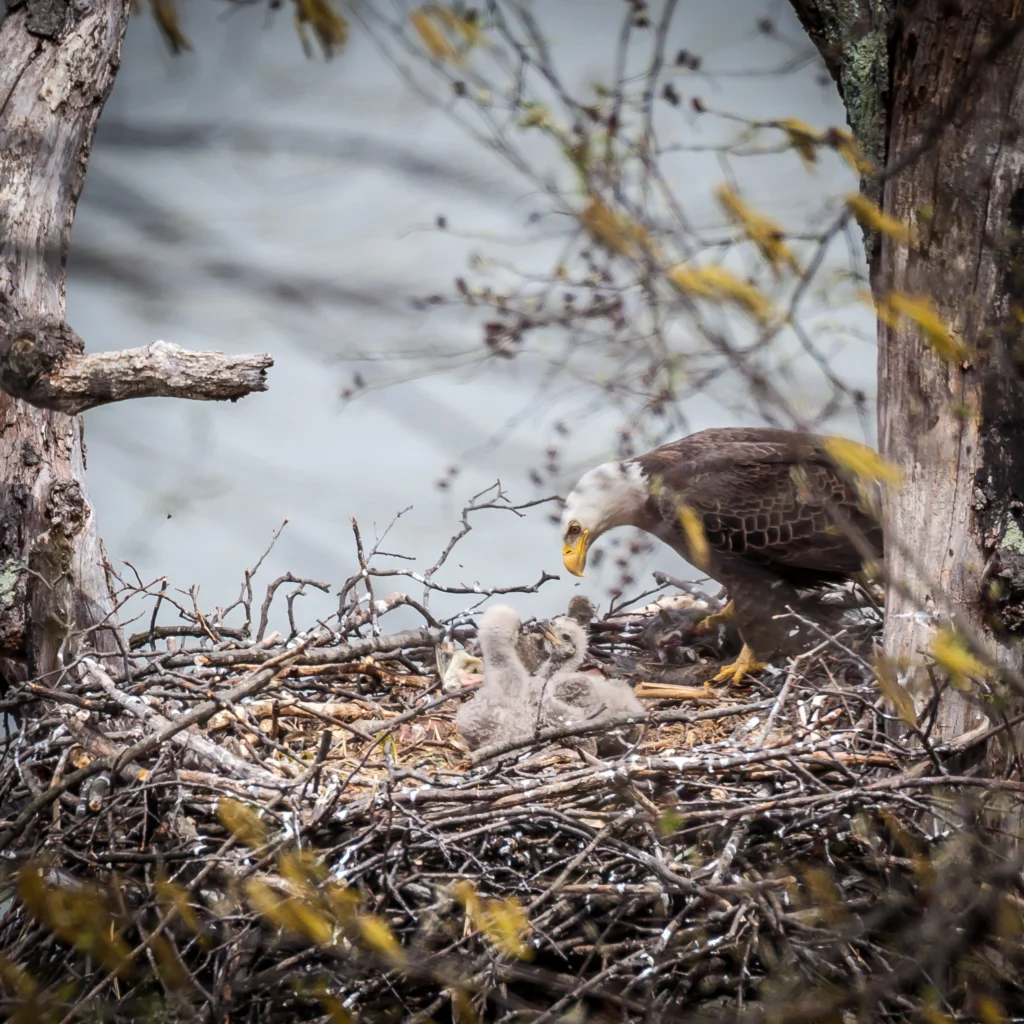
A Bald Eagle pair aggressively defends a territory and nest during the breeding season. Both male and female work together to build their nest, an enormous platform of large sticks lined with grass, plant stalks, sod, and other soft materials. The nest is built high in a large tree, usually close to water. In the absence of a suitable tree, an eagle pair may nest on a cliff or even on the ground.
A mated pair of Bald Eagles will reuse the same nest each year, adding new material again and again. Sometimes these structures become so large and unwieldy that they take down the trees they’re built upon. Bald Eagle nests are some of the largest bird nests in the world — the largest ever recorded was in Florida, and measured 9.5 feet in diameter and 20 feet deep, weighing almost 3 tons!
Eggs & Young
The female Bald Eagle lays one to three eggs, which both parents take turns incubating. After about a month, the young hatch, already covered in light gray down. The adults guard and feed the young eagles, which grow quickly and are ready to fledge in 10 to 12 weeks. Juvenile Bald Eagles have mottled brown-and-white plumage, and are sometimes misidentified as Golden Eagles. They acquire the characteristic white head and tail of adults between four and five years old.