Aerial view a rainforest habitat over a mountain with clouds.

Purple Quail-Dove

Geotrygon purpurata

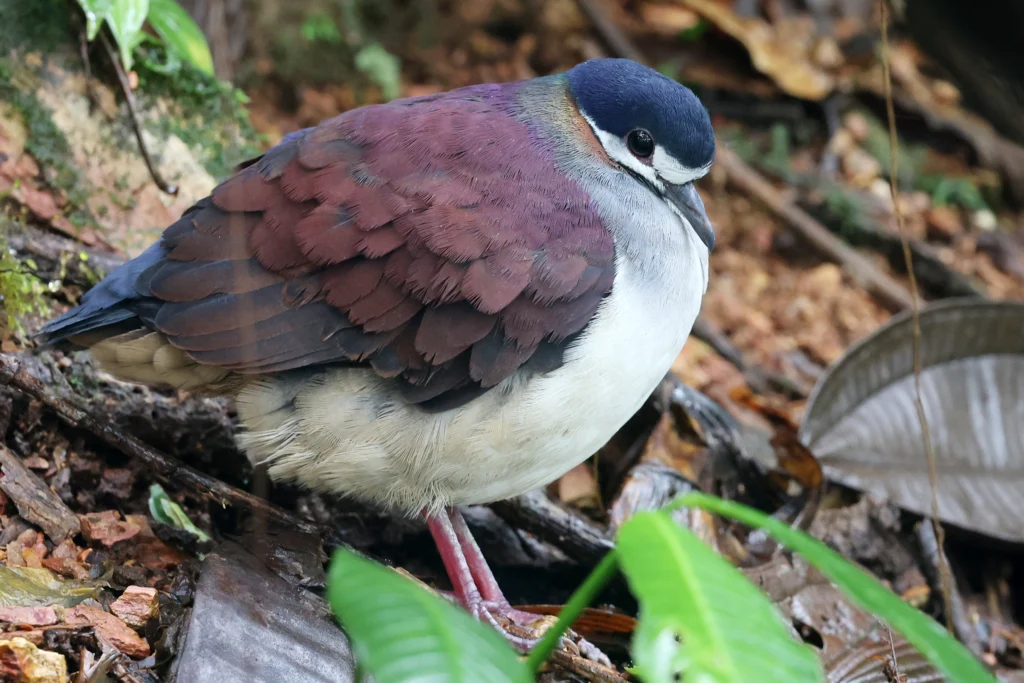
Purple Quail-Dove. Photo by John Mills, Macaulay Library at the Cornell Lab of Ornithology.

Purple Quail-Dove

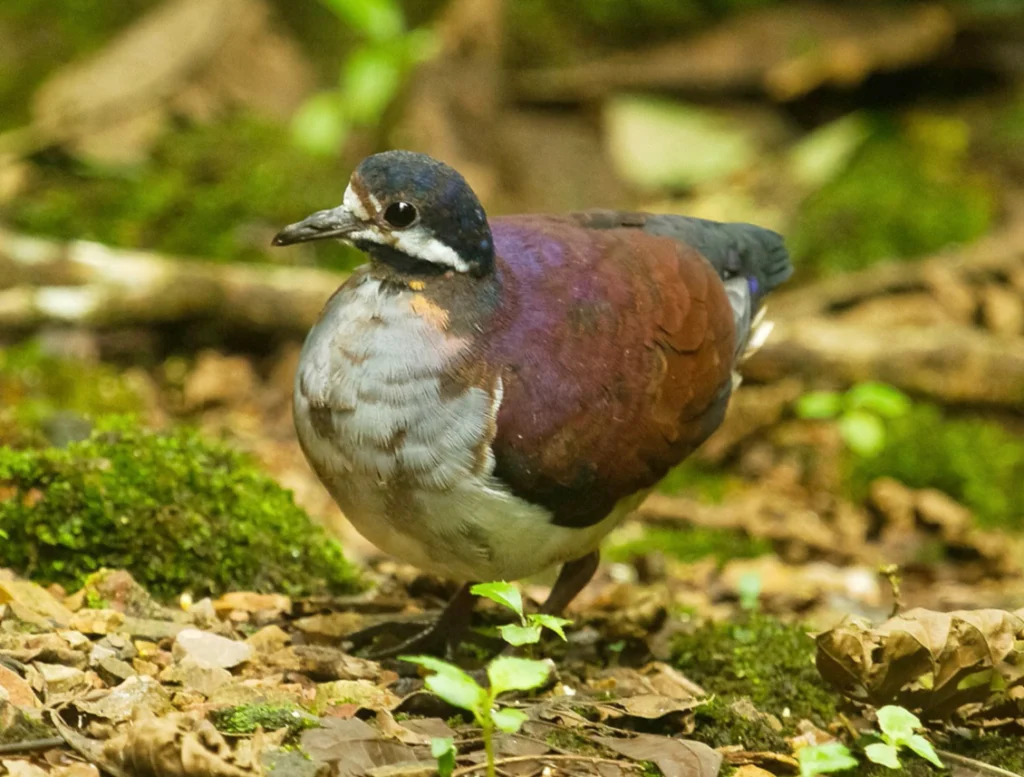
Purple Quail-Dove. Photo by John Mills, Macaulay Library at the Cornell Lab of Ornithology.

Geotrygon purpurata

Overview

Conservation Status
Population Trends
Decreasing
Population Size
600–1,700
Family
Doves
Location
South America
Migration Pattern
Nonmigratory
Migration Distance
Nonmigratory
Also Known As
  • Purple Partridge Dove
  • Indigo-crowned Quail-Dove
  • Purple-crowned Quail-Dove
  • Paloma Perdiz Púrpura (Spanish)

About

The shy, stunning Purple Quail-Dove belongs to a larger family that includes familiar species such as the widespread Mourning Dove and Rock Pigeon. It was once considered a subspecies of the Sapphire Quail-Dove, a close relative found in southern Colombia, eastern Ecuador and Peru, and western Brazil. The Purple Quail-Dove was split into a separate species in 2010 based on differences in its plumage and song.

This bird’s genus name, Geotrygon, is derived from the Greek words for “earth” and “dove,” and refers to its ground-dwelling habits. Its species name, `, means “purple-clad.” This “purple earth dove” has a highly restricted range in one of the wettest, most biodiverse regions of the Americas.

The Purple Quail-Dove inhabits the dripping-wet rainforests of the Chocó region, which runs down the Pacific coast of South America from Panama to northwestern Ecuador. This region hosts an astounding diversity of plants and animals, including over 900 species of birds, many found nowhere else in the world. The Purple Quail-Dove is one of these endemic birds, along with dozens of others, including the Baudo Guan, Scarlet-breasted Dacnis, and Glistening-green Tanager.

Threats

Birds around the world are declining. Many of them, like the Purple Quail-Dove, have small populations and restricted ranges that make them especially vulnerable to threats. Habitat loss and climate change can affect both the rarest species and the most familiar backyard birds. The Purple Quail-Dove faces additional pressure from hunting.

Habitat Loss

Rainforest habitat throughout the Chocó region is being lost to agriculture (particularly oil palm plantations), cattle grazing, mining, and other human-driven deforestation. The Chocó is one of the most biodiverse places on Earth, and among the most threatened.

Habitat Loss

Climate Change

A changing climate presents a suite of often unpredictable threats to birds: extreme weather events, droughts, habitat loss due to rising sea levels, and intense heat are just a few ways climate change puts birds at risk.

Climate Change

Conservation Strategies & Projects

Birds need our help to overcome the threats they face. At ABC, we’re inspired by the wonder of birds and driven by our responsibility to find solutions to meet their greatest challenges. With science as our foundation, and with inclusion and partnership at the heart of all we do, we take bold action for birds across the Americas.

Creating & Maintaining Reserves

ABC-supported reserves have provided habitat for this species, including a recently expanded protected area, the Atuncela Integrated Management Regional District, in Colombia, as well as Ecuador’s Rio Canandé and Mashpi Amagusa Reserves. ABC has supported ecotourism and reforestation at Río Canandé Reserve to restore habitat and enhance sustainability.

Creating and Maintaining Reserves

Bird Gallery

The Purple Quail-Dove is richly colored in jewel-toned shades that blend effectively into the dark forest interior. Adults have an eponymous purple back shading into purplish-chestnut wings, set off by a shining patch of golden, purple, and bluish-green on the sides of the neck. Swaths of dark blue mark this bird’s crown, nape, lower back, and rump, and its white face and throat are bisected by a dark blue malar stripe. The upper chest is bluish-gray, and the belly is white. Females are a bit duller than males, and juveniles are even more so, lacking a distinct facial pattern and iridescent neck patches.

Sounds

Call

Mitch Lysinger, XC260384. Accessible at www.xeno-canto.org/260384.

Song

Olaf Jahn, XC261594. Accessible at www.xeno-canto.org/261594.

Habitat

The Purple Quail-Dove is only found in the extremely wet lowland tropical forests of the Chocó region.

  • Inhabits underbrush and the ground strata of primary lowland and montane evergreen forests

Range & Region

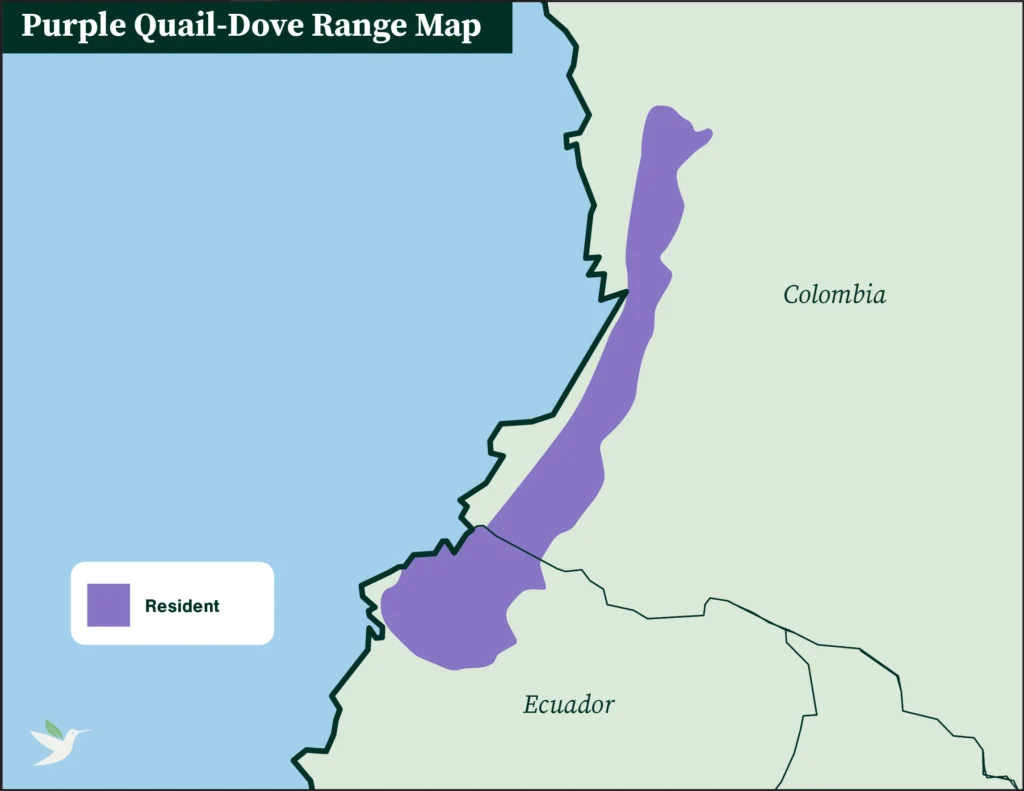
Purple Quail-Dove range map.

Specific Area
Western Colombia through northwest Ecuador

Range Detail
The Chocó region, extending from eastern Panama through western Colombia and northwestern Ecuador, supports an abundance of birdlife. The Purple Quail-Dove occurs only in western Colombia through northwest Ecuador.

Did you know?
The Chocó forest is the second most biodiverse and one of the five most threatened biodiversity hotspots on Earth. The area is home to no fewer than 63 endemic bird species, including the Purple Quail-Dove, found nowhere else on Earth.

Range
South America
Migration Pattern
Nonmigratory
Migration Distance
Nonmigratory

Life History

Like its near relatives, the Purple Quail-Dove is highly terrestrial, spending most of its time on or near the ground. Information about the species is scant, but circumstantial evidence suggests that, in Ecuador, it breeds in June.

Diet

The Purple Quail-Dove forages on the ground for seeds and small invertebrates, probing through leaf litter and undergrowth. It is usually observed foraging alone or in pairs. Foods taken include beetles, seeds, and small fruits.

Courtship

The Purple Quail-Dove is probably socially monogamous, like other quail-dove species. It is normally a solitary species, but sometimes seen in pairs.

Nesting

Although little is known about the nest of the Purple Quail-Dove, it likely builds a platform nest of sticks and twigs close to the ground, similar to the nests of other birds in its genus.

Eggs & Young

Like other quail-doves, the female Purple Quail-Dove probably lays a clutch of one to two white or buff-colored eggs. A mated pair likely takes turns incubating the clutch and bringing food to the young after hatching. Young quail-doves probably leave the nest after about two weeks.