Aerial view a rainforest habitat over a mountain with clouds.

Ash-breasted Tit-Tyrant

Anairetes alpinus

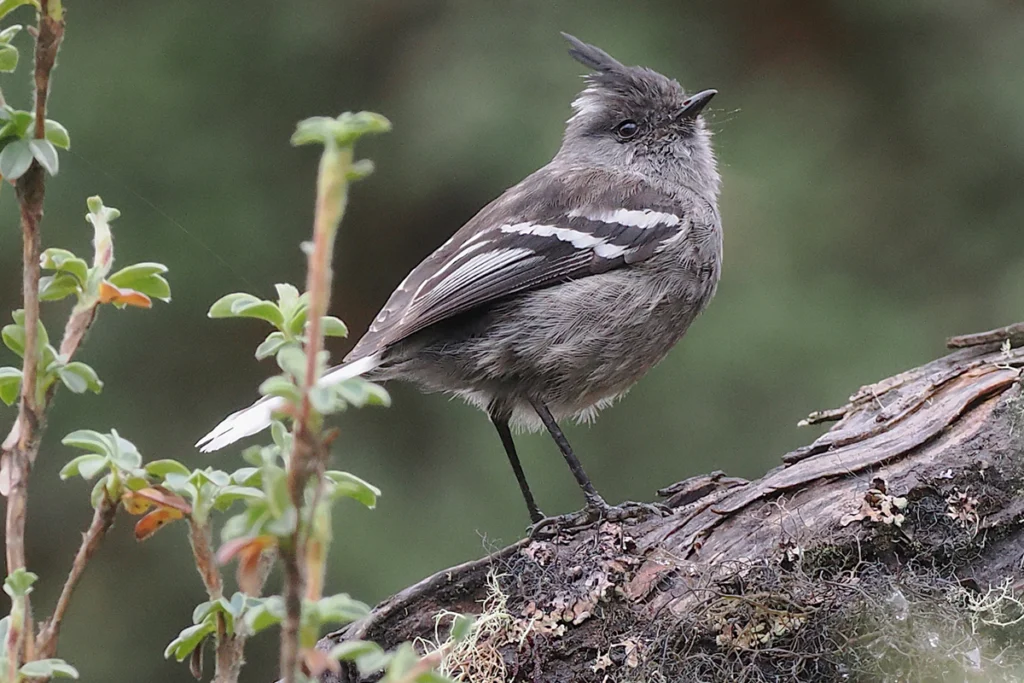
Ash-breasted Tit-Tyrant. Photo by Fabrice Schmitt.

Ash-breasted Tit-Tyrant

Ash-breasted Tit-Tyrant. Photo by Fabrice Schmitt.

Anairetes alpinus

Overview

Conservation Status
Population Trends
Decreasing
Population Size
150–700
Family
Tyrant Flycatchers
Location
South America
Migration Pattern
Nonmigratory
Migration Distance
Nonmigratory
Also Known As
  • Torito de Pecho Cenizo
  • Cachudito Pechicenizo

About

The Ash-breasted Tit-Tyrant is a small, active gray bird with a very limited range, found only in the high Andes of Peru and Bolivia. It is one of only a few groups of small flycatchers that occur at such high altitudes.

This bird’s appearance is reflected in the name “ash-breasted.” The word “tyrant” acknowledges its inclusion in the huge tyrant flycatcher family, which contains hundreds of species across the Americas, ranging from the Lulu’s Tody-Flycatcher to the Western Kingbird. The Ash-breasted Tit-Tyrant was given the added epithet of “tit” due to its small size and lively ways, which reminded researchers of members of the Paridae family (known as “tits” in Europe) such as the Carolina Chickadee and Tufted Titmouse. Despite appearances, the Ash-breasted Tit-Tyrant is not related to birds of this family.

Threats

Birds around the world are declining, and many of them, like the Ash-breasted Tit-Tyrant, are facing urgent, acute threats. Because of its small population size, fragmented range, and habitat loss, the Ash-breasted Tit-Tyrant is classified as Endangered on the International Union for Conservation of Nature (IUCN) Red List.

Habitat Loss

Polylepis-tree-dominated habitat has disappeared at alarming rates, putting the Ash-breasted Tit-Tyrant and other Polylepis-dependent species at risk. Overgrazing and the uncontrolled use of fire prevent Polylepis regeneration. Wood cutting for timber, firewood, and charcoal also poses a threat, and exotic tree species such as eucalyptus displace native trees.

Habitat Loss

Climate Change

A changing climate could affect habitat and food availability for the Ash-breasted Tit-Tyrant, and compound the effects of the enormous amount of Polylepis habitat already lost.

Climate Change

Conservation Strategies & Projects

Birds need our help to overcome the threats they face. At ABC, we’re inspired by the wonder of birds and driven by our responsibility to find solutions to meet their greatest challenges. Working in tandem with Peruvian and Bolivian partners, including Asociación Ecosistemas Andinos (ECOAN) in Peru and Asociación Armonía and Instituto de Ecología in Bolivia, ABC continues to be engaged in programs to increase protections for this species.

Creating & Maintaining Reserves

ABC and partners have established nine community-owned and managed Private Conservation Areas covering more than 21,000 acres to protect and restore threatened Polylepis woodlands.

Creating and Maintaining Reserves

Restore Habitat

ABC has supported work by ECOAN in Peru, Armonía, and the Instituto de Ecología to protect and restore Polylepis woodlands for the Ash-breasted Tit-Tyrant. More than 7 million trees, including thousands of Polylepis trees, have been planted to restore lost habitat. In both Peru and Bolivia, ABC has assisted our partners in providing fuel-efficient stoves in communities to reduce demand for fuel wood and alleviate pressure on habitat for endangered birds.

Nearly 7 Million Trees Planted: Celebrating 20 Years of Reforestation Efforts

Bird Gallery

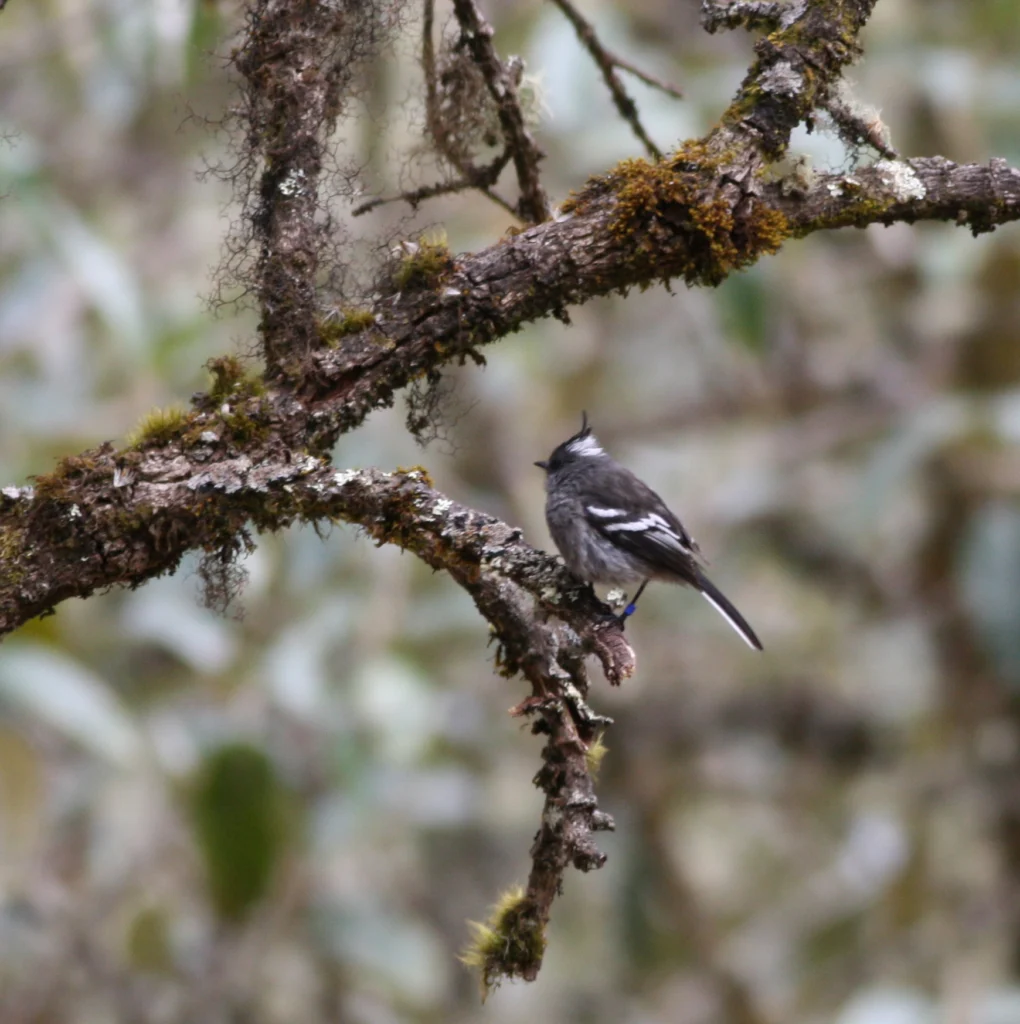
The Ash-breasted Tit-Tyrant is gray, with a wispy-looking, black, forked crest and a short, slender black bill. It has a white hindcrown patch, a yellowish-white belly, black wings with white wing bars, and a black tail with white outer feathers.
The sexes look similar.

Bird Sounds

Calls of this species are rough and rather burry-sounding; one is a rising note followed by short, descending notes.

Call

Credit: Andrew Spencer, XC74468. Accessible at www.xeno-canto.org/74468.

Call

Credit: Peter Boesman, XC218495. Accessible at www.xeno-canto.org/218495.

Habitat

The Ash-breasted Tit-Tyrant has an extremely small range and is restricted almost entirely to Polylepis forests.

  • Occurs in stunted forests dominated by Polylepis and other native trees and shrubs on steep, rocky slopes from 12,000 to 15,000 feet

Range & Region

Ash-breasted Tit-tyrant range map.

Specific Area
High Andean mountains of Peru and Bolivia

Range Detail
The Ash-breasted Tit-Tyrant is found only in the high Andes of Peru and Bolivia. It is local to the Cordillera Blanca, department of Ancash, Peru. The species’ distribution is very fragmented.

Did you know?
Two subspecies of Ash-breasted Tit-Tyrant are found in two separate populations across the Andes of Peru and Bolivia. One subspecies occurs on the western slope of the Andes in northern Peru; the other is found in southeastern Peru and northwestern Bolivia.

Range
South America
Migration Pattern
Nonmigratory
Migration Distance
Nonmigratory

Life History

Small and rare, the Ash-breasted Tit-Tyrant is an active flycatcher, moving quickly along the outer branches of Polylepis trees, but typically remaining concealed within vegetation. The Ash-breasted Tit-Tyrant has been observed foraging alone, in pairs, or in family groups. Much remains to be discovered about its breeding biology.

Diet

The Ash-breasted Tit-Tyrant is insectivorous, actively gleaning along outer tree branches for prey, particularly soft-bodied caterpillars. It also sallies out after flying insects in the manner of other flycatcher species.

Courtship

The Ash-breasted Tit-Tyrant is presumed to be socially monogamous, like other members of its genus.

Nesting

First described by Harold Greeney in 2013, the nest of the Ash-breasted Tit-Tyrant is a deep, compact cup of moss thickly lined with feathers, which provides insulation from cold alpine temperatures and may also help camouflage the eggs and chicks. It builds its nest approximately 4.5 feet above ground within a hanging epiphyte clump.

Eggs & Young

The female Ash-breasted Tit-Tyrant lays a clutch of two to three white eggs, which she incubates for almost two weeks. Both parent birds appear to feed the nestlings.