Wood Thrust Habitat - a beautiful lush green forest overlooks a flowing river with a small island in the middle. Photo by Som Prasad

Pine Warbler

Setophaga pinus

Pine Warbler perched on pinecone. Photo by Joshua Galick.

Pine Warbler

Pine Warbler perched on pinecone. Photo by Joshua Galick.

Setophaga pinus

Overview

Conservation Status
Population Trends
Stable
Population Size
13 million
Family
Warblers
Location
North America
Migration Pattern
Latitudinal
Migration Distance
Short Distance
Also Known As
  • Pine Creeping Warbler
  • Chipe Pinero or Reinita de Pinos

About

The Pine Warbler is an aptly named species, rarely seen away from its namesake trees, where it gleans rather sluggishly among the foliage and sings its dreamy-sounding song from the canopy.

This wood-warbler spends both the breeding and nonbreeding seasons entirely within North America. (Two subspecies are resident in the Caribbean Islands.) Although other warbler species, including the Yellow-rumped Warbler and Common Yellowthroat, also winter in North America to some extent, none do so as completely as the Pine Warbler.

The Pine Warbler is able to remain in North America during the winter due to an interesting physiological adaptation. Although primarily insectivorous, the Pine Warbler is the only North American wood-warbler that is also able to eat large quantities of seeds, particularly during the winter. In order to make the switch to a seed-heavy diet, this bird undergoes an interesting internal alteration.

Studies have shown that Pine Warblers can actually change their digestive systems depending on their diet. When feeding primarily on seeds, this bird’s gizzard (the muscular part of the stomach that grinds food) enlarges, becoming more efficient at processing this harder food. This ability increases the Pine Warbler’s food options during the winter season, when insect abundance decreases.

Threats

Birds around the world are declining, but some are holding steady. Birds like the Pine Warbler are made more vulnerable by the cumulative impacts of threats like habitat loss, pesticides, and collisions.

Habitat Loss

Human development can remove essential pine forest habitat used by Pine Warblers throughout their annual cycle. Many of the old-growth pine forests in the southeastern U.S. have been lost, replaced by younger, even-aged stands of pines. Pine Warblers fare best in older forests and may have reduced nesting success in these young forests.

Habitat Loss

Glass Collisions

Migrating at night, Pine Warblers are especially susceptible to collisions with communication towers and other tall structures, including buildings. They may also collide with reflective glass windows.

Glass Collisions

Pesticides & Toxins

DDT, a pesticide used widely in the U.S. in the mid-20th century, had negative impacts on birds from a wide range of species, including the Pine Warbler. While DDT is no longer used, other pesticides used to treat tree diseases and insect infestations can affect Pine Warblers.

Pesticides & Toxins

Conservation Strategies & Projects

Birds need our help to overcome the threats they face to prevent the extinction of the most vulnerable species and keep common birds from declining. Inspired by the wonder of birds and with science as our foundation, ABC forms partnerships throughout the Western Hemisphere and takes bold action for birds.

Restoring Habitat

ABC is part of several Migratory Bird Joint Ventures, partnerships designed to improve habitat for priority bird species. The JVs often work with private landowners to help them steward their land for birds.

Restoring Habitat

Preventing Glass Collisions

ABC has been a leader in the effort to reduce the devastating toll of glass collisions on birds. We’ve developed innovative methods for evaluating the effectiveness of collision deterrents, created resources to elevate our collective understanding of collisions and make solutions readily accessible, and advocated for bird-friendly policies in the U.S.

Preventing Glass Collisions

Avoiding Pesticides & Toxins

ABC works with partners at the state and federal levels in the U.S. to call for the regulation or cancellation of the pesticides and toxins most harmful to birds. We develop innovative programs, like working directly with farmers to use neonicotinoid coating-free seeds, advancing research into pesticides’ toll on birds, and encouraging millions to pass on using harmful pesticides.

Avoiding Pesticides & Toxins

Bird Gallery

The Pine Warbler’s appearance can be highly variable depending on its age and sex. Adult males are usually the brightest, with a yellow throat and breast, olive upperparts, and blurry olive streaking along the sides. Yellow “spectacles” contrast with the olive face and darker cheek patch. The adult female is a more muted version of the male. Immature Pine Warblers can be confusing, as they are a drab gray-brown above with no trace of yellow.

All Pine Warblers possess a white belly and undertail coverts (feathers between the belly and tail), two low-contrast white wing bars, a long tail, dark legs, and a stout bill.

Bright Pine Warblers can sometimes be confused with the Yellow-throated Vireo — look for the vireo’s stouter beak with a small hook. Dull fall or juvenile Pine Warblers are often mistaken for fall-plumaged Bay-breasted and Blackpoll Warblers, but can be told apart by a longer tail, contrast between darker cheeks and lighter throat, and overall lack of color.

Sounds

The song of the Pine Warbler is a variable, melodic trill that can have a slow, rather lazy cadence. This song can easily be confused with the songs of the Chipping Sparrow or Dark-eyed Junco.

Song

Credit: Thomas Magarian, XC790562. Accessible at www.xeno-canto.org/790562.

Song

Credit: Christopher McPherson, XC691777. Accessible at www.xeno-canto.org/691777.

Habitat

Habitat is so important to the Pine Warbler that it’s in the species’ name! Pine Warblers use a variety of open pine forests year-round.

  • Found in open pine woods and upland pine forests with open understory, including red, white, pitch, jack, pitch, loblolly, shortleaf, and longleaf pines.
  • Breeds in mature pine plantations
  • Absent from other types of conifers, such as spruce, fir, larch, or hemlock, unless pines are also present
  • Uses mixed pine/oak and other deciduous woods during migration and sometimes in the nonbreeding season
  • Sometimes found at forest edges and suburban areas near bird feeders

Range & Region

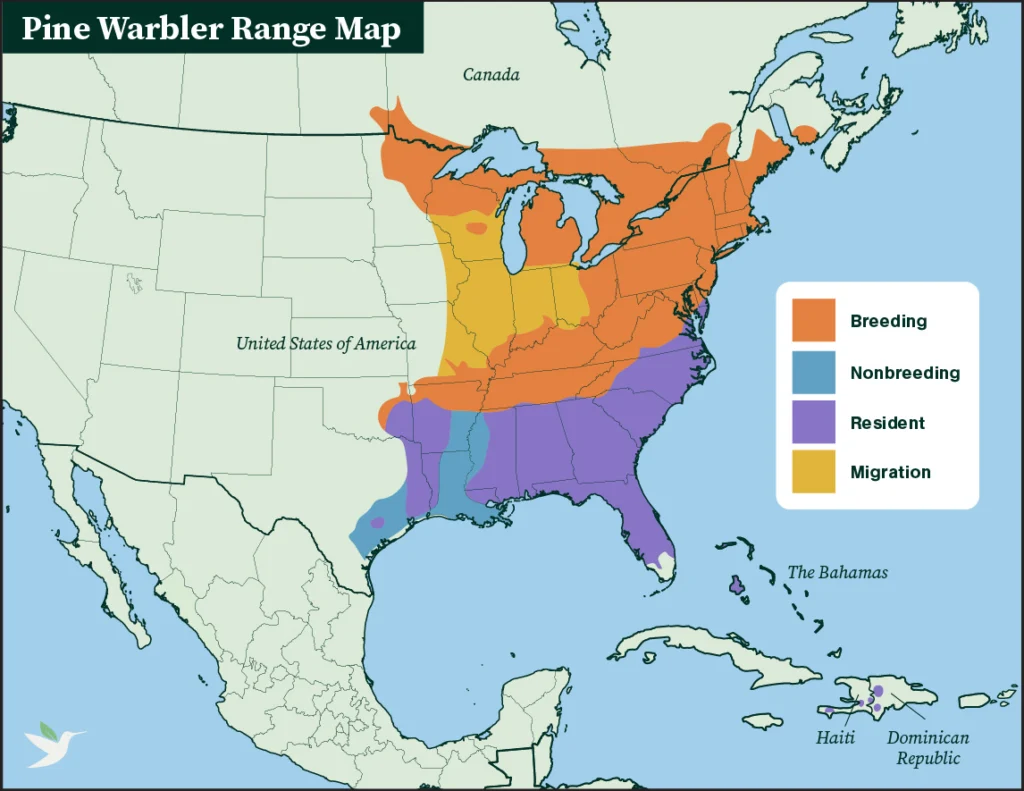
Pine Warbler range map.

Specific Area
Eastern North America, Caribbean

Range Detail
Where there are pines, there are Pine Warblers! Of the four subspecies of Pine Warbler, only one is migratory. This migratory subspecies breeds from southern Canada and the eastern U.S. west to Minnesota, Missouri, and east Texas in rather scattered populations where there is suitable pine habitat. It is absent in the prairie regions of the Midwest and bottomland hardwood forests along the lower Mississippi River.

This migratory subspecies of Pine Warbler spends the nonbreeding season in the southeastern U.S., where it joins birds from the resident Florida subspecies. It is gregarious during migration and in the winter, when it’s often seen in small flocks.

Three resident subspecies of Pine Warbler are recognized; one occurs in southern Florida, one on the northern Bahama Islands, and one on Hispaniola (Dominican Republic/Haiti).

Did you know?
Pine Warblers are one of the first warbler species to migrate north in spring, and one of the last to leave in the fall.

Range
North America
Migration Pattern
Latitudinal
Migration Distance
Short Distance

Life History

You may know where to look for Pine Warblers (in pine forests!), but actually spotting one may be difficult. They move among the highest branches of trees, picking through needles and bark for caterpillars and other arthropods. During the breeding season, they sometimes form flocks of dozens of birds.

Diet

The Pine Warbler feeds heavily on insects and their eggs, caterpillars, and spiders during its nesting season, hopping slowly through the tree canopy, moving up and down tree trunks in Brown Creeper-like fashion, flying out after prey, and sometimes feeding from the ground. In the winter months, the Pine Warbler’s unique digestive system allows it to eat large quantities of seeds, and it may visit bird feeders for corn, peanuts, and suet.

Courtship

More information is needed about the Pine Warbler’s courtship and breeding displays. Males can be aggressive early in the breeding season, chasing away birds from their territory. It’s assumed that Pine Warblers maintain a pair bond throughout the nesting season.

Nesting

The Pine Warbler’s nest is almost always high in a pine tree, with older, larger pines favored. These nests are usually well-concealed by pine needles or cones, and quite difficult to see from below. The female builds her cup-shaped nest using pine needles, twigs, strips of bark, and plant stems, often bound with spider silk. It is lined with softer materials such as plant down, animal hair, and feathers.

Eggs & Young

The female Pine Warbler lays a clutch of three to five eggs, which she incubates herself. Her mate often brings her food while she broods. Both parents take turns brooding and feeding the young after they hatch. As nests are high off the ground and well-hidden, more remains to be discovered about the timing of Pine Warbler fledging. After fledging, young and adult Pine Warblers often coalesce into small groups.