Overview
About
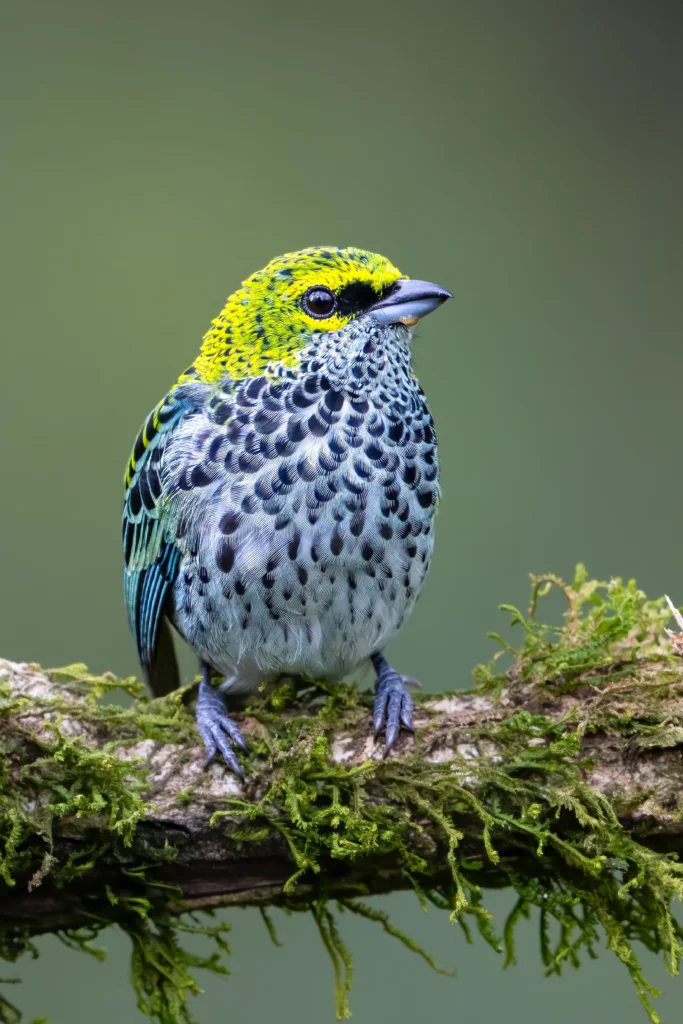
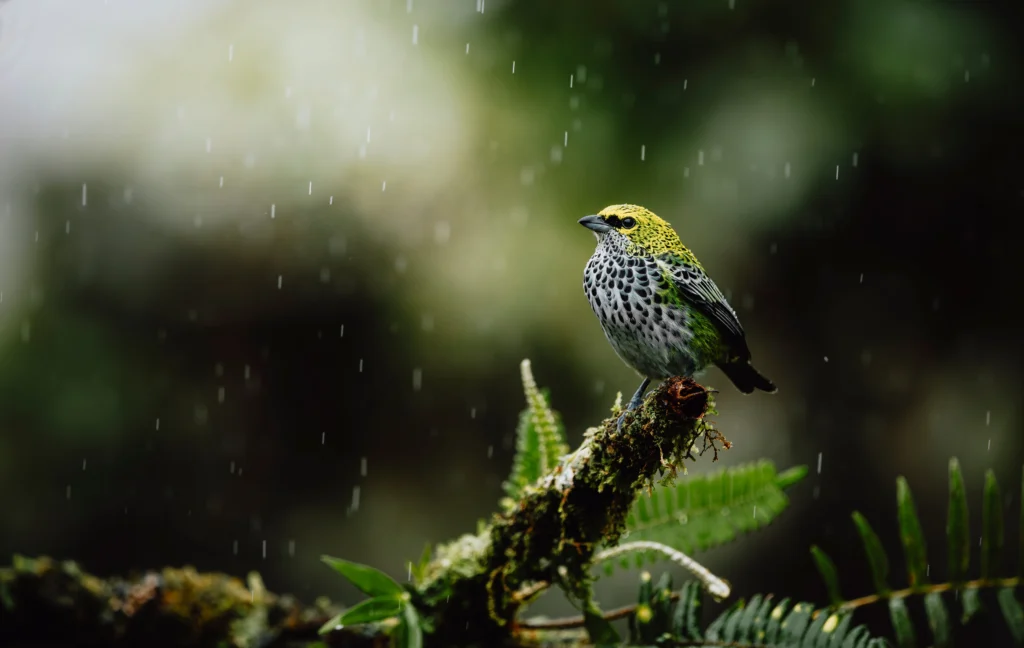
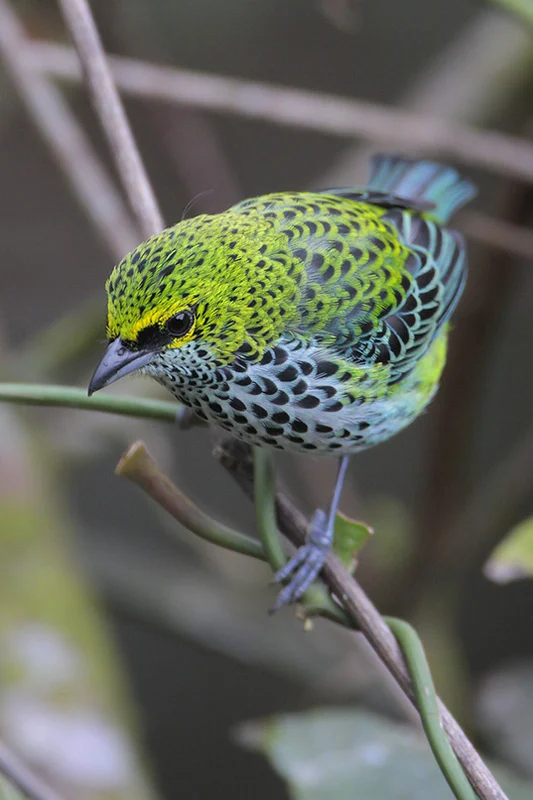
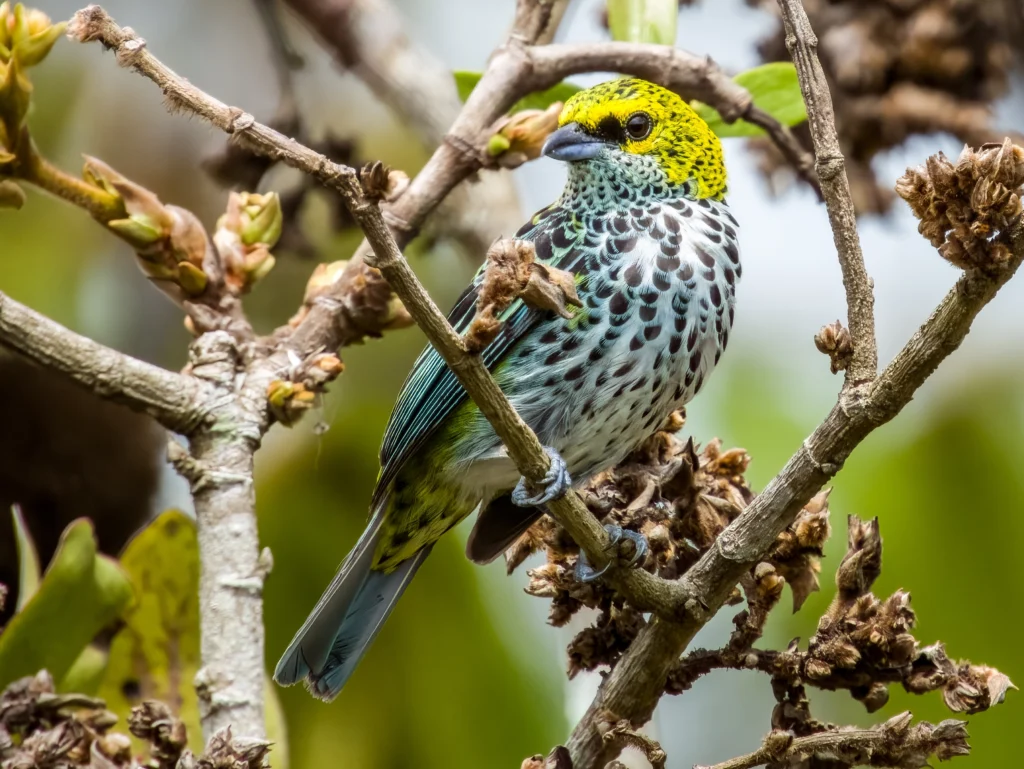
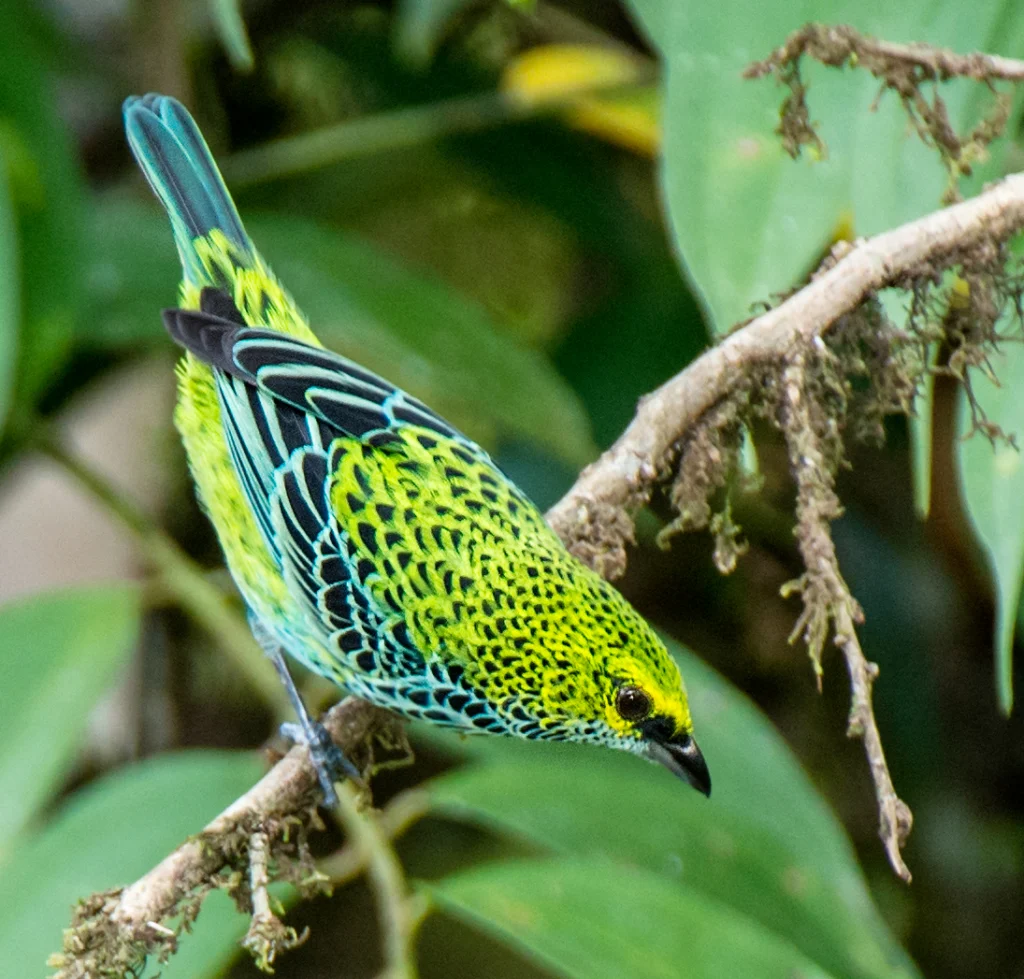
The Speckled Tanager is a preternaturally beautiful bird, even among the other stunning Central and South American tanagers of the family Thraupidae. The black speckles that give this species its name come from black feathers with brightly colored edges, giving the impression of scales over the bird’s body. The edges blend together to create a palette of iridescent yellow-green and green-blue over the body of the bird.
Striking as these patterns and hues may be, they actually provide good camouflage for this bird up in the green, backlit forest canopies where it spends most of its time. The tanager’s speckles, like the spots on a jaguar or the camo pattern on a hunter’s jacket, are a form of disruptive patterning, a camouflage strategy that breaks up or obscures an animal’s outline, allowing it to blend with its background. Up among the bright green leaves, these birds can easily go unseen. Up close, however, their plumage is hard to ignore.
Threats
Birds around the world are declining, and many of them face urgent threats. The Speckled Tanager lives primarily in old-growth forest, and healthy populations depend on the persistence of forests throughout their range in Central and South America. Though not considered a species of conservation concern, this bird is declining, and deforestation is one likely cause.
Deforestation
Speckled Tanagers are mostly found in old-growth, or “primary,” forests — forests which have not been severely disturbed by human activities. As such, they are particularly vulnerable to habitat loss, as the forests they depend on are cleared to make way for agricultural operations, which often aren’t managed in ways that benefit birds.
Conservation Strategies & Projects
Birds like the Speckled Tanager need our help to overcome the threats they face. To ensure that this and other species have the habitat they need to survive, ABC and our partners create and maintain reserves throughout Central and South America. With science as our foundation, and with inclusion and partnership at the heart of all we do, we take bold action for birds across the Americas.
Creating & Maintaining Reserves
Protecting tropical forest habitat is necessary for the survival of this species and many others. Working with dozens of partners and local communities throughout Latin America and the Caribbean, ABC supports a growing network of protected areas in more than a dozen countries. Totaling more than 1.3 million acres, nearly one-third of the world’s birdlife (more than 3,000 species) is protected by an ABC-supported reserve.
Improving Habitat
Although Speckled Tanagers are primarily birds of old-growth forests, some research suggests they may be adaptable to restored and recovering forests as well. Agricultural land, for instance, can be managed in a way that supports farmers and communities as well as birds and other wildlife. ABC supports bird-friendly stewardship by incentivizing farmers, ranchers, and companies in Latin America and the Caribbean to adopt practices that restore the land and maintain habitat so that bird populations can thrive.
Bird Gallery
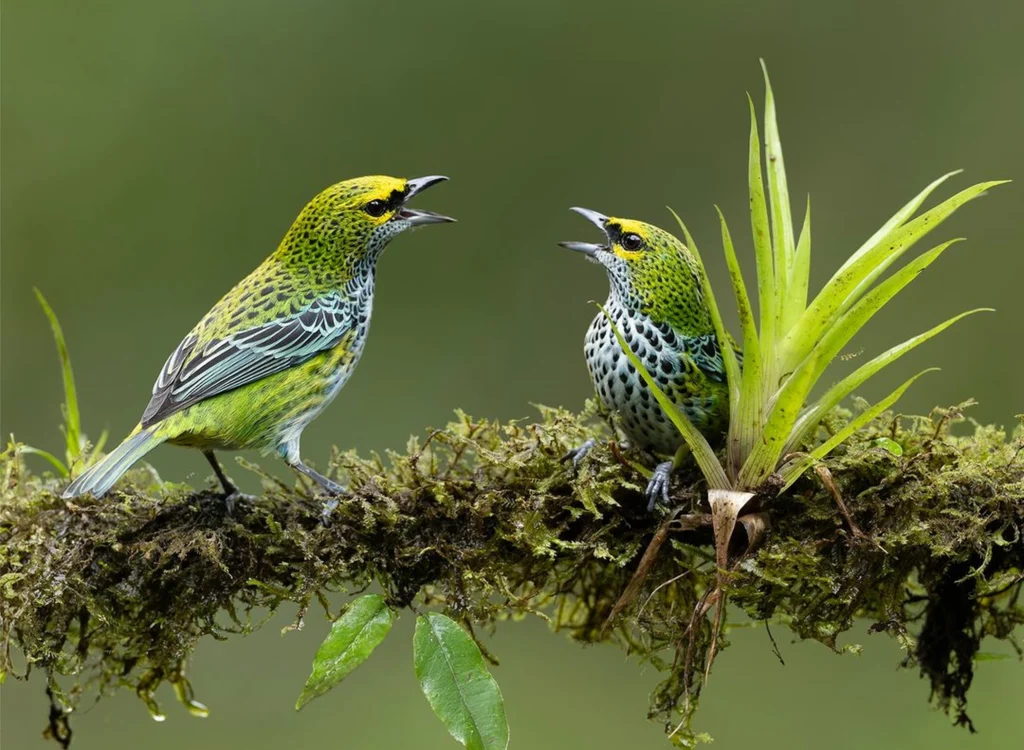
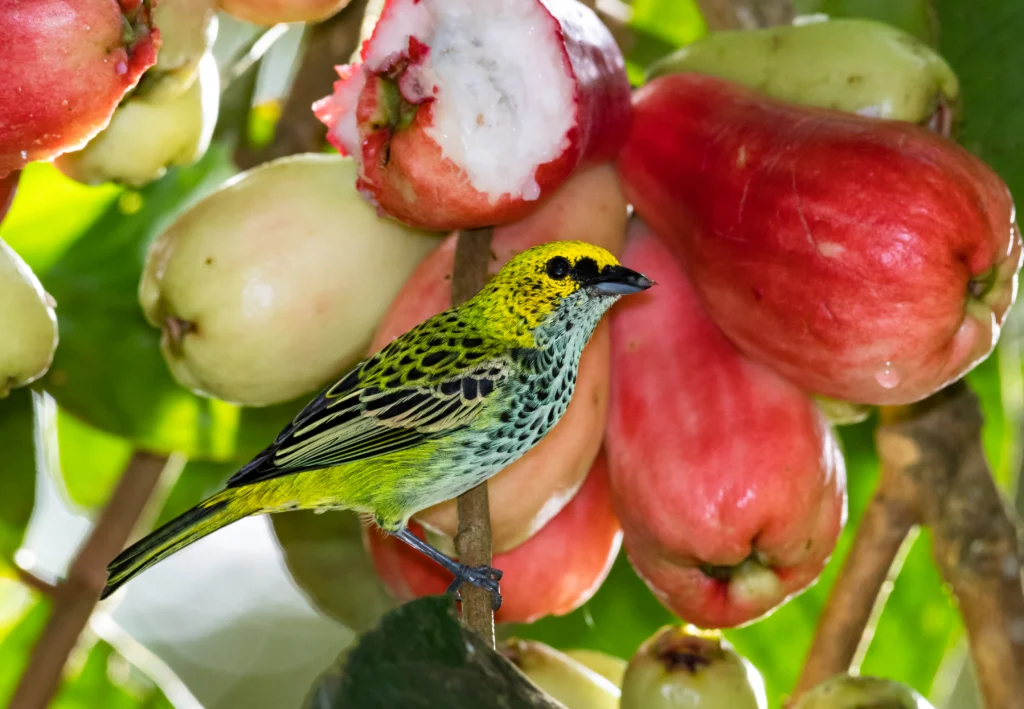
The Speckled Tanager is a gem of the canopy. The head, back, and sides are a shining chartreuse, sometimes shading into bright yellow on the head and face, and all densely spotted with black. The black wing and tail feathers are edged with bright turquoise, and the throat and belly range from matching turquoise to white, also covered in similar black spots. The eyes are dark brown, and black lores connect the eye with the slate gray bill.
Sounds
Speckled Tanagers are often heard giving thin, sharp, very high-pitched tsit calls as they forage together in small groups. Sometimes, they will gradually speed these calls up into a rapid virtuosic trill, dropping slightly in pitch — a vocalization that is likely this species’ song.
Credit: Oscar Humberto Marín Gómez, XC245067. Accessible at https://xeno-canto.org/245067.
Credit: Oscar Laverde, XC12444. Accessible at https://xeno-canto.org/12444.
Habitat
The Speckled Tanager’s preferred habitat is humid montane forest, typically from about 1,000 to 5,000 feet on the mainland, although somewhat lower on Trinidad.
- Most commonly found in old-growth forest
- Will sometimes use regenerating disturbed forest, including adjacent to coffee and cocoa plantations
Range & Region
Range & Region
Specific Area
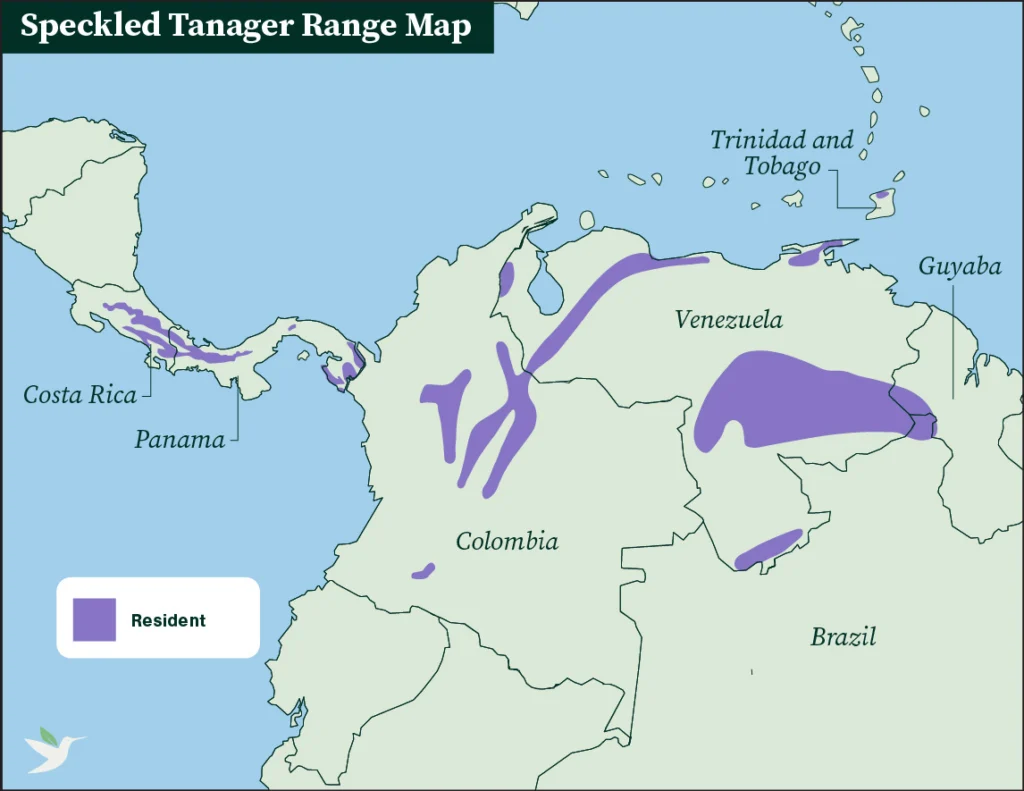
Central America, northern South America, Trinidad
Range Detail
The Speckled Tanager is a bird of montane forests, its distribution following mountain ranges from Costa Rica and Panama into Colombia, Venezuela, and Trinidad. This species is also reported from specific localities in Suriname and Guyana, where the mountain ranges in which it is found extend into these countries.
Did you know?
The social habits of this tanager have long raised speculation among researchers that family groups may stick together through the year — not just a female and a male, but their offspring of the previous breeding season as well. This might explain the tendency for small groups of consistently between three and six birds, and the apparent lack of territoriality, even during the breeding season. A naturalist in the 1950s noted three birds all helping at a single nest, raising the possibility that these birds might be “cooperative breeders,” where young from the previous year stay with their parents to help them raise the next season’s cohort.
Life History
Speckled Tanagers are gregarious birds, typically seen in groups of three to six individuals as they forage actively in the canopy. They will also join larger mixed-species flocks, especially those including other tanagers. While this species is poorly represented in peer-reviewed scientific literature, descriptive accounts allow us to piece together some aspects of this bird’s life history.
Diet
The Speckled Tanager mostly eats small fruits from a number of different shrubs and trees, but also gleans insects from fruits and leaves. Unlike closely related species, such as the Cherry-throated Tanager, the Speckled Tanager also eats mistletoe berries and larger fruits, which it must eat bite by bite.
Courtship
Year-round, this species is most commonly seen in groups, and so may not be territorial. Most of the tropical tanagers are assumed to be monogamous, but sexual behavior has not been thoroughly studied for this species, including courtship behavior and specifics of the mating system.
Nesting
The male and female build the nest together, an open cup made of leaves and leaf parts, lined with finer materials that may include leaf strips, mycelium, and mammal hair. The nest is placed in a tree, often near an opening in the canopy such as a clearing or stream.
Eggs & Young
In the handful of nests that have been observed, the female laid three white eggs with dark blotches at the wider end. Apparently, females incubate and brood the young while males provision them, but the sexes look very similar, so the roles for each member of the pair may not be so clearly delineated. The eggs hatch after about two weeks, and nestlings fledge after another two weeks.