
One Bird’s Biography
One early May, I watched a pair of Baltimore Orioles courting in my backyard. Before long, the female was weaving an intricate nest in the sugar maple outside my bedroom window.

Cardinalis cardinalis
meesquouns (Algonquian)

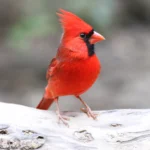
Few birds are so familiar and well-loved as the Northern Cardinal. The male “Redbird” is unmistakable thanks to its distinctive crest and vivid red plumage. The female’s plumage of brown with red accents is more subdued, but she sings just as beautifully as her mate.
The cardinal is a popular motif on countless bird-themed decorations, holiday cards, and ornaments. It even features as a main character in the Angry Birds media franchise. The species’ eye-catching plumage and wide distribution also helped land the Northern Cardinal the title of “most popular state bird,” because the following seven states declare it the official bird (the most for any species): Illinois, Indiana, Kentucky, North Carolina, Ohio, Virginia, and West Virginia. It’s also a popular sports mascot, from Missouri (the St. Louis professional baseball team) to Arizona (professional football team), and at countless colleges and high schools.
Like the Prothonotary Warbler, the Northern Cardinal’s name contains a reference to the Roman Catholic Church.
The Northern Cardinal’s bright red plumage reminded early European settlers of the church’s cardinals, high-ranking bishops who wear red robes and caps. Both this bird’s common name and its scientific moniker Cardinalis cardinalis refer to these church officials. The Prothonotary Warbler’s name also refers to robe colors — in this case, yellow — worn by Catholic Church officials, the chief notaries.
Like Steller’s and Blue Jays, the Northern Cardinal seems to thrive in human-altered habitats. Although common and widespread, it is still vulnerable to many of the same factors threatening less adaptable species, particularly predation by cats, collisions, and pesticide poisoning.
Outdoor domestic cats are the leading human-caused driver of bird population declines, responsible for the deaths of an estimated 2.4 billion birds every year — and that’s just in the U.S. Northern Cardinals and other backyard species are common victims of cats.
Every year, more than 1 billion birds die in the U.S. from collisions with buildings. While collisions with reflective windows in city centers during migration often grab headlines, the threat of collisions persists for migratory and resident birds anywhere windows go untreated — including residential homes.
Pesticides take a heavy toll on birds in a variety of ways. Birds can be harmed by direct poisoning from pesticides, lose insect prey to pesticides sprayed on crops and lawns, or be slowly poisoned by ingesting small mammal prey that have themselves ingested rodenticides.
Birds, even common backyard species like the Northern Cardinal, need our help to overcome the threats they face. At ABC, we’re inspired by the wonder of birds and driven by our responsibility to find solutions to meet their greatest challenges. With science as our foundation, and with inclusion and partnership at the heart of all we do, we take bold action for birds across the Americas.
Cats make wonderful companions, but they’re safest (and birds are, too) when they’re kept indoors or under the control of their owners. ABC advocates for responsible cat ownership, encouraging millions of pet owners to take steps to keep their cats contained and advocating for policies that benefit birds, cats, and human health.
ABC has been a leader in the effort to reduce the devastating toll of glass collisions on birds. We’ve developed innovative methods for evaluating the effectiveness of collision deterrents, created resources to elevate our collective understanding of collisions and make solutions readily accessible, and advocated for bird-friendly policies in the U.S.
ABC works with partners at the state and federal levels in the U.S. to call for the regulation or cancellation of the pesticides and toxins most harmful to birds. We develop innovative programs, like working directly with farmers to use neonicotinoid coating-free seeds, advancing research into pesticides’ toll on birds, and encouraging millions to pass on using harmful pesticides.
Male Northern Cardinals are among the most recognizable birds in North America: mostly red from crest to tail with a black mask and an orange-red bill. Females are grayish tan with red accents in the crest, wings, and tail; they also have a gray to black mask and an orange-red bill. Juveniles look like females, but their bills are dark and they have less red on the body.


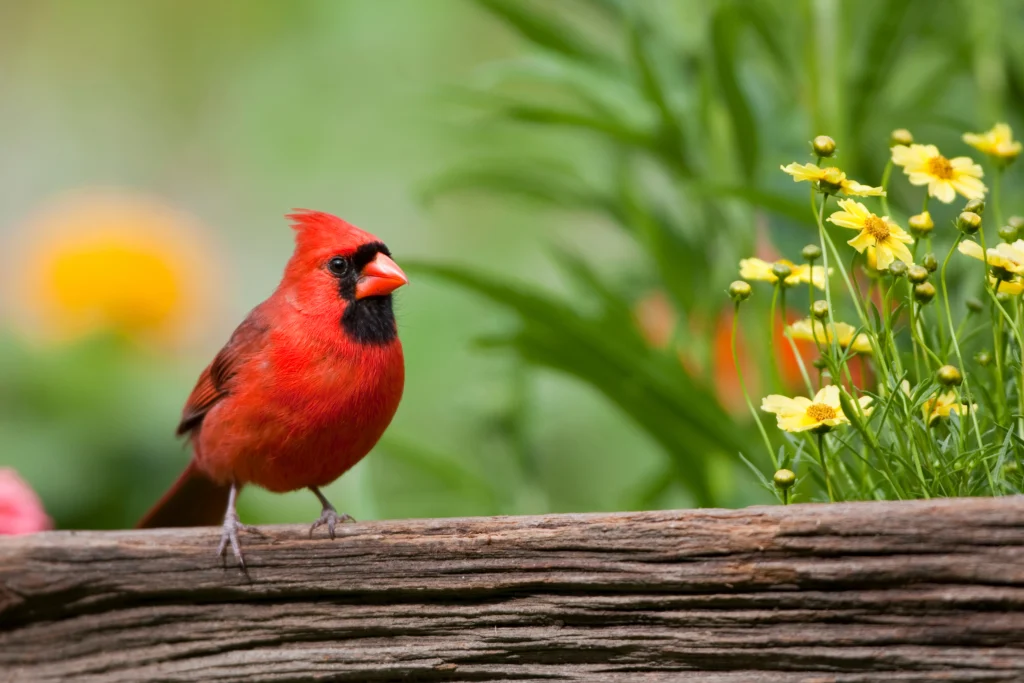

The sweet songs of the Northern Cardinal consist of clear, down-slurred whistles. They may sound like what cheer, what cheer, what cheer, cheer-cheer-cheer, wheat-wheat-wheat-wheat, and bir-dy, bir-dy, bir-dy, bir-dy. Both males and females often communicate via a chip or pik call.
The female cardinal sings duets with her mate during courtship and while she’s on the nest. During that time, her singing tells her mate when to bring food — and also when to stay away. This warning keeps the more conspicuous male’s visits to a minimum, lest his flashy color expose the nest to predators.
Bobby Wilcox, XC667645. Accessible at www.xeno-canto.org/667645.
Bruce Lagerquist, XC421948. Accessible at www.xeno-canto.org/421948.
Richard E. Webster, XC931709. Accessible at www.xeno-canto.org/931709.
Northern Cardinals prefer forest edges and other areas with shrubs or small trees.


Specific Area
Eastern North America, southwestern U.S. to Guatemala
Range Detail
Widely distributed, the Northern Cardinal can be admired from southeastern Canada south through the eastern and central United States, southern Arizona and New Mexico, and through most of Mexico, northern Belize, and Guatemala. It is an introduced species in Hawaiʻi, southern California, and Bermuda. The Northern Cardinal’s range continues to expand in many areas due to climate change and sprawling suburbs (with birdfeeders), where these birds thrive. The Northern Cardinal does not migrate, so its beautiful songs and bright color can be enjoyed year-round.
Eighteen subspecies are recognized, further divided into two groups based on color, crest size, and bill shape. Other distinctions occur with regard to song dialects and flocking behavior during the winter.
Did you know?
The Northern Cardinal’s brilliant plumage and sweet songs made it a popular cage bird in the 1800s. Fortunately, it is now protected in the U.S. by the Migratory Bird Treaty Act and other legislation.
With a cheerful song and bright red plumage, Northern Cardinals are a welcome presence in many backyards, where they can be found hopping between branches of low shrubs and trees. They retain their brilliant red feathers year-round, making them stand out against winter backgrounds and among the Dark-eyed Juncos, Tufted Titmice, and White-throated Sparrows they forage with.

The Northern Cardinal is granivorous, or grain-eating, and is well-equipped to handle this diet thanks to its conical, seed-cracking bill, which is similar to those of other seed-eating birds, such as the Rose-breasted Grosbeak and Dickcissel. It also eats fruits, including berries, and insects as they are available — a dietary flexibility that allows the species to remain in the same area year-round. Invertebrates provide essential protein for fast-growing nestlings during the breeding season.
The cardinal’s rich red coloration is due to carotenoids acquired by eating fruits, such as wild grapes and dogwood berries, and insects.
A male cardinal will doggedly defend his territory during the breeding season, chasing away intruders and even, mistakenly, attacking his own reflection in car mirrors, windows, and other reflective surfaces, sometimes for hours at a time. Females also show this aggressive behavior. During the winter, however, Northern Cardinals congregate in loose flocks that feed together.
Northern Cardinals are monogamous, sometimes remaining together throughout the winter and in successive years. The male feeds the female as part of courtship, and mated pairs can often be spotted feeding together.
After a pair forms, the female scouts for possible nest sites, and often the male accompanies her. They call to each other and carry nest material before the final site is chosen. She constructs most of the nest — an open cup of twigs, grasses, bark, leaves, pine needles, and other materials that is about 4 inches in diameter and 2.6 inches high. Nests are wedged into position about 3.2–6.5 feet above the ground in hawthorns, dogwoods, honeysuckles, eastern redcedar, sugar maples, and many other trees and shrubs.
Cardinals usually produce two to five eggs per clutch and may have one or two broods per season. Their oval eggs are grayish, buffy, or greenish white with gray to brown specks. Incubation takes 11–13 days, and chicks leave the nest at 7–13 days old. Young birds remain with their parents and are fed by them for 3–8 weeks after fledging.
Related News & Stories

Join the flock! Your donation helps conserve the habitats that birds need to survive and thrive.