Cherry-throated Tanager

Nemosia rourei

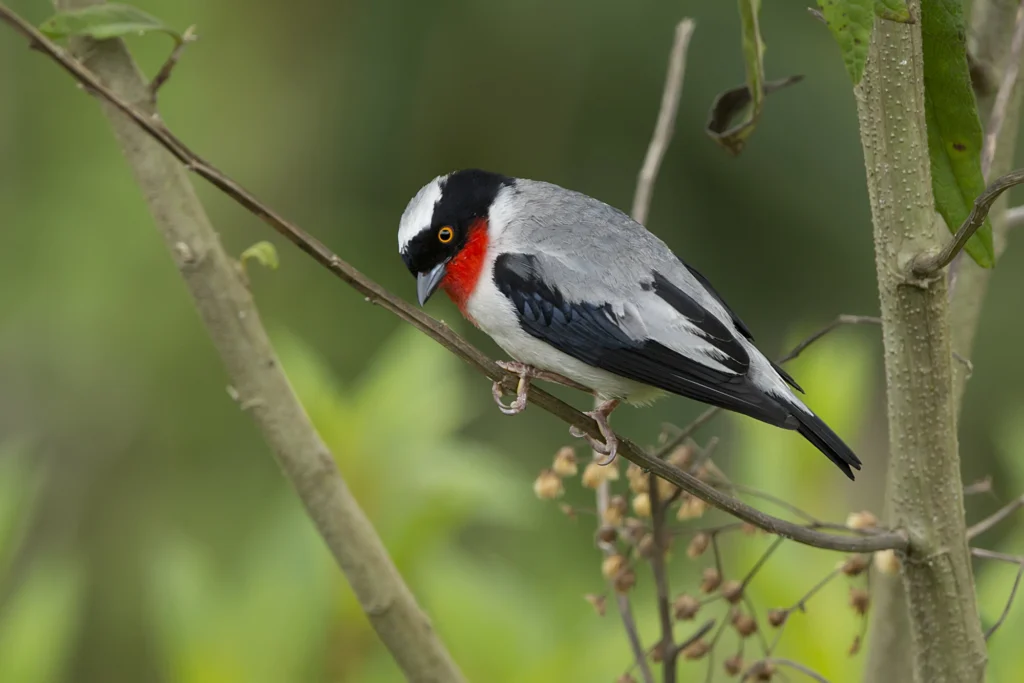
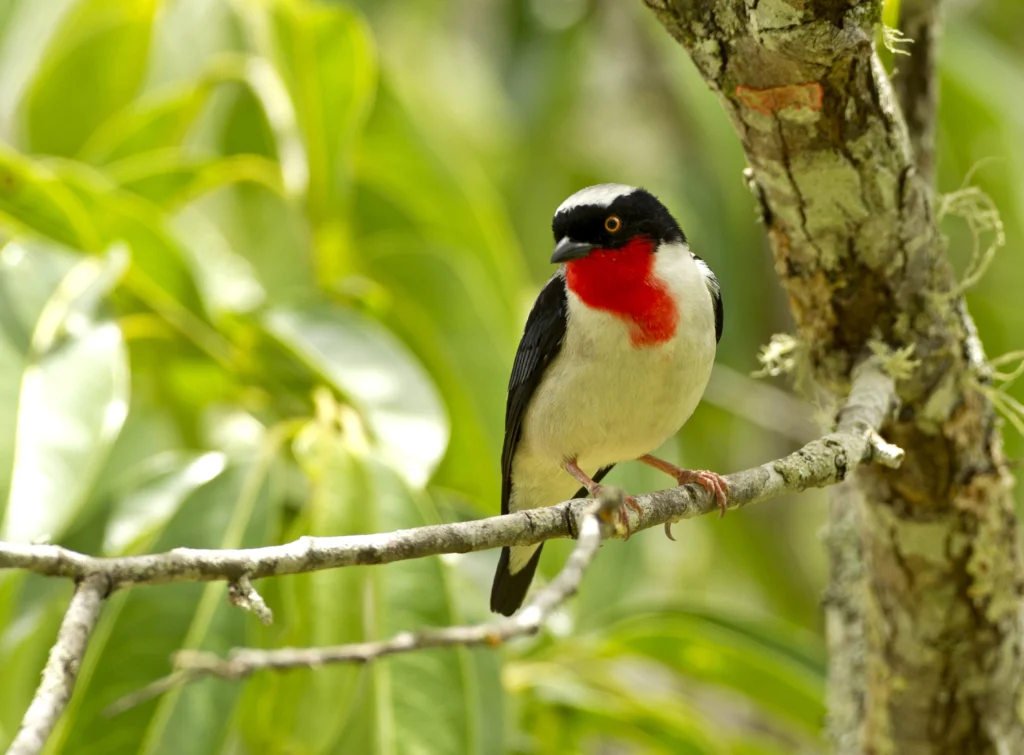
Cherry-throated Tanager. Photo by Ciro Albano.

Cherry-throated Tanager

Cherry-throated Tanager. Photo by Ciro Albano.

Nemosia rourei

Overview

Conservation Status
Population Trends
Decreasing
Population Size
20
Family
Tanagers
Location
South America
Migration Pattern
Nonmigratory
Migration Distance
Nonmigratory
Also Known As
  • Saira-apunhalada (“stabbed tanager” in Portuguese)

About

With its crisp black, gray, and white plumage offset by a shockingly scarlet-red throat and bright yellow eyes, the Cherry-throated Tanager is a stunning bird in its own right. But the Cherry-throated Tanager is also one of the rarest birds in the world, represented by only 20 individuals in a tiny pocket of lush Atlantic Forest habitat in southeast Brazil.

The Cherry-throated Tanager is completely dependent on the remaining old-growth cloud forest fragments for nesting. It can survive foraging in middle-aged forests as long as there is a nearby old-growth cloud forest core.

First described from a single specimen in 1870, the Cherry-throated Tanager was not seen again until 1941. Then, after going unobserved for more than five decades, it was rediscovered again in 1998. Its extremely small population, the restricted range it occupies, and the pressures of deforestation and urban encroachment on its remaining habitat have raised flags as red as this rare tanager’s namesake plumage. Conservationists are determined to prevent another vanishing act of this Critically Endangered bird.

Securing habitat for the Cherry-throated Tanager is the surest way to prevent its extinction. ABC has partnered with Rainforest Trust, World Land Trust, and SAVE Brasil, to support Instituto Marcos Daniel in their conservation efforts to save this species, especially their creation and expansion of the Kaetes Reserve, hoping to give this emergency bird a firmer foothold in its only remaining habitat.
Threats

While habitat loss can affect all species, the Cherry-throated Tanager, like other range-restricted species with small populations, feels the impact of habitat loss and degradation more rapidly and dramatically than wide-ranging species with larger numbers. Compounding habitat loss are the gaps in researchers’ knowledge of the bird, which was thought to be extinct until as recently as 1998.

Habitat Loss

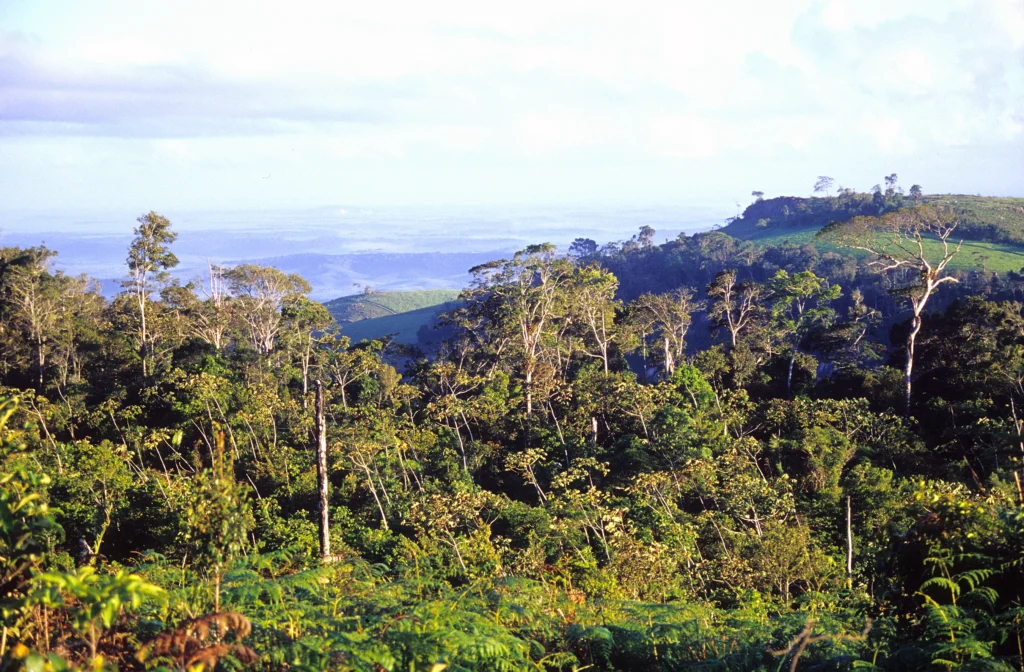
Habitat loss is the gravest threat facing the Cherry-throated Tanager. Only remnants of Brazil’s Atlantic Forest remain after decades of deforestation and conversion for agriculture. The tanager now lives in highly fragmented habitat that is also under pressure from encroaching urban development.

Habitat Loss

Conservation Strategies & Projects

Inspired by the wonder of birds like the Cherry-throated Tanager, ABC has formed strong partnerships to deliver science-based conservation solutions to prevent the imminent extinction of some of the rarest birds in the Western Hemisphere. While the Cherry-throated Tanager population remains perilously small, protecting habitat is the surest way to help the species stabilize and recover.

These efforts also support other species in need of conservation, including the Endangered Vinaceous-breasted Amazon and the Vulnerable White-bearded Antshrike, Golden-tailed Parrotlet, and Brown-backed Parrotlet. The Critically Endangered buffy-headed marmoset and Near Threatened Brazilian golden frog benefit from these actions, as well.

Creating & Maintaining Reserves

ABC and our partners have helped to secure important habitat for the Cherry-throated Tanager, working with local governments, communities, and other stakeholders to ensure thousands of acres are protected from development or conversion.

With the support of the Latin American Reserve Stewardship Initiative (LARSI), ABC’s partners on the ground have built capacity for the long-term maintenance and growth of reserves for the Cherry-throated Tanager. Our partner, Instituto Marcos Daniel, is carrying out monitoring programs to gain important insights into the life history and ecology of the tanager.

A Splash of Hope: Cherry-throated Tanager Gets New Protected Area in Bid to Dodge Extinction

Bird Gallery

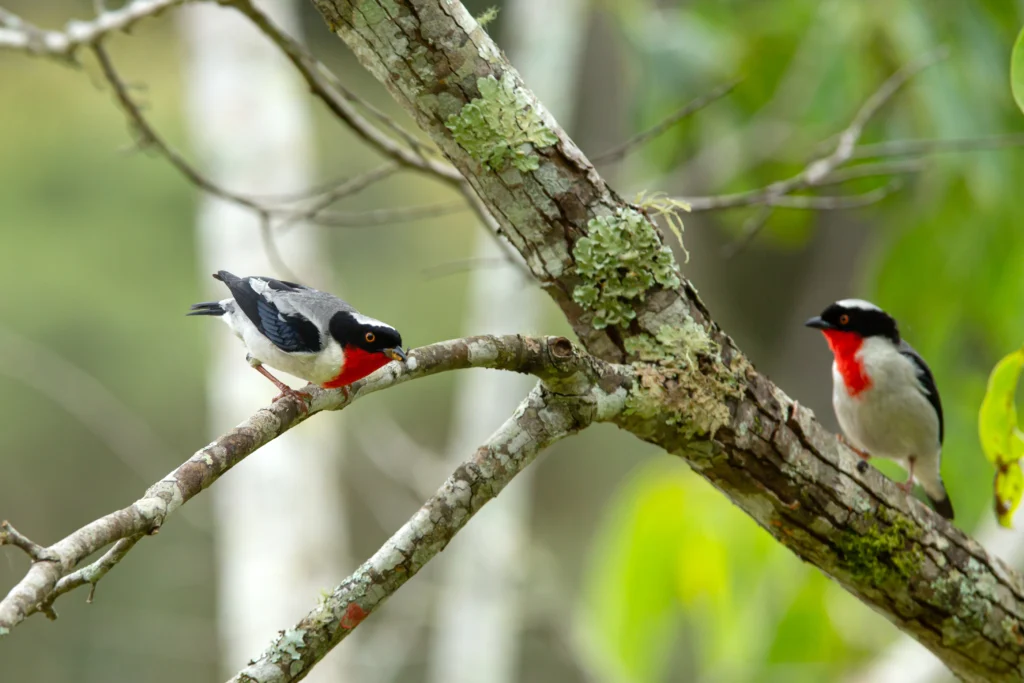
Sporting a black mask, a pearly-gray crown, and its namesake red throat patch, the Cherry-throated Tanager is a distinctive bird within its range. The bird’s upperparts are black and gray, and its belly is white with a light gray wash. The bill is black, and the eyes are amber. Sexes look quite similar, and juveniles have a throat patch that is duller in color.

Sounds

Call

Ross Gallardy, XC415957. Accessible at www.xeno-canto.org/415957.

Song

Monyzi Pezzin, XC179816. Accessible at www.xeno-canto.org/179816.

Habitat

The Cherry-throated Tanager is found in humid mountain forests.

  • Occupies dense montane and cloud forest in areas with large trees, palms, and lichens

Range & Region

Specific Area
Southeast Brazil

Range Detail
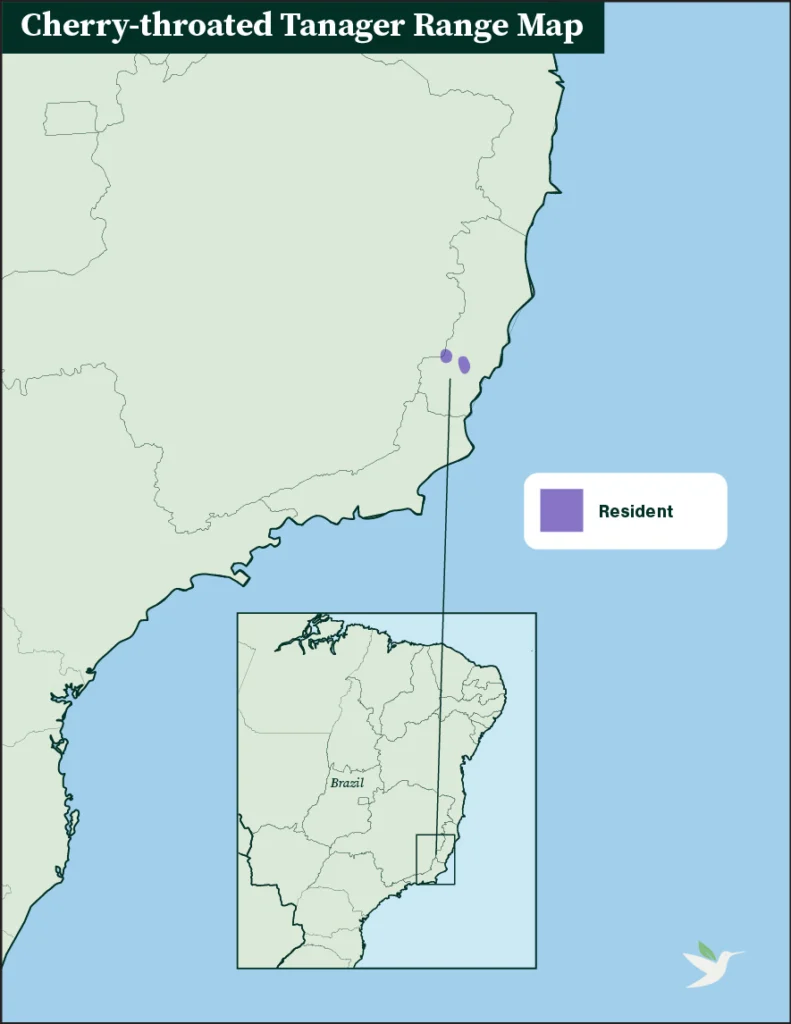
There is only one place to find the Cherry-throated Tanager: Brazil’s Atlantic Forest, located in the Caetés region of Espírito Santo.

Did you know? 
Since it was rediscovered in the 1990s, the Cherry-throated Tanager has been definitively recorded at only three locations, all within southern Espírito Santo.

Range
South America
Migration Pattern
Nonmigratory
Migration Distance
Nonmigratory

Life History

Cherry-throated Tanagers are often spotted in small flocks and tend to forage at the top of the canopy. Like other tanagers, such as Seven-colored Tanager and Gilt-edged Tanager, the birds may join mixed-species feeding flocks. Much about the life history of the Cherry-throated Tanager remains to be discovered, but monitoring programs are providing insight into previously unknown aspects of the tanager’s life.

Diet

Traveling through the trees in pairs or small flocks of up to a dozen birds, Cherry-throated Tanagers forage for a variety of insects, spiders, and other small arthropods on moss- and lichen-covered branches.

Courtship

Coinciding with a peak in food abundance and the change between dry and wet seasons, the Cherry-throated Tanager begins nesting in late November. Pairs are monogamous, remaining together for the breeding season.

Nesting

The female builds a cup-shaped nest high up in a tree on a horizontal branch. Lichens are used in the construction of the nest.

Eggs & Young

The female incubates a clutch of two or three eggs. Limited information is available regarding the incubation period and early days of young before fledging, but both parents have been observed feeding young.