Overview
About
The majestic Golden Eagle, named for the shining feathers on the back of its head and neck, inspires awe in people around the world. Reflecting the reverence many have for this raptor, the Golden Eagle is the national symbol for five countries: Albania, Germany, Austria, Mexico, and Kazakhstan.
An important distinction between this species and the similarly-sized Bald Eagle is the Golden Eagle’s smaller head and bill, especially noticeable in flight. These two raptors are not closely related; the Golden Eagle is a “booted” eagle (meaning its legs are feathered) belonging to the Aquila genus, whereas the Bald Eagle is a “fish” eagle, a member of the Haliaeetus, or sea-eagle, genus.
Threats
Although the Golden Eagle is widely distributed over Europe, Asia, and North America, it is declining in many areas, especially in places where development is increasing.
Habitat Loss
Golden Eagle habitat can be lost to increased development to accommodate human population growth. Resource extraction and oil, gas, and wind development also remove suitable eagle habitat.
Wind Turbines
One of the biggest threats to the Golden Eagle comes from the risk of fatal collisions with poorly sited wind turbines being built in areas that are critically important to this species.
Pesticides & Toxins
Lead poisoning is another major threat to the Golden Eagle; like the California Condor, it hunts and scavenges in areas where lead is often left in the environment by hunters.
Climate Change
Changing climate conditions can lead to more frequent and intense wildfires throughout the Golden Eagle’s habitats, affecting its prey base.
Conservation Strategies & Projects
ABC continues to advocate for cautious siting of wind turbines and other practices that can reduce the risk of Golden Eagle collisions. We support policies to reduce the risk of lead poisoning, such as promoting non-lead ammunition. ABC also belongs to the Eastern Golden Eagle Working Group, which is working to raise conservation awareness about this population of the species.
Rethink Wind Turbines
ABC supports the responsible development of renewable energy, but urges the wind industry to conduct assessments before placing turbines in places where Golden Eagles and other protected birds will likely be impacted.
Avoid Pesticides & Toxins
Because of lead shot’s deadly impact on raptors such as the Golden Eagle, ABC continues to encourage hunters to use non-lead alternatives. We have also advocated for more transparency about how toxins in the environment, including metals like lead, impact birds and other wildlife.
Address Climate Change
Although fire is a naturally occurring component of fire-adapted ecosystems, climate-change-driven wildfire is an increasing threat. ABC, our partners, and conservationists are working to adapt to and mitigate these threats.
Bird Gallery
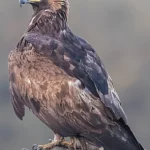
The Golden Eagle is a huge, dark-brown raptor named for the gleaming wash of gold on its face, crown, and neck. This impressive raptor is larger than a Turkey Vulture, with a wingspan ranging from 6 to over 7 feet. Females are significantly larger than males.
In flight, an adult Golden Eagle shows grayish-brown at the base of the tail and flight feathers and dark brown wing coverts and underside. Its legs are feathered all the way down to the yellow feet. Juveniles have a distinctive white-based tail with a dark tip as well as white patches under (and sometimes atop) the wings, most visible in flight. This coloration becomes more uniformly dark as the bird ages, and the Golden Eagle attains its mature plumage at five years of age.
Six subspecies of Golden Eagle are recognized, one of which, Aquila chrysaetos canadensis, occurs only in North America.
Bird Sounds
Golden Eagle chicks, juveniles, and adults have a wide repertoire of calls that appear to vary in purpose according to the birds’ ages. Although considered a relatively silent species, this eagle actually gives a wide assortment of vocalizations, including yips, yelps, chips, chitters, clucks, and whistles.
Luc Souret, XC605650. Accessible at www.xeno-canto.org/605650.
Lars Edenius, XC753803. Accessible at www.xeno-canto.org/753803.
Birger Hörnfeldt, XC837112. Accessible at www.xeno-canto.org/837112.
Habitat
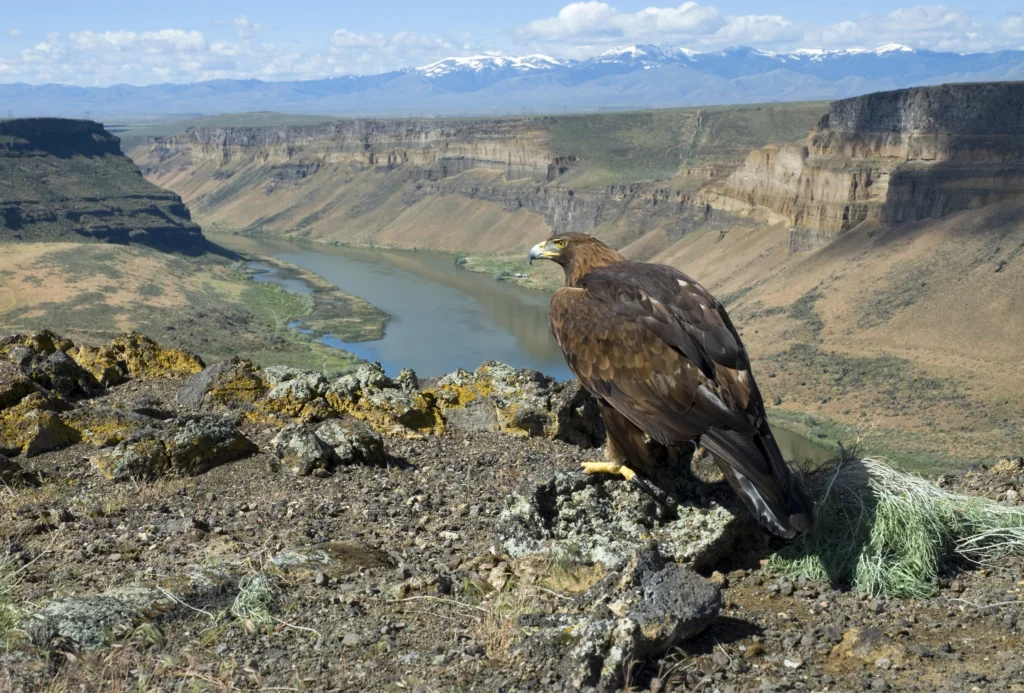
The Golden Eagle utilizes a wide variety of habitat types in the Western Hemisphere, breeding in tundra, grass and shrubland, and even forest.
- Breeds in trees or cliffs adjacent to different types of open tundra, including wet marsh, heath, tussock-heath, and hillside heath tundras
- Found year-round in open grass and shrublands of many types, including sage, juniper, and oak savanna
- Eastern Bald Eagles nest in trees and on cliffsides within eastern Canada’s forests. Most spend the nonbreeding season further south, in the Appalachian Mountains and marshlands along the east coast
Range & Region
Specific Area
North America, with populations in Eurasia and northern Africa
Range Detail
In North America, most Golden Eagles breed across the west, ranging from Alaska through Canada south to central Mexico. These birds frequent open habitats such as grasslands, desert scrub, and mixed woodlands interspersed with mountains, cliffsides, and perches for breeding, roosting, and hunting. Western populations may be resident or migratory.
A separate, smaller population of Golden Eagles occupies eastern North America. These birds breed in the forests of northern Canada and migrate to southern Canada and higher-elevation areas of the U.S. for the winter months, including the Appalachian and Ozark mountains and the Allegheny and Cumberland Plateau regions.
Did you know?
Golden Eagle migration strategies vary from resident to long-distance migration. Most Golden Eagles in Alaska and Canada are migratory; pairs that breed in the continental U.S. and further south may remain in the same area year-round.
Life History
The Golden Eagle is a formidable predator, able to take down animals as large as wild and domestic goat kids and calves and birds as large as Sandhill Cranes. In Mongolia, it is even used by falconers to hunt wolves!
Diet
Golden Eagles employ a variety of hunting methods, sighting prey from a perch, stooping on it from high in the air, or “contour-hunting” — cruising low over hills and ridge tops to sneak up on prey. It may pursue its quarry on foot like a Cooper’s Hawk, or several Golden Eagles may tag-team as they hunt, a cooperative method also used by the sociable Harris’s Hawk.
The Golden Eagle feeds primarily on small mammals, including rabbits, hares, ground squirrels, marmots, and prairie dogs. It may take prey as large as coyotes, foxes, and badgers, and also hunts large birds such as sage-grouse, Wild Turkey, and cranes. It will readily take carrion when available.
Courtship
Golden Eagles begin to breed at approximately five years old, forming monogamous pairs that may remain together for multiple seasons, with the bond sometimes persisting year-round. Eagle pairs establish and maintain their bond through courtship flights, vocalizing, nest building, and maintaining close proximity to one another.
Nesting
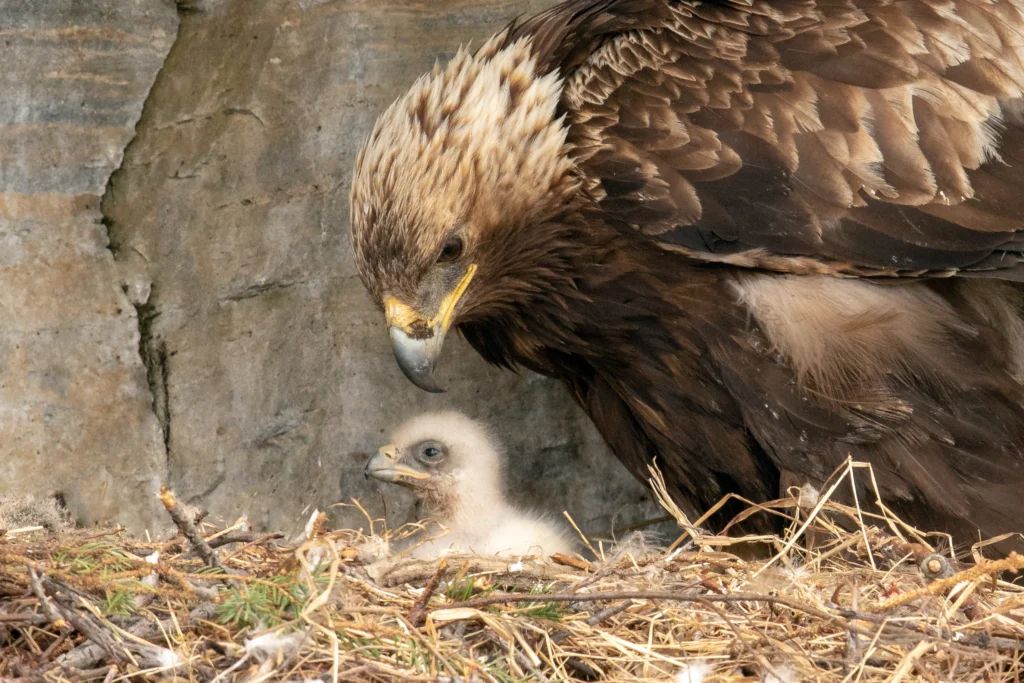
The Golden Eagle’s huge platform nest is built of sticks, lined with smaller branches, soft grasses, lichens, and animal hair. The eagle pair sometimes incorporates unconventional materials like bones, shed antlers, wire, and bits of fence post into their nest. The nest is usually located on the ledge of a high cliff, but may also be built in a tree, on an artificial structure such as a power pylon, or even on the ground.
Golden Eagles may use the same nest for multiple seasons, adding new nesting material each year.
Eggs & Young
The female Golden Eagle lays a clutch of one to three brown-speckled white eggs at intervals of three to five days. She begins to brood as soon as the first egg is laid, and incubates the clutch for roughly a month and a half, occasionally assisted by her mate.
The downy eagle chicks hatch in the order they were laid (known as asynchronous hatching), leading to a discrepancy in size and parental attention, with the bigger, stronger chicks getting the most food and care. Usually only one or two chicks survive to fledging.
Both parents bring food to the nest; at first, the female tears it into small pieces for the chicks, but they grow quickly and are soon able to feed themselves. They fledge about two and a half months after hatching, and remain close to their parents for a short time thereafter before dispersing more widely.