Island Scrub-Jay

Aphelocoma insularis

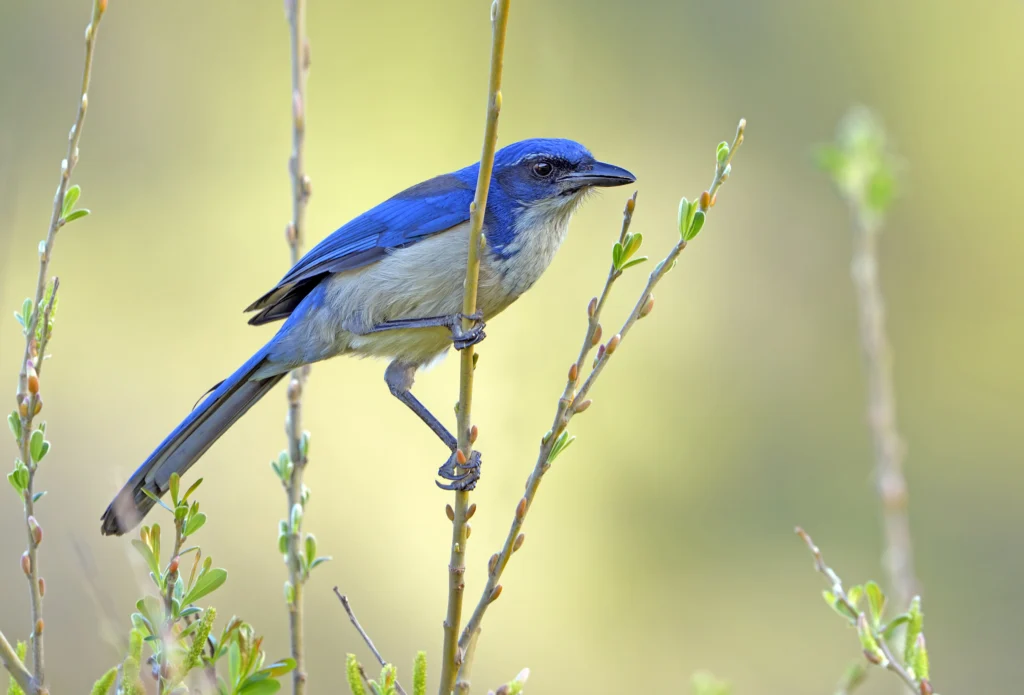
Island Scrub-Jay by Adam Jackson, Macaulay Library at the Cornell Lab of Ornithology

Island Scrub-Jay

Island Scrub-Jay by Adam Jackson, Macaulay Library at the Cornell Lab of Ornithology

Aphelocoma insularis

Overview

Conservation Status
Population Size
1,700–2,300
Family
Jays
Location
Islands
Migration Pattern
Nonmigratory
Migration Distance
Nonmigratory

About

The Island Scrub-Jay is found nowhere in the world except on California’s Santa Cruz Island, making it the only island endemic bird species north of Mexico. The bird was once considered part of the species known simply as the Scrub Jay, which was split into three species (Western, Island, and Florida Scrub-Jays) in 1995. The Island Scrub-Jay is noticeably larger and more brightly colored than its relatives, including the Florida Scrub-Jay (the only bird species endemic to Florida). Fossil remains suggest that Island Scrub-Jay probably diverged from its closest relative, the bird now known as California Scrub-Jay, about 150,000 years ago.

Like other species endemic to islands, such as Darwin’s famous finches and birds of the Hawaiian archipelago, including the Palila, ‘I’iwi, and Kiwikiu, the Island Scrub-Jay evolved specialized adaptations in isolation, illustrating Darwin’s famous theory of evolution.

The Island Scrub-Jay has been extensively studied. It can be found in two distinct habitats on Santa Cruz Island: oak forests and scrub, and pine woods. Although these two habitats lie near each other and the jays move freely between them, the birds that live in the oak forests have evolved shorter, stouter beaks, which are ideal for hammering open acorns, while the scrub-jays of the pine forests have developed longer, shallower beaks that are perfect for accessing food buried within pine cone crevices.

These adaptations evolved on the same island in relatively contiguous habitats, contradicting the idea that evolutionary changes only occur when populations are separated by a physical barrier, such as an ocean, mountain range, or inhospitable habitat. Apparently, species can diverge without isolation.

Threats

Birds around the world are declining, and for species like the Island Scrub-Jay, the threats that can affect all birds — habitat loss, invasive species, climate change, and more — are all the more urgent. Endemic species with small populations and limited geographic ranges are extremely vulnerable to the changes that come with these threats.

Habitat Loss

Overgrazing by feral sheep starting in the mid-1800s degraded the habitat on Santa Cruz Island to the point that half of the island was at least moderately impacted by the 1980s. Erosion in overgrazed areas can further degrade habitat.

Habitat Loss

Cats & Invasive Species

Although non-native livestock such as sheep and feral pigs have been removed from Santa Cruz Island, threats remain from introduced, invasive plants and animals, including Argentine ants and the potential arrival of disease-carrying mosquitoes.

Cats & Invasive Species

Climate Change

Changing climatic conditions can increase the frequency of drought conditions, potentially leading to the subsequent threat of habitat-destroying fires.

Climate Change

Conservation Strategies & Projects

The Island Scrub-Jay and other endemic species need our help to overcome the threats they face. All of Santa Cruz Island, the Island Scrub-Jay’s only home, is protected, and a portion of the island is now considered a National Park. The Nature Conservancy maintains the rest of the land. A series of projects has helped remove cattle, feral sheep, and invasive pigs, which were detrimental to the habitat the scrub-jay needs.

At ABC, we’re inspired by the wonder of birds and driven by our responsibility to find solutions to meet their greatest challenges. With science as our foundation, and with inclusion and partnership at the heart of all we do, we take bold action for birds across the Americas.

Support Petitions & Advocacy

ABC and our partners advocate for policies that give birds like the Island Scrub-Jay the protections they need, and conservationists the resources required to effectively conserve species and their habitats. Policies enacted by the U.S. Congress and federal agencies like the U.S. Fish and Wildlife Service have a huge impact on birds. Learn more about current policy priorities and use your voice for birds.

Take Action

Bird Gallery

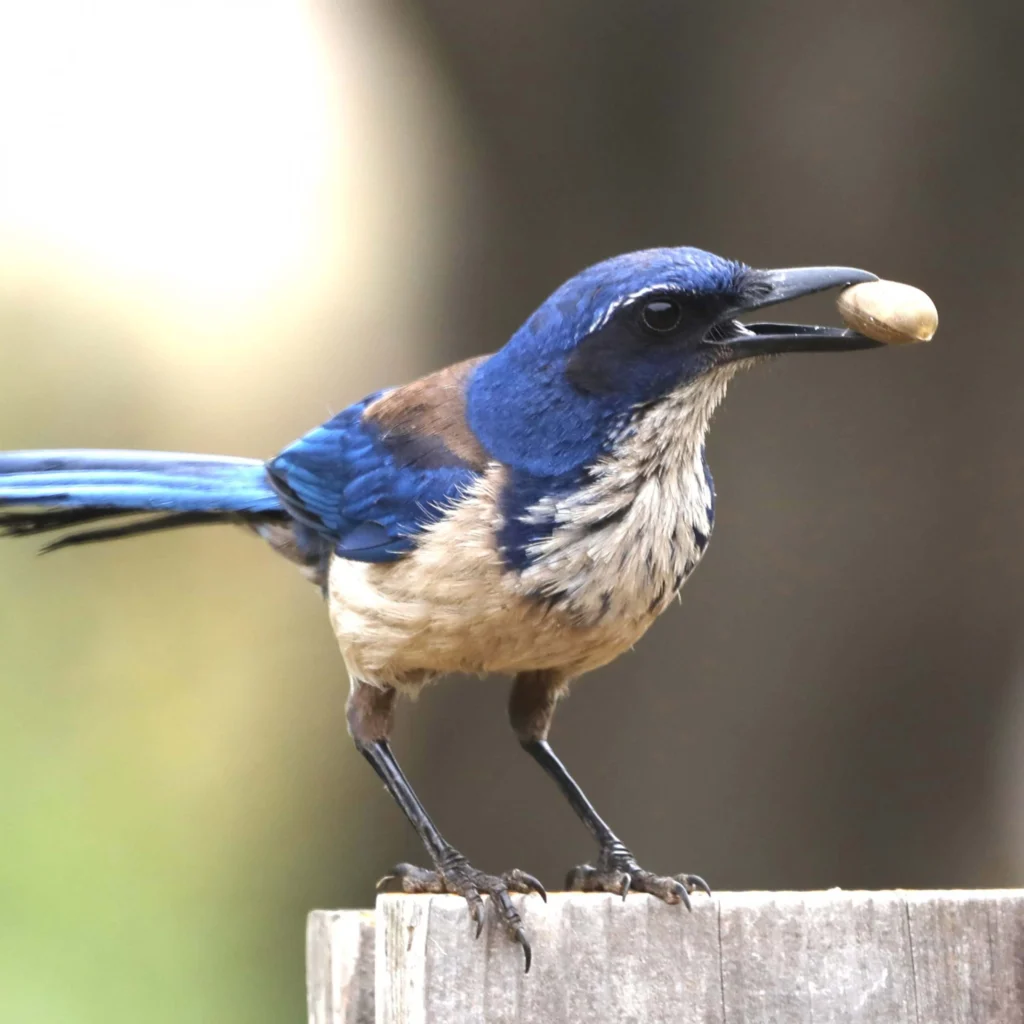
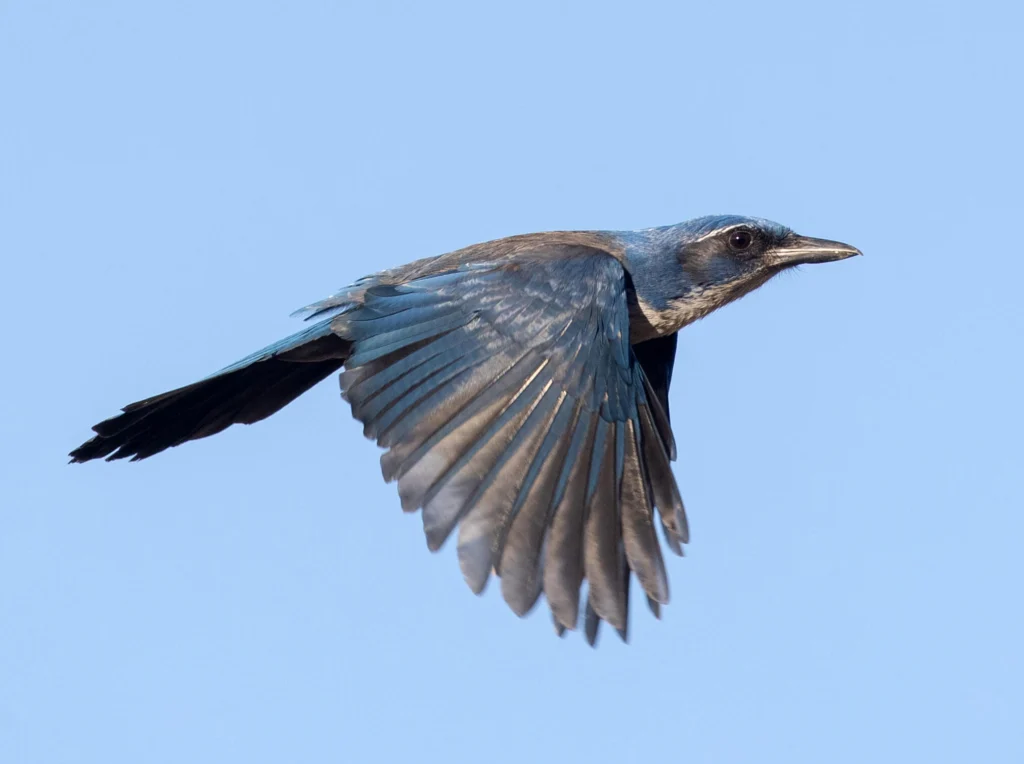
The Island Scrub-Jay has a bright blue crown, nape, upper wing, tail, and paler blue undertail coverts. It has a black face and white chin and throat, separated from the grayish-white underparts by an almost complete blue collar. Other ID features include a large gray-brown patch on the upper back and a large black bill. Juveniles are grayish-white overall, with blue wings and tail. Like other scrub-jays, it lacks a crest.

Bird Sounds

Both sexes give loud, harsh calls, including raspy single notes and long “shek-shek-shek” series. It also produces low clucking and clicking sounds.

Call

Credit: Paul Marvin, XC359505. Accessible at www.xeno-canto.org/359505.

Call

Credit: Guy Kirwan, XC390116. Accessible at www.xeno-canto.org/390116.

Habitat

This clever corvid inhabits oak and pine forests throughout Santa Cruz Island.

  • Found in oak woodlands of coast live oak or island oak with an understory of plants that may include wood mint, poison oak, blackberry, and toyon
  • Uses oak-dominated chaparral — woody, evergreen shrub habitat dotted with taller trees
  • Also found in pine forests — including Bishop pine, a fire-adapted, drought-tolerant conifer found only in coastal California and Mexico — with understory species such as chamise, toyon, chaparral currant, poison oak, and the rare island barberry

Range & Region

Island Scrub-Jay range map by ABC

Specific Area
Santa Cruz Island, California

Range Detail
The Island Scrub-Jay is found only on Santa Cruz Island, the largest of California’s Channel Islands. At roughly 24 miles long and 96 miles square, Santa Cruz Island is about the size of New York’s Staten Island, and three times the size of Manhattan.

Did you know?
With limited space to spread out, most breeding Island Scrub-Jays maintain a territory year-round. But only about half the adults are breeding — the rest are “floaters.” These nonbreeding adults form loose groups, occupying habitats that would be unsuitable nesting sites.

Range
Islands
Migration Pattern
Nonmigratory
Migration Distance
Nonmigratory

Life History

Curious and clever like most corvids, the Island Scrub-Jay is also charismatic: The birds are remarkably unafraid of people and will land right next to visitors to their island home. These big jays cache their acorns in large numbers each fall. More than a winter food source for the scrub-jay, their stashes of acorns promote the regeneration of the very oak woodlands they rely on. Island Scrub-Jays have evolved bills that suit the habitats where they are found. Oak forest dwellers possess short, stout beaks for optimal acorn access, and those in pine forests pick through pine cones with their longer, narrower beaks.

Diet

The Island Scrub-Jay forages in a variety of ways: It gleans along the ground or tree branches, often opening its bill and sweeping its head from side to side to disturb the ground litter and expose prey. Some probe deeply into pine cones for seeds. This bird also flycatches in pursuit of aerial insects such as grasshoppers. Other prey include spiders, snakes, lizards, mice, and other birds’ eggs and nestlings.

Courtship

Only half of the adult population breeds, but those that do are monogamous and may stay with the same mate for life. Pairs defend a permanent territory year-round. Vocalizations help the jays maintain their pair bonds, and males perform courtship feeding.

Nesting

Both members of an Island Scrub-Jay pair build their nest, a large, bulky cup of coarse sticks lined with finer twigs and rootlets. The nest can be placed anywhere from ground level to 40 feet off the ground.

Eggs & Young

The female jay lays a clutch of three to five blue-green eggs, which she incubates for approximately two and a half weeks. Her mate brings her food while she sits on the nest. The naked, helpless hatchlings grow quickly and clamber out of the nest before they can fly. Their parents continue to care for them, and young birds remain near their parents’ territory for a short time, but soon join a flock of nonbreeders and disperse more widely.