Overview
About
The handsome Kirtland’s Warbler is one of North America’s larger warblers. At a glance, it could be mistaken for a Yellow-rumped Warbler, but it has an entirely lemon-yellow underside, a distinctive tail-bobbing habit like a Prairie Warbler, and a gray, rather than yellow, rump. This species was named for Dr. Jared Kirtland, whose Ohio farm yielded one of the first specimens of this species in 1851.
To nest successfully, the Kirtland’s Warbler requires dense, young stands of jack pine that are 6 to 15 years old, 5 to 15 feet high, and grow in very well-drained, sandy soil. Scientists speculate that the age and size of the jack pine trees may be important in concealing the birds’ nests, which are constructed on the ground. Dense ground cover, usually composed of sedges, blueberry, bearberry, and sweetfern, also helps hide nests.
The early-successional habitat favored by the Kirtland’s Warbler was historically created and maintained by naturally occurring periodic wildfires, but fire suppression programs reduced the amount of young jack pine, resulting in the near-extinction of the species. It took many decades of coordinated conservation work to help bring the population back from the brink of extinction.
Threats
Birds are declining around the world, and some are brought dangerously close to the brink of extinction. In the 1970s and 1980s, the number of singing male Kirtland’s Warblers had dipped below 200 birds. Habitat loss has been the leading factor in the species’ steep decline, but collisions with windows and human-made structures and encounters with free-roaming cats pose additional threats. Additionally, nest parasitism by Brown-headed Cowbirds has historically been a major threat, but has declined in the last 10 years as cowbird populations have fallen. The dramatic drop in the Kirtland’s Warbler’s population in the mid-20th century led to its designation as one of the first species listed under the Endangered Species Act.
Habitat Loss
Kirtland’s Warblers have very specific habitat requirements for successful nesting: young jack pines ranging from 5 to 15 feet tall. However, European settlers moving into these fire-prone areas suppressed the naturally occurring fires that spurred forest regeneration and created the habitat Kirtland’s Warblers need to breed. In addition, housing and commercial development have led to habitat loss on this warbler’s nonbreeding grounds in The Bahamas.
Glass Collisions
Collisions take an enormous toll on birds. Migrating Kirtland’s Warblers risk fatal collisions with glass windows, wind turbines, towers, and other lighted structures. This risk is compounded by the fact that these warblers’ migratory route includes major cities like Detroit, Cleveland, and Miami. Window collisions can occur on structures of any size, though the risk increases when birds, disoriented by bright artificial lights emanating from urban centers, are lured off-course and drawn into these window-filled, reflective environments.
Climate Change
Climate change threatens Kirtland’s Warbler populations in their nonbreeding habitat in The Bahamas. Increasing frequency and severity of hurricanes can destroy habitat and kill birds directly, while rising sea levels threaten the vegetation these birds depend on. Perhaps the most significant threat, however, comes from the increasingly dry winters, which mean fewer insects and less fruit, both of which Kirtland’s Warblers rely on in their nonbreeding season.
Conservation Strategies & Projects
Birds, especially vulnerable species like Kirtland’s Warbler, need our help to overcome the many threats they face. The Kirtland’s Warbler’s population has rebounded over the course of several decades, thanks to strong partnerships and collaborative conservation efforts backed by science. By 2019, the species had recovered sufficiently to prompt its “delisting,” or removal, from the federal endangered species list. The Kirtland’s Warbler’s story is not over, though. This species needs ongoing, intensive conservation management in order to survive.
Restoring Habitat
Habitat is the foundation for birds’ survival, and for Kirtland’s Warbler specifically, habitat loss is the single greatest threat to the species’ survival. ABC belongs to the Kirtland’s Warbler Conservation Team, a group of wildlife biologists, foresters, researchers, and conservationists that manage breeding habitat for this species. ABC has launched a long-term fund to help maintain the ongoing recovery of the Kirtland’s Warbler by generating sustainable revenue for important research, habitat development, and community outreach efforts throughout the species’ range.
Protecting Migration
Migratory birds need conservation action where they breed, where they spend the nonbreeding season, and at all of the stopover habitats they use along the way. To make these incredible journeys safer, ABC’s BirdScapes program is working to provide migratory species such as the Kirtland’s Warbler with the habitat they need where they need it most. We work directly with partners on the ground in The Bahamas to raise awareness of the Kirtland’s Warbler and build support for its conservation on its nonbreeding grounds.
Bird Gallery
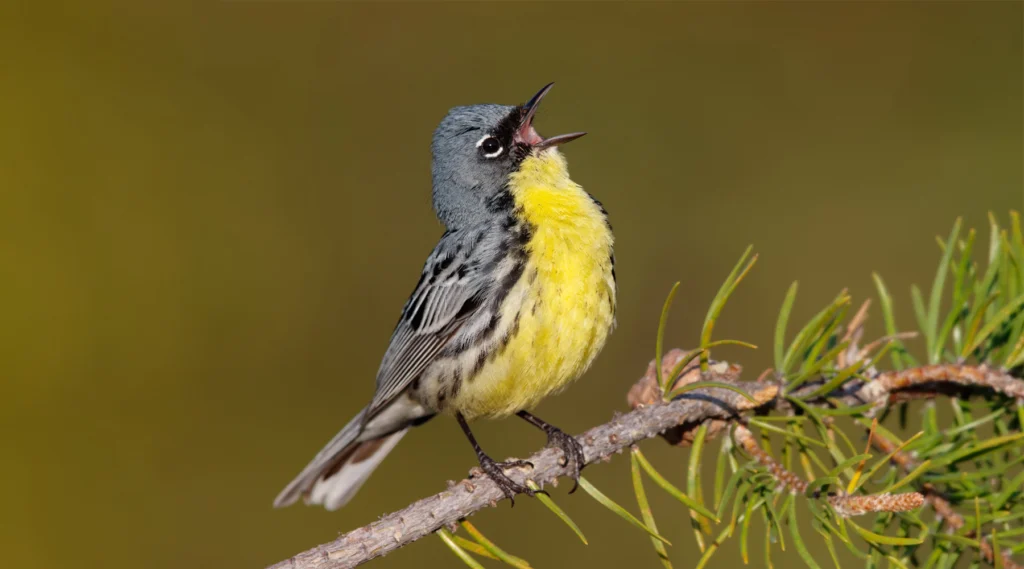
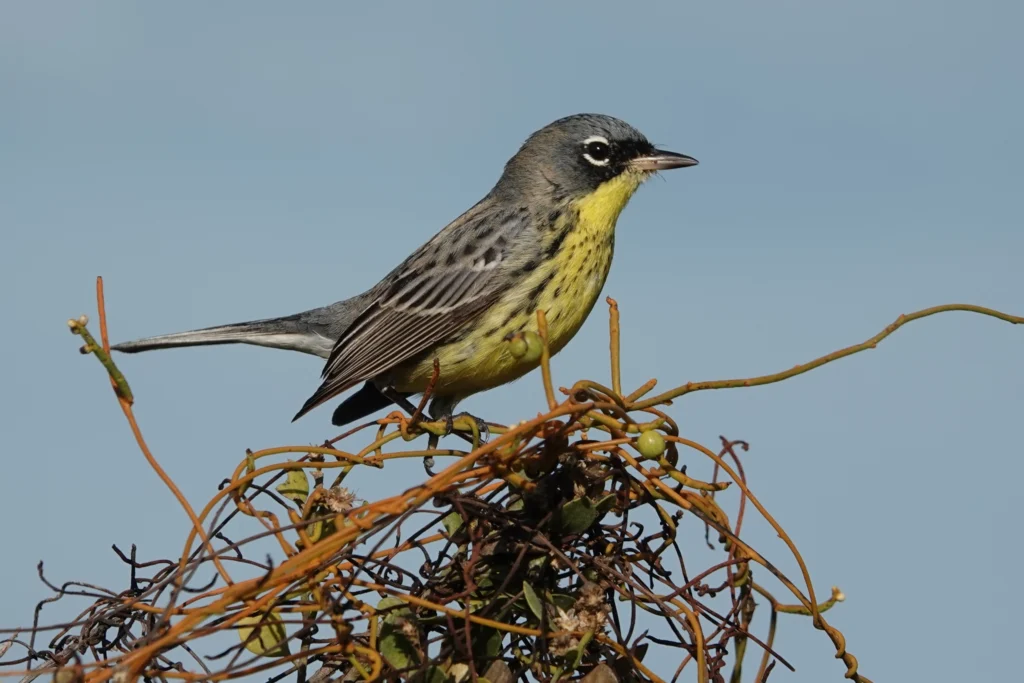
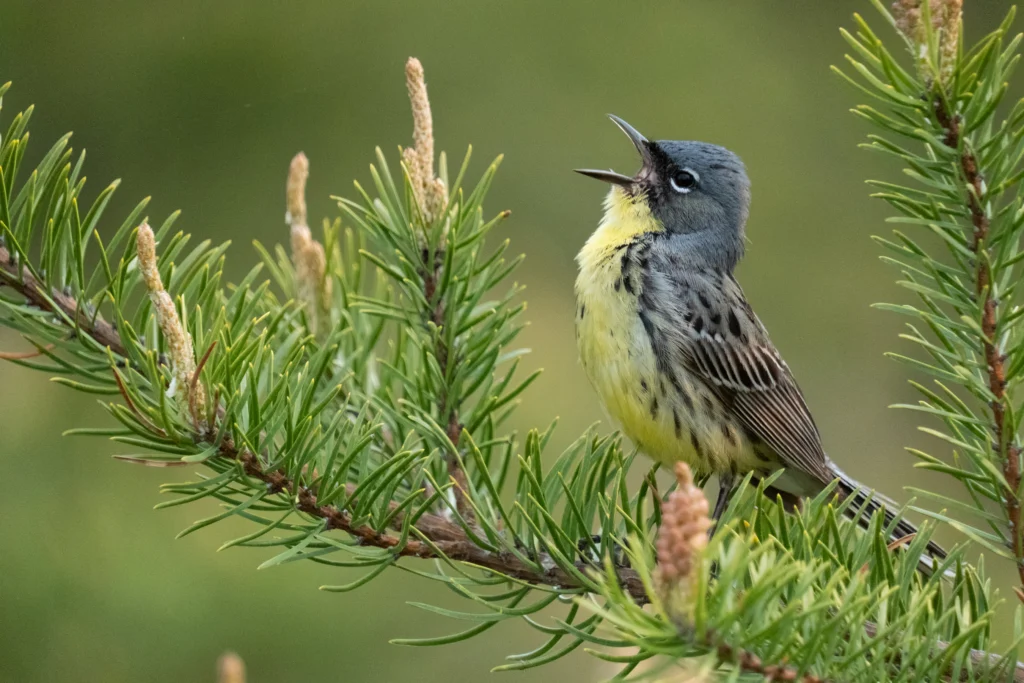
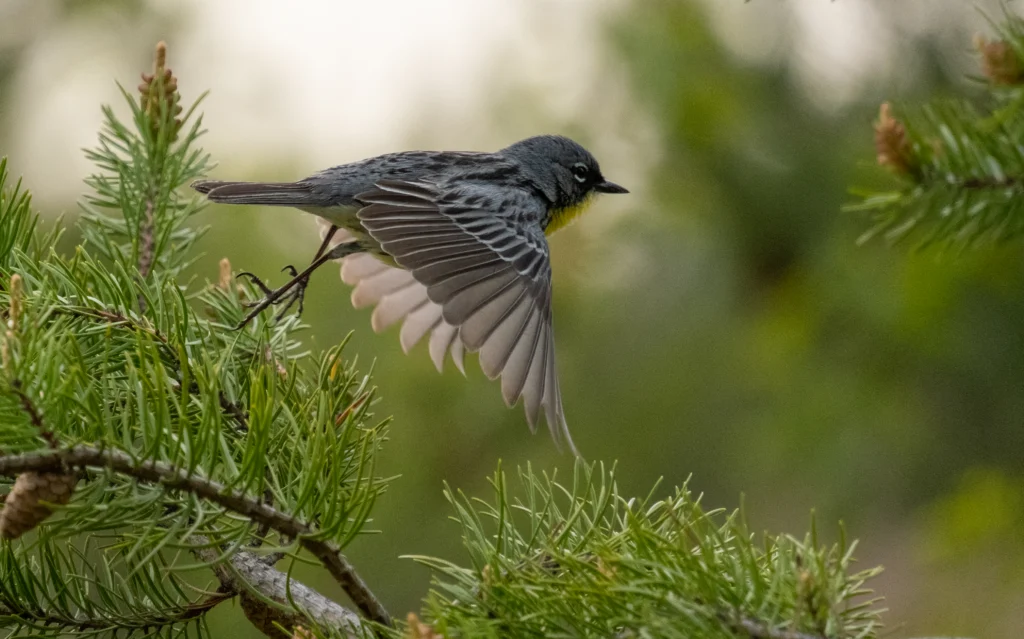
The Kirtland’s Warbler has a grayish-blue back with darker streaks and thin white wingbars. Its underside is pale yellow, marked by dark streaks and stippling. This species has a “broken” white eyering (crescents above and below the eye). Males have black lores (the area between the base of the bill and the eye) and more black in the face than females. Immature birds are dull brown, rather than gray-blue, above.
Sounds
On its breeding grounds, the male Kirtland’s Warbler sings loudly and persistently from a prominent perch. This is the only time when this bird is easy to see. His song is a series of three phrases, growing increasingly louder. The most common call, given by both sexes on their nonbreeding grounds, is a sharp chip. Birds also give a flight call during migration, a short, thin, and high-pitched tseet.
Credit: Sue Riffe, XC419387. Accessible at www.xeno-canto.org/419387.
Credit: Jesse Fagan, XC327676. Accessible at www.xeno-canto.org/327676.
Paul Joseph Hurtado, XC103387. Accessible at https://xeno-canto.org/103387.
Habitat
The Kirtland’s Warbler has remarkably specific habitat requirements in both its breeding and nonbreeding ranges. The Kirtland’s Warbler breeds exclusively in young jack pine stands. Nonbreeding habitat is limited to shrublands.
- Breeds in young stands of jack pine, 6 to 15 years old and 5 to 15 feet high, on well-drained soil with dense ground cover of sedges, blueberry, bearberry, and sweetfern
- Winters in early-successional upland scrub, especially among wild sage, milkberry, and black torch shrubs
- Often found on goat farms in the nonbreeding season, where shrub habitat is maintained by grazing
Range & Region
Specific Area
Great Lakes region, the Caribbean
Range Detail
The Kirtland’s Warbler has one of the smallest breeding ranges of any North American bird. Almost the entire population breeds in north-central lower Michigan, with small but increasing numbers in Michigan’s Upper Peninsula, Wisconsin, and Ontario, Canada. This species has a similarly small nonbreeding range in The Bahamas and the Turks and Caicos Islands, and very rarely elsewhere.
Did you know?
Although each male defends a territory, individual Kirtland’s Warblers territories tend to cluster together on the landscape. Most of the pairs in a population will be part of one of these loose colonies, which may have up to 100 territorial males.
Life History
The Kirtland’s Warbler is a specialist of dense vegetation, moving ably through thickets in search of insects, tail bobbing all the while. Males declare their territories by singing loudly from high perches, the only time when they are easily spotted. Otherwise, this handsome warbler can be skulky and difficult to glimpse in the dense underbrush it favors.
Diet
The Kirtland’s Warbler feeds by gleaning rather slowly and deliberately through pine needles and other tree foliage, from ground to mid-canopy level. It consumes insects and their larvae, and small fruits like blueberries. Sometimes, these birds hover to snatch flying insects from the air or to grab prey from branch tips. Like other Neotropical migratory species, such as the Baltimore Oriole and Tennessee Warbler, the Kirtland’s Warbler consumes a considerable amount of fruit on its nonbreeding grounds.
Courtship
Male Kirtland’s Warblers return to the breeding grounds first to establish territories, but are closely followed by females. While singing ability and other factors likely influence females in choosing their mates, researchers believe habitat quality is the most important factor for this extreme habitat specialist. Once a female chooses a nest site, her mate may bring her food items such as insects. He will continue provisioning her while she is incubating or brooding their young.
Nesting
The Kirtland’s Warbler nests on the ground in groves of young jack pines, the lower branches providing cover for nests and fledglings, as well as foraging space for incubating females. Female Kirtland’s Warblers first create a depression in the sandy soil, then construct an open-cup nest of grasses, sedges, pine needles, and leaves. Her nest is well-hidden by grasses and other low vegetation.
Eggs & Young
The female lays three to six eggs, then does most of the incubating, with her mate bringing her food. The eggs hatch after about two weeks, and both parents help care for the hatchlings. The young birds grow quickly, leaving the nest only about 10 days after hatching. During this fledgling period, the parents continue to care for their young until they are independent.