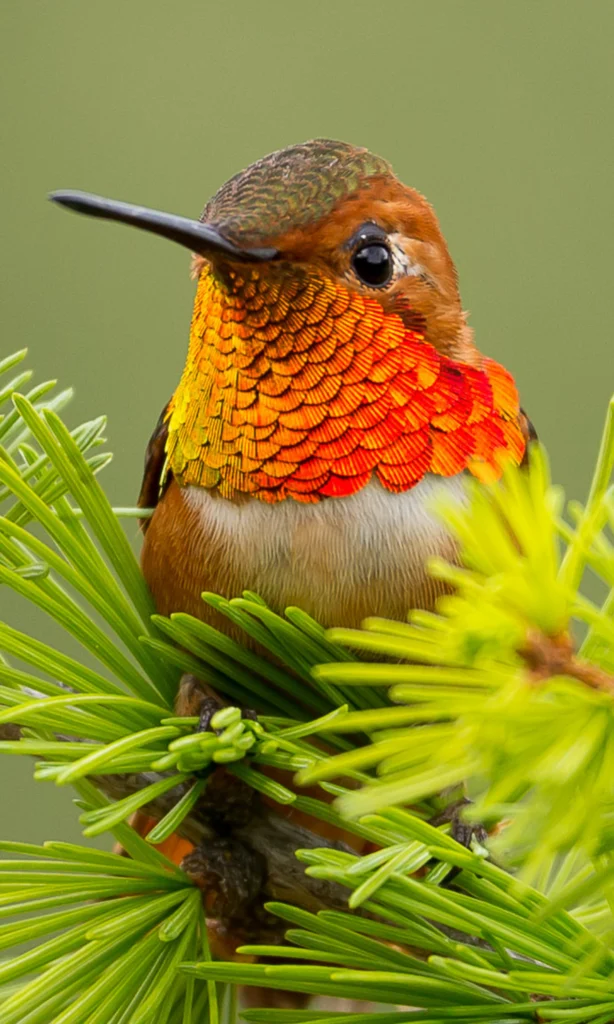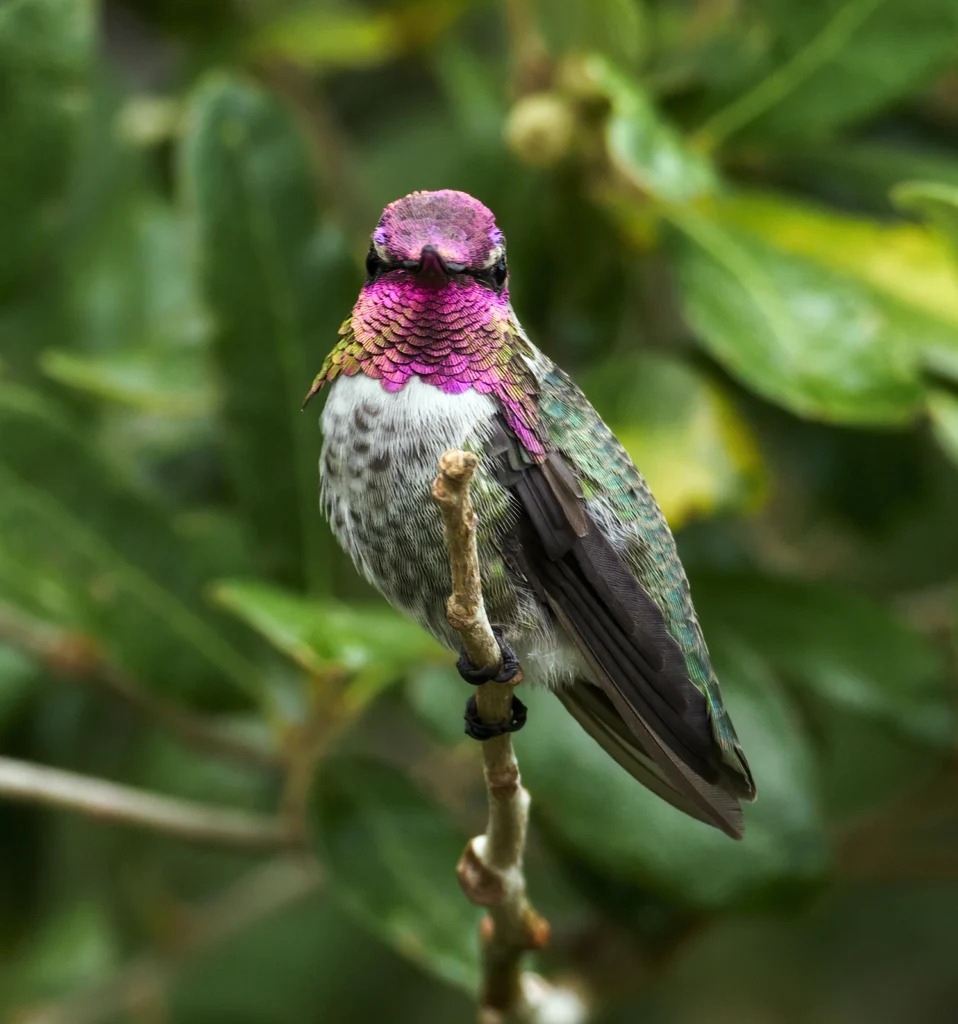

Do Hummingbirds Migrate?
Throughout the summer months, hummingbirds can be found across almost all of North America. The vast majority of hummingbirds fly to Mexico or Central America for the nonbreeding season.

Loddigesia mirabilis
Quinde (hummingbird, Chachapoyas Quechua)
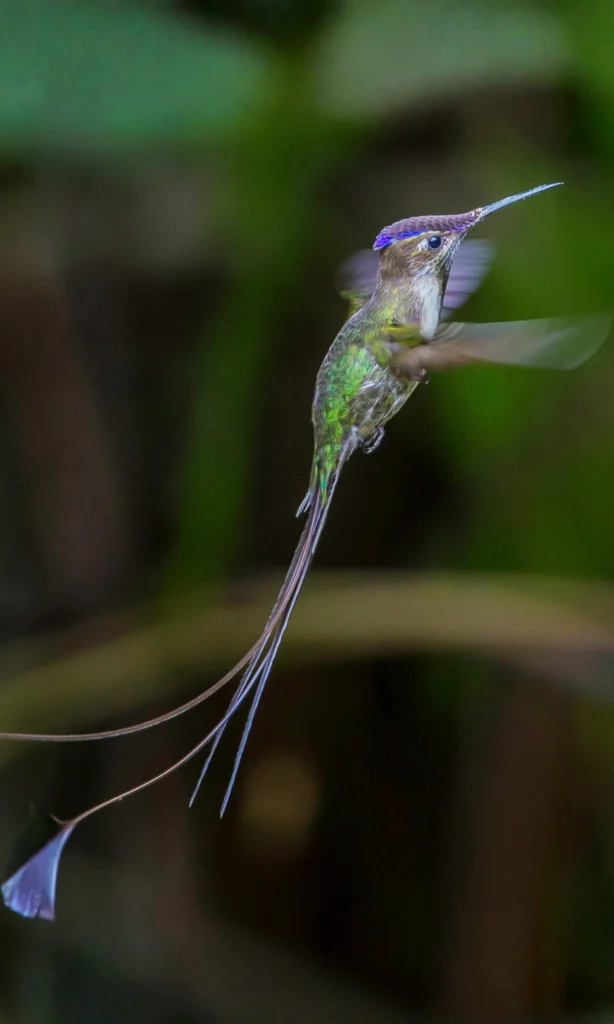
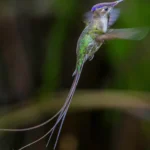
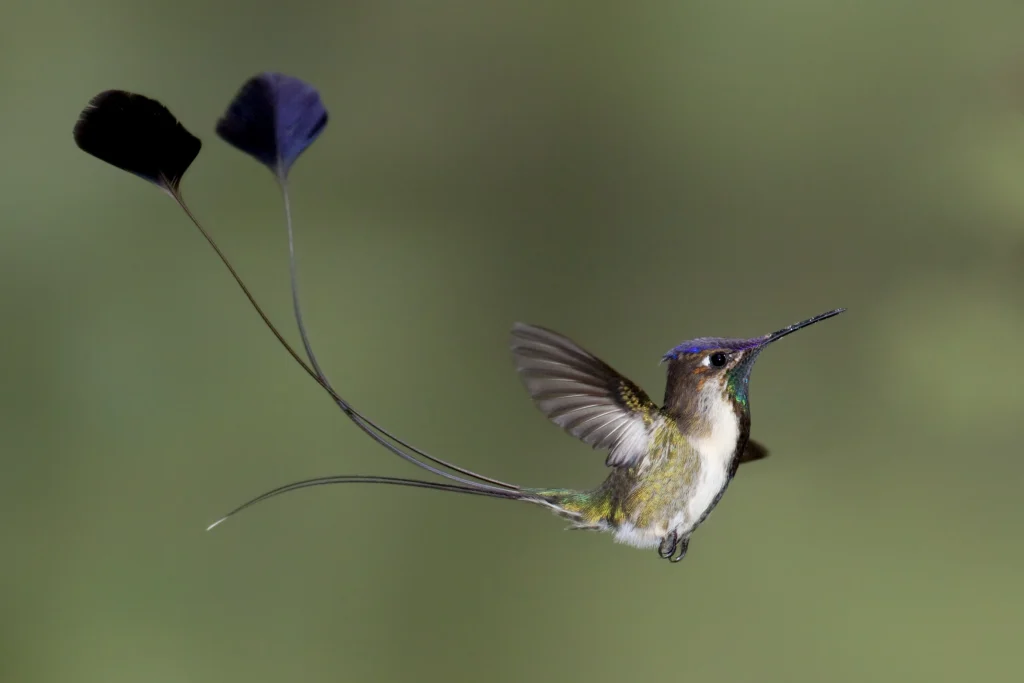
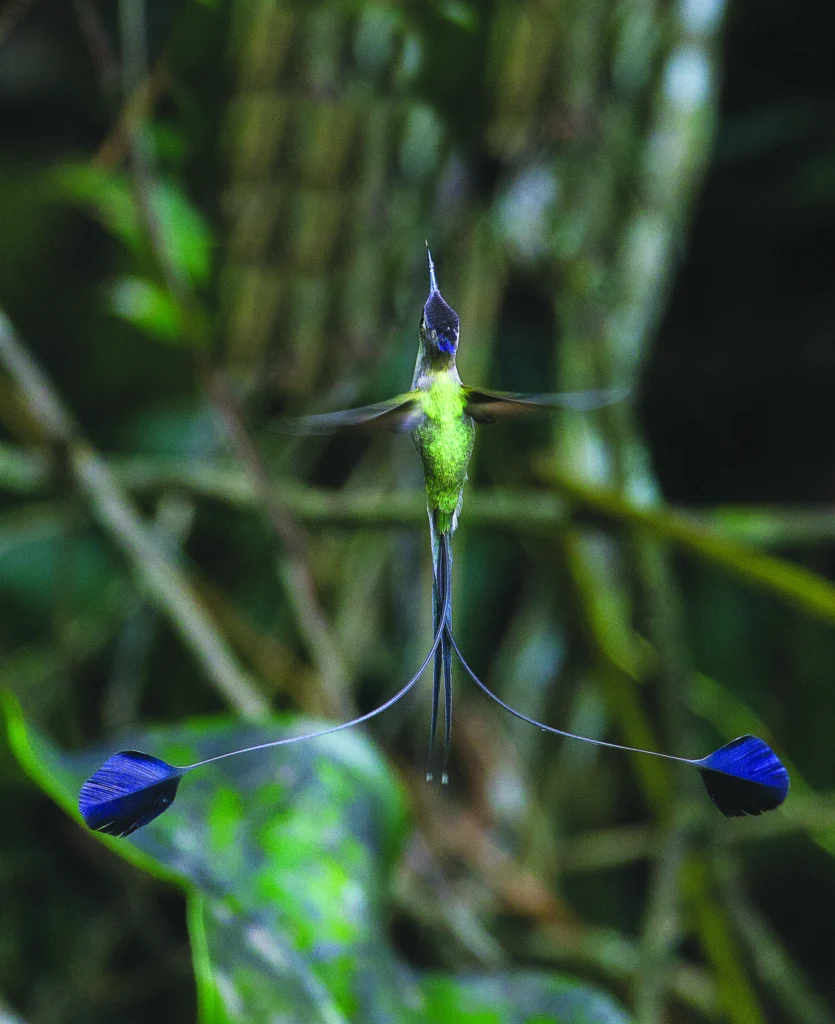
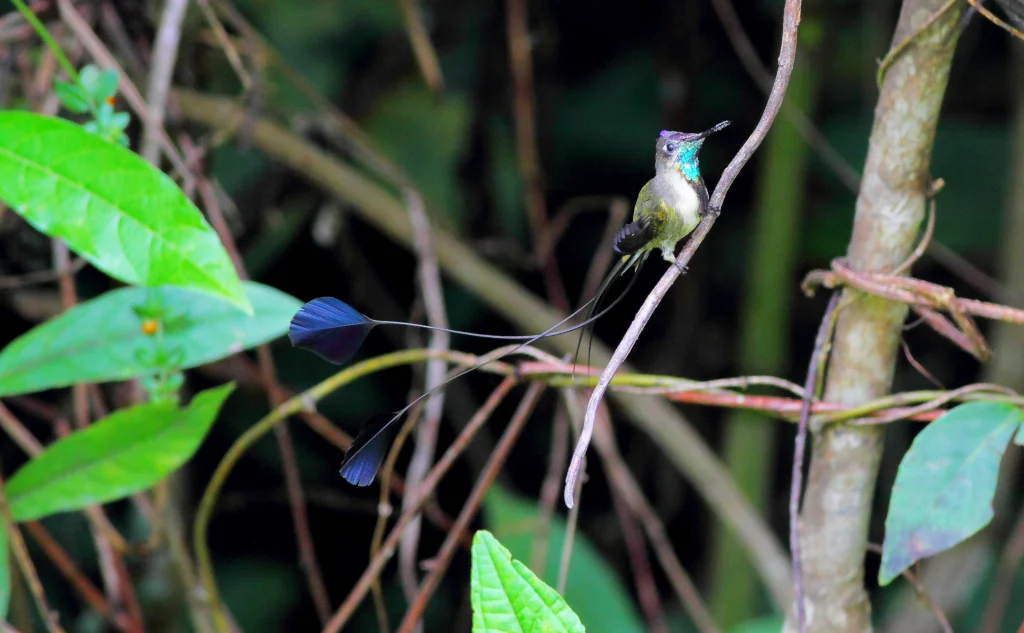
The Marvelous Spatuletail, like many hummingbird species such as the Black-eared Fairy and Rainbow-bearded Thornbill, has a name that is both charming and wonderfully descriptive. This beautiful little hummingbird shines in shades of white, green, and bronze; the male also sports vivid blue crest feathers, a brilliant turquoise throat, a distinctive black streak down his white underparts, and a uniquely bizarre tail. This bird’s namesake tail has only four feathers, the outer two being long, thin wires several times the length of the bird, tipped with the iridescent racquets or “spatules,” each larger than the Spatuletail’s head. These remarkable feathers are under exquisite control thanks to specialized musculature and are used during the male’s courtship display.
Male Spatuletails perform their energetic display at communal display areas called leks, where females visit to compare performers and select a mate. Other hummingbird species, such as the Snowcap, use this type of mating system, as do pheasants like the Greater Sage-Grouse and Lesser Prairie-Chicken. During the first part of his display, the male Spatuletail bounces back and forth across a horizontal twig at high speed. Then he hovers in front of the female while furiously waving his spatules about, making snapping and chittering sounds all the while.
Unique to its genus Loddigesia, this species was first described in 1835 and is only found in northern Peru’s Rio Utcubamba Valley. Its distinctive tail and dramatic courtship “dance” have inspired community pride and conservation awareness. Local festivals, school performances, and dances, which are sometimes referred to as the danza del colibrí cola de espátula, celebrate the bird while teaching students and visitors about the importance of protecting its habitat. The species has also been highlighted nationally as a symbol of Peru’s biodiversity, appearing on a commemorative coin issued by the Banco Central de Reserva del Perú in 2019, and in conservation initiatives in Pomacochas and nearby communities.
The main threat to the Marvelous Spatuletail is habitat destruction, caused by burning for agriculture and illegal wood-cutting. Fires used to clear land can damage the montane forest and shrub habitats that this hummingbird depends on for foraging and nesting. Because these Andean cloud forest ecosystems are not naturally fire-adapted, burned vegetation often recovers slowly and may not regenerate fully without human intervention, leaving degraded habitat for years. In some communities, fires are also intentionally set due to the belief that burning vegetation can help bring rain, which can further increase the risk of uncontrolled fires and habitat loss in the region.
Much of the forest within the Marvelous Spatuletail’s range has been destroyed since 1978, largely due to slash-and-burn agricultural practices and unsustainable logging for firewood. This species’ use of forest edges and wooded areas on steep slopes may protect it to some extent from the immediate impacts of deforestation.
Vulnerable birds like the Marvelous Spatuletail need our help to overcome the threats they face. At ABC, we’re inspired by the wonder of birds and driven by our responsibility to find solutions to meet their greatest challenges. With science as our foundation, and with inclusion and partnership at the heart of all we do, we take bold action for birds across the Americas.
Habitat is the foundation for birds’ survival. Working with dozens of partners and local communities throughout Latin America and the Caribbean, ABC supports a growing network of protected areas in more than a dozen countries. Totaling more than 1.3 million acres, nearly one-third of the world’s birdlife (more than 3,000 species) is protected by an ABC-supported reserve — including the Marvelous Spateuletail.
In 2006, ABC and Asociación Ecosistemas Andinos (ECOAN), in partnership with the local Pomacochas community, worked to establish the Huembo conservation easement, an Alliance for Zero Extinction site and the first protected area for the Marvelous Spatuletail. ECOAN monitors breeding activity to guide habitat restoration efforts, and, with support from ABC, ECOAN has expanded the reserve, established a tree nursery, and planted hundreds of thousands of trees and shrubs within and around the reserve, including many of the Spatuletail’s preferred nectar plants. ABC and ECOAN also built an ecolodge with hummingbird feeders that reliably attract the species, providing opportunities for visitors and supporting the local economy with ecotourism.
The Marvelous Spatuletail is a sight to behold. Males and females are shiny shades of emerald, white, and bronze. The male also sports a vibrant blue crown, an iridescent turquoise gorget (throat), and a bold black stripe running down the center of his white underparts. His tail is composed of only four feathers. The outer two feathers are long and wire-like, crossing each other and ending in large violet-blue discs or “spatules.” These specialized feathers grow to three or four times the bird’s body length, and the male can move each one independently. Females are a similar iridescent green-to-bronze above and white below, but lack the crest, gorget, and black midline stripe. While females lack the exaggerated racquets of males, their elongated tailfeathers are almost the length of her body, and end with modest spatules of the same violet-blue as the male’s.
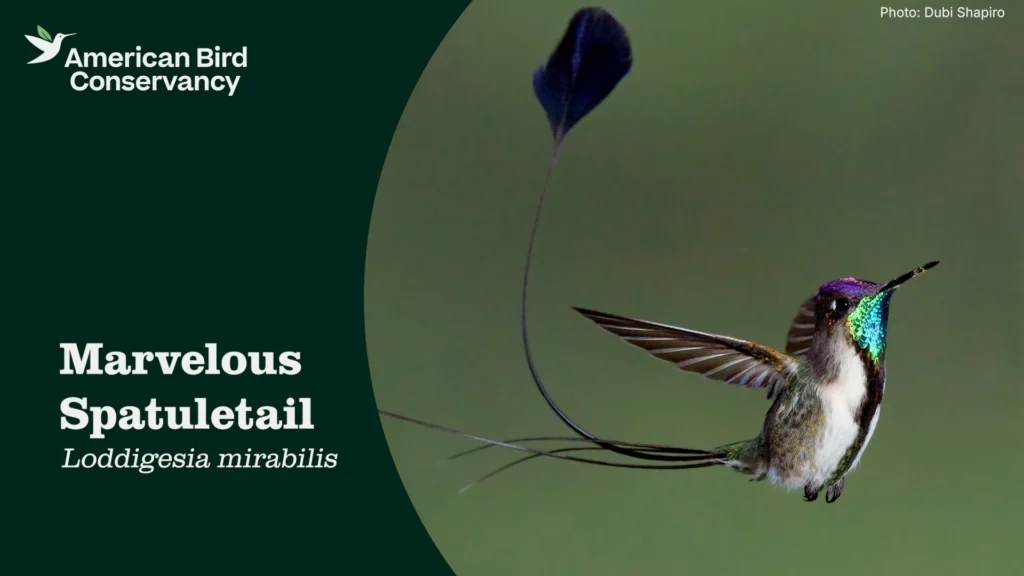
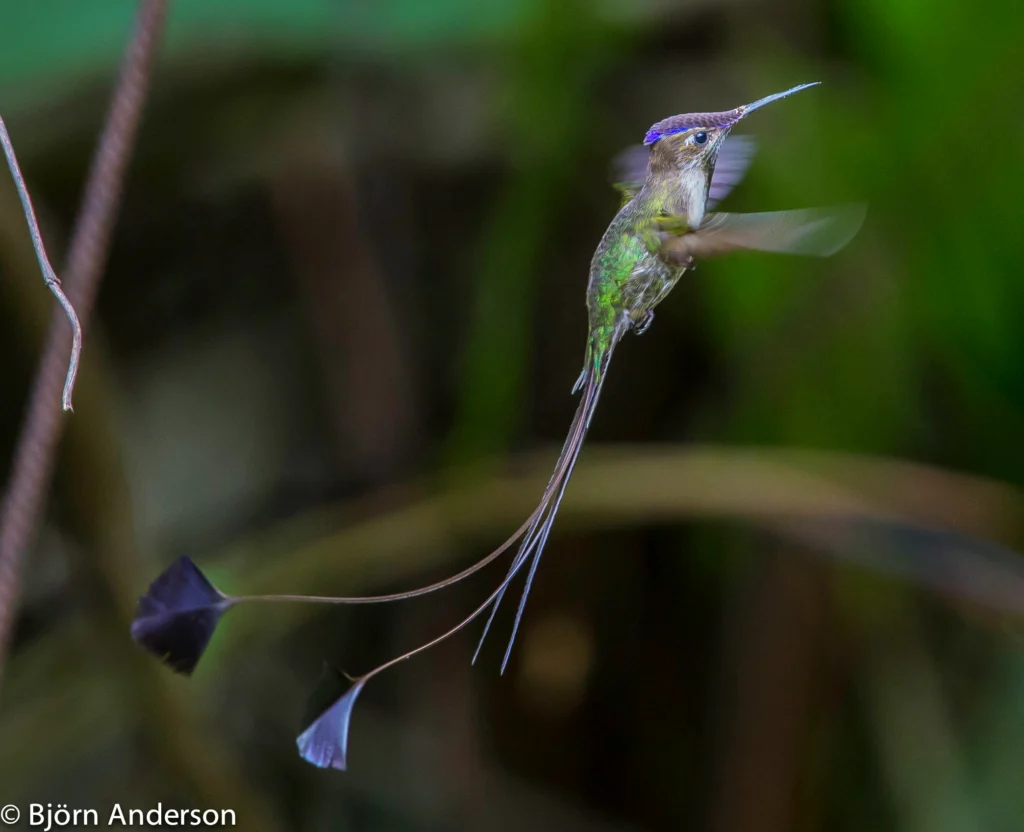
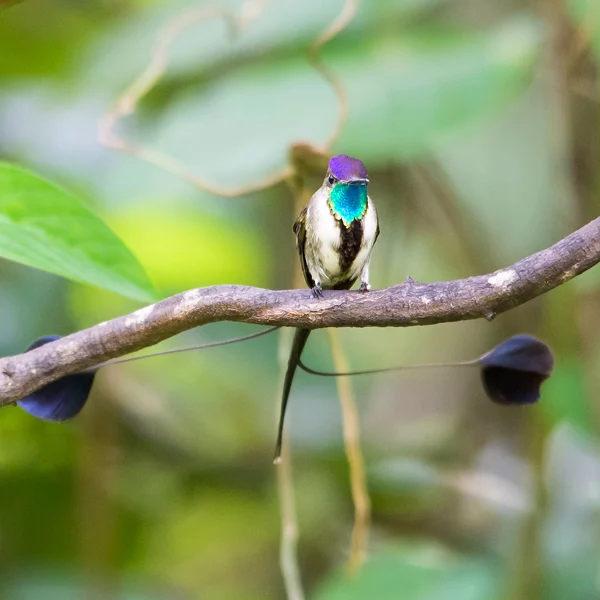

As part of their courtship display, males produce loud snaps and extremely high-pitched metallic buzzing sounds, at least some of which may be produced by the wing or tail feathers. Males and females both give high upslurred tsip and sharp downslurred tsewp calls.
Credit: Wouter Halfwerk, XC9282. Accessible at https://xeno-canto.org/9282.
Credit: Andrew Spencer, XC41717. Accessible at https://xeno-canto.org/41717.
The Marvelous Spatuletail inhabits open habitat in the cloud forests of the Andes, where it feeds on flowering shrubs.
Specific Area
Peru
Range Detail
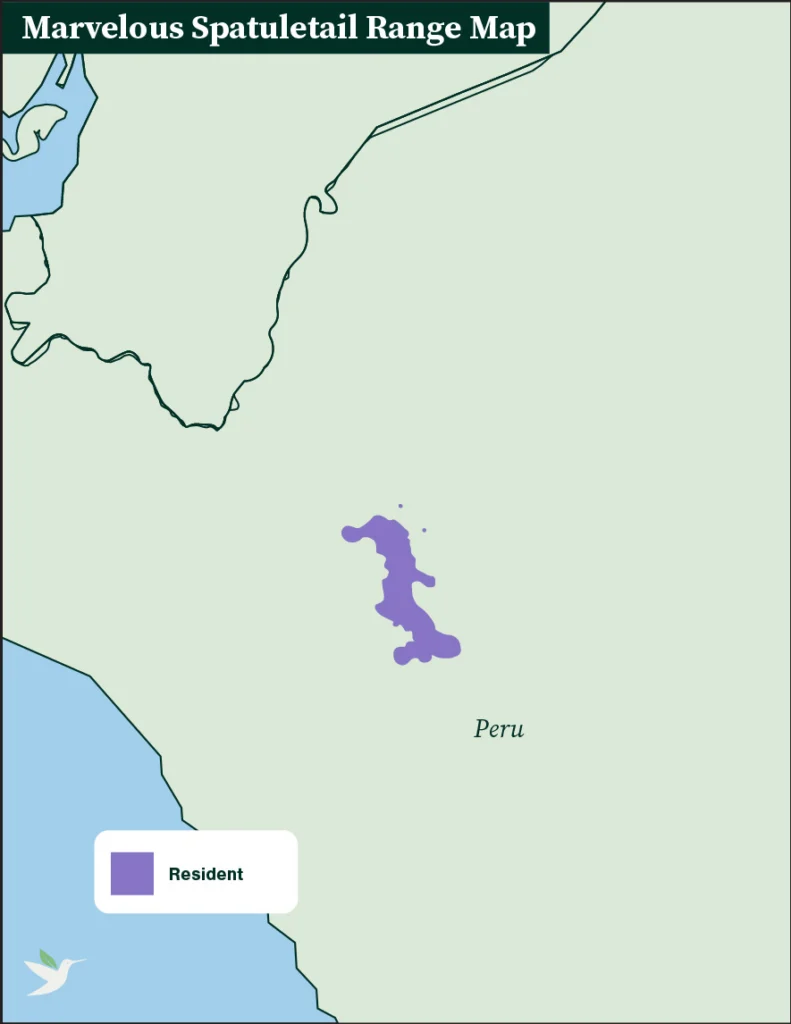
The Marvelous Spatuletail has an extremely restricted range, living only in the Rio Utcubamba Valley in northern Peru.
Did you know?
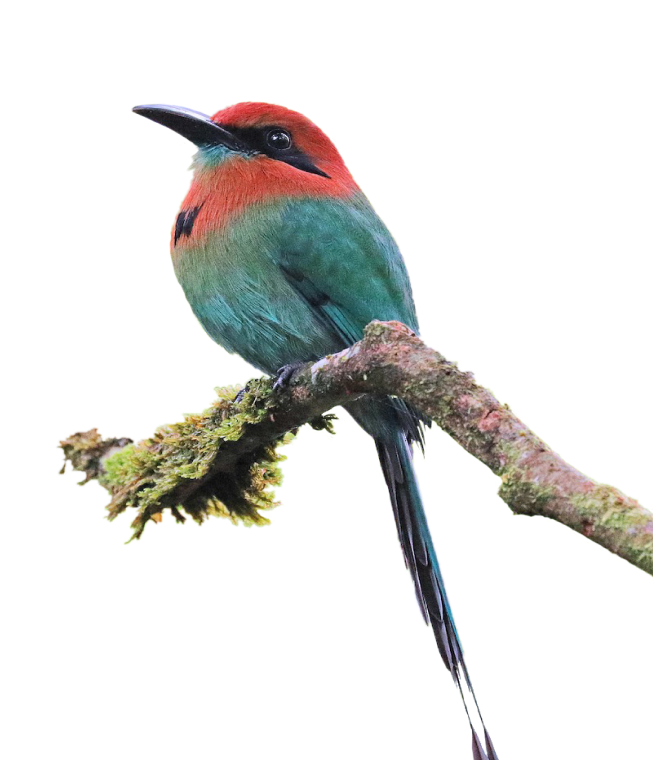
Though indeed marvelous, the Spatuletail is not the only bird to have evolved long wire-like, spatule-tipped tails. Other examples include the Greater Racket-tailed Drongo, the Racket-tailed Roller, the racket-tail parrots, and most motmot species.
Marvelous Spatuletails forage from flowering shrubs, often perching while feeding rather than hovering. These hummingbirds visit nectar sources in sequence along a regularly traveled route, a feeding strategy known as trap-lining. Male Spatuletails establish feeding territories, where they aggressively chase away other males and large insects such as bumblebees that might try to feed alongside them.
Marvelous Spatuletails are only known to eat nectar, and have been observed feeding from at least five species of plants. Some observers state that this species may prefer the flowers of Bomarea formosissima. Spatuletails also visit feeders.
Males perform elaborate courtship displays with the aim of mating with multiple females, and provide no parental care to their young. Males perform on communal display grounds or leks, where females come to observe and compare.
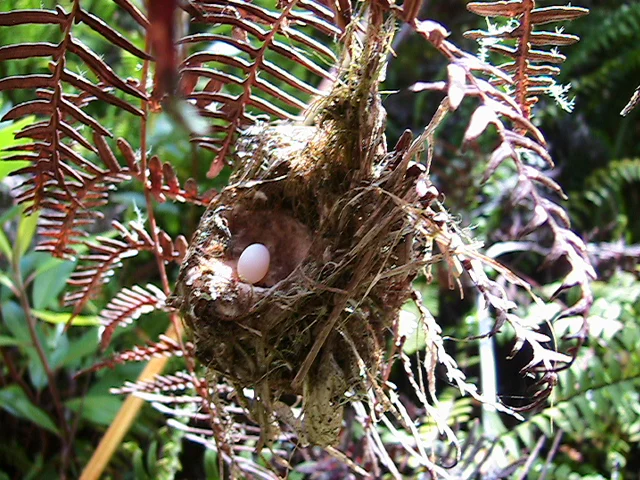
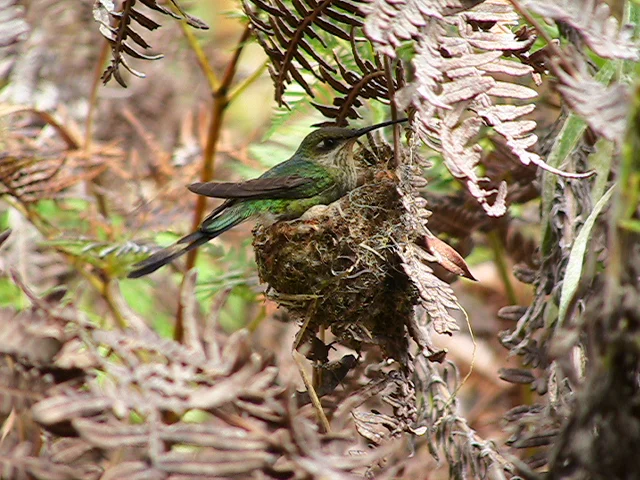
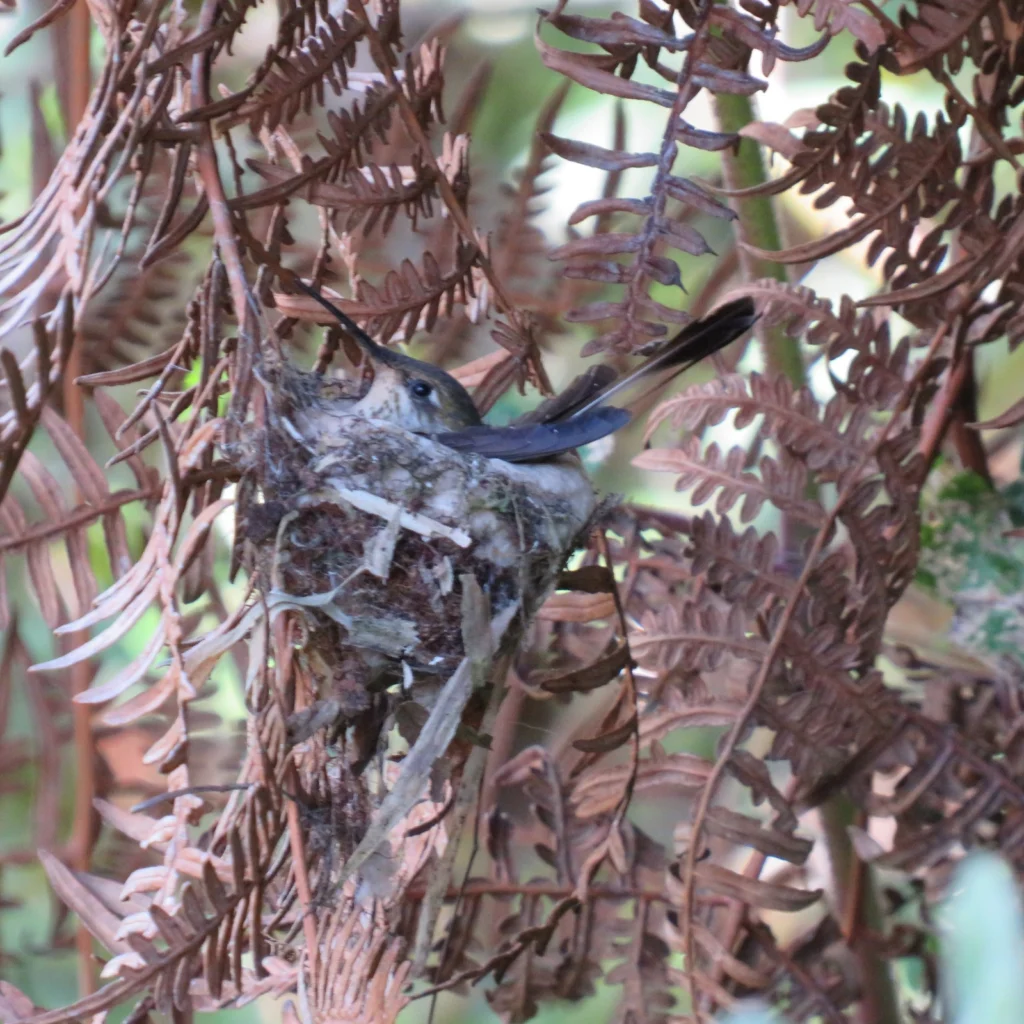
After mating at the lek, a female Spatuletail is on her own. She builds her nest out of plant fibers and moss, placing it on a low, horizontal branch, then lines it with soft materials and strengthens it with spider webs and other sticky material.
The average clutch consists of two white eggs, which the female alone incubates. The young are born blind and featherless, but grow quickly. They leave the nest after only a week to 10 days.
Related News & Stories



Join the flock! Your donation helps preserve the habitats that birds need to survive.