Rough-legged Hawk

Buteo lagopus

Rough-legged Hawk facing front while in shrub bush. Photo by Tim Zurowski, Shutterstock

Rough-legged Hawk

Rough-legged Hawk facing front while in shrub bush. Photo by Tim Zurowski, Shutterstock

Buteo lagopus

Overview

Conservation Status
Population Trends
Stable
Population Size
590,000 (world)
Family
Hawks
Location
North America
Worldwide
Migration Pattern
Latitudinal
Migration Distance
Medium Distance
Also Known As
  • Rough-legged Buzzard (Europe)
  • Roughleg
  • Black Hawk
  • Mouse Hawk
  • Squalling Hawk
  • Aguililla Ártica (Spanish – Mexico)

About

The Rough-legged Hawk is a raptor that breeds in Arctic and high subarctic regions around the world, migrating to more southerly regions each year to delight intrepid winter birders. The name “Rough-legged” refers to this raptor’s fully feathered legs, a feature shared by the Ferruginous Hawk and Golden Eagle.

Besides its feathered legs, the Rough-legged Hawk also has a noticeably small beak. These features illustrate a biological principle known as Allen’s Rule, which states that the appendages of endothermic (warm-blooded) animals in colder climates are relatively smaller than those in warmer climates. Smaller, feathered features minimize bare surface areas and help reduce heat loss, critical requirements for survival in freezing polar regions. Allen’s Rule can be seen in other Arctic-dwelling birds such as the Snowy Owl, Arctic Tern, and Willow Ptarmigan.

This handsome raptor is about the size of a Red-tailed Hawk, but its long, narrow wings appear more plank-like in flight. It has a habit of hovering as it hunts over open spaces, rather like an overgrown American Kestrel, and often perches on the tips of branches and shrubs, where similar-sized hawks rarely alight.

Threats

Birds around the world are declining, and even those that nest in far-flung regions, such as the Rough-legged Hawk, are facing ever-increasing threats from the cumulative impacts of climate change and habitat loss.

Climate Change

Variable and extreme weather patterns caused by a changing climate mean habitat loss and degradation on the Rough-legged Hawk’s Arctic breeding grounds, making it more difficult for these birds to find nesting and hunting areas.

Climate Change

Collisions

Like many raptors, the Rough-legged Hawk is vulnerable to collisions with poorly sited wind turbines, which are becoming more common throughout their nonbreeding range. Fatal collisions with vehicles and powerlines pose other significant threats.

Shooting

The Rough-legged Hawk, like many raptors, was once persecuted by farmers and ranchers. Although hunting the Rough-legged Hawk is now illegal, it is still sometimes shot in some areas. It is also accidentally killed in traps set for other animals.

Conservation Strategies & Projects

Even birds with stable populations like the Rough-legged Hawk need our help to overcome the threats they face and prevent future declines. At ABC, we’re inspired by the wonder of birds and driven by our responsibility to find science-backed solutions to meet their greatest challenges.

Rethinking Wind Turbines

ABC encourages Bird-Smart wind energy, an approach to clean energy projects that minimizes risks to birds and other wildlife. We identify the areas most critical to birds and guide wind developers to support safer siting. And, we continue to advocate for policies that prioritize best practices in project planning and implementation.

Rethinking Wind Turbines

Support Petitions & Advocacy

ABC’s policy team is working in the U.S. to ensure that birds get the funding, resources, and protections they need. We urge our members to join the effort to advocate for the preservation of essential bird conservation programs.

Petitions & Advocacy

Bird Gallery

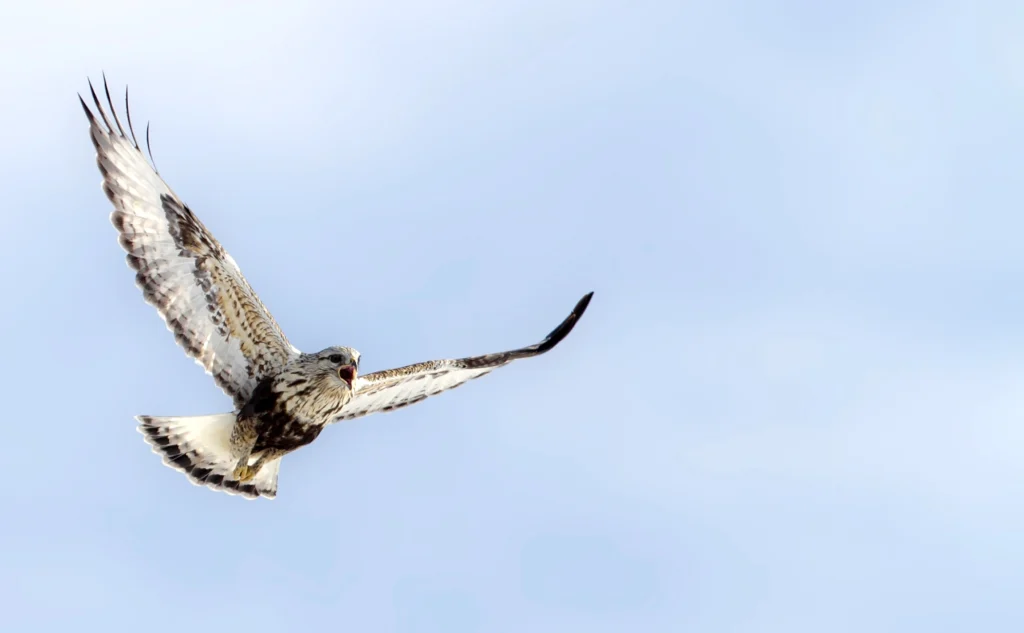
A good-sized raptor, the Rough-legged Hawk is about the size of a Red-tailed Hawk, but has a lankier appearance, with long, narrow-looking wings, a noticeably smaller beak, and feathered legs. The plumage of this hawk is diverse, with light and dark color morphs (the light morph being more common) as well as intermediate variations. A light-morph Rough-legged Hawk shows a pale head and underparts, a contrasting black belly band, and large black patches on the feathers referred to as secondaries (the “wrist” portion of a bird’s wing) that are especially visible in flight. The rarer dark morph of Rough-legged Hawk is black, with contrasting pale flight feathers and a tail that has multiple black bands, with the widest one at the tip.

Sounds

Generally silent away from its breeding grounds, the Rough-legged Hawk gives a loud, shrill, descending alarm call near its nest, sounding like kyaaaaah or kee-eer.

Calls

Credit: Andrew Spencer, XC141720. Accessible at www.xeno-canto.org/141720.

Alarm calls

Credit: Lars Edenius, XC665961. Accessible at www.xeno-canto.org/665961.

Habitat

In North America, Rough-legged Hawks breed in tundra or taiga in Arctic and subarctic Alaska and Canada, then migrate south for the nonbreeding season to the open country of southern Canada and the northern United States.

  • Breeds on cliff faces in tundra/taiga
  • May breed at the boreal forest edge
  • Spends the nonbreeding season in open areas such as fields, pastures, and marshes

Range & Region

Specific Area
North America, Europe, Asia

Range Detail
The Rough-legged Hawk breeds in Arctic regions across the world. In North America, its breeding range includes Alaska and Canada. During the nonbreeding months, it migrates to the southern border regions of Canada and across a wide swath of the United States south to California, Arizona, New Mexico, Texas, Missouri, Kentucky, and Maryland.

In Eurasia, the Rough-legged Hawk breeds from northern Scandinavia east across the Siberian Arctic to the Pacific Ocean. It migrates to spend the nonbreeding season in Central Europe and Asia.

Did you know?
Nonbreeding populations of Rough-legged Hawks fluctuate regionally from year to year, with “invasions” occurring when numbers of its small rodent prey increase rapidly. Similar boom-and-bust cycles can be observed in other raptors, such as the Snowy Owl and Northern Hawk Owl, as well as in seed-eating birds like the Evening Grosbeak and Red Crossbill.

Range
North America
Worldwide
Migration Pattern
Latitudinal
Migration Distance
Medium Distance

Life History

The Rough-legged Hawk is a widespread but rather hard-to-find species, as it breeds in remote places. Winter sightings can be sporadic, as numbers of this hawk tend to fluctuate with the availability of prey. They are graceful flyers with a tendency to perch on poles and fences, and even on the slender, uppermost branches of trees.

Diet

The Rough-legged Hawk is a small rodent specialist, preying primarily upon lemmings, voles, mice, rabbits, and ground squirrels. It may also take ptarmigan and a variety of other small birds. During the winter, it also feeds on carrion, particularly road-killed animals. This hawk hunts from atop a perch or on the wing. In flight, it often hovers facing the wind, abruptly dropping down in a vertical plunge to pick off prey.

Courtship

The Rough-legged Hawk is monogamous during its breeding season, and some pairs stay together on the nonbreeding grounds, too. Males perform circular courtship flights to attract a female, and also perform “sky-dance” displays, soaring high and diving down steeply.

Nesting

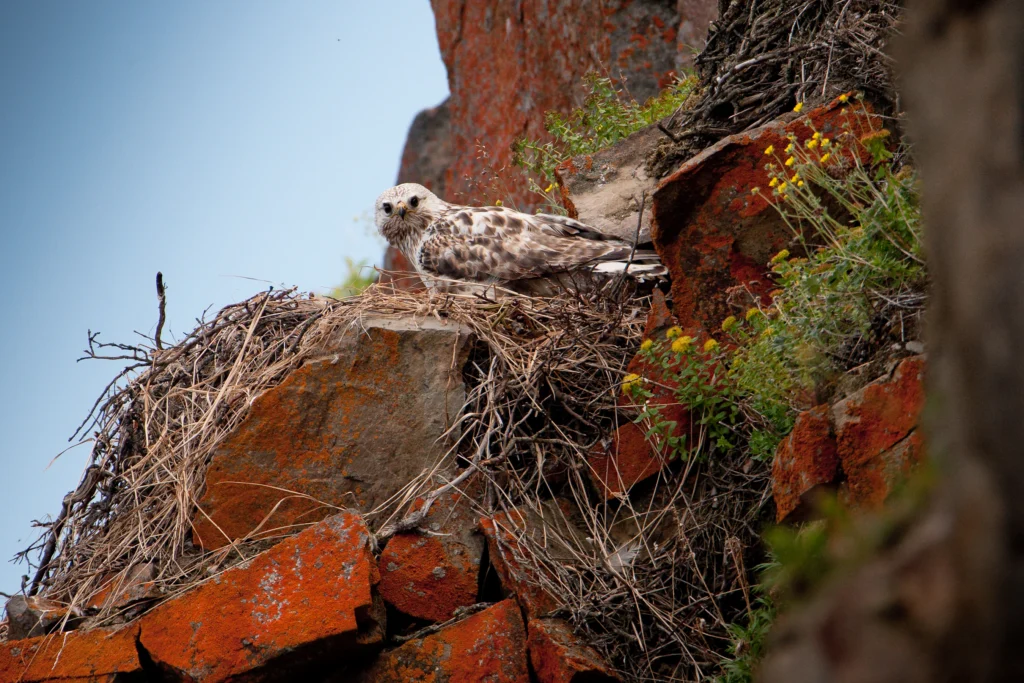
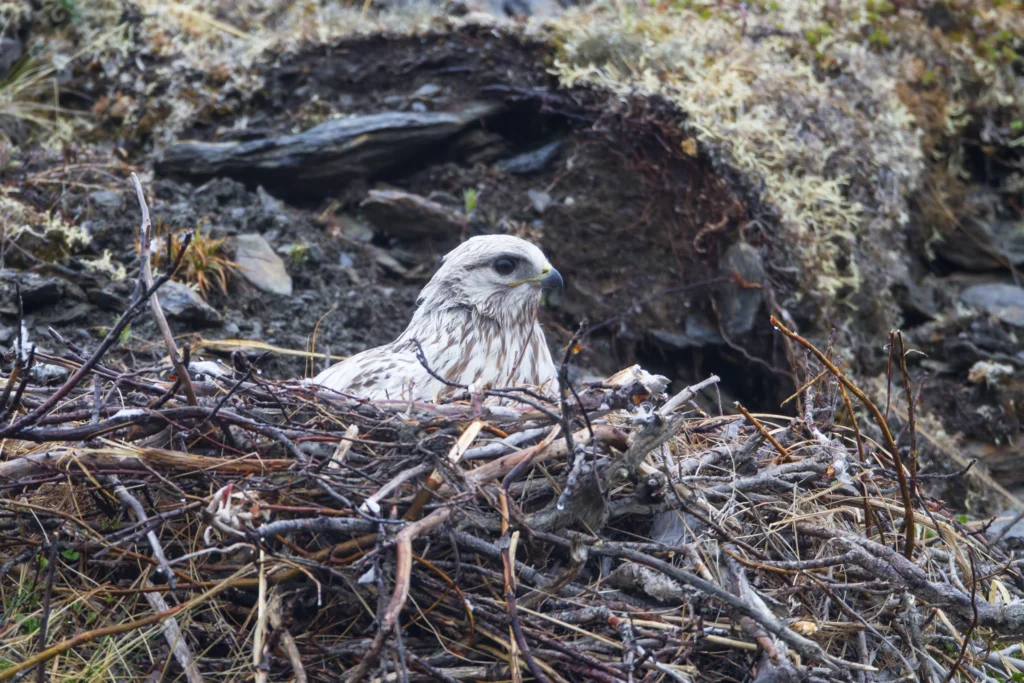
The male Rough-legged Hawk selects a nest site high on a cliff, rocky outcrop, or riverbank, preferably on open tundra. This species sometimes will nest high in a tree, or more rarely, on human-built structures such as towers, buildings, or bridges. The male brings material while his mate builds the nest, a bulky structure of sticks lined with grasses, hair, and feathers.

Eggs & Young

The female Rough-legged Hawk lays a clutch of two to seven eggs, with the number varying depending on the availability of rodent prey. She incubates the eggs for 28 to 31 days. Her mate brings her food as she sits, and sometimes tends the eggs if she leaves the nest for short periods. She broods the young after hatching, while the male continues to bring food. As the young grow, both parents begin to supply prey. The young Rough-legged Hawks leave the nest after five to six weeks, and remain near their parents for approximately another month. They reach adulthood after two years.