Overview
About
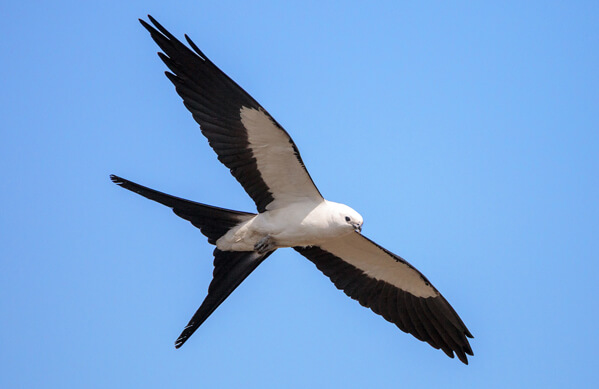
The Swallow-tailed Kite is unmistakable in flight, with long, pointed wings, a deeply forked tail, and contrasting black-and-white plumage. This largest of American kites is a graceful, buoyant flier, so lightweight and maneuverable that it can capture a dragonfly mid-air or pluck a lizard from its treetop hideout — all without a single wingbeat. It uses its forked tail as a rudder and continuously moves it, sometimes to nearly 90 degrees, to maintain its flight path, make a sharp turn, or circle. This consummate aerial acrobat seems more like a giant Barn Swallow than a raptor.
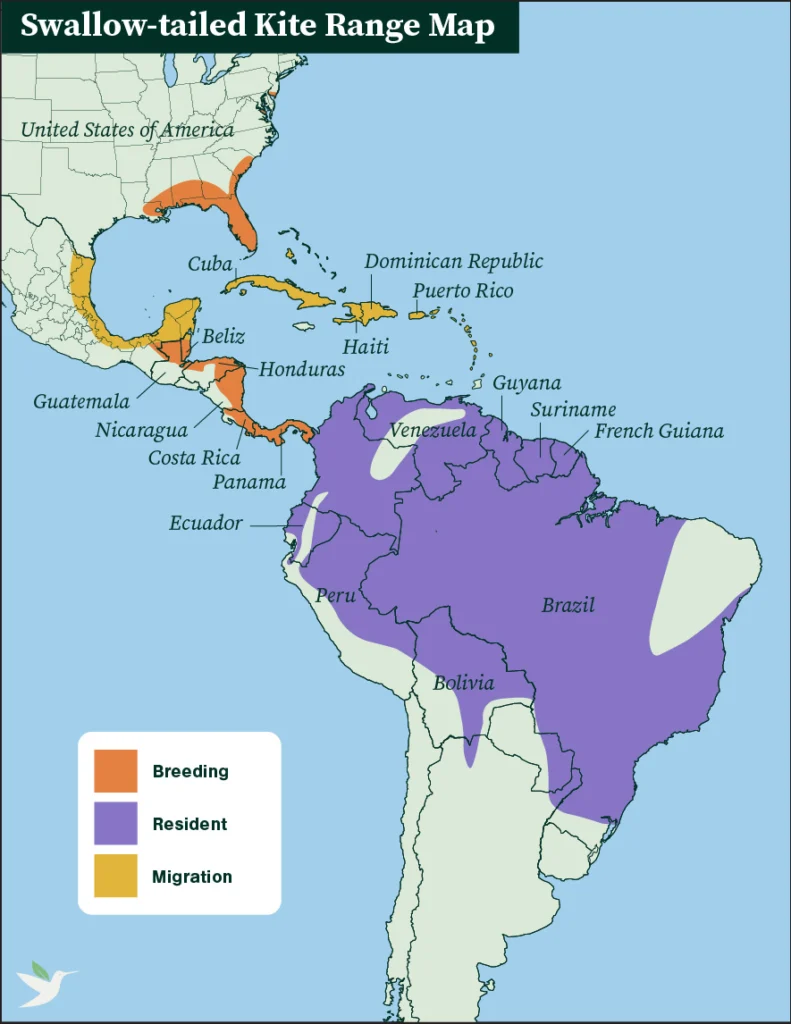
Two Swallow-tailed Kite subspecies are recognized. The population that nests in the United States breeds in bottomland, riparian, and swamp forests in the Southeast and migrates to South America following the breeding season. The other subspecies, which comprises the majority of the world’s Swallow-tailed Kites, is resident in Central and South America.
The substantial loss and degradation of habitat once drove Swallow-tailed Kite numbers down in the U.S., but populations are recovering due, in part, to the use of bird-friendly conservation practices in working forests throughout the Southeast.
Threats
Though Swallow-tailed Kite numbers are on the rise today, the species suffered a heavy toll over decades of widespread forest clearing and shooting. The Swallow-tailed Kite was once found all along the Mississippi River, as far north as Minnesota, and nested in at least 21 states. Today, it breeds in only seven, all in the southeastern U.S.
Habitat Loss
Habitat loss remains the primary threat to this species. In its U.S. range, large areas of humid bottomland forest have fallen to unsustainable logging and development. Although the U.S. population seems to be increasing due to reforestation in riparian areas, the trend may not last long, as these habitats are threatened anew by development.
Conservation Strategies & Projects
At ABC, we’re inspired by birds and driven to find science-backed solutions to reduce the declines migratory birds have experienced throughout the 19th and 20th centuries. Using technology to gain insight into migratory patterns and innovative partnerships to improve the most important habitats, we are helping to bring about a brighter future for birds like the Swallow-tailed Kite.
Restoring Habitat
Swallow-tailed Kites are once again becoming a familiar sight in parts of the Southeastern U.S. Working with the Sustainable Forestry Initiative (SFI) and partners like International Paper, we are helping to guide forest management that benefits landowners on working lands while maintaining habitat for the Swallow-tailed Kite and other vulnerable species.
Protecting Migration
Harnessing the power of wildlife tracking technologies such as Motus, ABC and our partners are gaining valuable insight into the habitats Swallow-tailed Kites are using on their breeding territories, as they migrate, and on their South American nonbreeding grounds. Learning where kites go and how they make their moves guides conservation action for the species.
Bird Gallery
From its bill to the tips of its forked tail, the Swallow-tailed Kite measures almost two feet long, with a wingspan of over 4 feet. Its white body, black wings, and distinctive tail make it easy to identify. Juveniles are similar to adults, but have a subtle buffy hue to their head and chest feathers. Their flight style is also noticeable: They are very buoyant and graceful, soaring on thermals, flapping infrequently with smooth, unhurried wingbeats.
Sounds
The Swallow-tailed Kite is not often heard. One of its calls is a high-pitched, whistled klee-klee-klee.
Credit: Dusan M. Brinkhuizen, XC93821. Accessible at www.xeno-canto.org/93821.
Habitat
A forest bird through and through, the Swallow-tailed Kite is an emblem of the bottomland forests and their adjacent pinelands of the southeastern U.S.
- Breeds in bottomland, riparian, and swamp forests, using tall trees for nesting, situated near open areas for foraging
- Year-round residents and the migratory northern subspecies use humid lowland forests
Range & Region
Specific Area
North America, South America
Range Detail
The Swallow-tailed Kite has two subspecies. One remains year-round in the humid lowland forests of South America as far south as southern Brazil and northern Argentina, but may migrate shorter distances. The other breeds in the southeastern U.S., from coastal South Carolina to Florida and west to Louisiana and Eastern Texas. This population migrates south for the nonbreeding season.
Did You Know?
Swallow-tailed Kites are unusually sociable for a raptor species. Before undertaking their journeys south, hundreds of kites gather at pre-migration roosts where they hunt and build up fat reserves to help power their 5,000-mile trips.
Life History
The Swallow-tailed Kite is social — an unusual trait in a raptor, shared with the Harris’s Hawk. Pairs commonly nest in close proximity, and outside the breeding season, communal night and pre-migratory roosts may attract hundreds of kites. These birds also migrate in large groups that sometimes number in the thousands. The Swallow-tailed Kite is built for life on the wing, even drinking while in flight by skimming the water’s surface to collect water, just like a swallow does.
Diet
The Swallow-tailed Kite’s main prey are flying insects such as dragonflies and cicadas, which the birds capture and eat on the wing. As they cruise the treetops, they also snag snakes, lizards, treefrogs, and even bird nestlings and eggs. In South Florida, where Swallow-tailed Kites sometimes nest in suburbs, their diet is known to include hatchlings of the introduced and now-thriving green iguana. Unusual for raptors, Swallow-tailed Kites will eat fruit, especially on their nonbreeding grounds.
Courtship
Breeding pairs are thought to be monogamous. At the start of the breeding season, they establish small territories close to the nest site, selecting sites high in the crown of very tall trees such as pine or cottonwood. During courtship, Swallow-tailed Kites spend a lot of time diving, chasing, and vocalizing.
Nesting
The male and female bring nesting material to their chosen site and work together to build the nest, which can take as long as two weeks. The nest is a shallow cup of twigs, lined with Spanish moss or other soft vegetation, measuring 12–25 inches across and 5–12 inches tall.
Eggs & Young
The Swallow-tailed Kite’s clutch ranges from one to three cream-colored eggs accented with reddish brown markings. Incubation lasts 27 to 33 days, and young remain in the nest for roughly six weeks after hatching.