Overview
About
The Whimbrel, a large shorebird about the size of an American Crow, is the widest-ranging of the world’s curlews, nesting in Arctic regions across North America and Eurasia. The North American population of Whimbrel, Numenius phaeopus hudsonicus, was considered a separate species, called the Hudsonian Curlew, until 1957.
A long-distance migratory bird, the Whimbrel covers thousands of miles each way from its breeding grounds in the boreal forests of northern Canada and Alaska to its nonbreeding territories that extend as far south as Bolivia. One Whimbrel racked up more than 50,000 miles in three years after being fitted with a transmitter. Some members of the species even make nonstop flights of some 2,500 miles over open ocean.
The Whimbrel’s genus name, Numenius, is Greek for “new moon,” and refers to the crescent shape of the bird’s bill. The Whimbrel’s common name and the odd nickname “Jack Titterel” most likely refer to the sound of its whistled calls. Another of the Whimbrel’s nicknames, “Seven Seas Whistler,” gives a nod to its worldwide distribution. The most unusual of this bird’s nicknames, “Peerie Whaap,” originated in the Shetland Islands, from the Scottish words “Peerie” (small or tiny) and “Whaap” (curlew).
Threats
Shorebirds are among the most threatened bird groups in the Western Hemisphere. A Tipping Point species, the Whimbrel has lost more than half of its population in the last 50 years, with declines increasing over the past decade. Hunting in North America dealt huge blows to the Whimbrel until the signing of the Migratory Birds Convention by the U.S. and Canada in 1916, but hunting continues in other parts of its range. Today, the Whimbrel faces threats from habitat loss, climate change, and pollution.
Habitat Loss
Destruction or development of coastal wetlands and development of tundra for oil and gas infrastructure threaten Whimbrel habitats.
Climate Change
Rising sea levels could wipe out important Whimbrel nesting, stopover, and wintering habitats. Any increase in the number and severity of hurricanes due to climate change could make this bird’s long overseas migrations even more perilous.
Pesticides & Toxins
Whimbrels are exposed to a variety of harmful environmental contaminants from runoff and water pollution. One study in Chile showed high levels of cadmium in Whimbrels and their prey caused by untreated mining waste.
Conservation Strategies & Projects
Long-distance migratory birds need conservation efforts at every point in their journeys, on both the breeding and nonbreeding grounds, and the stopover habitats they use in between. With science as our foundation, and with inclusion and partnership at the heart of all we do, ABC takes bold action to protect migratory birds across the Americas.
Protecting Migration
ABC plays a leading role in expanding the Motus Wildlife Tracking System in the U.S., building capacity for this invaluable technology that gives researchers insight into birds’ movements. Staff from ABC have conducted field research to track Whimbrels’ site fidelity to foraging and roosting areas, which can help to create more effective conservation plans for Whimbrels.
Avoiding Pesticides & Toxins
ABC works with partners at the state and federal levels in the U.S. to call for the regulation or cancellation of the pesticides and toxins most harmful to birds. We develop innovative programs, like working directly with farmers to use neonicotinoid coating-free seeds, advancing research into pesticides’ toll on birds, and encouraging millions to pass on using harmful pesticides.
Support Petitions & Advocacy
Through advocacy, ABC ensures birds like the Whimbrel have a seat at the table and get the protections they need. We advocate for policies and funding that make a difference for birds and ecosystems. We take on challenging issues when birds are on the line. And we help our supporters become advocates for birds, too.
Bird Gallery
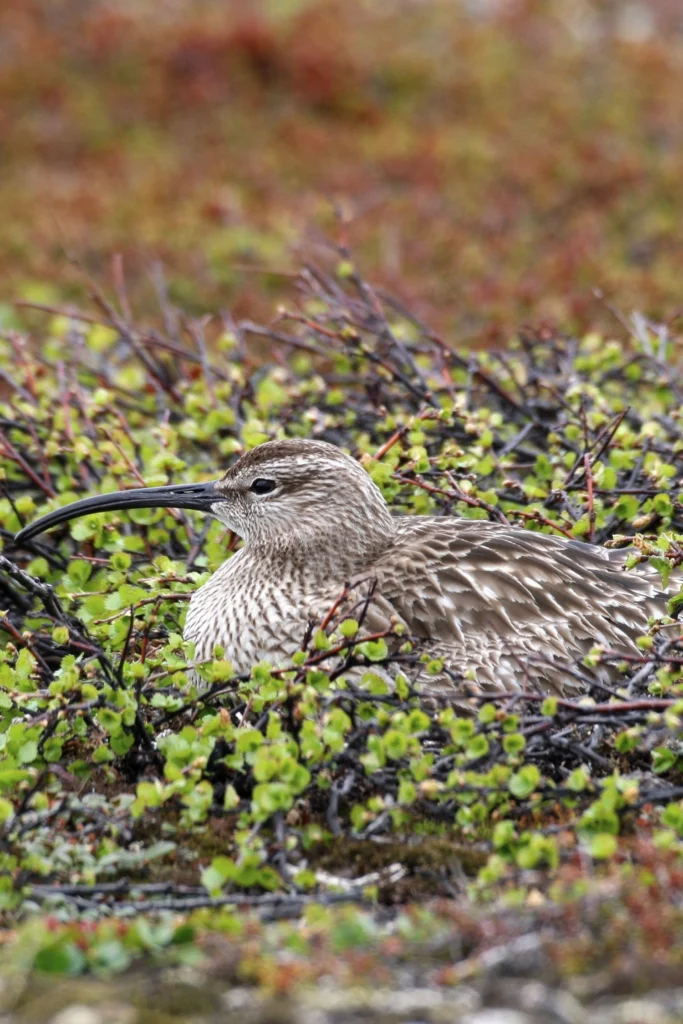
The Whimbrel is a large, stocky shorebird with brown and buff plumage streaked and stippled in darker brown. It has a boldly striped head, blue-gray legs, and a long, down-curved bill. Males and females appear similar; females are larger with slightly longer bills.
Bird Sounds
The Whimbrel is quite vocal, giving a variety of whistled calls, which gave it the nickname of “Seven Seas Whistler.”
Credit: Manuel Grosselet, XC571875. Accessible at www.xeno-canto.org/571875.
Credit: Frank Lambert, XC356265. Accessible at www.xeno-canto.org/356265.
Credit: Paul Marvin, XC630756. Accessible at www.xeno-canto.org/630756.
Habitat
The tundra is the destination for breeding Whimbrels, but outside of the breeding season, these birds make their way to coastlines with access to crabs and other aquatic invertebrates.
- Nests, often in loose colonies, on a variety of tundra types, including drier uplands, sedge meadows dotted with hummocks, and boggy, mossy areas interspersed with shrubs and dwarf trees
- During migration and the nonbreeding season, found along rocky and sandy beaches, mud and tidal flats, mangrove swamps, and estuarine marshes
Range & Region
Specific Area
Canada and Alaska, the east and west coasts of the U.S., Mexico, and Central and South America
Range Detail
Whimbrels are found around the world, and there are four recognized subspecies. The North American subspecies, N. p. hudsonicus, nests in two separate populations — one in Alaska and northwestern Canada, and the second along the western and southern shores of the Hudson Bay.
Did you know?
The Whimbrel is a long-distance migratory species, with some individuals flying nonstop for thousands of miles between breeding and wintering areas. North American Whimbrels migrate as far as 2,500 miles between breeding grounds in the Arctic and nonbreeding grounds as far away as Tierra del Fuego at the southernmost point in South America.
Life History
The Whimbrel has the distinction of being the most widely distributed curlew, and the only curlew to nest in both the Nearctic, the biogeographic region that includes most of North America, and the Palearctic, which covers Europe, most of Asia, and North Africa. Whimbrels are excellent long-distance flyers, but they’re also well-suited to life along the coasts: Their long, curved bills are just the right shape to fit into the burrows of fiddler crabs, their preferred prey.
Diet
On its breeding grounds, the Whimbrel picks insects, snails, berries, and other vegetable matter from the surface of the ground with the tip of its bill. During migration and in the nonbreeding season, the Whimbrel digs deeper, using its beak to probe invertebrate burrows along muddy and sandy shores as it forages for invertebrates, particularly fiddler crabs, a favored food. It also takes marine worms, mollusks, small fish, and insects.
Courtship
After arriving on the breeding grounds, the male Whimbrel begins flight displays to attract a mate, flying high, circling, then gliding down while calling. New pairs also engage in courtship chases on the ground and mid-air. Pairs are monogamous and fiercely territorial, mobbing and chasing away potential nest predators.
Nesting
The female Whimbrel creates a simple scrape on the ground for her nest, usually atop a hummock or near a small shrub. She lines the scrape with lichen, moss, leaves, twigs, or grass.
Eggs & Young
The female Whimbrel lays a clutch of four greenish, blotched eggs. Both parents take turns incubating the eggs for close to a month. The hatchlings are precocial, able to leave the nest and feed themselves within several hours. The parent birds continue to protect them after they leave the nest and until migration begins.
The female Whimbrel begins her southbound migration about a month after the chicks hatch. Her mate stays with the chicks until they fledge, then departs, followed by the young after another month or so. Young Whimbrels will usually remain on the nonbreeding grounds for their first year or two.