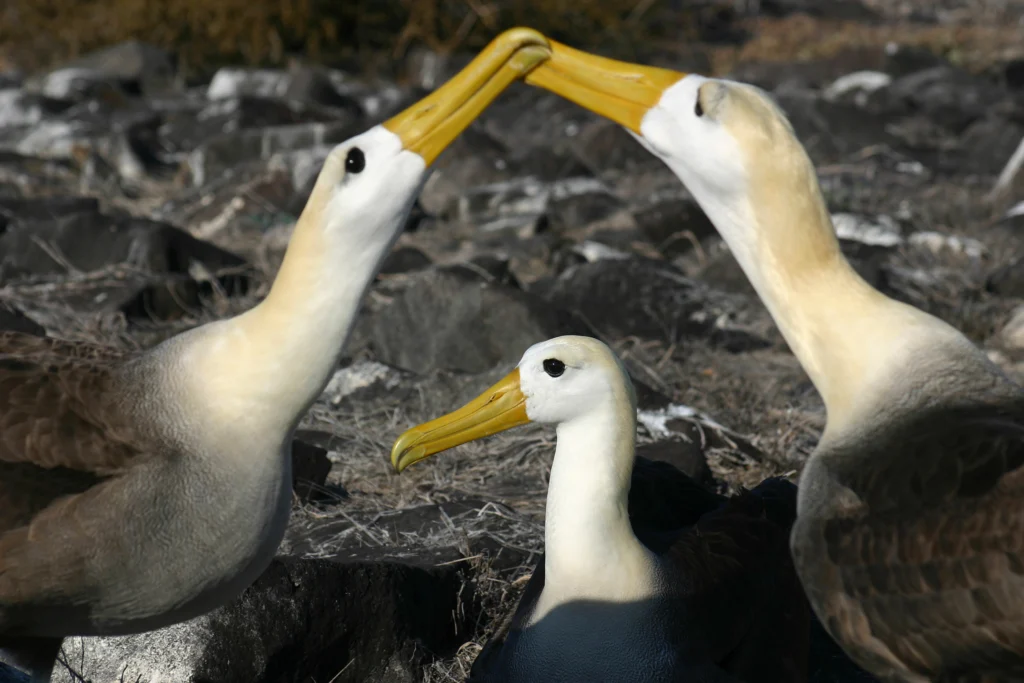
For the past four years, ABC has been working with the Moloka’i Land Trust, the U.S. Fish and Wildlife Service (USFWS) Coastal Program, and other partners to study seabirds at the site and design a plan for the construction of a predator-proof fence at Mokio Preserve that will allow seabirds such as the Laysan Albatross, Wedge-tailed Shearwater, and other species to colonize the site. A temporary fence to keep out deer has enabled native plant restoration to take root over the majority of the site. A key part of this work: getting research scientists, such as those at Maui Nui Seabird Recovery Project and the U.S. Geological Survey (USGS), to consult on methods to establish baseline data and monitor restoration results. Acoustic monitoring systems, called song meters, were set up in 2016 to determine if nocturnal seabirds were present.
“There had been a few detections of Wedge-tailed Shearwaters on song meters, suggesting they were in the area, but no successful nesting until now. This is a direct benefit of protecting the site,” says Hannah Nevins, ABC’s Seabird Program Director. “This is great news and lends more urgency to getting the fence built as soon as possible.”
Coastal habitats in Hawai’i and around the world are also threatened by sea level rise, development, and overuse. Restoring coastal ecosystems provides resiliency that can help buffer sea level rise and maintain or improve the health of corals and fish populations, as well as habitat for endangered species. Increasingly, conservation fences designed to keep out invasive predators are being used to speed up coastal ecosystem recovery. While the fences keep out animals as small as invasive mice, gates allow human access for study, and, where permitted, recreation such as fishing and sightseeing.
“Mokio is a special place and it has been phenomenal to see the transformation from a degraded area, dominated by nonnative kiawe (a tropical mesquite tree) to primarily native coastal strand habitat with blooming native species carpeting the ground,” says Butch Haase, Executive Director of Moloka’i Land Trust, who has been leading the effort to protect this site since 2010. “It is possible now to stand in the middle of the preserve and see only native species and ocean, giving people a chance to experience what Hawai’i used to be like. It is our hope that seeing this restored land will inspire others to do the same elsewhere across our islands.”
Seabirds are a critical part of coastal ecosystems. As top-level marine predators, they bring nutrients from the ocean to their nests. In turn, their droppings fertilize coastal plants and nearshore waters. Recent research has shown that islands with healthy seabird populations have healthier corals and fish populations near them. A recently published study also calculated that nutrients deposited via seabird feces constitute an ecosystem service valued at $473 million annually, and over $1 billion when secondary benefits (valued at $650 million) are added.
Invasive predators such as rats, mongooses, and cats are the leading cause of seabird declines. Excluding these animals with specially designed fences is a proven tool to restore seabird colonies.
The Mokio-Anapuka Restoration Site is the result of a partnership between ABC, Moloka’i Land Trust, Maui Nui Endangered Seabird Recovery Project, USFWS, USGS, and the Hawai’i State Department of Land and Natural Resources, Maui-Nui Native Ecosystem Protection and Management team.
ABC is grateful to the following supporters for making this project possible: United States Fish and Wildlife Service Coastal Program, Science Applications Program, and the Partners Program; the David and Lucile Packard Foundation; Lynn and Stuart White; the BAND Foundation; and the Sacharuna Foundation.