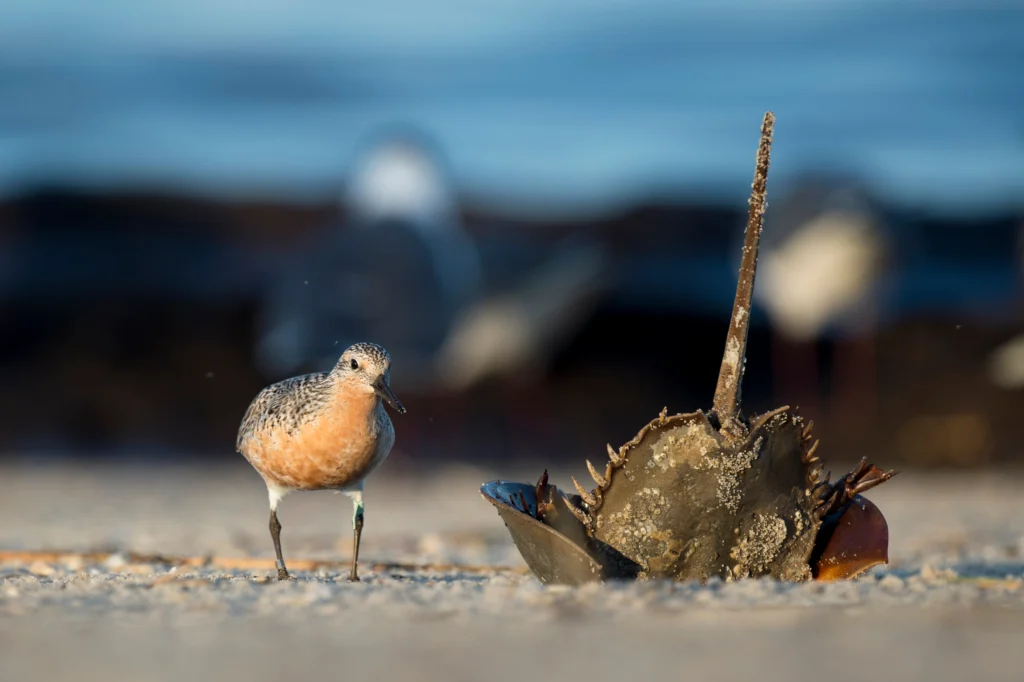
Amid all the noise and headlines related to the federal government’s reopening, the horseshoe crab and birds that rely on it — including the federally Threatened Red Knot — have quietly claimed a victory. Among many provisions in the U.S. Congress’ continuing resolution is one instructing the Food and Drug Administration (FDA) to update its 2012 endotoxin testing guidance to accept synthetic methods. Once the guidance is updated, it could help to reduce the harvest of horseshoe crabs for their blood, a practice that has led to the deaths of thousands of horseshoe crabs annually.
American Bird Conservancy (ABC) has led efforts advocating for this policy change. While the language is not binding, it is a meaningful directive from Congress to the FDA to act. Since the 1970s, the biomedical industry has used horseshoe crab blood in medical safety tests that ensure therapies, such as vaccines, injectable drugs, and implantable devices, are free from dangerous bacterial endotoxins. Horseshoe crabs are in decline across their range on the Atlantic coast, and the harvest for biomedical use puts additional pressure on the species — as well as on shorebirds, which rely on abundant, nutritionally dense horseshoe crab eggs to fuel their migrations each year.
Fortunately, synthetic testing alternatives that are proven safe and effective are available and do not require the harvest of horseshoe crabs. Biomedical companies are interested in adopting synthetic methods, but FDA guidance has lagged.
“The recovery of the Red Knot is a top priority for ABC,” said Annie Chester, Policy Director for ABC. “Wider acceptance and subsequent adoption of synthetic methods could help reduce the biomedical harvest of horseshoe crabs, which would mean more horseshoe crabs, and their eggs, left in the environment, benefiting Red Knots and other shorebirds as well as marine species.”
The report language follows action taken earlier this year by the U.S. Pharmacopeia (USP), which sets standards used by the pharmaceutical industry. The USP approved new guidance for manufacturers on how to use synthetic endotoxin testing methods. This, along with longstanding acceptance of synthetic methods in Europe, and movement in other countries, underscores the timeliness of this report language and the need for the FDA to act.
“It’s time,” said Brian Brooks, Vice President of Advocacy and Threats Programs for ABC. “Synthetic alternatives are cost effective, readily available, and don’t contribute to the decline of horseshoe crabs and the species that rely on them. ABC has worked on this issue for many years and urges the FDA to follow the report language and update its guidance – a necessary step to recover these species.”