Antioquia Brushfinch

Atlapetes blancae

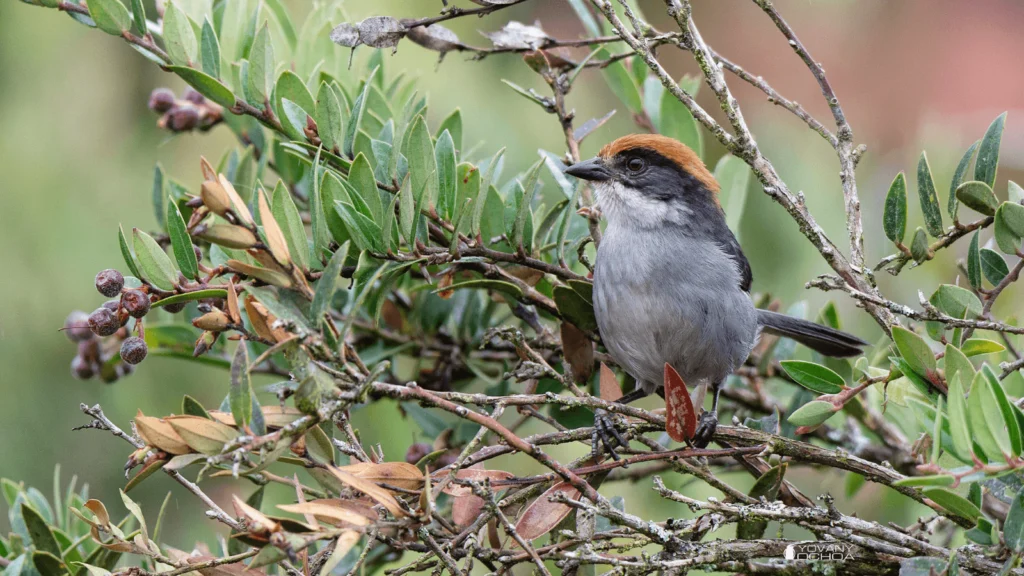
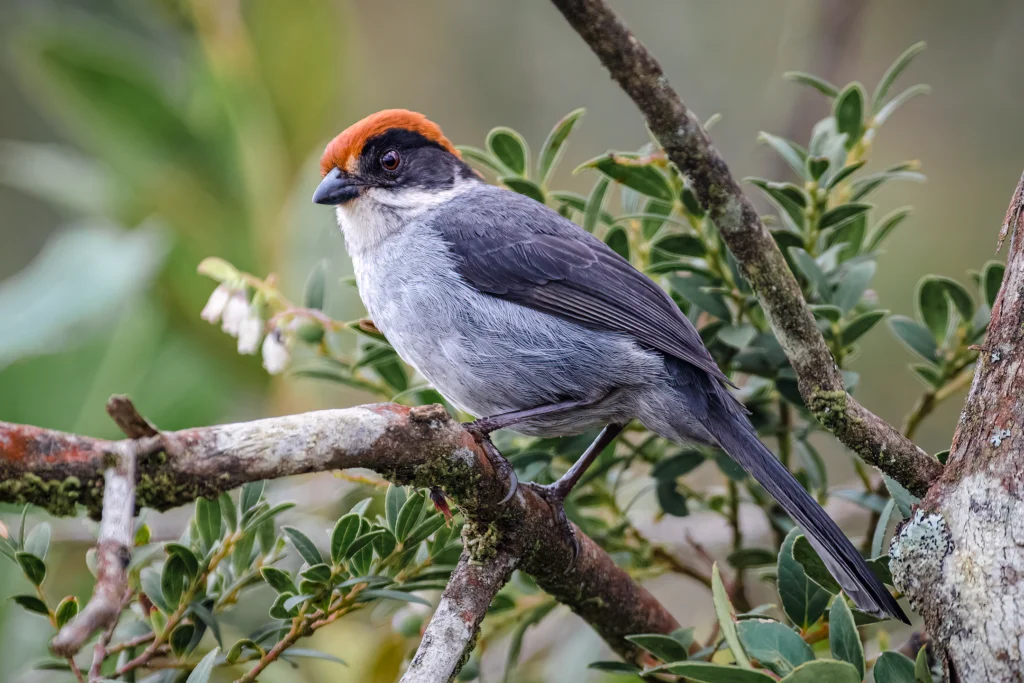
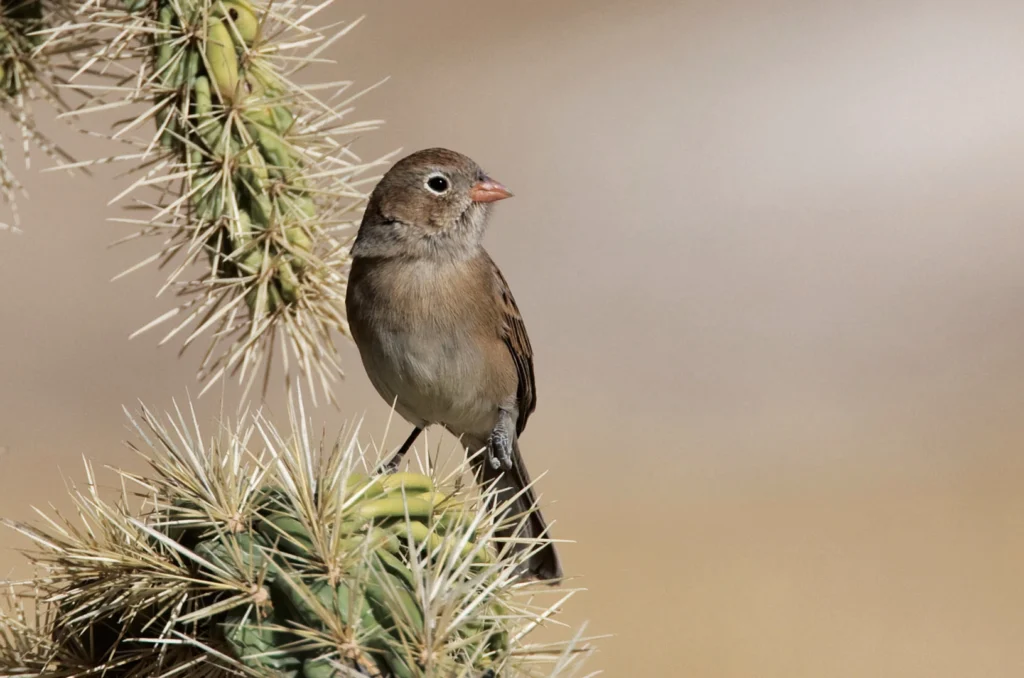
Antioquia Brushfinch. Photo by Yovanny Ochoa.

Antioquia Brushfinch

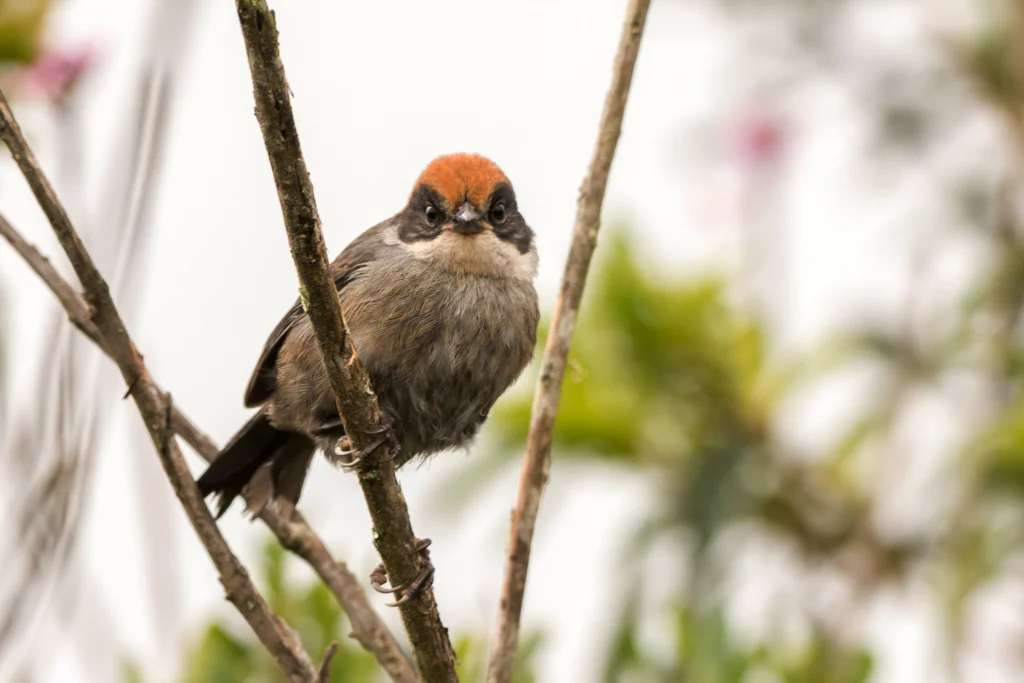
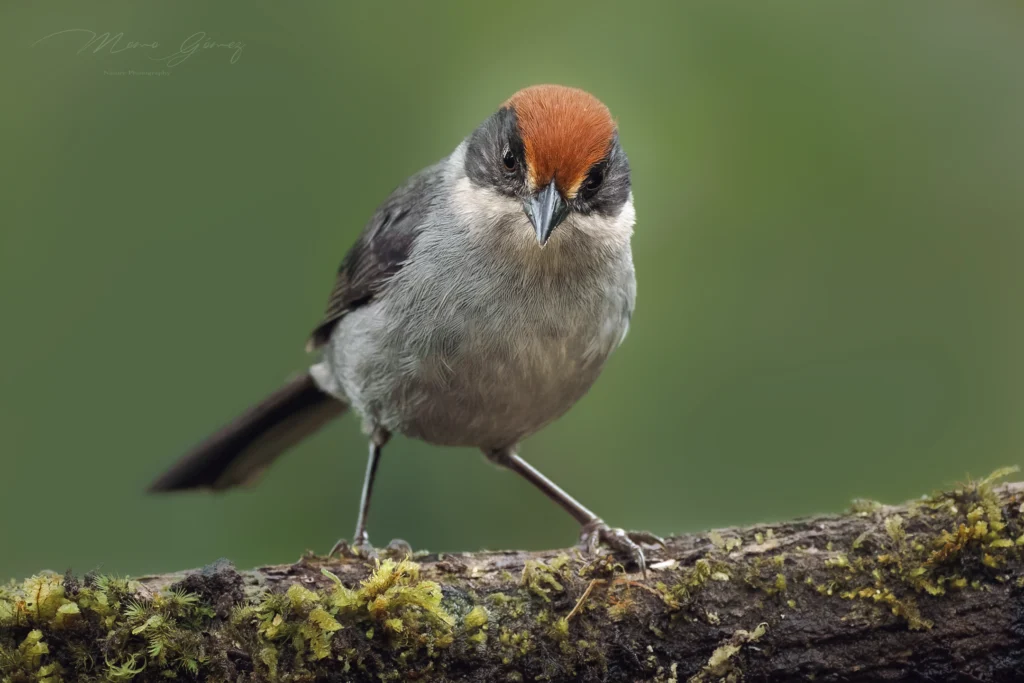
Antioquia Brushfinch. Photo by Yovanny Ochoa.

Atlapetes blancae

Overview

Conservation Status
Population Trends
Decreasing
Population Size
109 individuals
Family
Sparrows
Location
South America
Migration Pattern
Nonmigratory
Migration Distance
Nonmigratory

About

The Antioquia Brushfinch was first described in 2007, but only on the basis of three museum specimens. A live bird was not found in the field until 2018, when an unfamiliar brushfinch was spotted by a keen-eyed agronomist on his way to weekly Mass on the outskirts of Medellín, Colombia.

The Antioquia Brushfinch belongs to a group of large sparrows found in humid mountain forests from Mexico south to Argentina. Its species name, blancae, refers to the bird’s pale underparts. It also refers to the Colombian lepidopterologist Blanca Huertas, the wife of ornithologist Thomas M. Donegan, who described the new bird.

This recently rediscovered relative of Ecuador’s Pale-headed Brushfinch joins the ranks of some of the rarest birds in the Western Hemisphere, including the Blue-eyed Ground-Dove, Marsh Antwren, and Cherry-throated Tanager.

Threats

Birds around the world are declining, and many of them are facing urgent, acute threats. This is especially true of range-restricted species with small populations, like the Antioquia Brushfinch. But all birds, from rare, recently discovered species such as the Antioquia Brushfinch to more familiar backyard birds, are made more vulnerable by the cumulative impacts of threats like habitat loss and climate change.

Habitat Loss

Little native habitat remains for the Antioquia Brushfinch, which can be found only in small patches of native scrub in what is now mostly pastoral countryside outside of Medellín. Seventy-three percent of the land where it was first discovered has been converted to cattle pasture, and the remaining habitat is under severe threat of conversion for pasture and cropland.

Habitat Loss

Cats & Invasive Species

The Antioquia Brushfinch may be vulnerable to predation by outdoor cats. Its nests are at risk from invasion by the Shiny Cowbird; like the related Brown-headed Cowbird, this bird lays its eggs in other birds’ nests, often to the detriment of the host parent’s own young.

Cats & Invasive Species

Climate Change

A changing climate presents a suite of often unpredictable threats to birds: extreme weather events, droughts, habitat loss due to rising sea levels, and intense heat are just a few ways climate change puts birds at risk.

Climate Change

Conservation Strategies & Projects

ABC is working with the local community to protect priority lands for the Antioquia Brushfinch. Three searches supported by ABC and organized by local partner Corporación SalvaMontes have helped pinpoint important areas for Antioquia Brushfinch protection and allowed for more accurate population estimates.

Creating & Maintaining Reserves

In 2021, ABC supported efforts of Corporación SalvaMontes, which signed conservation agreements with landowners to protect a total of 351 acres of habitat. That same year, ABC helped partner Fundación Guanacas expand the existing Gaunacas Reserve through the purchase of three parcels where the Antioquia Brushfinch had been observed, totaling 239 acres.

These and other partner efforts on working lands will create habitat corridors that enable isolated Antioquia Brushfinch populations to connect — ultimately enhancing the species’ viability and prospects for long-term survival.

New Reserve in Colombia will Protect Critically Endangered Antioquia Brushfinch

Lost Birds

ABC continues to support and join local researchers in the search for remaining Antioquia Brushfinch habitat and to identify areas suitable for protection. This work is part of ABC’s larger effort to rediscover and conserve “lost” bird species.

Lost Birds

Stopping Cat Attacks

Cats make wonderful companions, but they’re safest (and birds are, too) when they’re kept indoors or under the control of their owners. ABC advocates for responsible cat ownership, encouraging millions of pet owners to take steps to keep their cats contained and advocating for policies that benefit birds, cats, and human health.

Domestic Cats Kill 7 Million Birds in Colombia Each Year, According to First-of-its-Kind Study

Bird Gallery

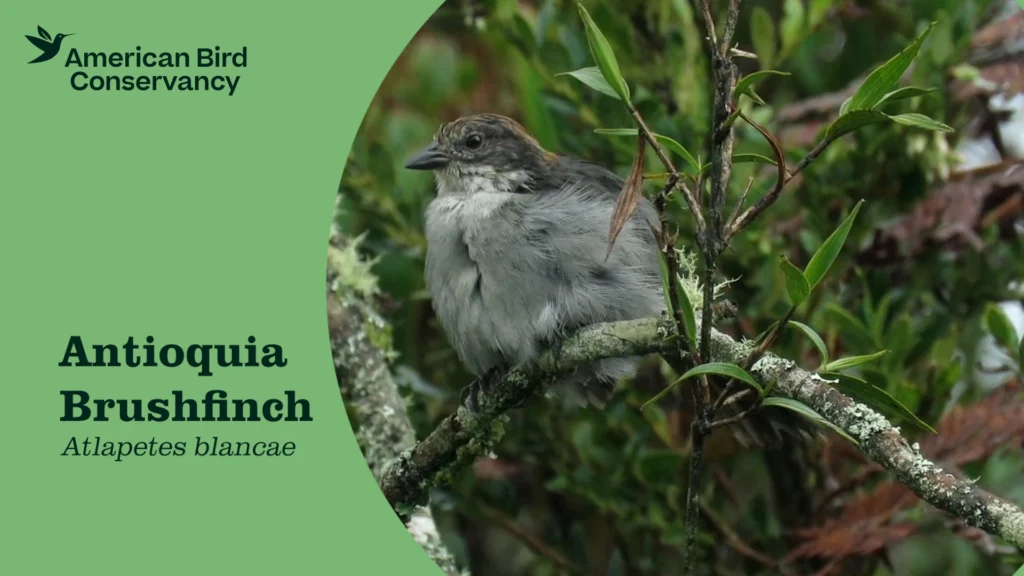
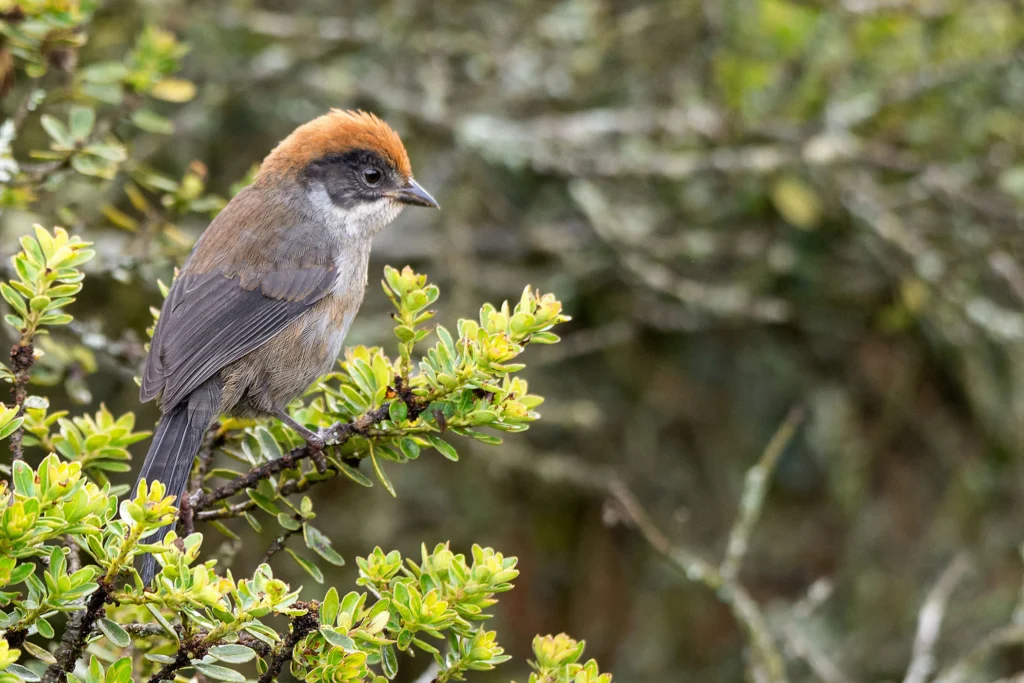
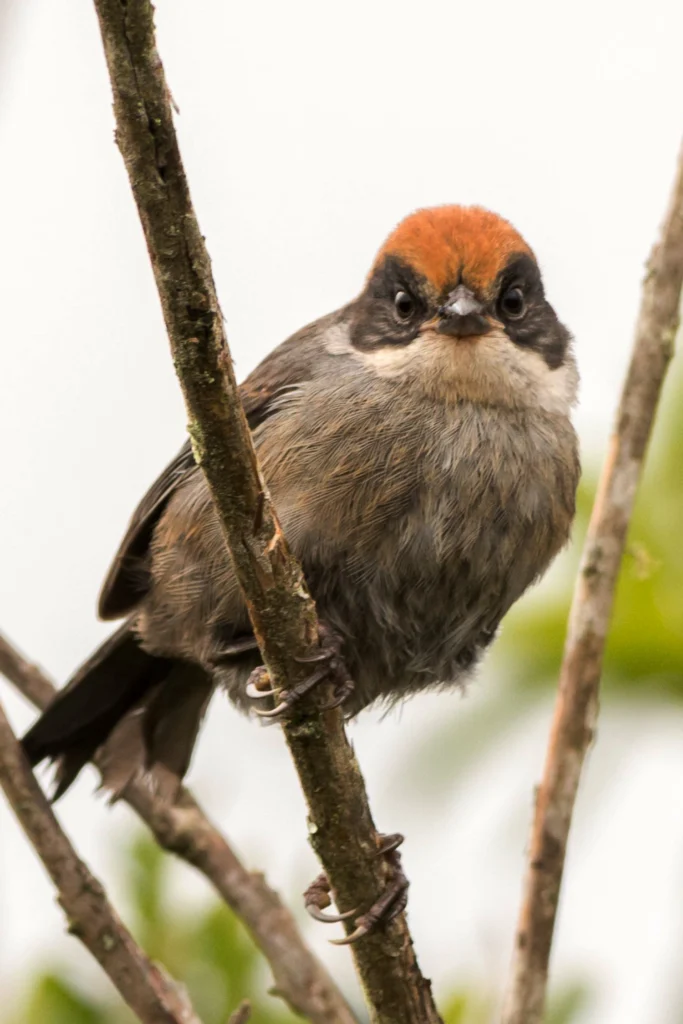
The Antioquia Brushfinch is a large sparrow, about the size of an Eastern Towhee. It has light gray underparts, a darker gray back and wings, a white throat, and a contrasting black mask around the eye. Distinctive field marks are its rusty crown and light reddish-brown lores (the area between the base of the bill and the eye). Its legs and bill are black, and the eye is reddish-brown. Males and females look alike. Juveniles are similar to adults but have duller coloring on the crown and mask.

At first glance, the Antioquia Brushfinch resembles the more widespread Slaty Brushfinch, but that species is generally a darker gray.

Sounds

The male Antioquia Brushfinch’s song is a rapid series of squeaky, buzzy trills, sung from the top of a shrub or small tree. Only the male sings. This bird’s soft, short calls, given by both sexes, are described as tzzzz … tzzzz.

Song

Antioquia Brushfinch by Edwin Munera; Cornell Lab of Ornithology | Macaulay Library

Call

Antioquia Brushfinch by David Dorini; Cornell Lab of Ornithology | Macaulay Library

Habitat

The Antioquia Brushfinch is most frequently found in the lower layers of shrubby habitats.

  • Inhabits small, shrubby native trees and bushes, Páramo (high-altitude open habitat of native ferns, grasses, and shrubs), and backyard gardens.

Range & Region

Specific Area
Colombia

Range Detail
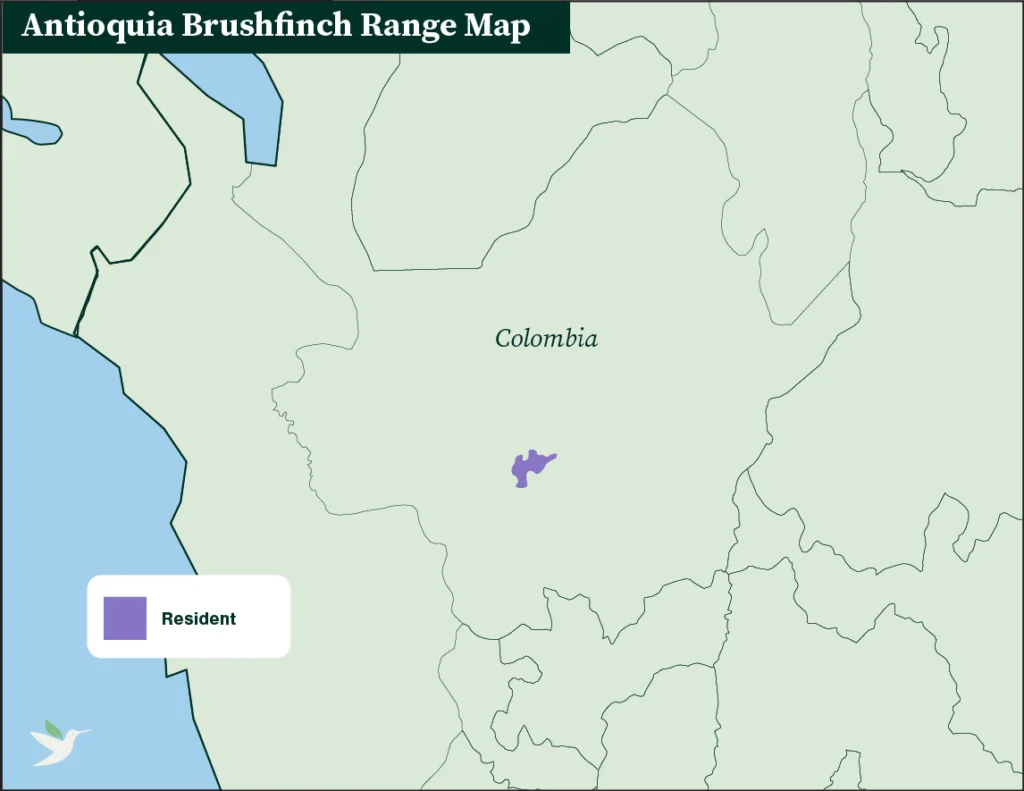
The Antioquia Brushfinch is restricted to the northern end of the Central Andes in Colombia. It’s found in countryside outside of Medellín, Colombia, in the area known as “Altiplano Norte de Antioquia.”

Did you know?
The Antioquia Brushfinch is usually observed in couples and sometimes in small family groups.

Range
South America
Migration Pattern
Nonmigratory
Migration Distance
Nonmigratory

Life History

Like other birds of its family, the Antioquia Brushfinch is relatively social, with members of a pair foraging together and staying in contact with high-pitched calls. Young birds often remain with their parents to form small family groups.

Diet

The Antioquia Brushfinch forages low in shrubby habitats or on the ground for small fruits, seeds, insects, and nectar. It feeds by pecking on the ground and gleaning insect prey from foliage.

Courtship

Although species-specific data is still being gathered, the Antioquia Brushfinch, similar to close relatives such as the Pale-headed Brushfinch, likely forms stable pairs that remain together year-round.

Nesting

The nest of this species is an open cup of grasses, built low in a thick shrub. The female likely does the majority of the nest building while the male guards her. A second clutch may be laid if the first attempt fails.

Eggs & Young

The only documented Antioquia Brushfinch nest had a clutch of two white eggs with reddish-brown spotting. The female likely does all the incubation, which lasts for a period of approximately two weeks. Both sexes feed the young after hatching. Fledglings associate with adults for several months to up to a year after leaving the nest.