

Do Hummingbirds Migrate?
Throughout the summer months, hummingbirds can be found across almost all of North America. The vast majority of hummingbirds fly to Mexico or Central America for the nonbreeding season.

Calypte anna
Colibrí Cabeza Roja (Spanish)
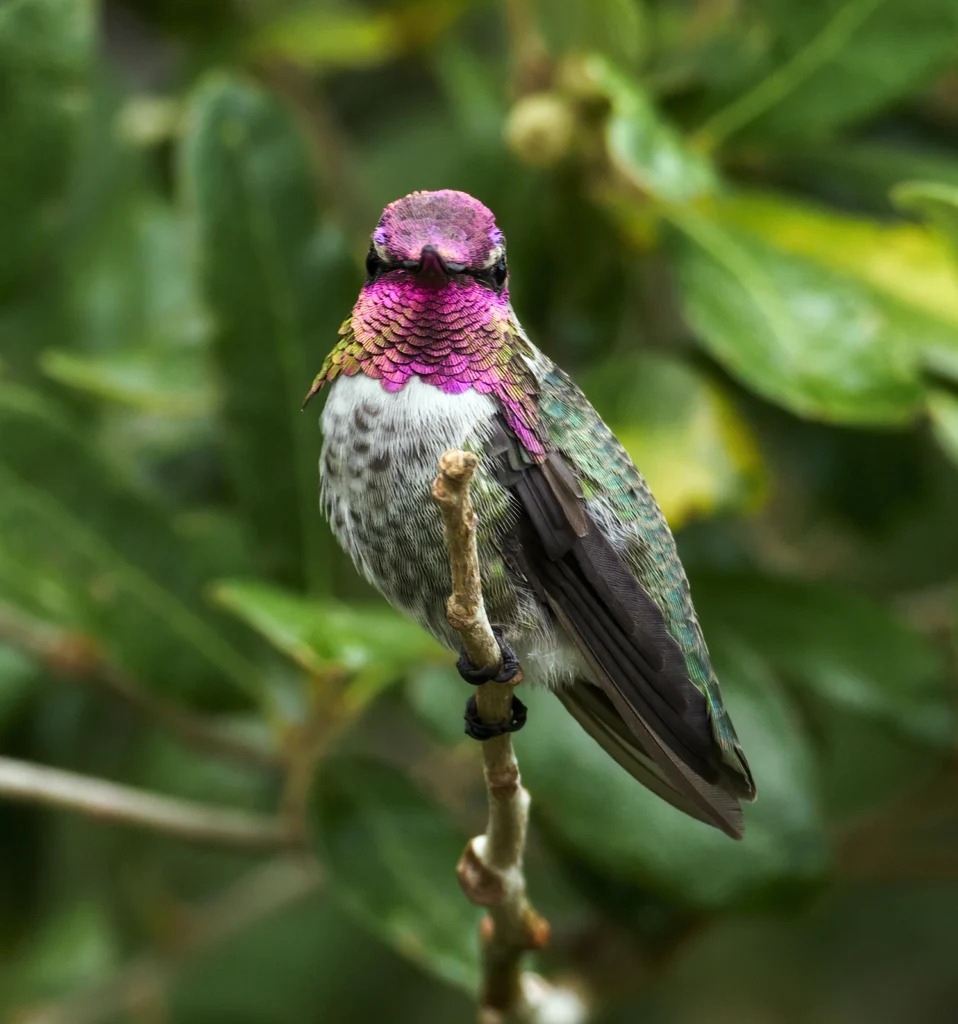
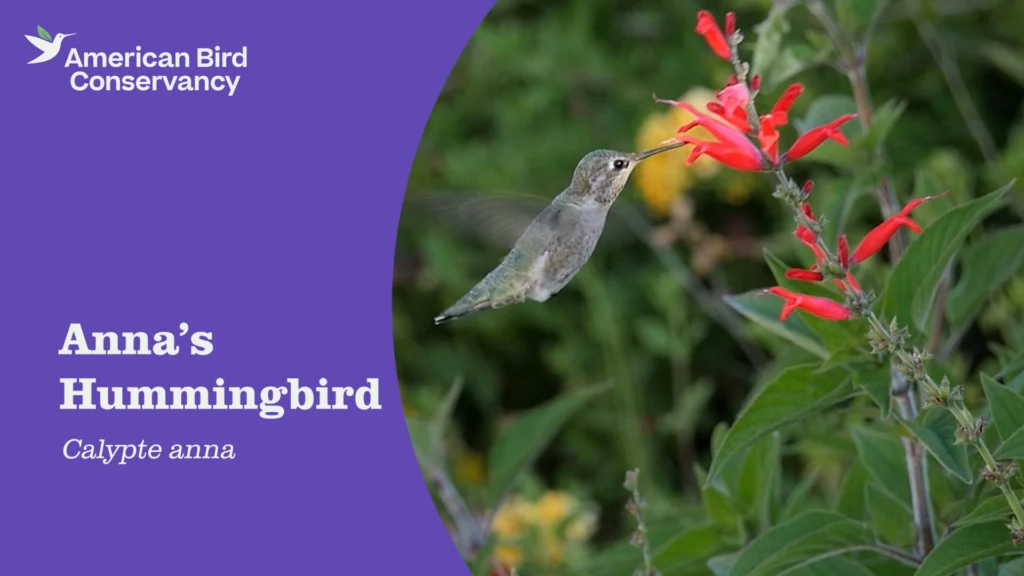
The Anna’s Hummingbird is a characteristic and charismatic species of coastal Central, Southern, and Baja California, although this species has expanded its range northward along the Pacific Coast and eastward into the Desert Southwest. Like the Rufous Hummingbird, Anna’s is well known for its aggressive territorial behavior. Males fiercely defend feeding areas, where they chase away other male hummingbirds and even large insects such as bumblebees and hawk moths that try to feed there.
Although the Anna’s Hummingbird readily feeds from non-native plants, wild plants are still crucial to these birds — and the birds are just as critical to these native plants. Anna’s Hummingbirds are important pollinators of the chaparral flora of coastal California. Many of these plants flower in the winter months, coinciding with California’s wet season. To take advantage of this boon of nectar, Anna’s Hummingbirds in coastal California breed in what is the nonbreeding season for most North American species, nesting as early as mid-December. After the rains end, many hummingbirds will move up into the mountains to take advantage of blooms at higher elevations.
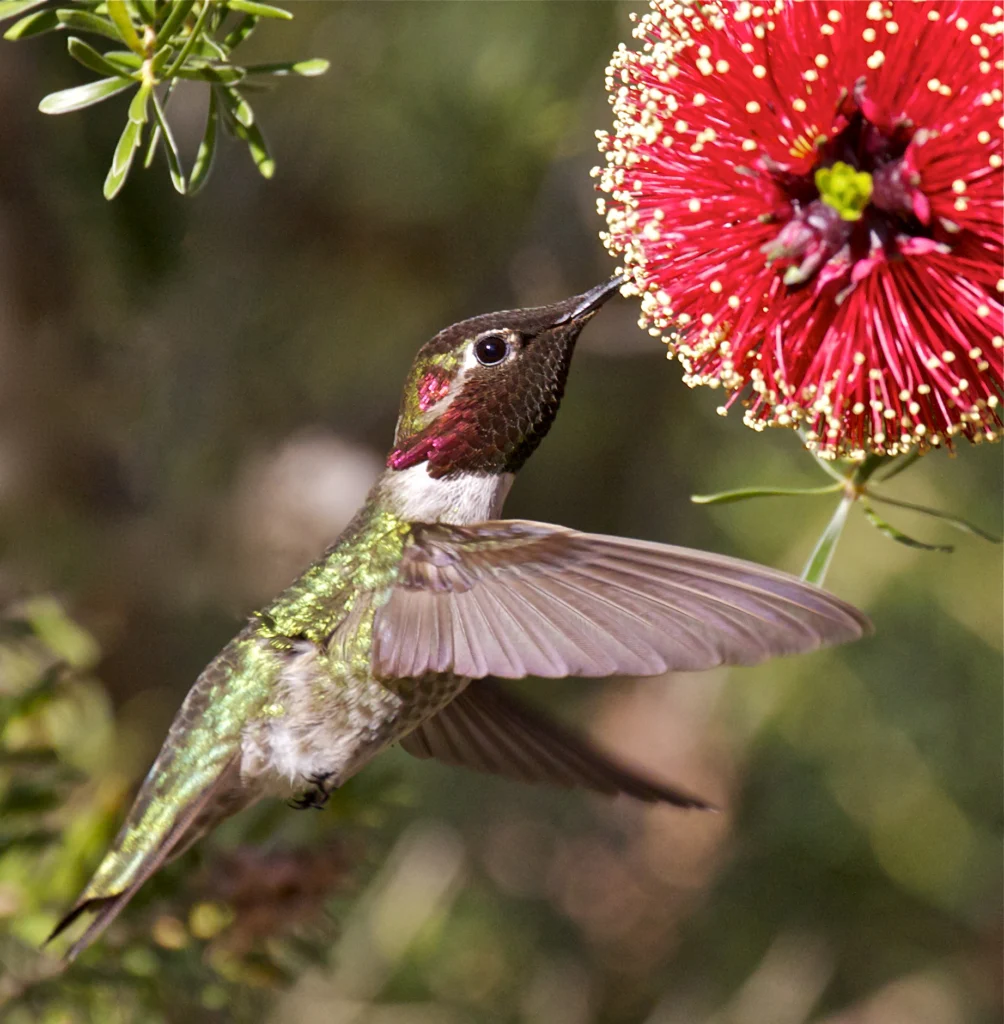
The Anna’s Hummingbird is a highly vocal species, especially for a hummingbird. Males sing a complex, scratchy-sounding song while perched and during their high-flying courtship spectacles. The male performs this diving display by first ascending to 100 feet or higher, then swooping toward the ground. At the bottom of his dive, he will be moving at about 60 miles per hour, just overhead of a female (or intruding male). At the last minute, he banks upward and flares his tail, causing his modified tail feathers to produce an explosive, high-pitched chirp. The gravitational force (“G-force”) caused by this maneuver would cause a human pilot to lose consciousness, but these little hummingbirds do it again and again, up to about 40 times back to back, when trying to impress a female. He also orients his dives to maximize the reflectance of his beautiful gorget — the gem-like patch of tiny iridescent purple-pink feathers on his throat. According to researchers Christopher Clark and Stephen Russell, from the perspective of a female, he looks like a “tiny, glowing magenta comet” plummeting towards her.
Birds around the world are declining, and many of them are facing urgent, acute threats. Even common and highly adaptable species like the Anna’s Hummingbird are vulnerable to threats from outdoor cats and untreated windows, especially around hummingbird feeders.
Outdoor cats are one of the leading human-caused drivers of bird population decline, killing billions of birds each year in the United States alone. Birds that use feeders, like Anna’s Hummingbird, are particularly vulnerable. Feeders are usually located in urban and suburban areas where there is a higher density of domestic cats. Furthermore, birds are often distracted by the social dynamics at these unnaturally large aggregations of feeding birds, and this is especially true for highly reactive species like hummingbirds.
Collisions take an enormous toll on birds. While collisions with reflective windows in city centers during migration take center stage, they are a year-round threat to birds, especially species that use urban and suburban resources like bird feeders. Hummingbirds are highly aggressive and extremely fast, and birds chasing each other near a feeder can easily lead to crashes and deaths.
Birds like the Anna’s Hummingbird need our help to overcome the threats they face. At ABC, we’re inspired by the wonder of birds and driven by our responsibility to find solutions to meet their greatest challenges. With science as our foundation, and with inclusion and partnership at the heart of all we do, we take bold action for birds across the Americas.
Cats make wonderful companions, but they’re safest (and birds are, too) when they’re kept indoors or under the control of their owners. ABC advocates for responsible cat ownership, encouraging millions of pet owners to take steps to keep their cats contained and advocating for policies that benefit birds, cats, and human health.
ABC has been a leader in the effort to reduce the devastating toll of glass collisions on birds. We’ve developed innovative methods for evaluating the effectiveness of collision deterrents, created resources to elevate our collective understanding of collisions and make solutions readily accessible, and advocated for bird-friendly policies in the U.S.
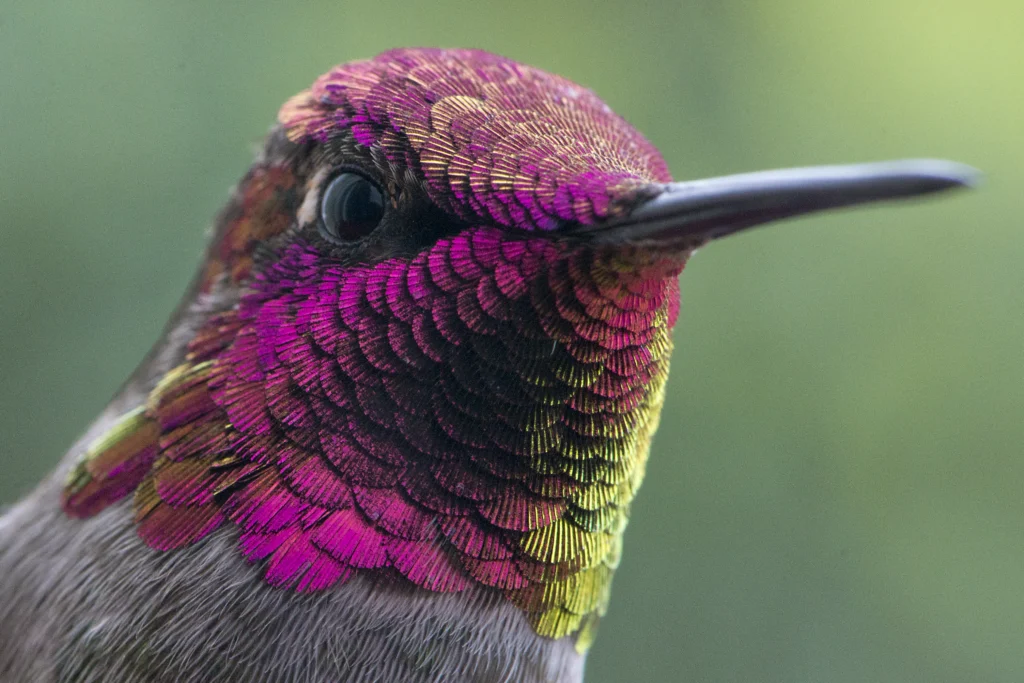
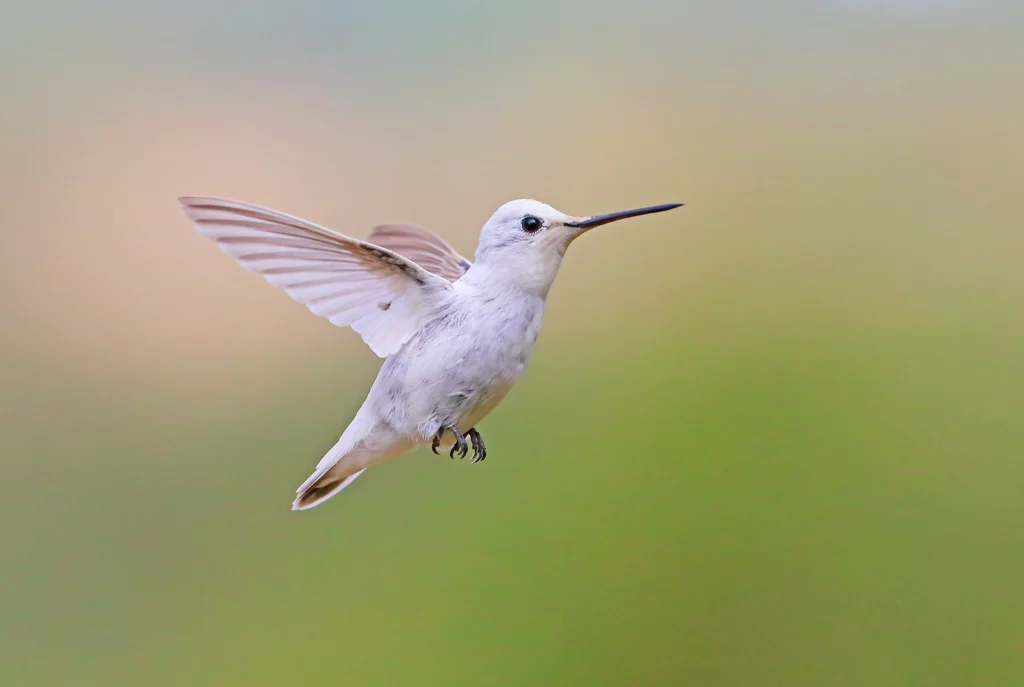
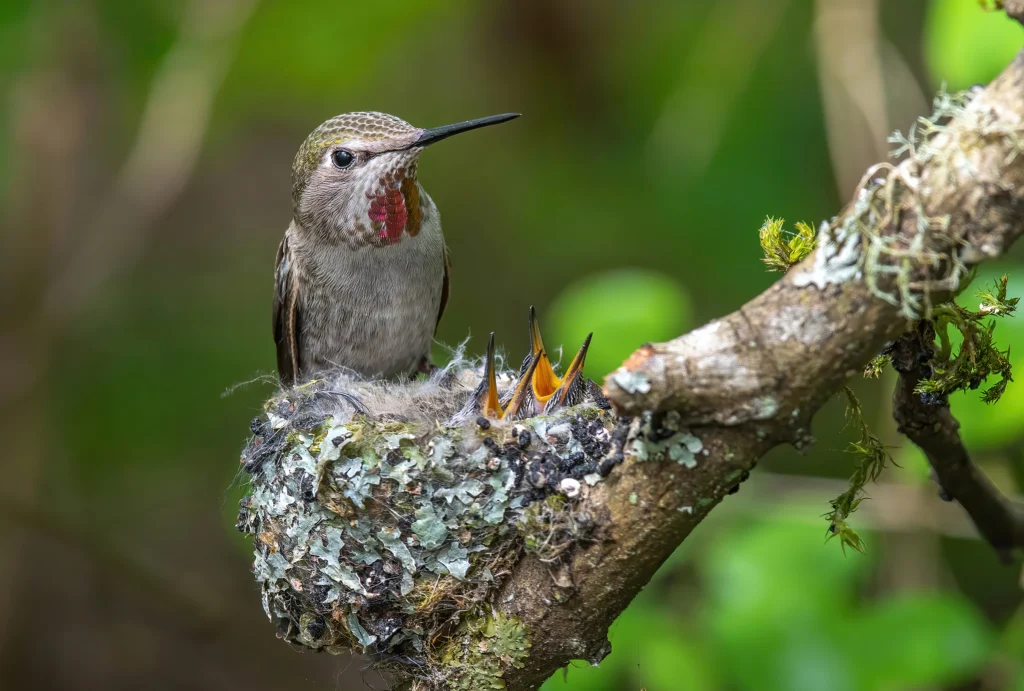
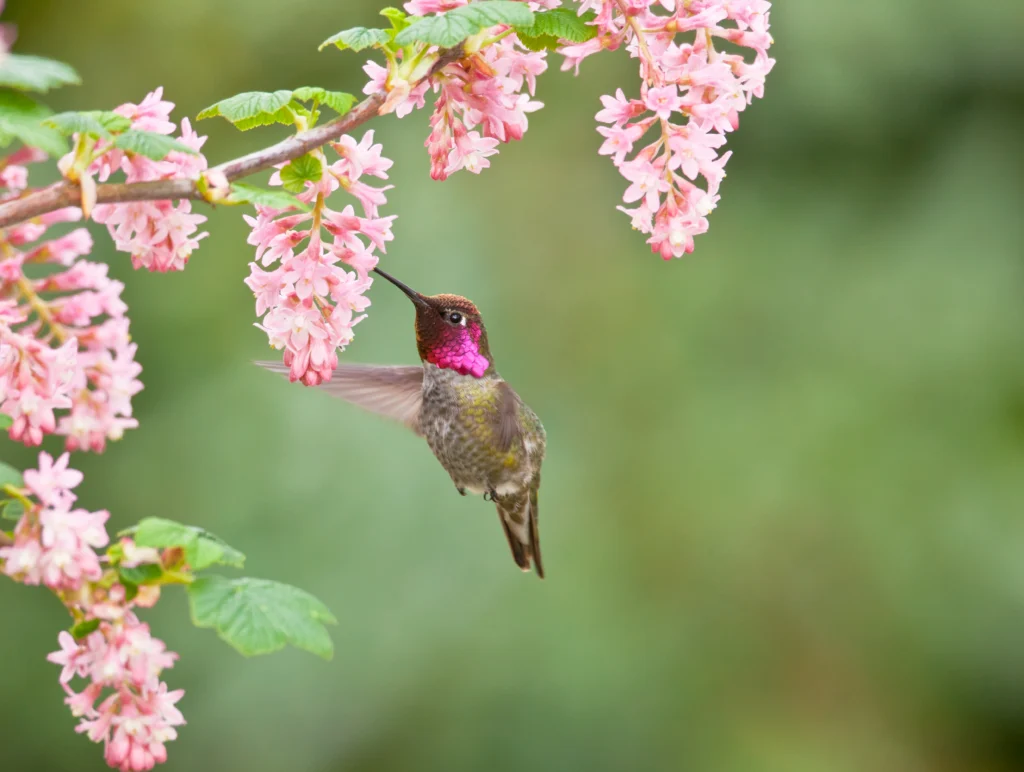
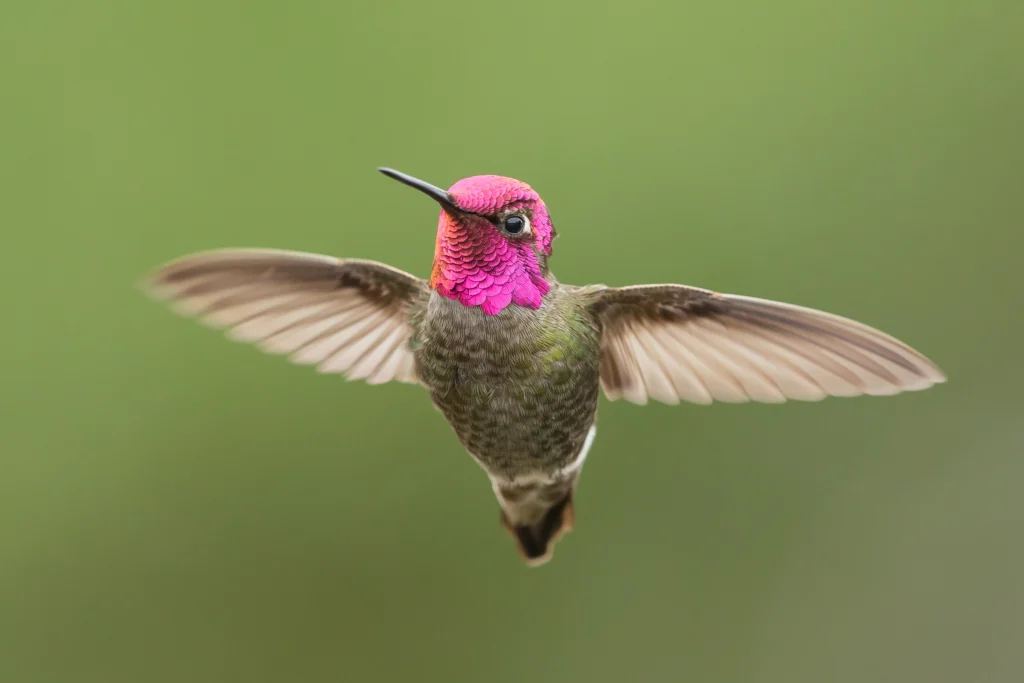
Hummingbirds are among the most strikingly colored animals, and with his shimmering iridescent magenta gorget, the male Anna’s is no exception. These highly reflective red-purple feathers extend down his throat and up over his head like a hood, abruptly transitioning to the iridescent teal to lime-green feathers of his back and tail. The breast and belly feathers are the same sheen of iridescent green, intermixed with more or fewer white feathers, creating a scaled pattern. The flight feathers on the wing are dark brown. Females and immature males are similar, but the gorget is replaced by a continuation of the white-green scaled pattern of the breast.
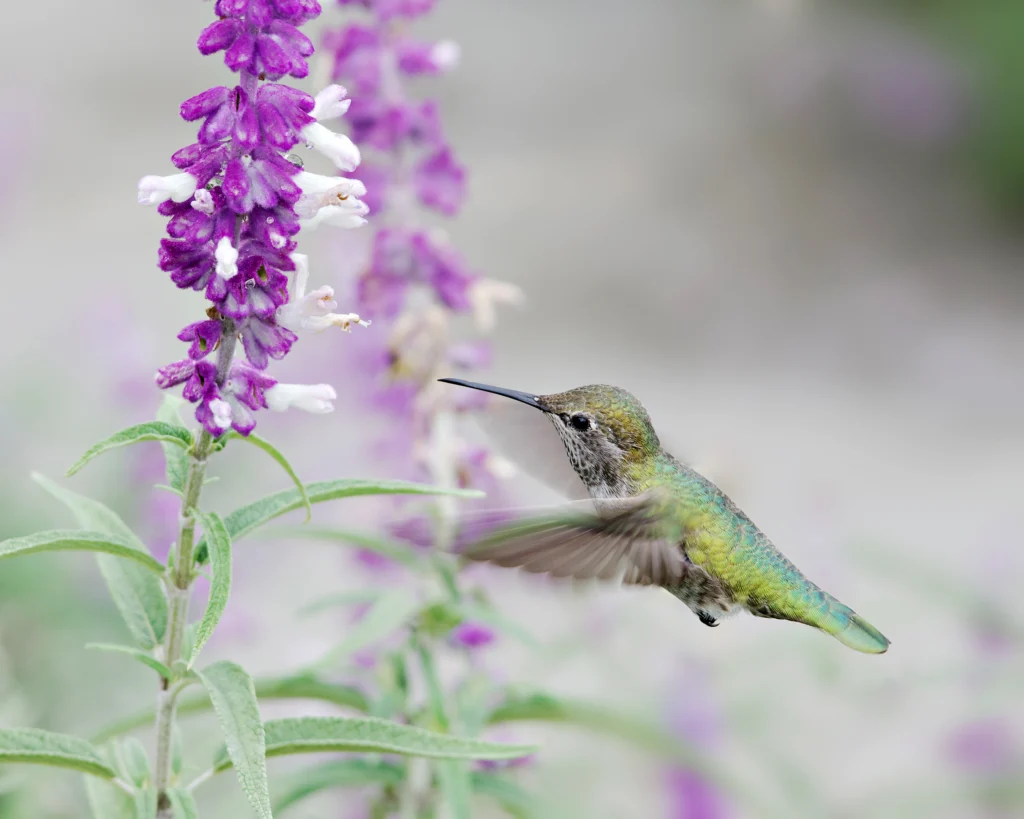
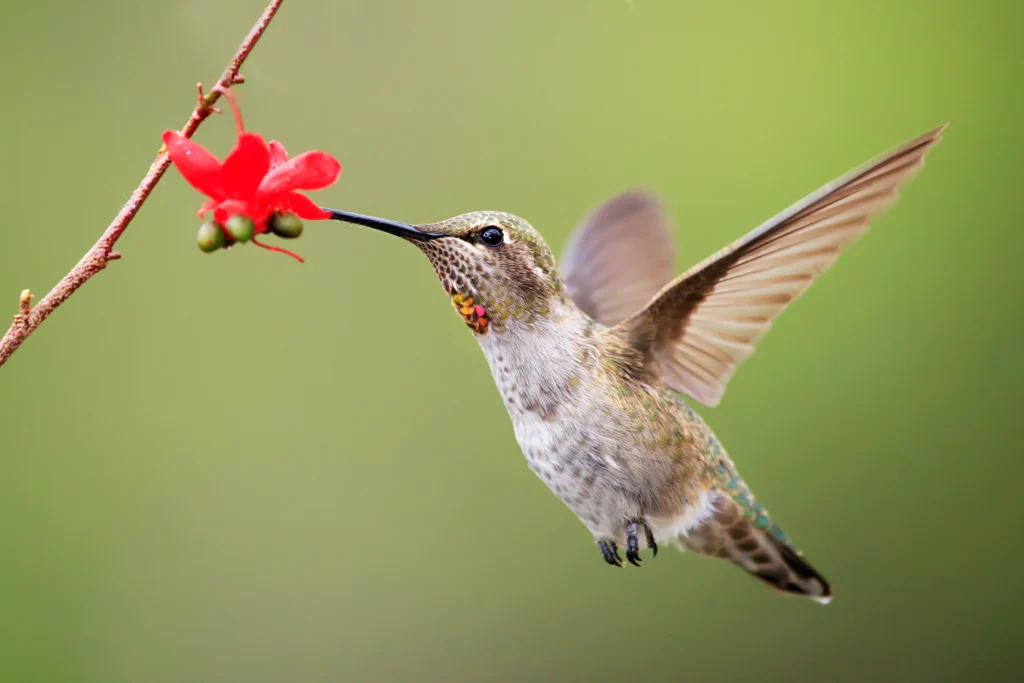
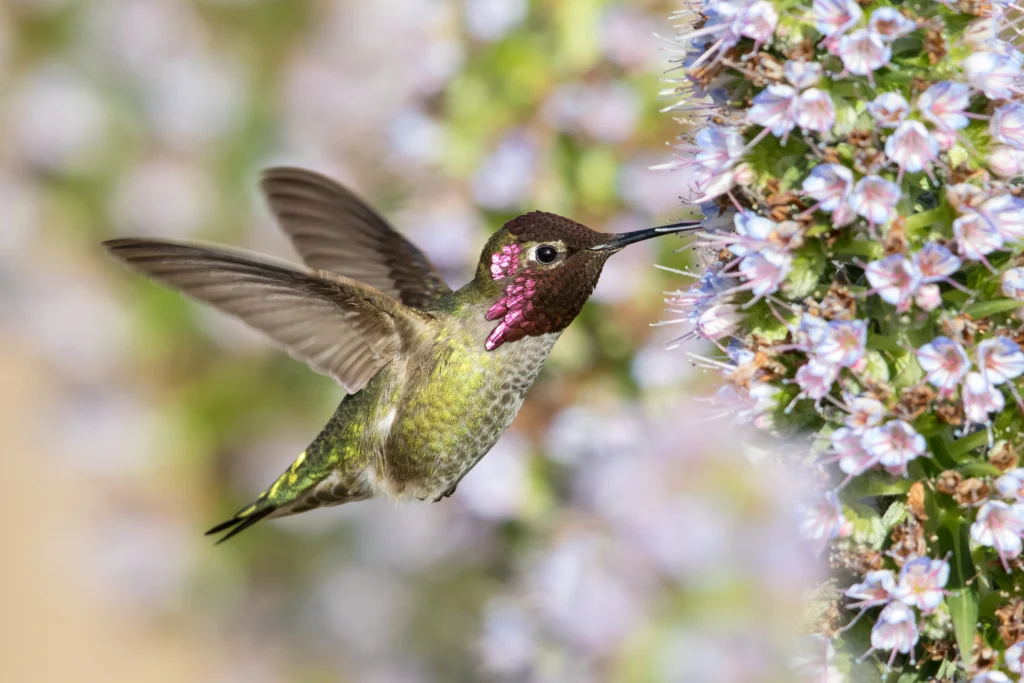
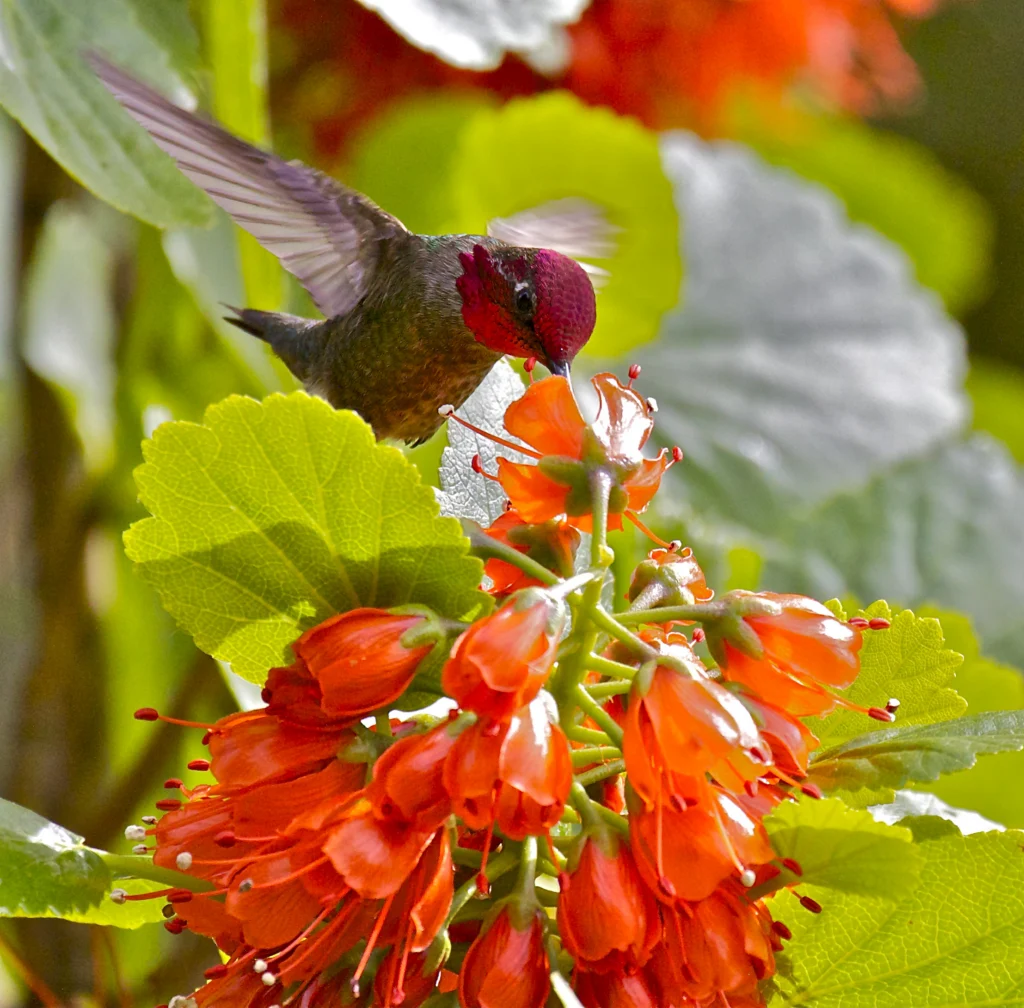
The Anna’s Hummingbird stands above many other hummingbird species in the complexity of their song. Rather than a few simple notes, male Anna’s sing a series of syllables with a distinctive scratchy or squeaky quality. Males also perform a dramatic flight display in which they produce an abrupt and surprisingly loud chirp at the bottom of a steep dive as air is forced through their tail feathers, which are adapted specifically to produce this sound. Males and females also give sharp percussive chip notes, sometimes strung together into “chatter calls,” and a low, buzzing wing whir.
Credit: Paul Marvin, XC453109. Accessible at https://xeno-canto.org/453109.
Credit: Ed Pandolfino, XC603659. Accessible at https://xeno-canto.org/603659.
Credit: Greg Irving, XC1077841. Accessible at https://xeno-canto.org/1077841.
The Anna’s Hummingbird most typically nests in woodland near open, shrubby habitat with blooming flowers. Nonbreeding birds will use essentially any habitat with sufficient blooming flowers or feeders.
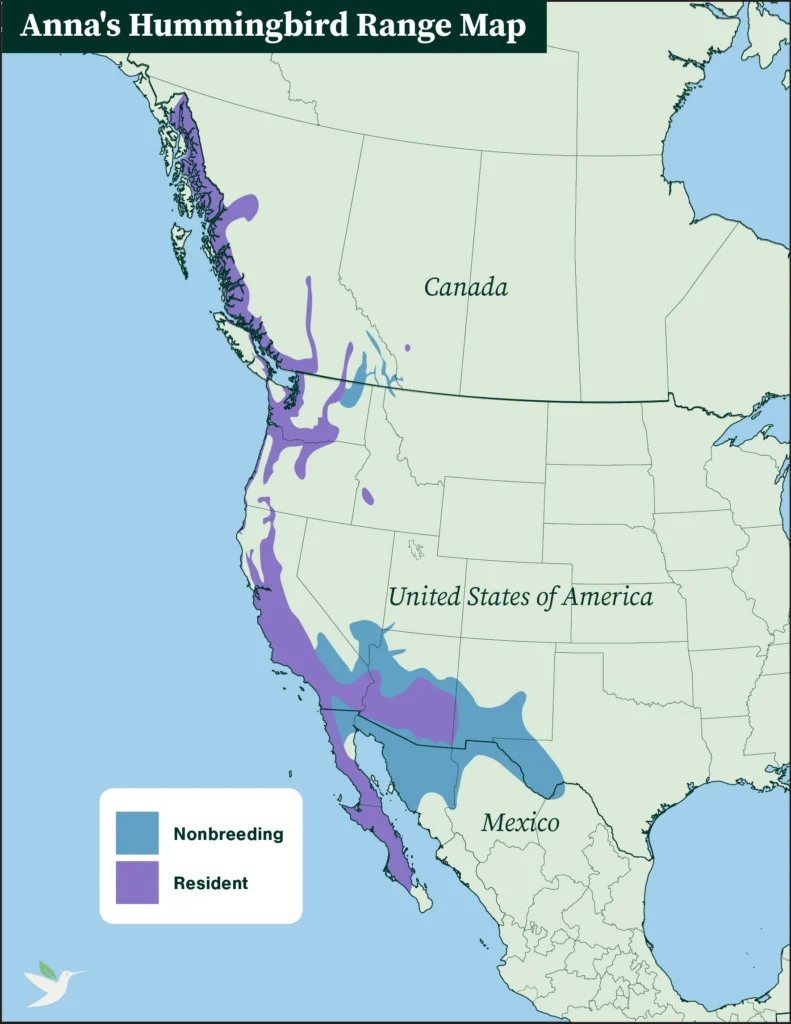
Specific Area
Western British Columbia to Baja California; Desert Southwest
Range Detail
Although they can occur from the Alaska coast to northern Mexico, Anna’s Hummingbirds are found mainly in California during their breeding season, where they are the most common hummingbird species. They are also found year-round along the Pacific slope of British Columbia, on the Channel Islands, and in Washington, Oregon, and southwestern Idaho. Seasonal movements are common and vary regionally, as different populations seek out food resources and follow favorable weather. The species is year-round in some areas, an elevational migrant in others, and birds range widely across the Southwest in the nonbreeding season, into northern Mexico and western Texas.
Did you know?
Previously confined to California and Baja California, the Anna’s Hummingbird has greatly expanded its range since the 1960s, thanks in large part to the proliferation of feeders and exotic flowering plants like eucalyptus species and tree tobacco (Nicotinia glauca).
The Anna’s Hummingbird is beautiful, abundant, and energetic, often seen buzzing loudly around ornamental trees and flowers or zipping past overhead. Many observant nature lovers in their range will have had the experience of being flashed by their fuchsia gorgets in a precise, directional reflection of the sun’s light — right into the faces of their targets.
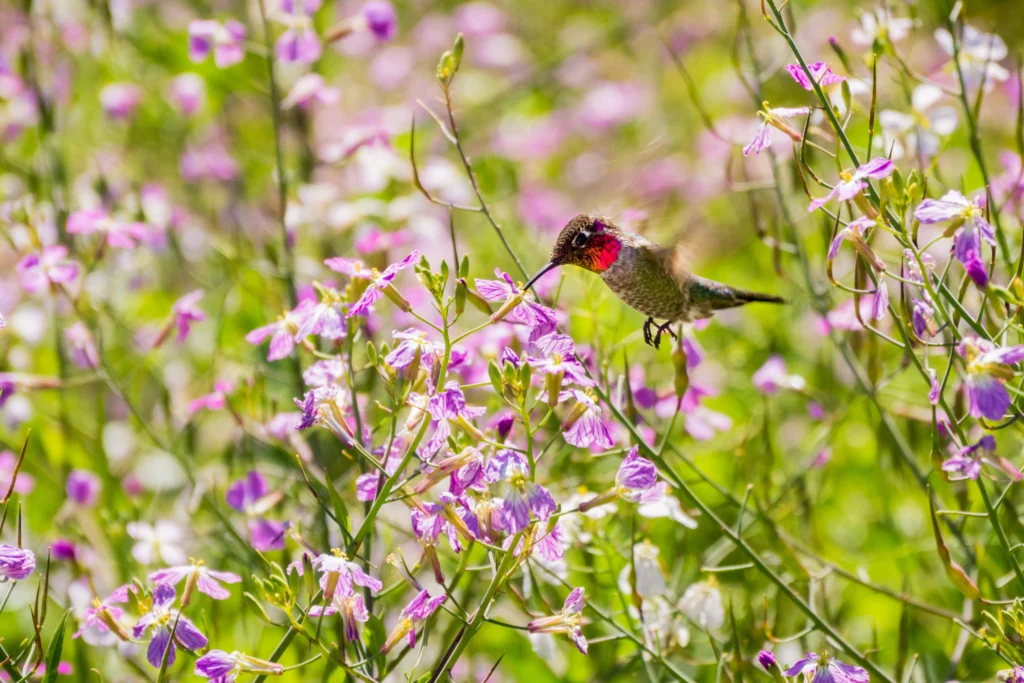
Anna’s Hummingbirds feed from a huge range of native and exotic flowers, but are especially fond of currant/gooseberry (Ribes) and sage (Salvia) in chaparral habitat, and Eucalyptus and tree tobacco (Nicotiana glauca) in developed areas. Aside from flower nectar and sap, Anna’s Hummingbirds take large quantities of insects. A nesting female can capture up to 2,000 insects a day, mostly small species like midges and leaf hoppers.
Courtship begins when a female enters a male’s territory, usually after having started to build a nest on her own. The resident male will then perform some combination of displays while she perches, chasing her if she flies. Aside from the dive display described above, a male will also sing and perform a “shuttle display,” flying back and forth in a small arc directly above her. The female assesses the male by his performance and decides based on this whether to mate with him.
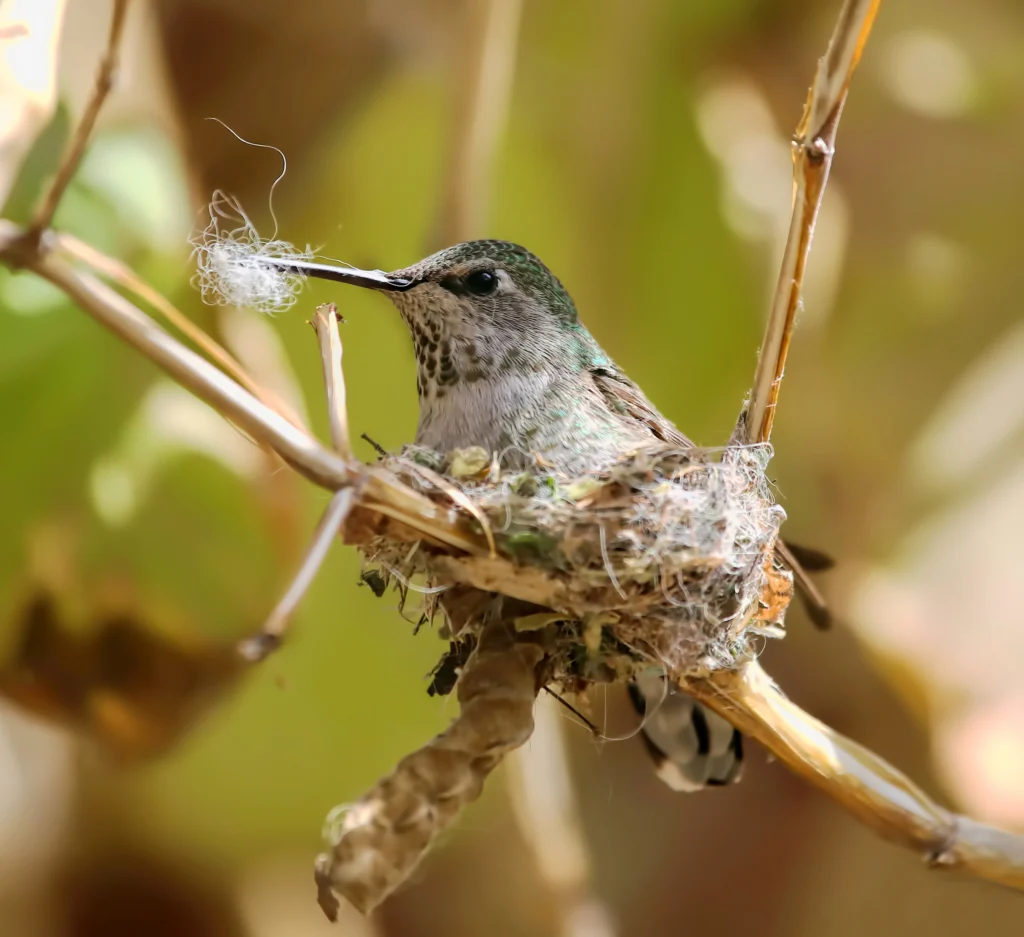
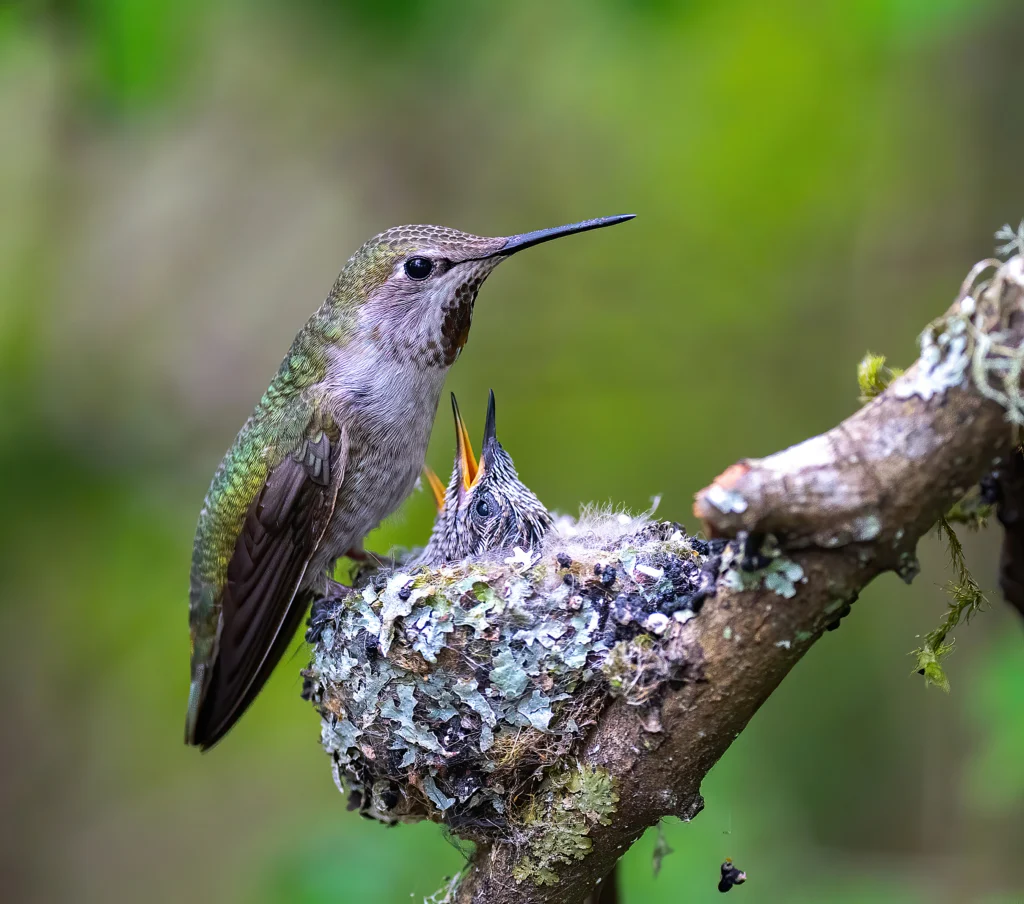
The female alone builds a tidy cup nest on a sheltered branch, which she will start before she has mated. The interior of the nest is made of soft, downy materials, such as cattail seeds, thistle down, feathers, and hair. The structure is bound together with flexible materials like spiderweb and lichen, which stretch to accommodate the growing young. Females decorate the outside of the nest to color match with the features of the branch it is built on, using materials like lichens, moss, or dead leaves.
As with most hummingbirds, only the female provides any parental care. Female Anna’s Hummingbirds lay two white, jellybean-sized eggs, which she incubates for 16 or 17 days. Nestlings hatch unfeathered and with eyes closed; naturalist D.R. Dickey described them as “black grubby caterpillars.” The young leave the nest after 20 to 30 days, and the female continues to feed them for a few more weeks.
Related News & Stories


Mi abuelita stood in front of her colorful ofrenda for Día de Muertos. Her long black braid swayed to the rhythm of her favorite song, "El Sirenito," by Rigo Tovar. She sang along as she carefully moved around the jarritos filled with atole, casuelas full of mōlli, and photos of her f...
Join the flock! Your donation helps preserve the habitats that birds need to survive.