
Create a Feeder-Free Hummingbird Paradise in Eight Steps
Discover ways to make your property attractive to hummingbirds by supplying natural elements like native plants that they require.

Pica hudsonia
Qalqaruq (Yup’ik)

More than most, the Black-billed Magpie is a bird that inspires strong emotions in humans. A familiar species across much of the West, the Black-billed Magpie is intelligent, adaptable, and bold. For these attributes, they are both admired and loathed. While considered an annoyance or an inconvenience by some, they are also highly social and will occasionally leave “gifts” for humans who feed them.
Like many other intelligent and opportunistic corvids, magpies will take advantage of whatever resources they can. As such, the Black-billed Magpie is probably best known as a scavenger of garbage, carrion, and poorly guarded picnics. This has given these birds a bad reputation, with many regarding them as pests. A common folk belief is that magpies will wound cows to eat their flesh or drink their blood. Magpies will, in fact, stand on the backs of cows to probe and peck. However, the goal is typically not to eat the cow itself, but the parasites on the cow, such as ticks, that are doing just that. Cows are not the only beneficiaries of this behavior — magpies will eat ticks off of other large mammals, including bison, moose, elk, and deer.
The Black-billed Magpie holds a special place in mythology as well. Magpies are recognized as messengers in numerous Indigenous cultures of North America, sometimes to the aid of humans, sometimes to carry news to the Creator. One widespread story tells of how the magpie, for helping humans and birds alike, was given the honor of “wearing the rainbow” — a reference to the iridescent sheen on this bird’s wings and tail.
Even widespread and common birds like the Black-billed Magpie are facing urgent threats. Though they are protected in the U.S. under the Migratory Bird Treaty Act and are no longer as widely persecuted as they once were, magpie populations have been in decline since the mid-1960s. Despite their adaptability, magpies are sensitive to habitat loss, particularly of the riparian areas where they nest. Pesticides can also impact magpie populations, and they still face persecution and lack protection in some places.
Black-billed Magpies are vulnerable to pesticides, including rodenticides, pesticide-treated seeds, and topical pesticides applied to livestock. With the latter, magpies ingest pesticides when eating parasites, including ticks, off the backs of cattle.
Though highly adaptable, Black-billed Magpies prefer to nest in dense vegetation, especially riparian thickets. When these habitats are lost or fragmented due to agricultural development or urban sprawl, magpies may not be able to nest successfully.
Even common backyard birds like the Black-billed Magpie need our help to overcome the threats they face. At ABC, we’re inspired by the wonder of birds and driven by our responsibility to find solutions to meet their greatest challenges. With science as our foundation, and with inclusion and partnership at the heart of all we do, we take bold action for birds across the Americas.
ABC works with partners at the state and federal levels in the U.S. to call for the regulation or cancellation of the pesticides and toxins most harmful to birds. We develop innovative programs, like working directly with farmers to encourage the use of seeds free of neonicotinoid coatings, advancing research into pesticides’ toll on birds, and encouraging millions to pass on using harmful pesticides.
The riparian areas where Black-billed Magpies nest are extremely important to a broad range of wildlife, providing food, breeding habitat, cover, and movement corridors for birds and other wildlife. By conserving these valuable habitats, we support a broad range of animals, from the Yellow Warbler to moose and bears.
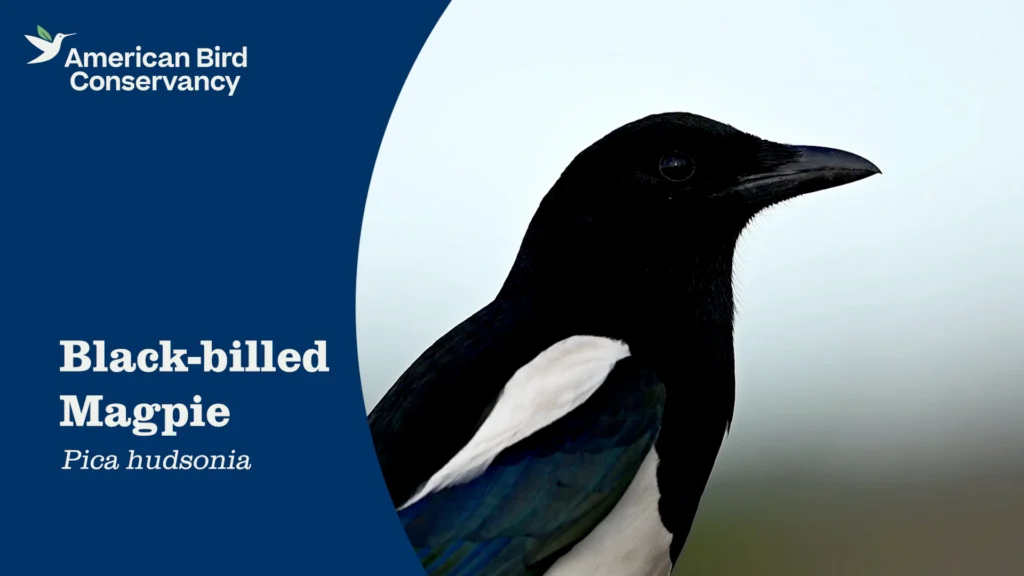
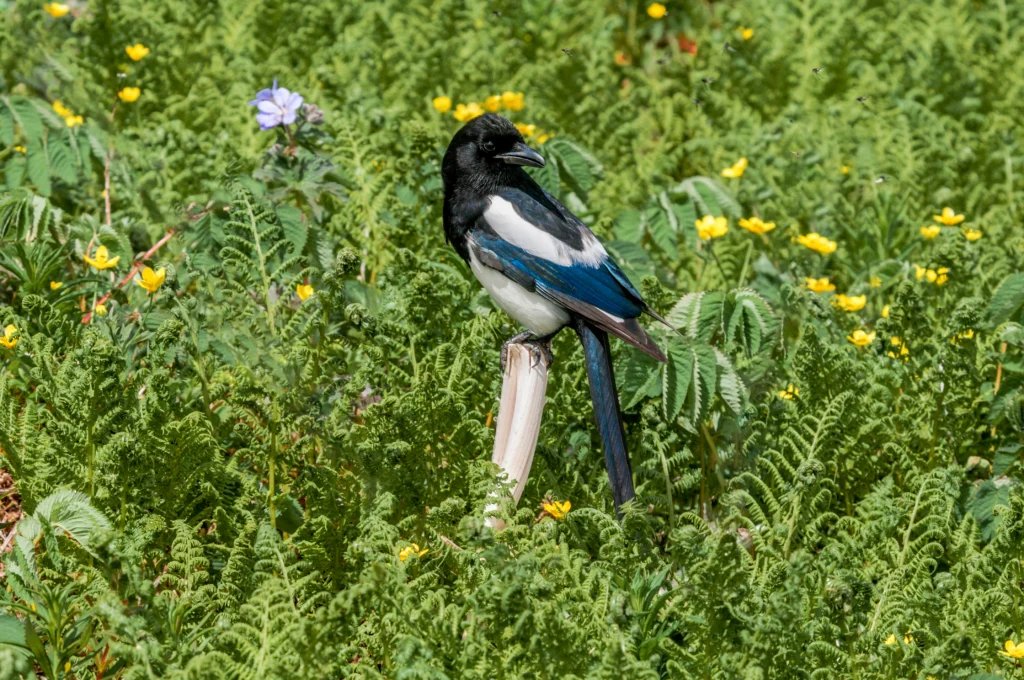
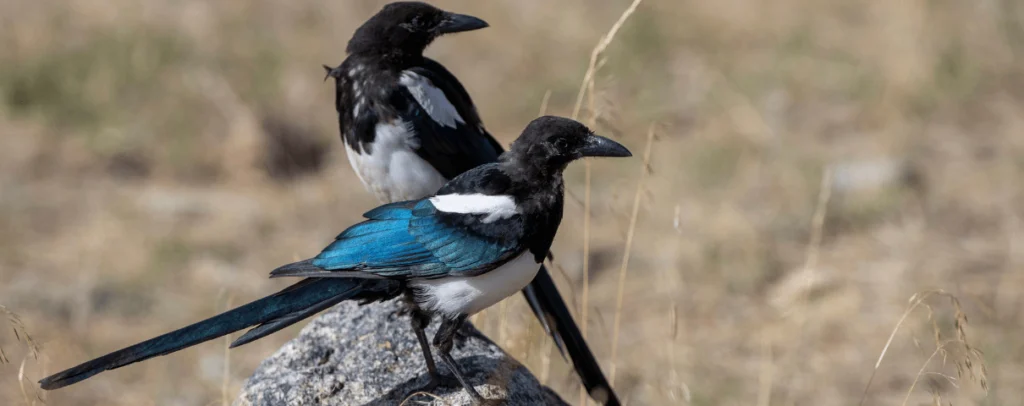
The Black-billed Magpie is instantly recognizable, with its bold black and white patterning, long tail, and graceful bounding flight. With an iridescent overlay on its wings and tail, you might think of this as a bird wearing a tuxedo with peacock flair. Magpies are mostly black, with broad white patches on the outer half of the wing and along the edge of the wing where it meets the body (the scapular feathers). The body below each wing is also white. This makes for a striking pattern of alternating black and white as this bird swoops in for a landing. The black wing and tail feathers are iridescent, showing metallic blue, green, or purple depending on the angle of light. Sexes are alike, and plumage does not change notably throughout the year. Juveniles are similar, though dingier overall, with less iridescence, and the whites and blacks are more muted.


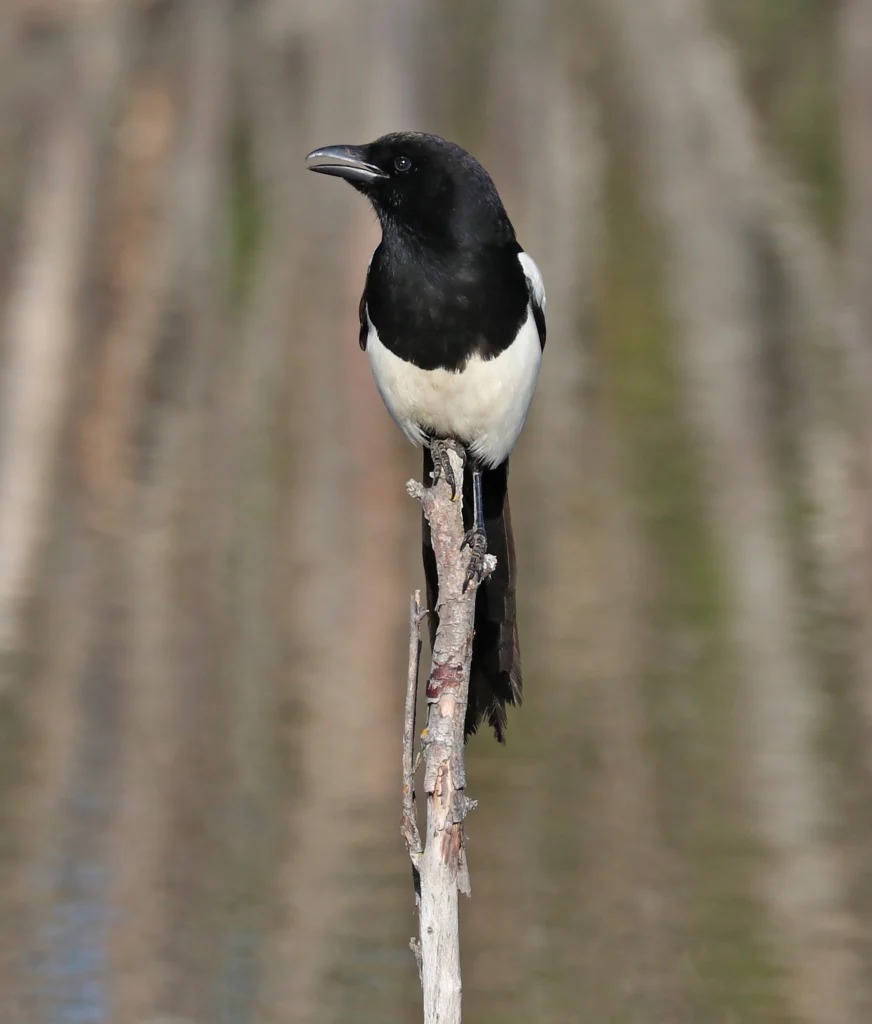
Like their relatives, the jays, ravens, and crows, Black-billed Magpies are extremely vocal, and their vocal repertoire is extensive and diverse. Magpies give a range of calls, from the simple, harsh repeated notes of their typical “chatter” alarm call, to complex, lengthy vocalizations that are generally considered to be a form of song, though they don’t appear to function the same as those of a typical songbird.
Credit: Yoann Blanchon, XC929924. Accessible at https://xeno-canto.org/929924.
Credit: Peter Ward and Ken Hall, XC614155. Accessible at https://xeno-canto.org/614155.
Credit: Jonathon Jongsma, XC254489. Accessible at https://xeno-canto.org/254489.
Black-billed Magpies occupy a wide range of developed and undeveloped habitats, but prefer open areas with dense cover available.
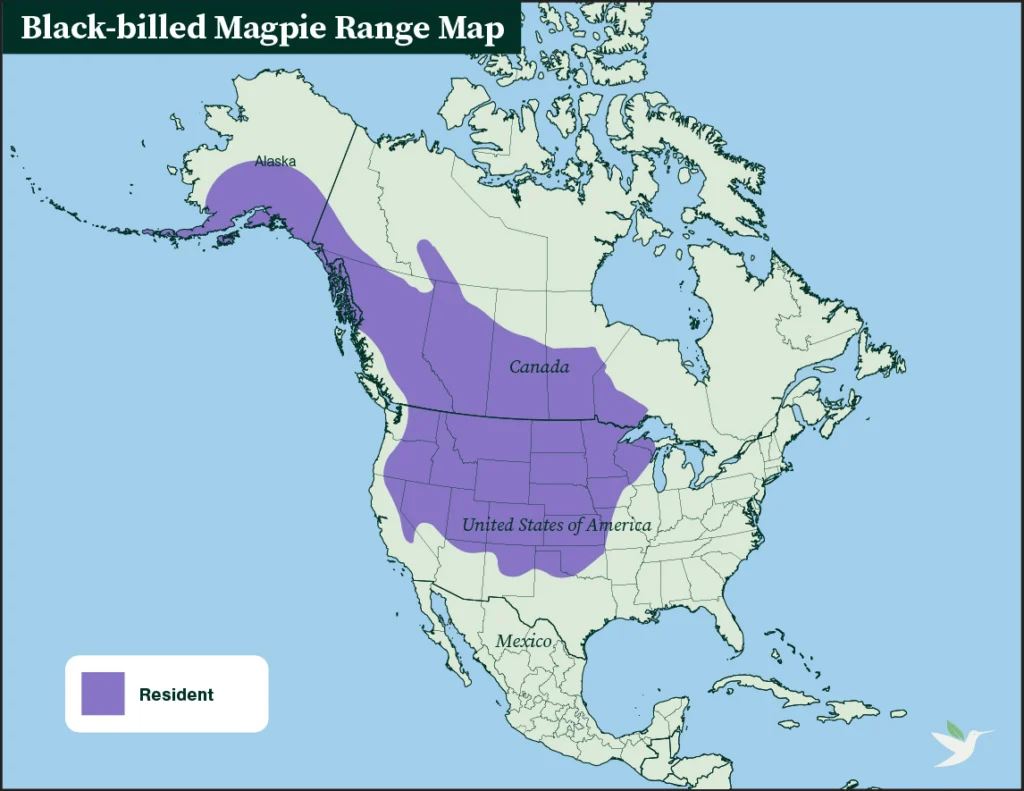
Specific Area
Southern Alaska, southwestern Canada, and western United States to the Great Lakes
Range Detail
The Black-billed Magpie inhabits open, dry country from the Alaska Peninsula and southern Alaska, south and east throughout the Great Plains, Rocky Mountains, and northern portions of the Desert Southwest. Though riparian areas are important, this species usually avoids forests, except when roosting. As such, the clearing of forested areas for settlement has opened up new habitat for these birds, especially in the Canadian boreal forest.
Did you know?
While Black-billed Magpies are very much a bird of open country, they will sometimes use dense woods for a very specific purpose. Similar to crows and ravens, magpies form communal roosts in the nonbreeding season, when they may seek shelter in the woods. These roosting aggregations can number up to several hundred individuals.
Black-billed Magpies are highly social and usually seen in pairs or groups. They are also quite vocal, and in the presence of a predator such as a fox or cat, will often be the first to alert other species — including humans, if they are paying attention. Magpies are also among the few species of animals known to hold “funerals,” although for this species, the occasion is more like a rowdy wake, with up to 40 birds calling loudly around the deceased for 10 to 15 minutes before silently flying off.
Black-billed Magpies eat mostly carrion, seeds, and arthropods, such as beetles and grasshoppers, which they hunt on the ground. However, they are highly opportunistic and will eat fruit, bird eggs and nestlings, and food discarded or left unattended by humans. Magpies are known to flip cow and bison patties to get at the beetles and larvae underneath, or to gorge on the fly maggots living on carrion, rather than the carrion itself. Magpies will even occasionally hunt small vertebrates such as mice and voles.
A male Black-billed Magpie performs a courtship dance that highlights the most striking features of his plumage. He circles the female with his body angled parallel to the ground and his tail raised and flared, flicking the white patches of his wings out sideways repeatedly. Females give begging calls (see Sounds above) to indicate their willingness to copulate, though this does not necessarily occur with any relation to male displays. Courtship feeding is also important to the pair bond, and a male will continue to feed his mate until she is done incubating their eggs.
The male and female choose a nest site and build together. Magpies are unusual among temperate North American birds in that they build globular or dome-shaped nests, large spherical structures of sticks that house an internal cup nest. Males and females each have their own role to play in nest construction, with the male responsible for the outer structure, and the female building the inner mud cup and lining it with softer materials like grass, stems, and rootlets. Magpies often nest in loose colonies within good habitat.
The female Black-billed Magpie lays up to nine eggs (though occasionally only one), and incubates them on her own for two to three weeks while her mate brings her food. Eggs have a pale gray to olive-brown background, with extensive darker spotting. Both parents feed the young, which remain in the nest for another three to four weeks before fledging. Both parents are strong defenders of their young and will vigorously defend against any intruder. In this, they are often assisted by neighboring magpies, together forming large raucous flocks in a behavior known as “mobbing.”
Related News & Stories for This Bird


Join the flock! Your donation helps preserve the habitats that birds need to survive.