Overview
About
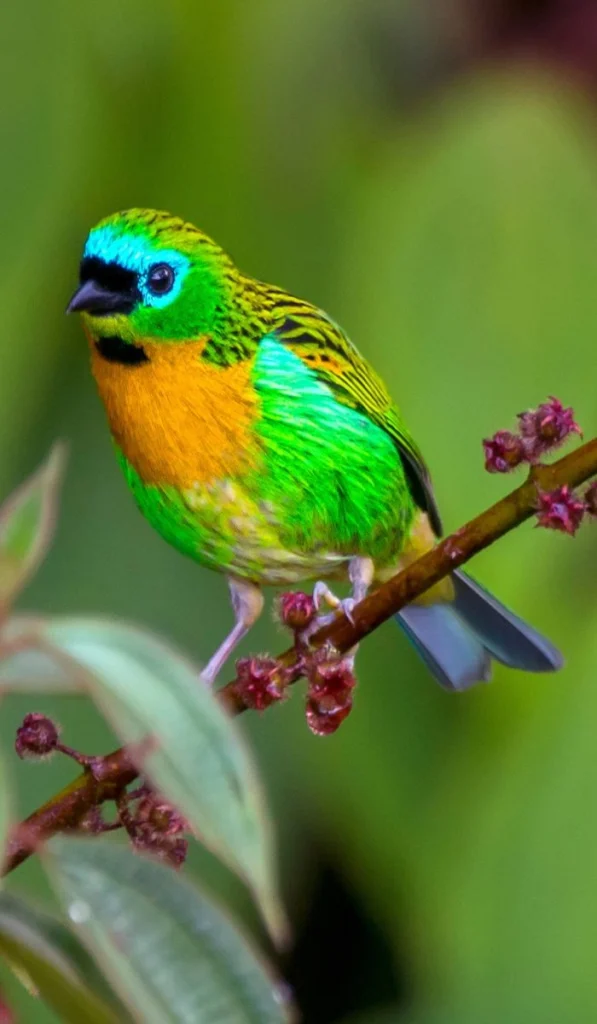
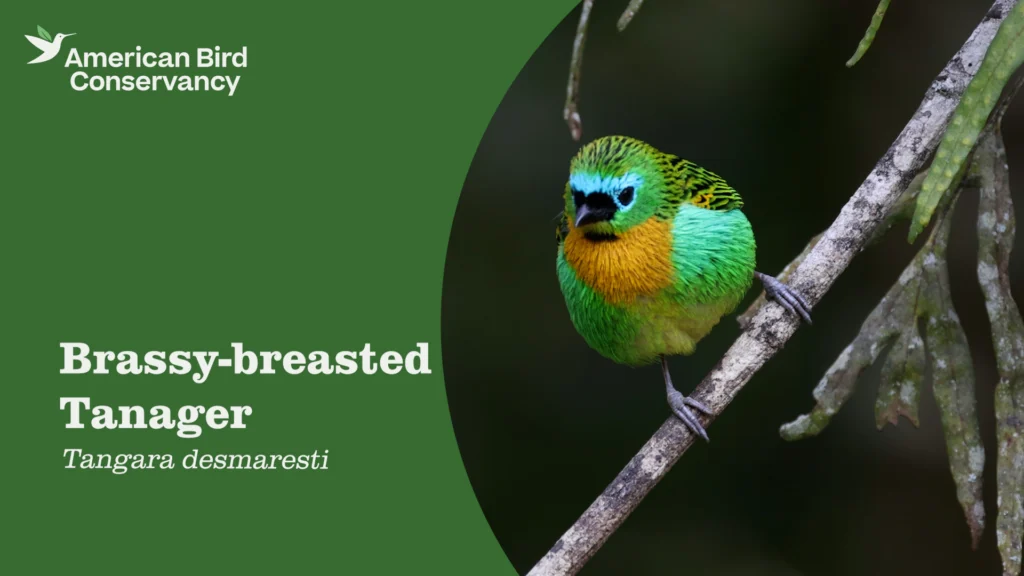
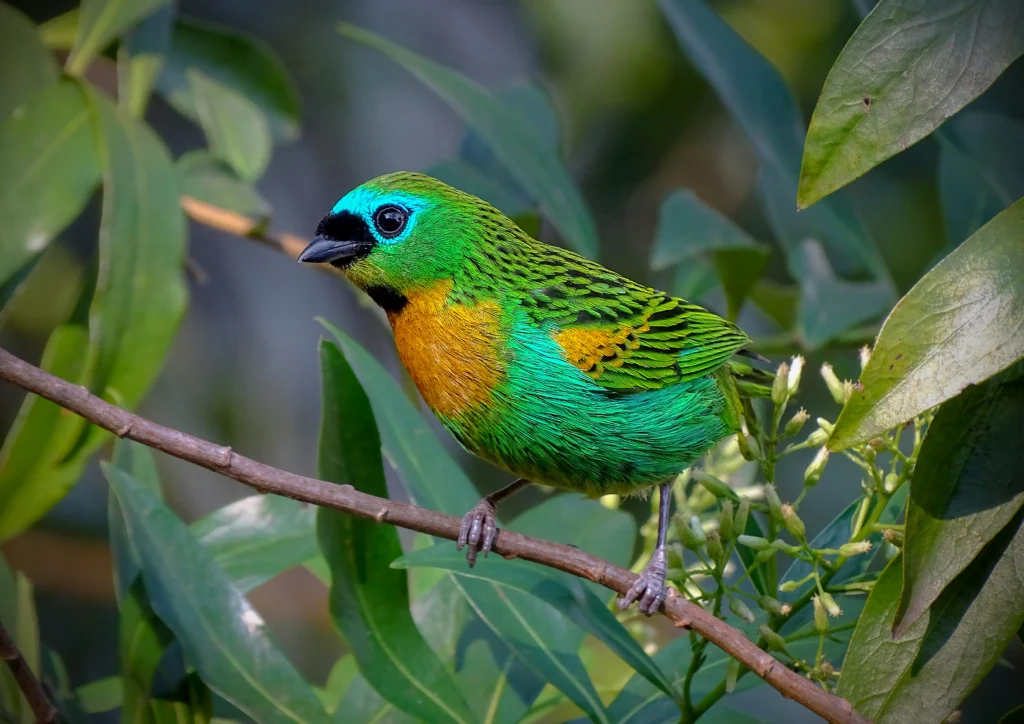
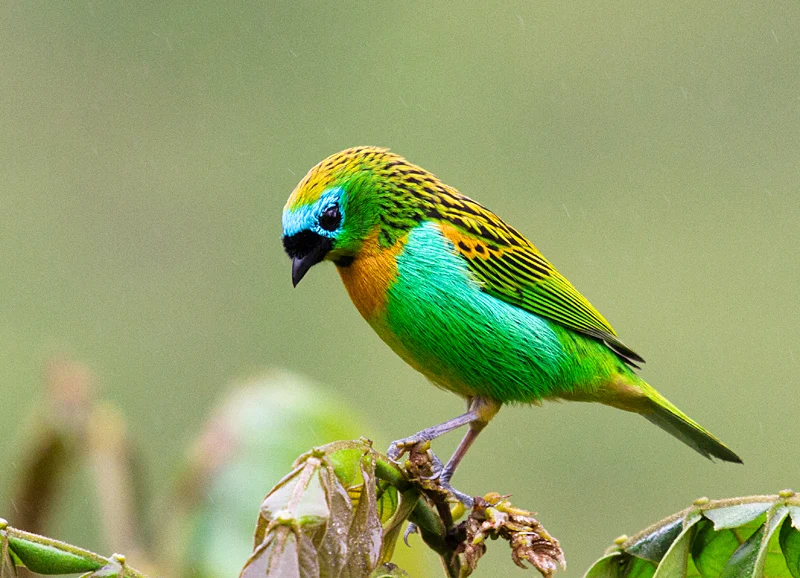
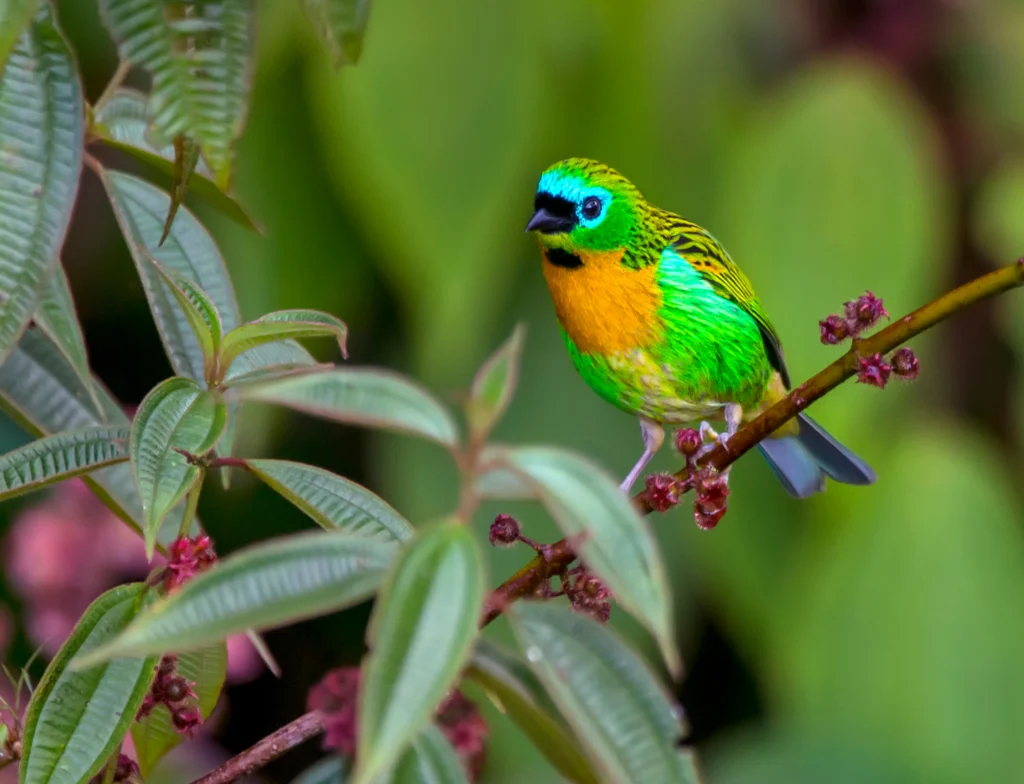
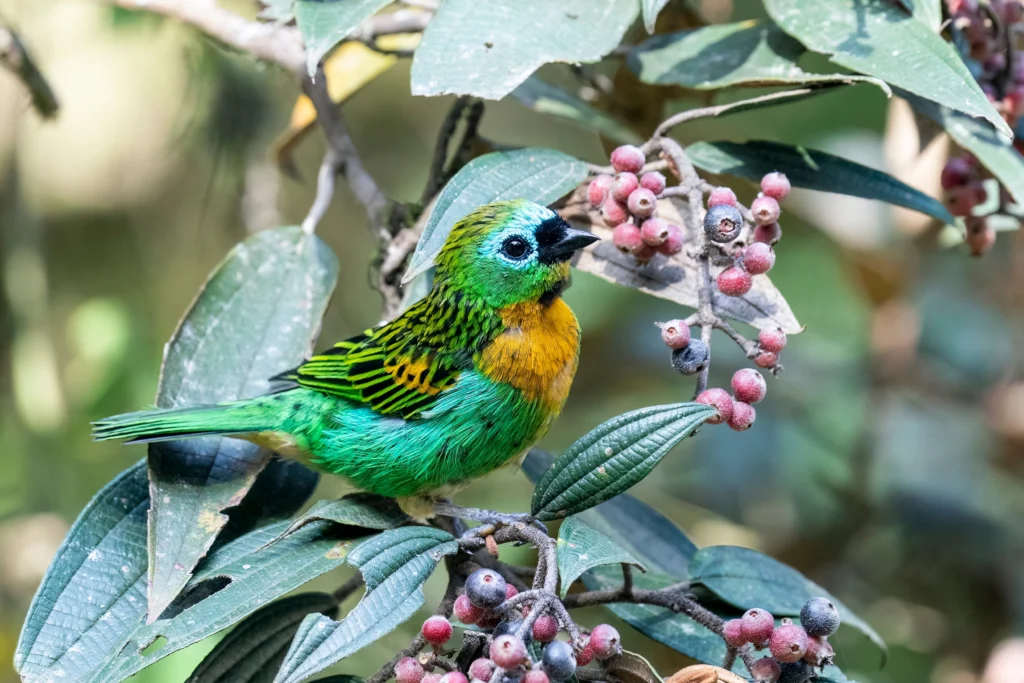
The Brassy-breasted Tanager, found only in Brazil’s Atlantic Forest, is a striking bird, appearing almost painted in day-glo with preternaturally bright shades of gold, lime green, teal-blue, and the namesake brass. These bright colors contrast sharply with small patches of black on the face and throat and streaks on the back, wings, and tail.
These colorful birds often move through the trees in large groups, sometimes alongside other species such as becards, foliage-gleaners, and other tanagers. Since these birds mostly forage in the canopy and eat similar foods (fruits and arthropods like insects and spiders), it may seem counter-intuitive that they would prefer to forage together. Researchers have been interested in this phenomenon for decades, and two benefits stand out that might explain this somewhat surprising behavior. First, birds in large mixed flocks can share vigilance; with more birds looking out for danger, each individual bird can afford to spend less time watching and more time eating. Second, birds might also have an easier time finding food in groups. Birds can see where their flockmates are successful, and insect prey might become more apparent if scared up by a foraging neighbor. Flock dynamics are complex and fascinating, with each species potentially playing subtly different roles. While biologists have yet to give the Brassy-breasted Tanager any in-depth study, someday research might reveal how this bird fits into the flock.
Threats
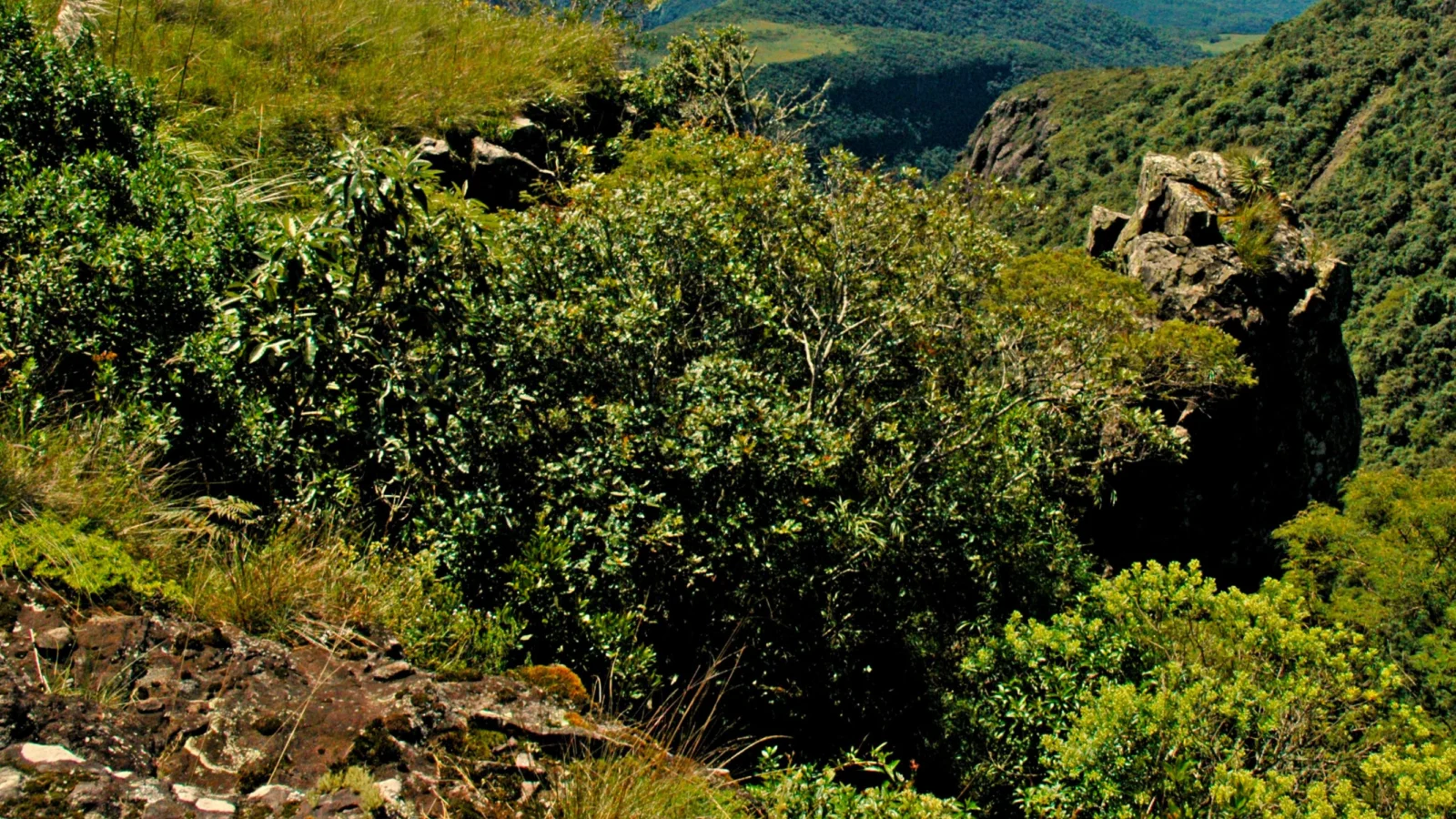
The Brassy-breasted Tanager is endemic to Brazil’s Atlantic Forest. Though perhaps not as well known as the Amazon Rainforest, the Atlantic Forest is a biodiversity hotspot with thousands of endemic species adapted to the rich and varied ecosystems present in this region. And like the Amazon, the Atlantic Forest has been massively depleted, and what remains is at risk. In fact, the Atlantic Forest has been described as one of the most threatened ecosystems on Earth.
Vanishing Forests
The vast Atlantic Forest has been reduced to less than 24 percent of its former size in the 500 years since colonization. Now only remnants remain, with many areas reduced to small, unsustainable, isolated fragments. Today, this important biome and global biodiversity hotspot is at risk from urbanization, agricultural expansion, and illegal logging.
Conservation Strategies & Projects
The Brassy-breasted Tanager needs our help to overcome the threats it faces. At ABC, we’re inspired by the wonder of birds and driven by our responsibility to find solutions to meet their greatest challenges. With science as our foundation, and with inclusion and partnership at the heart of all we do, we take bold action for birds across the Americas.
Create & Maintain Reserves
In 2026, SAVE Brazil, Rainforest Trust, and ABC worked with the Municipality of Salesópolis to establish a new wildlife refuge securing 14,000 acres of Atlantic Forest. Created to help save the Critically Endangered São Paulo Marsh Antwren, the Salesópolis Wildlife Refuge also protects habitat for the Brassy-breasted Tanager and many other species of the Atlantic Forest. Similarly, the Kaetés Reserve was created by Instituto Marcos Daniel with support from SAVE Brazil, World Land Trust, Rainforest Trust, and ABC to protect the Critically Endangered Cherry-throated Tanager.
Bird Gallery
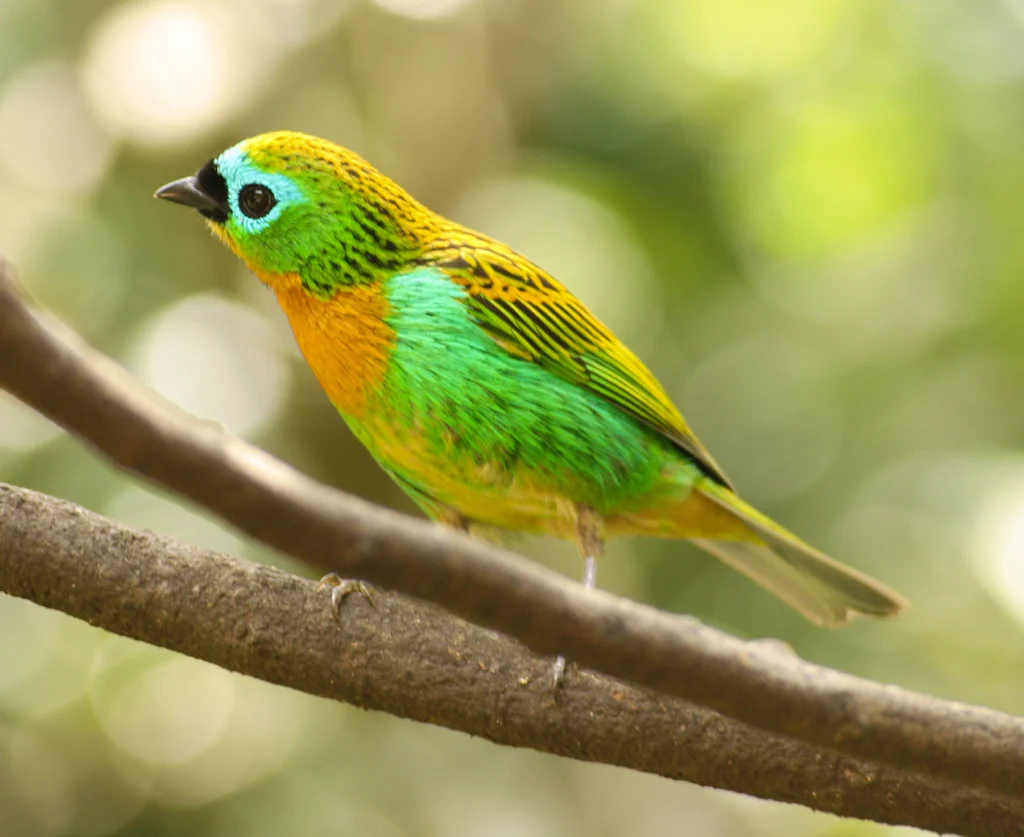
The gorgeous Brassy-breasted Tanager presents a vibrant color palette of green, blue, and gold, with patches of black providing a distinct contrast on the throat and around the bill, matching the bird’s deep black eyes. True to its name, this tanager sports a warm orangey-gold breast and throat, matched by a few feathers on the wing and set off by contrasting lime-green plumage over most of its body. The flanks are teal to seafoam green, matched by a mask of the same color that circles the eyes and stretches across the forehead. The brilliant green back and wings are streaked with dark gray-black, and the crown and upper back can show a gold wash, coloring just the edges of the feathers.
Sounds
Those unfamiliar with the tropical tanagers might be surprised at how high-pitched the Brassy-breasted Tanager’s voice is; most of this bird’s vocalizations sound like they could come from a hummingbird! Though reasonably well recorded, the functions of the Brassy-breasted Tanager’s many discrete calls have not been studied. However, the vocalization identified as this bird’s song likely serves a similar function to that of most other songbirds: To defend resources and attract potential mates.
Credit: Vitor Herdy, XC164488. Accessible at www.xeno-canto.org/164488.
Credit: Rodrigo Dela Rosa, XC177195. Accessible at www.xeno-canto.org/177195.
Credit: Jerome Fischer, XC295827. Accessible at www.xeno-canto.org/295827.
Credit: Jeremy Minns, XC84769. Accessible at www.xeno-canto.org/84769.
Habitat
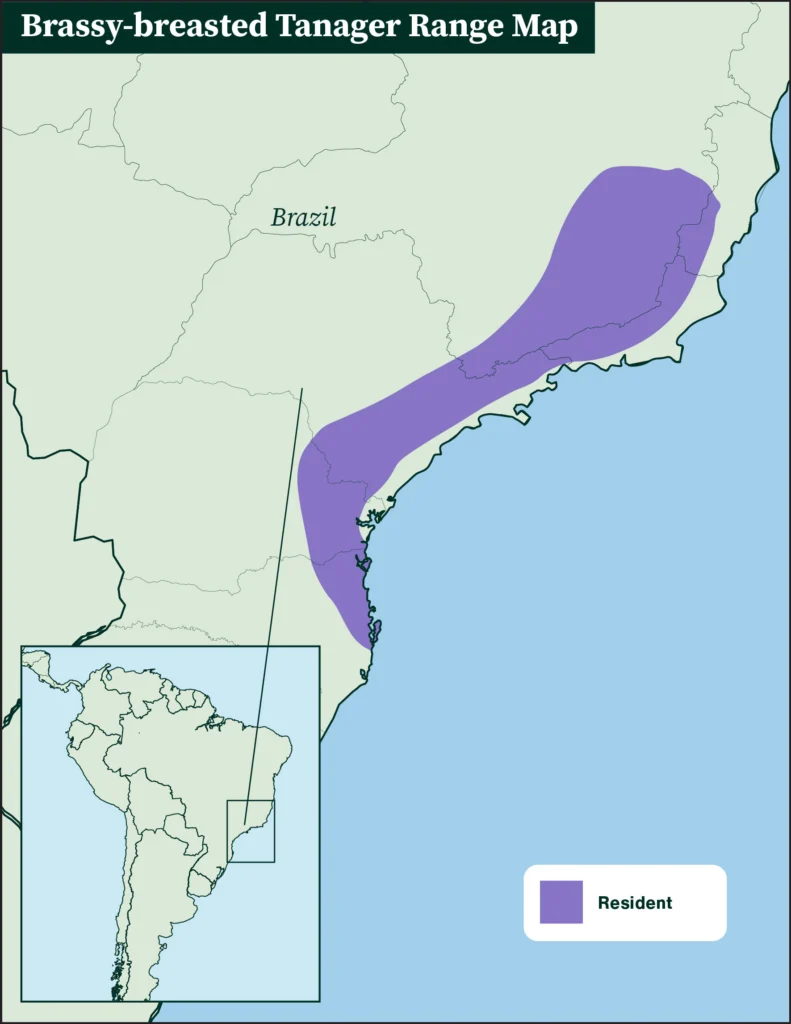
The Brassy-breasted Tanager is a bird of the humid montane Atlantic Forest, inland of the Atlantic coastal plain.
- Found at higher elevations, mostly between 2,500 and 6,000 feet
- Also uses secondary, regenerating forest and plantations
Range & Region
Range & Region
Specific Area
Southeastern Brazil
Range Detail
The Brassy-breasted Tanager is endemic to Brazil, where it is reasonably common in the southeastern region of the Atlantic Forest.
Did you know?
The species epithet desmaresti in the Brassy-breasted Tanager’s Latin name references Anselme Gaëtan Desmarest, a French naturalist who studied a wide range of species all over the world, including many birds in Central and South America.
Life History
The Brassy-breasted Tanager is a very active forager, constantly on the move as it deftly maneuvers the dense and leafy branches of its home. Like many endemic species of Latin America, the Brassy-breasted Tanager has not been thoroughly studied, and much of its life history and behavior is poorly known.
Diet
The Brassy-breasted Tanager forages mostly in the canopy and shrubs, where it hunts for insects among the leaves, moss, and lichen. They are equally fond of fruits, especially those of trees and shrubs in the nettle, myrtle, and melastome families.
Courtship
Courtship in this species is largely undocumented. However, researchers have noted a display where birds raise their head and flutter their wings in a manner reminiscent of begging displays performed by many species of songbirds. It is unclear whether this is performed by males, females, or both sexes.
Nesting
The female Brassy-breasted Tanager is largely responsible for building the nest, a thick cup, often at the tip of a branch. She makes her nest mostly of leaves, which she binds with spiderwebs and cocoons and decorates with lichen and moss. She may line the interior of her nest with lichens and the fibrous stalks of horsehair mushrooms. Though males don’t participate in building, they may help their mate by gathering nesting material while she is building.
Eggs & Young
In the handful of nests that have been observed, females laid two or three white eggs with gray spots. Though males have not been observed to incubate, they will bring food to the female while she is incubating. Eggs hatch after 12 to 13 days, and both parents feed the young with insects, spiders, and seeds.