Mountains. Island Oahu on Hawaii. Photo by Maria_Gb, Shutterstock.

Hawai‘i ʻĀkepa

Loxops coccineus

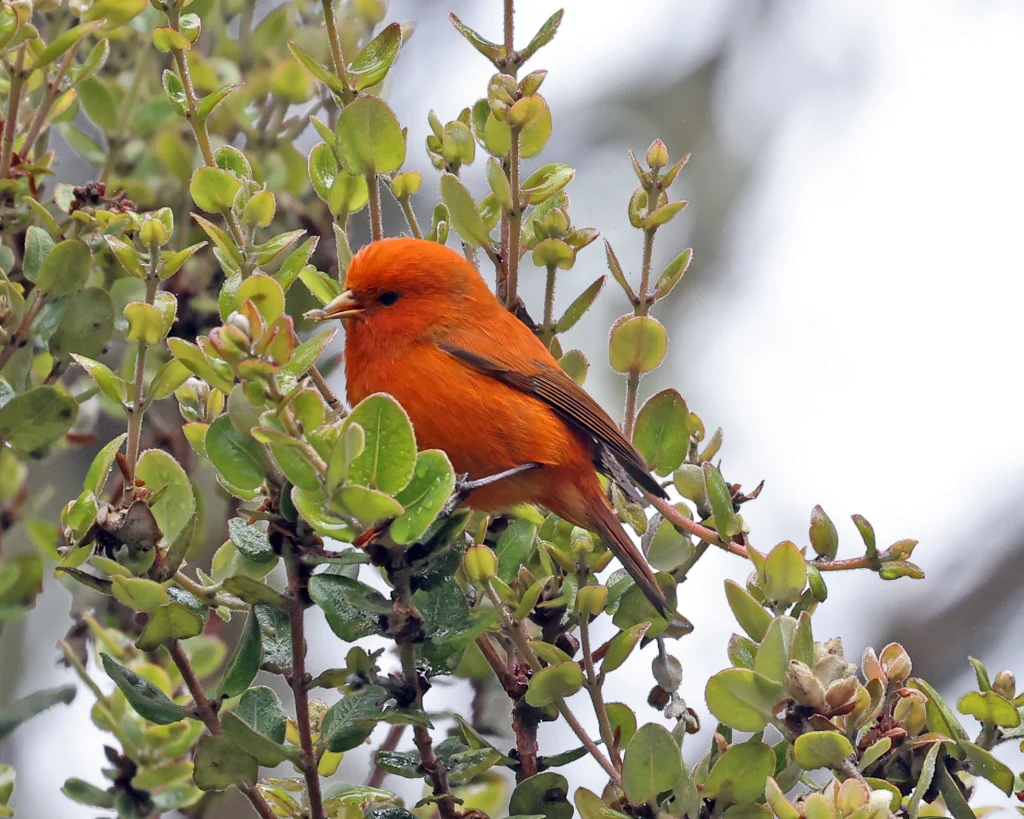
Hawai‘i ʻĀkepa male in tree. Photo by Krista Hinman, Macaulay Library at the Cornell Lab of Ornithology.

Hawai‘i ʻĀkepa

Hawai‘i ʻĀkepa male in tree. Photo by Krista Hinman, Macaulay Library at the Cornell Lab of Ornithology.

Loxops coccineus

Overview

Conservation Status
Population Trends
Decreasing
Population Size
10,800
Family
Fringillidae
Hawaiian Honeycreepers
Location
Hawai'i
Migration Pattern
Nonmigratory
Migration Distance
Nonmigratory
Also Known As
  • ʻAkakane
  • Nimble Native

About

The Hawaiian word ʻākepa means “quick” or “nimble,” words which describe this small, finch-like bird perfectly. The Hawaiʻi ʻĀkepa, which is endemic to the island of Hawaiʻi, was once considered part of a larger species that included other ʻākepas found on Oʻahu and Maui. In 2015, the three were split into separate species because of differences in vocalizations, genetics, and behavior. Unfortunately, the Oʻahu ʻĀkepa and Maui ʻĀkepa are now considered extinct, additional casualties of the ongoing conservation and extinction crisis in the Hawaiian Islands.

Another close relative of the Hawaiʻi ʻĀkepa is the ʻAkekeʻe, a Critically Endangered honeycreeper species endemic to Kauaʻi. Like that species, the Hawaiʻi ʻĀkepa has a specialized bill that shows lateral asymmetry: The lower mandible is slightly curved to one side, and the tips of its bill are slightly crossed. This unusual bill acts as a handy tool for prying open ʻōhiʻa leaf and flower buds as the ʻĀkepa forages for insect prey, much in the same way that the Red Crossbill and its relatives use their bills to open conifer cones.

Threats

Birds around the world are declining, and many of them, like Hawaiian honeycreepers, are facing urgent, acute threats. But all birds, from the rarest species to familiar backyard birds, are made more vulnerable by the cumulative impacts of threats like habitat loss and invasive species.

Habitat Loss

Habitat destruction and degradation in Hawaiʻi are ongoing, caused by logging, clearing for agriculture and ranching, and introduced species such as pigs, cattle, goats, and mouflon sheep.

Habitat Loss

Cats & Invasive Species

Non-native mosquitoes introduced deadly diseases such as avian malaria and pox to the Hawaiian Islands, which now restrict the Hawaiʻi ʻĀkepa to forests above 3,600 feet. Introduced rats prey on ʻĀkepa eggs and young, while non-native cats and Barn Owls prey on adults.

Cats & Invasive Species

Climate Change

Rising global temperatures will allow disease-carrying introduced mosquitoes to spread into higher elevations, further reducing the Hawaiʻi ʻĀkepa’s range.

Climate Change

Conservation Strategies & Projects

Birds need our help to overcome the threats they face. At ABC, we’re inspired by the wonder of birds and driven by our responsibility to find solutions to meet their greatest challenges. With science as our foundation, and with inclusion and partnership at the heart of all we do, we take bold action for birds across the Americas.

Create & Maintain Reserves

Fencing and removal of non-native ungulates, particularly pigs, are critical conservation actions being used at Hakalau Forest National Wildlife Refuge, the first refuge established solely for native Hawaiian forest birds such as the Hawaiʻi ʻĀkepa.

Control Mosquitoes

ABC belongs to a multi-agency partnership, Birds, Not Mosquitoes, that is deploying non-biting, lab-reared male mosquitoes carrying a naturally occurring bacteria that results in sterile eggs when the released males mate with wild females. With time, the population of invasive, malaria-carrying mosquitoes will be reduced in Hawaiʻi. ​

Birds, Not Mosquitoes Receives Hawaiʻi Conservation Innovation Award

Support Petitions & Advocacy

ABC and our partners work on an ongoing basis to advocate for the protections and resources Hawaiʻi’s birds need to ensure their survival. We pursue policy solutions at the state and federal levels in the United States that support work to conserve and regenerate habitat, remove the threats posed by introduced species, establish new populations of vulnerable species, and develop and implement innovative tools to prevent further extinctions. Learn more about the urgent issues impacting birds in Hawaiʻi and throughout the Western Hemisphere and take action.

Take Action

Bird Gallery

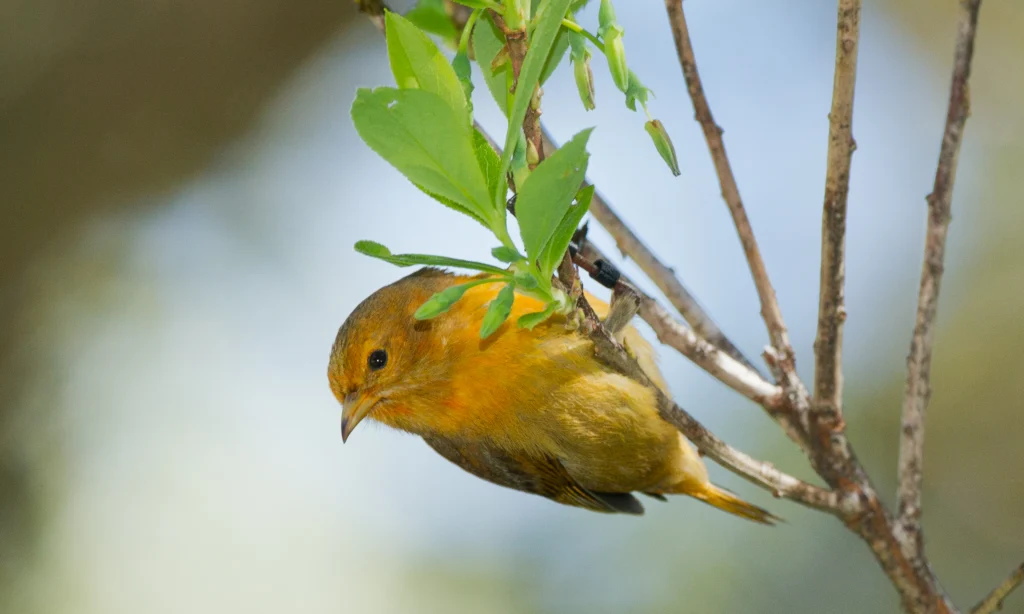
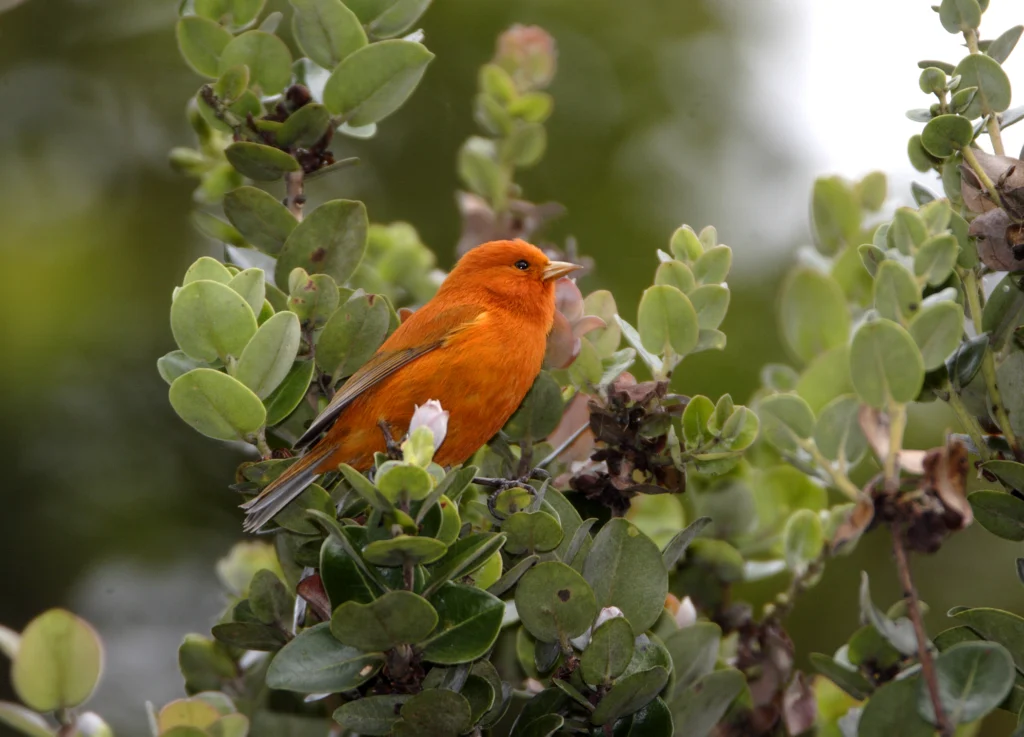
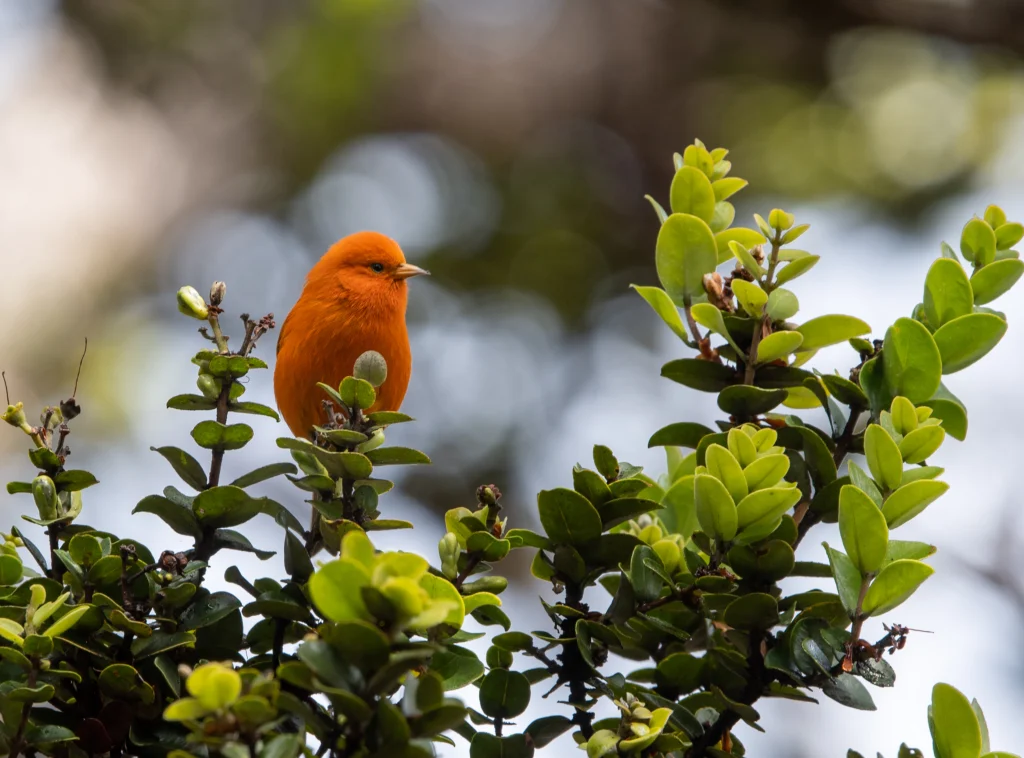
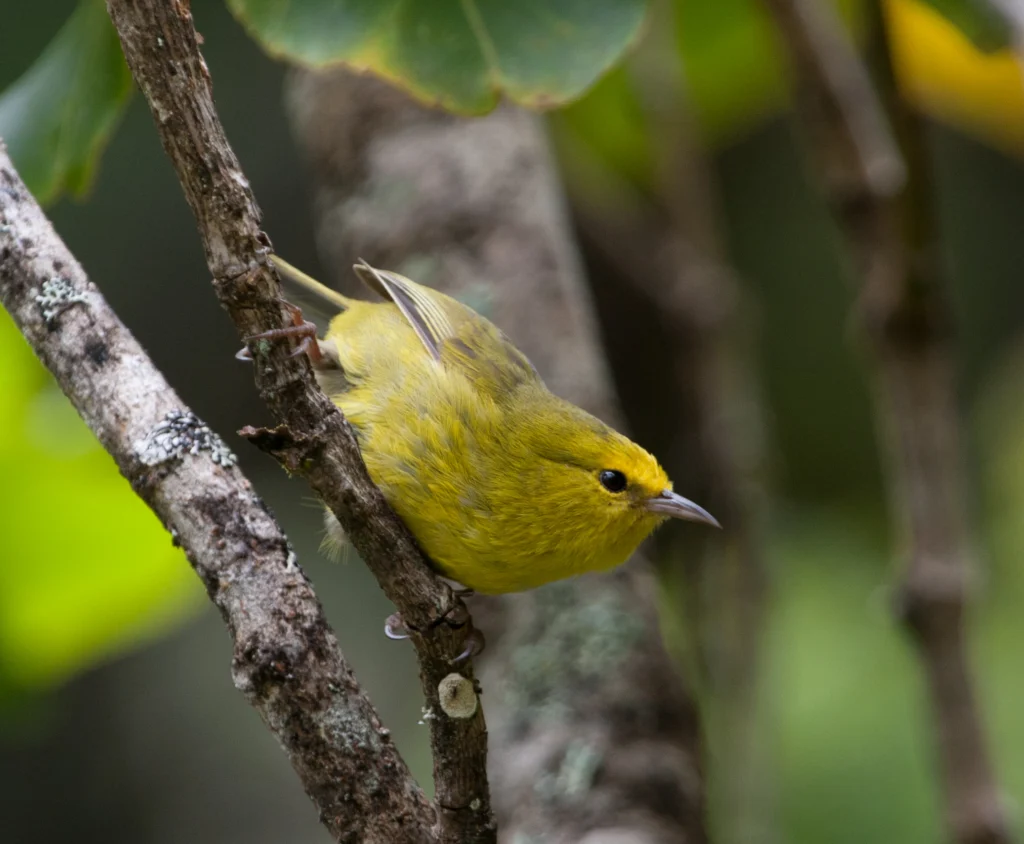
The Hawai‘i ʻĀkepa is a sexually dimorphic species, which means that males and females have differently colored plumage. The male Hawaiʻi ʻĀkepa is an eye-catching reddish-orange with brownish wings and tail, while the female is a more subdued grayish-green on the back, wings, and tail, and lighter below with an indistinct yellowish-orange breast band. Juveniles resemble females.

Male Hawaiʻi ʻĀkepa show delayed plumage maturation, not attaining full adult plumage until their third year of life. Second-year males are orange-brown above with a patchy-looking mix of dull oranges, yellows, and reds below.

Bird Sounds

The Hawaiʻi ʻĀkepa’s song is described as a lilting, up-and-down descending trill.
It makes quiet kee-wit calls, and juveniles make a mewing zeer call.

Song

Credit: Dan Lane, XC175513. Accessible at www.xeno-canto.org/175513.

Calls

Credit: Viral Joshi, XC794965. Accessible at www.xeno-canto.org/794965.

Habitat

Most inhabit old-growth mountain rainforests with large native trees to provide nest cavities.

  • Found in koa-ʻōhiʻa wet forests, koa-ʻōhiʻa mesic (mixed) forest, and disturbed forests and woodlands

Range & Region

Range & Region


hawaii akepa range map

Specific Area
Island of Hawaiʻi

Range Detail
The ʻĀkepa is found only on Hawaiʻi Island, where it has a fragmented distribution above 4,900 feet, with the largest numbers of birds on the slopes of Mauna Kea, Mauna Loa, and Hualālai.

Did you know?
ʻĀkepa were once found on other Hawaiian islands, including Oʻahu and Maui, but today they only exist on Hawaiʻi Island. 

Range
Hawai'i
Migration Pattern
Nonmigratory
Migration Distance
Nonmigratory

Life History

An active and lively honeycreeper, the ʻĀkepa hops through the trees seeking out insect prey, typically sticking to the high forest canopy. While seeking mates, male Hawaiʻi ʻĀkepa will compete with each other in large group displays that are reminiscent of manakin leks. The ʻĀkepa is among the smallest of Hawaiʻi’s honeycreepers.

Diet

The ʻĀkepa’s unusual bill allows it to pry open leaf buds and small seed pods to reach insects and spiders, their main food sources. It also takes caterpillars and sips nectar from ʻōhiʻa blossoms.

Courtship

The Hawaiʻi ʻĀkepa is socially monogamous, with many forming long-term pair bonds. Before finding a partner, males join in competitive group displays that involve simultaneous song bouts, bursts of hopping and even fighting high in the tree canopy, and aerial dog (finch?) fights that can spiral over 300 feet above ground.

Nesting

The first Hawaiʻi ʻĀkepa nest was discovered in 1974. This species is the only Hawaiian honeycreeper that requires natural cavities in old-growth ʻōhiʻa and koa trees for nest sites. When a nesting pair locates a suitable cavity, the female builds a cup-shaped nest inside it using rootlets, bark strips, ferns, mosses, and other vegetation.

Eggs & Young

The female ʻĀkepa lays a clutch of one to three (typically two) eggs, and incubates them herself. Her mate will feed her during the 14- to 16-day incubation period, although she will also forage outside the nest herself. Both parents feed the young, which fledge after 16 to 20 days in the nest. Parents continue to care for their young for up to ten weeks after they fledge.