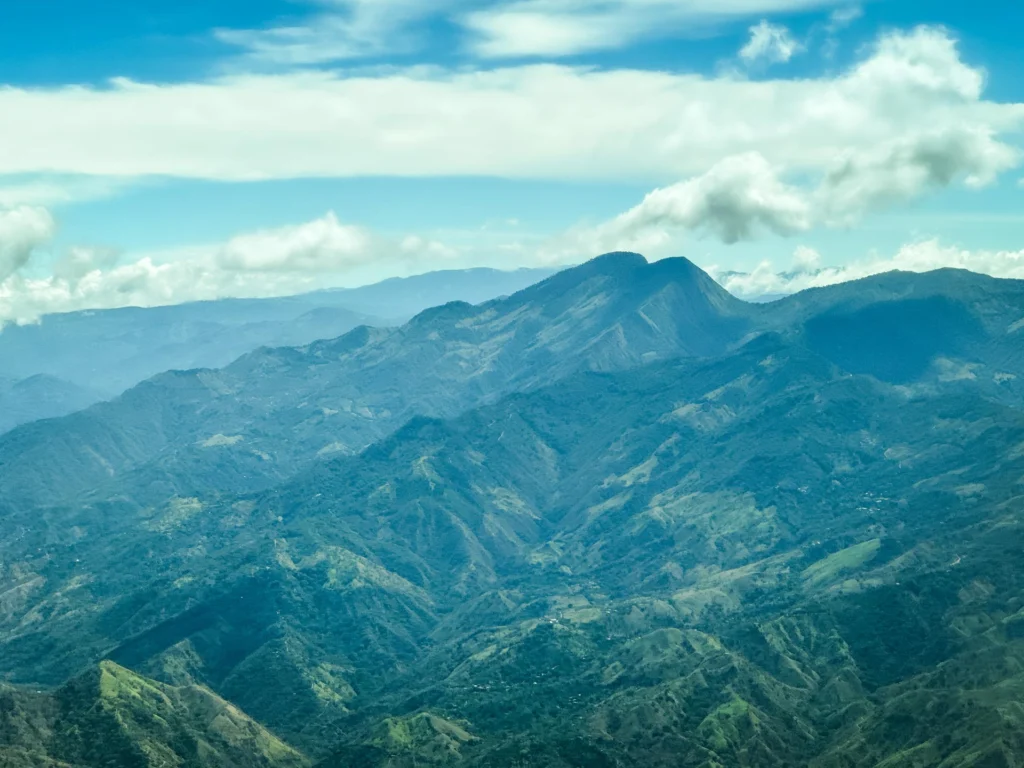
Aerial view a rainforest habitat over a mountain with clouds.

Masked Flowerpiercer

Diglossa cyanea

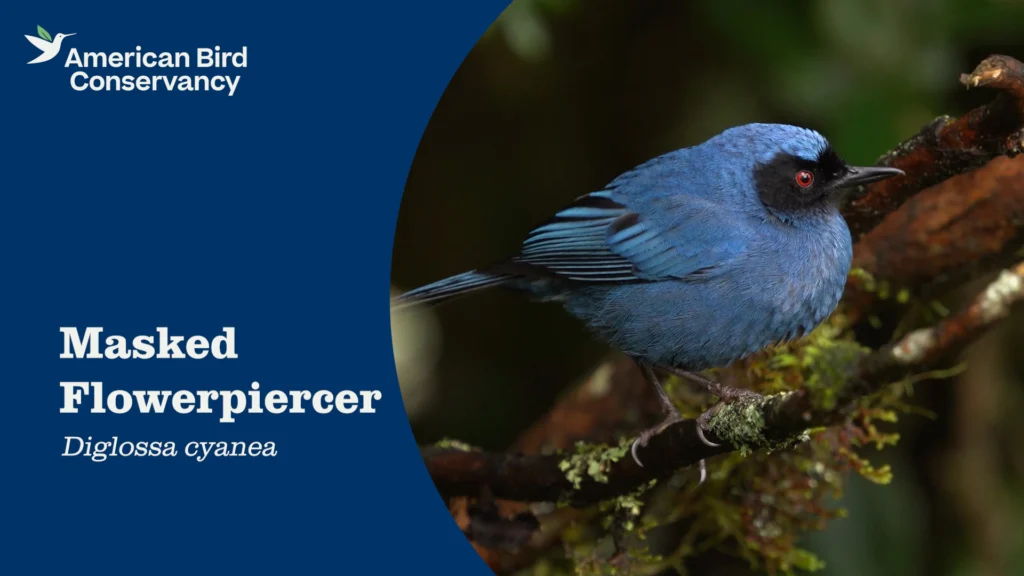
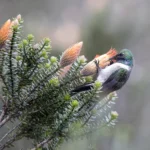
Masked Flowerpiercer with yellow flower between its beak. Photo by Scott Young, Macaulay Library at the Cornell Lab of Ornithology.

Masked Flowerpiercer

Masked Flowerpiercer with yellow flower between its beak. Photo by Scott Young, Macaulay Library at the Cornell Lab of Ornithology.

Diglossa cyanea

Overview

Conservation Status
Population Trends
Decreasing
Population Size
Unknown
Family
Tanagers
Thraupidae
Location
South America
Migration Pattern
Nonmigratory
Migration Distance
Nonmigratory

About

A common, confiding, and conspicuous member of the tanager family, the bright blue Masked Flowerpiercer is a familiar sight to birders throughout the Andes.
This bird is named for its feeding habits, which are made possible by its highly specialized bill.

Like other flowerpiercers, the Masked Flowerpiercer has a slightly upturned bill with a hooked upper mandible and a shorter, sharp lower mandible used to pierce the base of flowers to access the nectar inside. Its genus name, Diglossa, derives from the Greek word for “double-tongued” and refers to this bird’s forked, brush-tipped tongue, another specialization that facilitates nectar feeding.

By feeding from a flower’s base, the flowerpiercer can access nectar normally out of reach of other birds except Andean hummingbird species such as the Sword-billed Hummingbird and Violet-tailed Sylph. While the hummingbirds act as pollinators, the flowerpiercers do not provide this service, so they are often considered nectar “robbers”.

Threats

Birds around the world are declining, and many face urgent threats. But all birds, from the rarest species to familiar backyard birds, are made more vulnerable by the cumulative impacts of threats like habitat loss and climate change.

Habitat Loss

Habitat loss due to deforestation poses a threat to some local populations of Masked Flowerpiercer. This species is somewhat sensitive to human disturbance.

Habitat Loss

Climate Change

A rapidly changing climate has the potential to impact the Masked Flowerpiercer’s high-altitude habitats. Drought, increasing temperatures, and changing rainfall could degrade habitat quality and affect food resources for this bird.

Climate Change

Conservation Strategies & Projects

Birds need our help to overcome the threats they face. At ABC, we’re inspired by the wonder of birds and driven by our responsibility to find solutions to meet their greatest challenges. With science as our foundation, and with inclusion and partnership at the heart of all we do, we take bold action for birds across the Americas.

Creating & Maintaining Reserves

Working with dozens of partners and local communities, ABC supports a growing network of protected areas in more than a dozen countries. The Masked Flowerpiercer can be sighted at over 22 ABC-supported reserves, including Ecuador’s Tapichalaca and Yanacocha Reserves.

Creating and Maintaining Reserves

Address Climate Change

ABC and its partners are working to address the effects of climate change throughout the Americas in three key areas — mitigation, resilience, and adaptation — to help build a sustainable, long-term future for birds.

ABC's Position on Energy Development and Climate Change

Bird Gallery

The Masked Flowerpiercer is easily recognizable and aptly named, with a large black mask accented by bright red eyes and ultramarine blue body plumage. Its wings and tail feathers are black with blue edging, and its legs and feet are black. The sexes look alike, although the female’s colors are more subtle. Juvenile Masked Flowerpiercers are a dull blue-gray, with an indistinct mask.

Five subspecies are recognized across its range, differing in color intensity and song nuances.

Sounds

The Masked Flowerpiercer’s rather insubstantial-sounding song starts with thin, high-pitched tones that accelerate into a wispy-sounding twitter. Its calls are faint zeet notes.

Song

Credit: Sue Riffe, XC931837. Accessible at www.xeno-canto.org/931837.

Calls and song

Credit: Mitch Lysinger, XC261128. Accessible at www.xeno-canto.org/261128.

Habitat

This species is common in mountain forests throughout the northern and central Andes, usually above 6,600 feet. It is endemic to South America.

  • Primarily resides in humid mountain evergreen forest
  • Sometimes found in high-altitude forest with stunted trees (elfin forest), second-growth forest, forest edges, and scrub

Range & Region

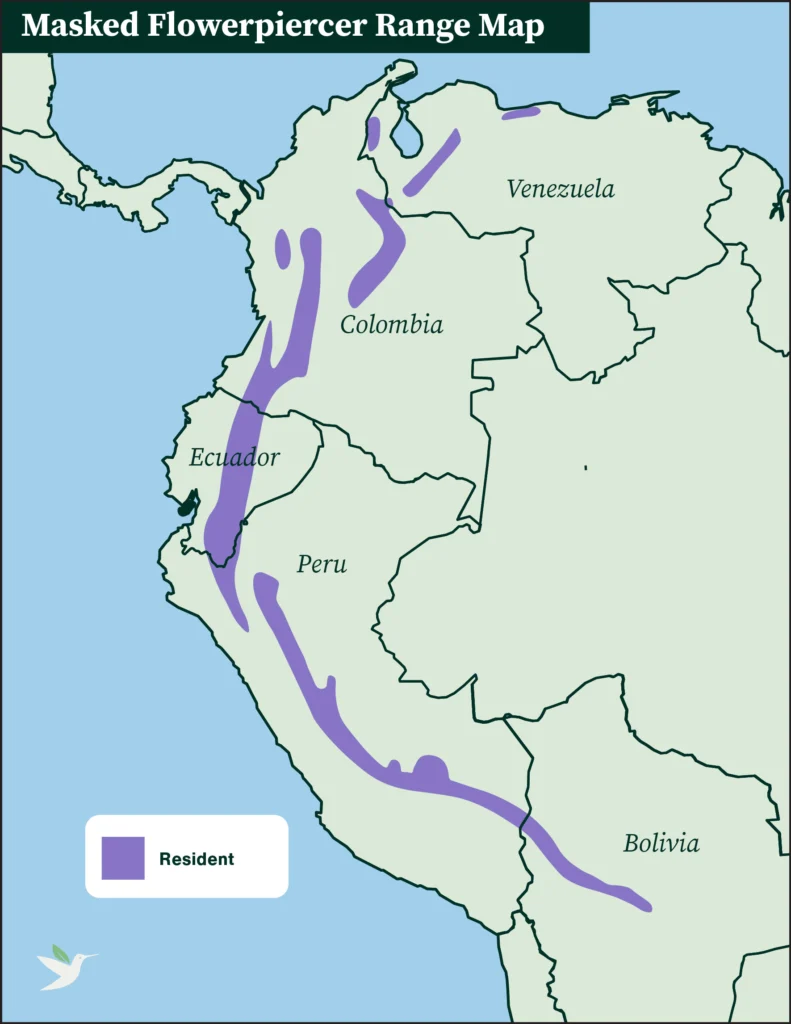
Masked Flowerpiercer range map.

Specific Area
The Andes from Venezuela through Colombia, Ecuador, Peru, and Bolivia.

Range Detail
The Masked Flowerpiercer is a common resident of humid, high-altitude evergreen forests, edges, and scrublands. It’s usually found at altitudes above 6,600 feet and is widespread on both slopes of the Andes.

Did you know?
Some subspecies of Masked Flowerpiercer may make altitudinal movements between the wet and dry seasons.

Range
South America
Migration Pattern
Nonmigratory
Migration Distance
Nonmigratory

Life History

The Masked Flowerpiercer is a sociable species, usually sighted foraging in pairs, small flocks, or mixed-species flocks along with other flowerpiercer and tanager species, hummingbirds, and warblers. A fairly active bird, the Masked Flowerpiercer moves among leaves in little hopping movements. Despite being a common and relatively easily observed species, information about the life history of the Masked Flowerpiercer, in particular its breeding biology, is scant.

Diet

The Masked Flowerpiercer feeds on nectar, small fruits and seeds, and insects. Like other flowerpiercers, it obtains nectar by puncturing the bases of flowers, a technique known as “nectar robbing.” This species has a slightly longer bill than other flowerpiercers, which also allows it to probe flowers in a more “conventional” manner. The Masked Flowerpiercer also visits hummingbird feeders for nectar.

Courtship

Like other flowerpiercer species, the Masked Flowerpiercer is likely monogamous, forming pair bonds that last the duration of the breeding season. They are reported to breed twice a year, likely during the rainy season.

Nesting

The Masked Flowerpiercer’s open-cup nest is constructed from moss, grass, and plant fibers, and lined with feathers.

Eggs & Young

Masked Flowerpiercer eggs have been described as pale greenish-blue, spotted with brown. Although specifics are lacking for this species, existing data on close relatives indicate that the female Masked Flowerpiercer likely incubates the clutch of two eggs, while both parents feed the chicks after hatching. Young probably leave the nest after approximately two weeks.