Painted Bunting

Passerina ciris

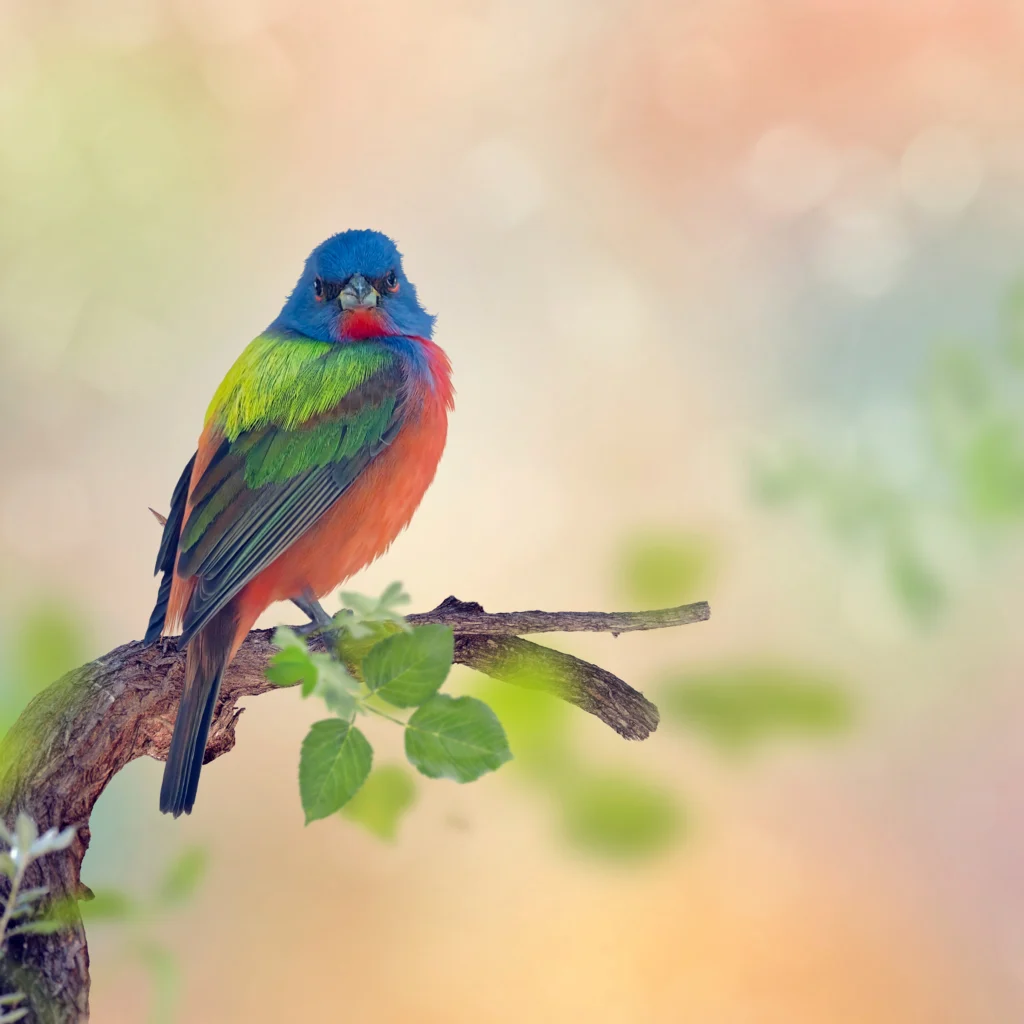
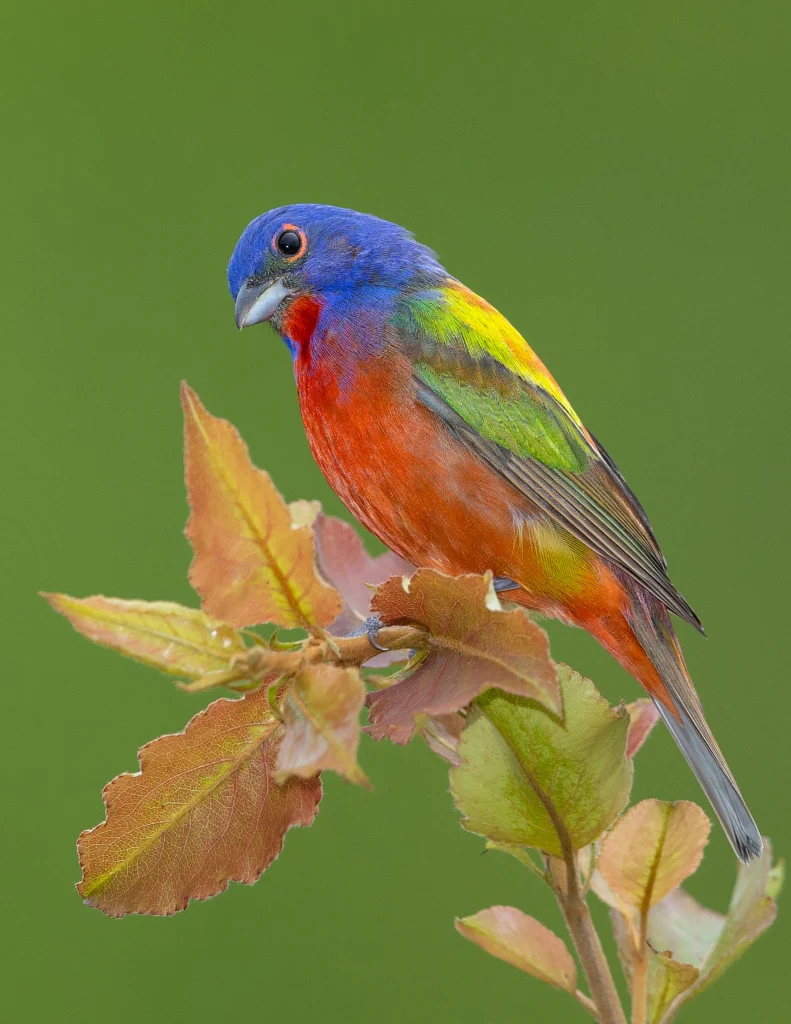
Painted Bunting. Photo by Gary Flanagan.

Painted Bunting

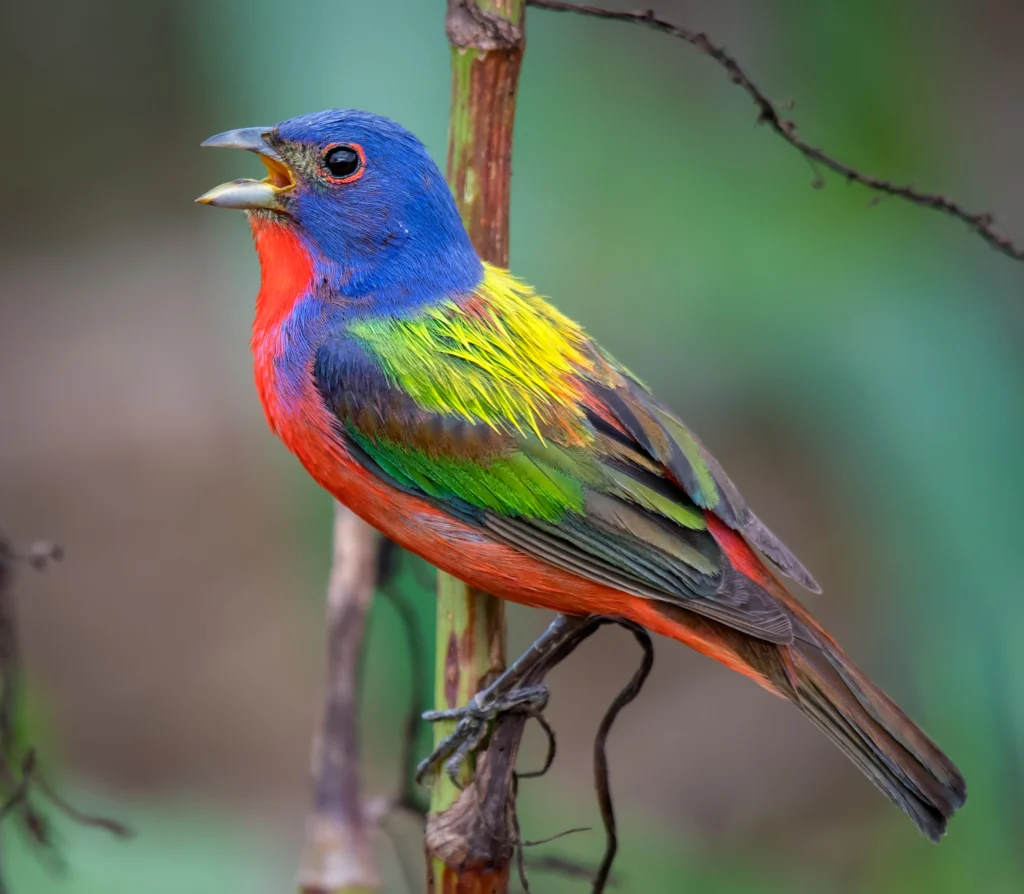
Painted Bunting. Photo by Gary Flanagan.

Passerina ciris

Overview

Conservation Status
Population Trends
Increasing
Population Size
15,000,000
Family
Buntings
Location
Caribbean
North America
Migration Pattern
Longitudinal
Migration Distance
Medium Distance
Also Known As
  • Azulillo sietecolores (Spanish)
  • Passerin nonpareil (French)

About

The adult male Painted Bunting is one of the most colorful of all U.S.-breeding birds. In Mexico, the Painted Bunting is commonly known as siete colores, or “seven colors;” in Louisiana, it is called nonpareil, French for “without equal.” Both are fitting terms for this gorgeous bird. Like other colorful species such as the Red-crested Cardinal, the Painted Bunting is a popular cage bird and is heavily trapped for the illegal pet trade.

This bird, like others sporting greens, blues, or iridescent colors, owes its unparalleled plumage largely to structural coloration. At the microscopic level, the surface of any green or blue feather is structured to filter out most of the incoming light and reflect only a narrow bandwidth, producing the strikingly vivid colors we see.

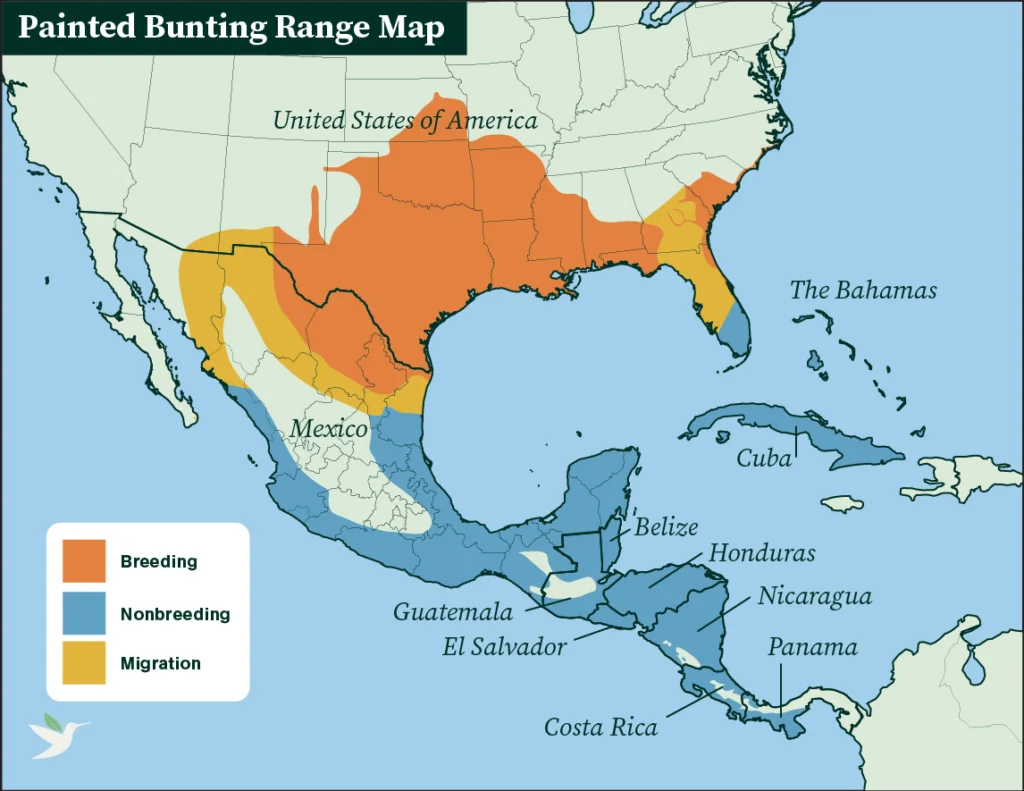
The Painted Bunting is unusual in that there are two separate populations that each breed and overwinter in different parts of the continent. The western or interior population breeds from western Florida to Texas and northern Mexico, while the eastern population breeds along the Atlantic Coast from Florida into North Carolina. A 2011 study found that these two populations are evolving independently, and may be on their way to becoming two separate species!

Threats

Birds around the world are declining, and even stable populations face urgent, acute threats. Habitat loss is a common threat to many species, but some, especially stunningly beautiful species like the Painted Bunting, face additional pressure from illegal trapping for the pet trade.

Illegal Trapping

For all its beauty, the plumage of male Painted Buntings can also be a liability. Adult males are a frequent target for the illegal pet trade, and their aggression toward territorial intruders makes them easy for poachers to trap using mounted specimens as lures. In his day, John James Audubon stated that these birds were captured and shipped to Europe by the thousands each spring.

Illegal Trapping

Habitat Loss

Suitable habitat is the foundation of what birds need to thrive, and habitat loss, fragmentation, and degradation impact innumerable species of birds and other wildlife. Nesting and wintering among thickets and scrub, the Painted Bunting is most strongly impacted by urban development and sprawl into rural areas with farmland or fallow fields, as well as highway maintenance that reduces thick, shrubby vegetation along roads.

Habitat Loss

Conservation Strategies & Projects

Birds, like the beautiful Painted Bunting, need our help. At ABC, we’re inspired by the wonder of birds and driven by our responsibility to find solutions to meet their greatest challenges. With science as our foundation, and with inclusion and partnership at the heart of all we do, we take bold action for birds across the Americas.

Creating & Maintaining Reserves

Habitat is the foundation for birds’ survival. Working with dozens of partners and local communities, ABC supports a growing network of protected areas in more than a dozen countries. Totaling more than 1.2 million acres, nearly one-third of the world’s birdlife (more than 3,000 species) is protected by an ABC-supported reserve.

Creating and Maintaining Reserves

Restoring Habitat

Through our work with the Migratory Bird Joint Ventures, including the Rio Grande and Oaks and Prairies JVs, across the Painted Bunting’s range in the U.S. and Mexico, ABC is helping to restore habitat for this and other species that migrate to the Neotropics. These regional collaborations bring together a host of partners to improve habitat on public and private lands.

Restoring Habitat

Bird Gallery

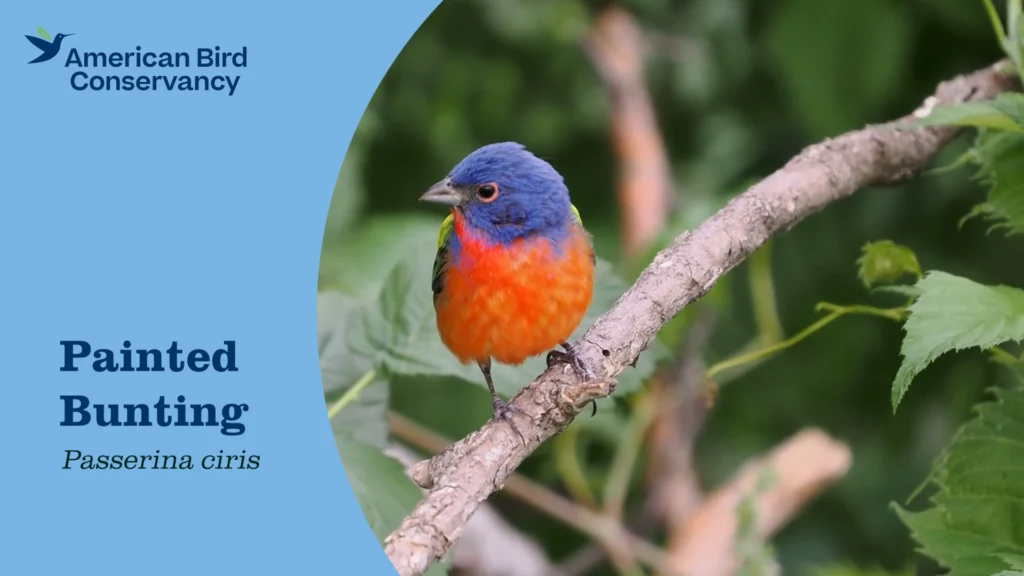
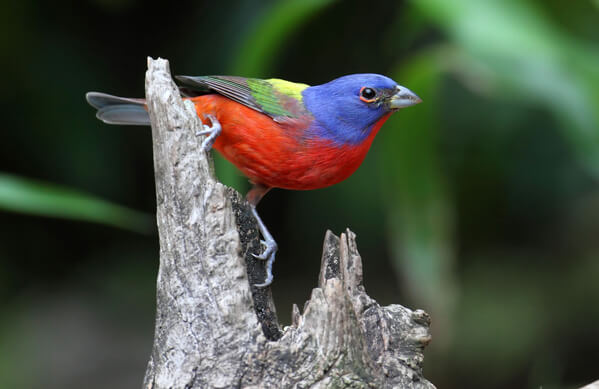
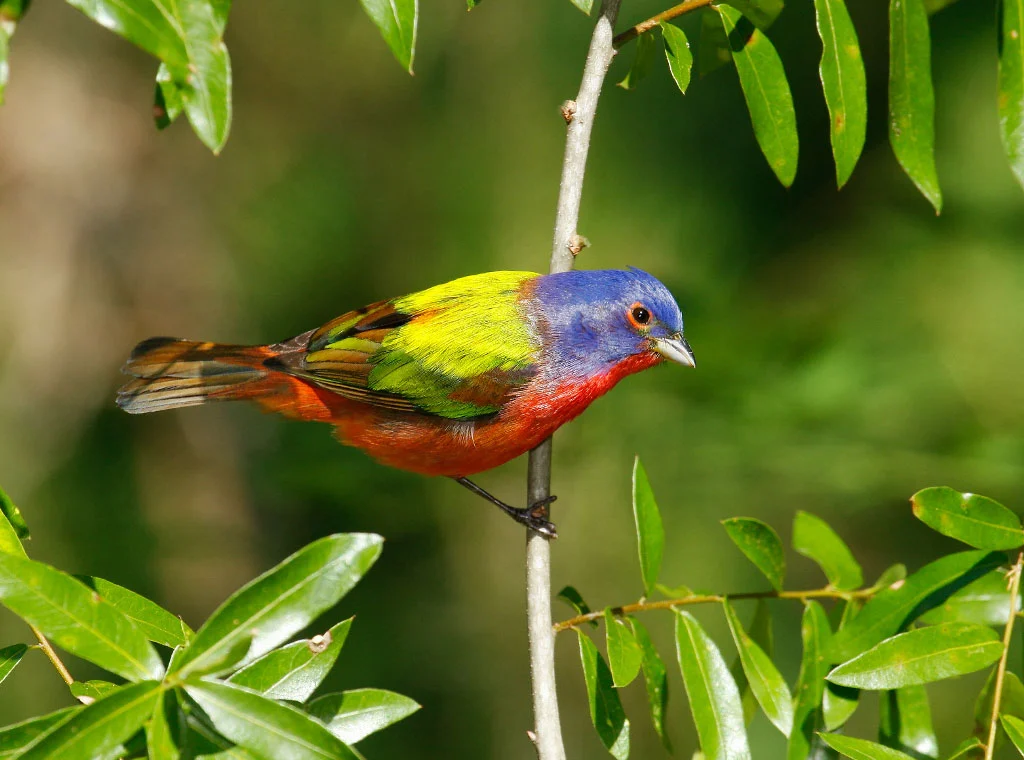
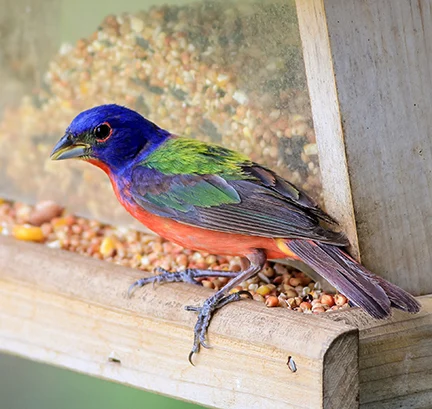
Male birds in adult plumage are unmistakable: The head is azure with a bright coral pink eyering, matched by an orange to red throat, breast, belly, and rump. Behind his head, the back is a vibrant yellow-green, while the wing and tail feathers are dark gray-black edged with the rainbow of color present on the rest of the bird. Females, while less colorful, are uniquely beautiful in their own right: lemon-yellow below, and a vibrant yellow- to lime-green above, similar to the back of the adult male. Juveniles are uniformly greenish-gray or greenish-brown above, and paler brown below. Immature males may look similar to adult females, although immature males may show a muted pattern foreshadowing their adult plumage. Males don’t reach their mature plumage until year two.

Sounds

Male Painted Buntings sing a sweet, high-pitched warble, given in a rapid but buoyant sing-song rhythm. The voice overall is mostly clear and musical, with occasional burry notes or short trills, somewhat similar to a House Finch. The most common call is a single short, sharp note often described as a plik or pik, given by both males and females.

Song

Credit: Jeffrey Mann, XC 899265. Accessible at https://xeno-canto.org/899265.

Call

Credit: Russ Wigh, XC 653211. Accessible at https://xeno-canto.org/653211.

Habitat

Painted Buntings prefer thick, scrubby lowlands in both their breeding and nonbreeding ranges. However, the separate eastern and western populations have slightly different habitats available to them based on their geography.

  • Western population breeds most commonly in dense, brushy areas, including areas next to farmland and roadsides
  • Eastern population breeds in scrub, thicket, and hammock habitat, as well as scrubby patches in yards and fallow fields
  • Both populations prefer dense thicket vegetation and tall grass in their respective nonbreeding grounds

Range & Region

Specific Area
Southern U.S., Mexico, Central America, the Caribbean

Range Detail
The Painted Bunting’s two distinct populations occupy separate breeding and nonbreeding ranges, with no overlap in either. The western population breeds in scrubby vegetation from the southern Mississippi River Valley inland to Texas and northern Mexico, and spends the nonbreeding season in central Mexico along the Pacific and Atlantic slopes and south as far as Panama. The eastern population breeds along the Atlantic Coast, from central Florida up into North Carolina, and overwinters in southern Florida, the Florida Keys, and the Caribbean.

Did you know?
In addition to being geographically separated, the eastern and western populations of Painted Bunting also time their molt differently. Like the great majority of songbirds, the eastern population molts on the breeding grounds before migrating to nonbreeding territories. However, the western population first migrates to the desert Southwest in a specific “molt migration” before continuing south to its tropical nonbreeding territory. Molt-migration is common among waterfowl but very rare among songbirds.

Range
Caribbean
North America
Migration Pattern
Longitudinal
Migration Distance
Medium Distance

Life History

Despite their eye-catching colors, this species can be quite secretive, skulking through the dense thickets and grasses that it prefers. However, the Painted Bunting has another treat in store for careful watchers: an elaborate courtship dance highlighting the male’s vibrant plumage, which females require before they will copulate. This dramatic, showy performance is in many ways similar to the famous dances of Papuan birds-of-paradise! If the spectacle doesn’t impress, she will chase him off.

Diet

With a large conical bill, the Painted Bunting is well-equipped to feed on seeds for most of the year, eating from a wide variety of plants, but in many populations focusing on grasses. During the breeding season, however, particularly when feeding young, they switch their diet to arthropods. The Painted Bunting most often forages on the ground, but will expand its foraging habitat in the breeding season. To collect seeds from herbs, the bunting flies up, grasps the stem in its bill, pulls it to the ground, and stands on the stem while eating the seeds.

Courtship

A male lands a few feet from the female on bare ground, raising his body feathers while extending his wings and fluttering rapidly. He may proceed through several dramatic postures highlighting different aspects of his plumage: raising his tail, showing the red rump; turning away and standing upright, showing his yellow-green back; and facing her and tilting his head to show the red and blue coloration of his throat. If the female wants to copulate, she performs her own simpler display, raising her tail and head, and rapidly fluttering her wings. At this point, the male performs a “moth flight,” slowly rising above her while fluttering his wings, before descending to copulate.

Nesting

The male and female each contribute to finding a suitable nest site in dense vegetation. The female builds a neat cup nest a few feet off the ground, woven firmly onto the supporting stems and branches. The nest is tightly constructed, and may include fine stems, grasses, twigs, and leaves or leaf skeletons bound together with spiderweb. The interior of the cup is lined with fine material such as grasses, rootlets, or hair.

Eggs & Young

The female will lay three or four speckled eggs, which she will incubate for eleven to twelve days. Nestlings are altricial, hatching naked and blind, but fledge after about nine days. The female provides all parental care.