Listening in on the Birds of New York City
American Bird Conservancy is using audio recording units in New York Harbor to understand and document returning birdlife returning to the area as it recovers.

Archilochus colubris


The Ruby-throated Hummingbird weighs less than a nickel, and like all hummingbird species, including the Calliope and Rufous Hummingbirds, it is a master of flight. Beating its wings 60 to 80 times a second, this tiny sprite creates a blur of motion and a whirring, insect-like sound. At first glance, it’s easy to mistake a Ruby-throated Hummingbird for a large bee!
All hummingbirds share skeletal and muscle adaptations that allow for speedy, agile flight. They have a unique, flexible shoulder joint that allows their long, blade-like wings to rotate almost 180 degrees while moving forward and backward in a horizontal figure-8 pattern. This pattern generates lift on both forward and backward wing strokes, allowing extreme maneuverability in flight.
Hummingbirds’ pectoral (chest) muscles are especially well-developed, comprising up to 30 percent of their body weight — a higher percentage than in any other bird group. The main wing bone, or humerus, is relatively short and strong, helping to stabilize a hummingbird’s wings during hovering flight, yet allowing for fine movements that enable quick changes of direction.
On cold nights, these diminutive dynamos conserve energy by lowering their body temperature and heart rate, entering a temporary state of torpor. The next morning, within a few minutes, the hummingbird speeds up its metabolism and gets its body temperature back to normal. Many other small birds, such as the Black-capped Chickadee, share this ability to enter controlled hypothermia.
Even species with increasing populations, like the Ruby-throated Hummingbird, have to contend with threats throughout the full annual life cycle. The cumulative impacts of threats like habitat loss, window collisions, and free-roaming cats can take a toll on species on their breeding and nonbreeding grounds and during migration.
On the breeding grounds in the eastern U.S. and Canada, as well as their nonbreeding grounds in Central America, Ruby-throated Hummingbirds face the loss and degradation of forest habitats from development and agriculture.
Ruby-throated Hummingbirds are frequent window collision victims. Collisions are frequently associated with migration through brightly lit urban centers with tall buildings, but they can — and do — happen at homes, too.
Domestic cats are the leading human-caused driver of bird population declines, killing an estimated 2.4 billion birds each year in the U.S. alone. Ruby-throated Hummingbirds are often the unfortunate victims of free-roaming cats.
Birds need our help to overcome the threats they face. At ABC, we’re inspired by the wonder of birds and driven by our responsibility to find solutions to meet their greatest challenges. With science as our foundation, and with inclusion and partnership at the heart of all we do, we take bold action for birds across the Americas.
ABC develops resources and evaluates collision-deterrent products to empower individuals, communities, businesses, and organizations to treat windows and prevent collisions.
We promote responsible pet ownership practices that keep our feline companions and the wildlife around us safe, and we advocate for policies that benefit birds, cats, and human health.
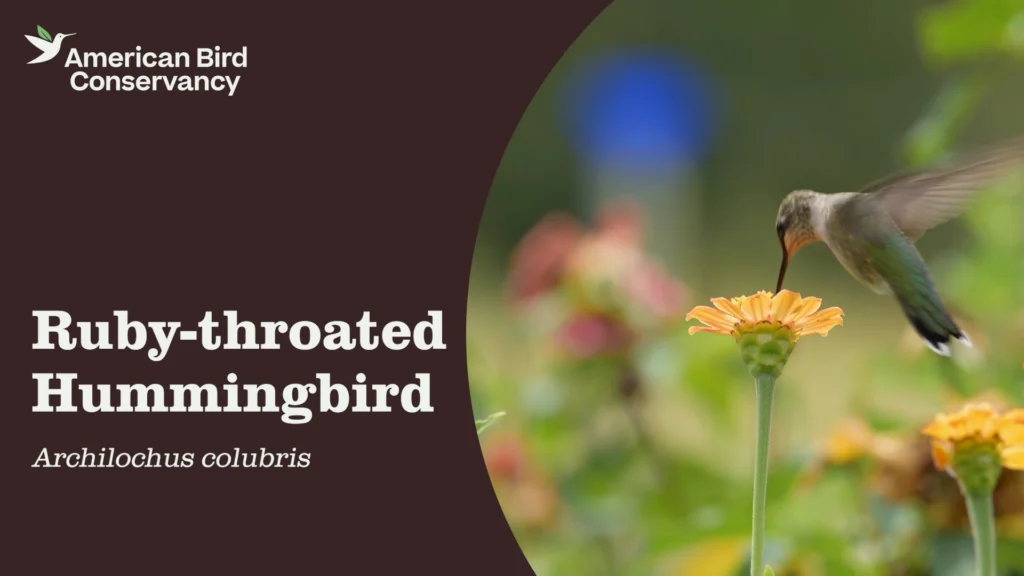
The Ruby-throated Hummingbird is as tiny as it is vibrant, measuring less than 4 inches long. The bird’s back and head are a spectacular, iridescent green-gold offset by white underparts. Males have a brilliant metallic ruby-red throat, called a gorget, and a forked tail. Females lack the colorful throat and have a square, white-tipped tail. Immature Ruby-throated Hummingbirds resemble adult females, but young males may show a hint of the species’ signature jewel-toned red feathers on the throat.


The male Ruby-throated Hummingbird greets the day with a song that consists of a simple series of chips. A commonly heard call given by both sexes is a squeaky chee-dit. The rapid beating of the Ruby-throated Hummingbird’s wings also creates a humming sound.
Credit: Russ Wigh, XC505916. Accessible at www.xeno-canto.org/505916.
Credit: Manuel Grosselet, XC758917. Accessible at www.xeno-canto.org/758917.
Credit: Patrick Turgeon, XC139834. Accessible at https://xeno-canto.org/139834.
The Ruby-throated Hummingbird is a bird of forests both on its breeding territory and its nonbreeding grounds. It resides in a variety of forested habitats as well as semi-open habitats like fields and meadows.


Specific Area
Eastern North America, western Canada, Mexico, Central America
Range Detail
The Ruby-throated Hummingbird is the only hummingbird species that nests east of the Mississippi River. During the spring and summer, Ruby-throated Hummingbirds may be found from southern Canada across the central and eastern states to the Gulf Coast. They spend the nonbreeding season mainly in the tropics, from coastal southern Mexico south to northern Panama, although some spend the season along the U.S. Gulf Coast and at Florida’s southern tip.
Did you know?
Incredibly, Ruby-throated Hummingbirds fly straight across the open water from Central America to the U.S. Gulf states during their migration. This nonstop flight is an amazing feat for a bird the size of a peanut!
Ruby-throated Hummingbirds lead intense lives despite their tiny size, undertaking an epic migratory journey and fiercely defending territories, sometimes even chasing off larger birds on their breeding grounds. Their tiny feet and short legs relegate them to life on the wing, though they can perch on thin branches. Ruby-throated Hummingbirds do not form pair bonds and are generally solitary outside of breeding behaviors.
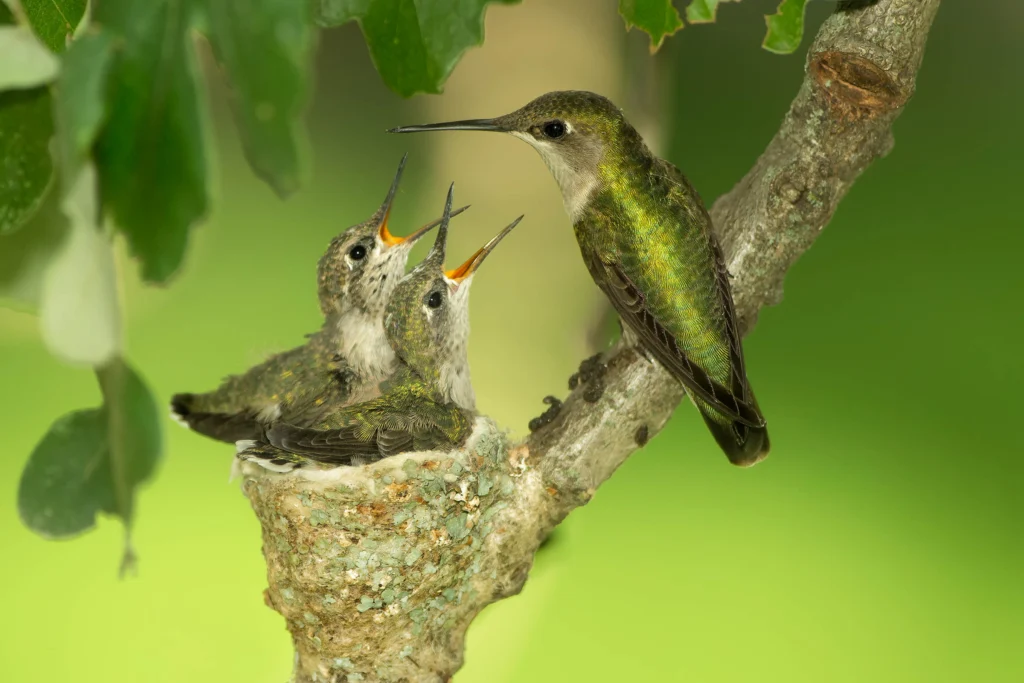
Ruby-throated Hummingbirds expend a great deal of energy during flight, so they need to feed almost constantly, each day consuming up to half their weight in sugar. They feed mainly on flower nectar, preferring red or orange tubular flowers such as Trumpet Creeper, Cardinal Flower, Spotted Jewelweed, and bee balm. They also eat insects and occasionally drink tree sap. Ruby-throated Hummingbirds also readily visit hummingbird feeders for sugar water and aggressively defend food sources against intruders.
A male Ruby-throated Hummingbird puts on an elaborate aerial courtship display, swooping from heights of up to 50 feet into a series of looping, U-shaped dives designed to impress any female entering his territory. His wings make a twittering sound during these displays, accompanied by the male’s voice, a high-pitched, squeaky chittering. Once a male Ruby-throated Hummingbird attracts a female, the two mate, and they begin to nest within the male’s territory.
The female selects a nest site near the tip of a downsloping branch above a fairly open area, sometimes above water. She builds her nest using plant material, particularly thistle and dandelion, but may also incorporate bud scales, pine resin, and spider webs. The outside of the nest is covered with lichens. Its incredibly small size — a nest is only about 2 inches across and 1 inch deep — and the lichen facade provides excellent camouflage.
The female Ruby-throated Hummingbird lays a clutch of two to three tiny eggs. As in all hummingbird species, the female provides all the care for the young, which quickly outgrow their little nest and fledge after two to three weeks.
Related News & Stories for This Bird


Although seldom seen by the casual birdwatcher, woodpecker tongues are a big part of what makes these birds unique. In combination with powerful chisel-like beaks, long, specialized tongues help woodpeckers access food other birds can't. But that's not the only thing that makes these orga...
Join the flock! Your donation helps preserve the habitats that birds need to survive.