Overview
About
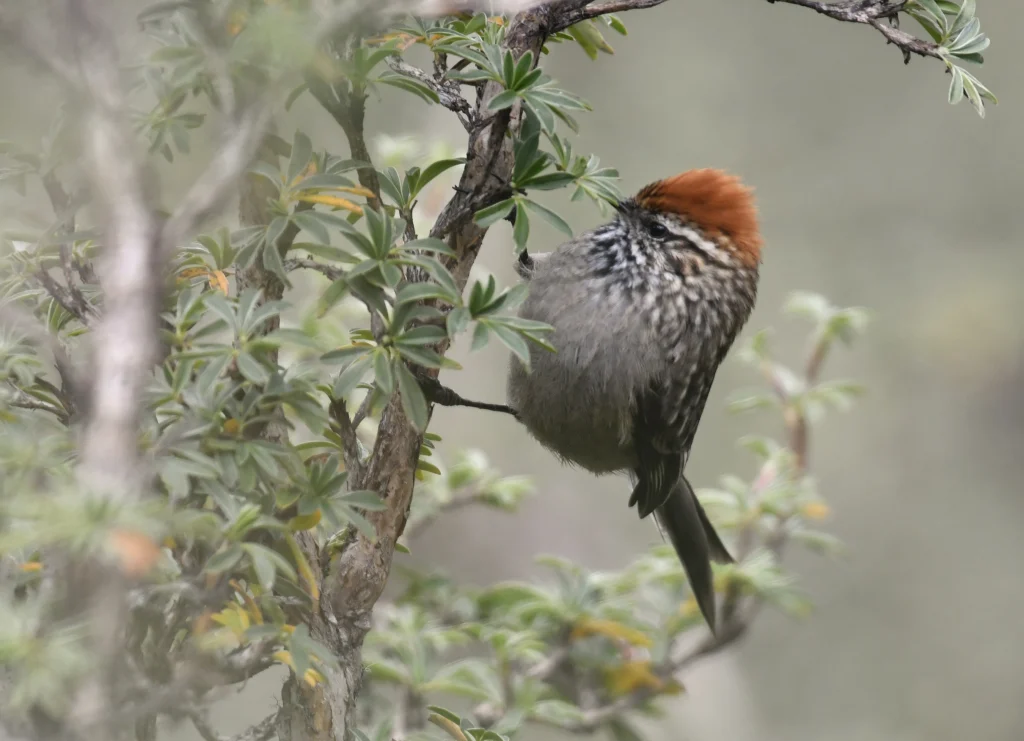
The lively little White-browed Tit-Spinetail is an extreme habitat specialist, found only in threatened Polylepis woodlands in the Andes of southern Peru. This small bird forages actively through the trees in pairs or small family groups, sometimes hanging from branches like a Carolina Chickadee or Tufted Titmouse. It often follows mixed-species flocks containing other Polylepis specialists such as the Ash-breasted Tit-Tyrant.
The White-browed Tit-Spinetail’s size and behavior led to some initial confusion about its classification. Why, and how?
Although the White-browed Tit-Spinetail reminded scientists of birds in the tit family, such as the Chestnut-backed Chickadee, it’s not closely related to them. Instead, this species is part of the huge Furnariidae, or ovenbird, family, a widely diverse, mainly insectivorous group of Neotropical birds that includes species as varied as the Royal Cinclodes and Pinto’s Spinetail.

Threats
The White-browed Tit-Spinetail is only found in small areas of high-altitude Polylepis forest in south-central Peru. This tiny, disappearing range places the species in particular peril from habitat loss.
Habitat Loss
The White-browed Tit-Spinetail’s specialized habitat is under threat. Polylepis wood is frequently harvested for fuel, and domestic animals and fires inhibit the natural regeneration of these trees.
Climate Change
Accelerating weather changes, such as rising temperatures, decreased rainfall, and melting glaciers, will affect the health and resiliency of the Polylepis forests where the White-browed Tit-Spinetail lives. Climate change can lead to range shifts, and plants like the Polylepis tree, which are adapted for high-altitude conditions, may be unable to make the move.
Conservation Strategies & Projects
Birds need our help to overcome the threats they face. At ABC, we’re inspired by the wonder of birds and driven by our responsibility to find solutions to meet their greatest challenges. ABC and our partner Asociación Ecosistemas Andinos (ECOAN) are working with local groups and communities to protect Polylepis woodlands where the White-browed Tit-Spinetail is hanging on to existence.
Creating & Maintaining Reserves
ABC and ECOAN have helped create nine nationally recognized protected areas in the Peruvian Andes that cover more than 21,000 acres of threatened habitat. ABC has directly supported ECOAN and local Indigenous communities in the Vilcanota mountains since 2002, establishing plant nurseries and greenhouses and organizing replanting events. This work has led to the planting of more than 1.6 million trees and shrubs to restore woodlands and promote fuel-efficient stoves, which reduces demand for firewood.
Supporting Partnerships
Since 2019, ABC has worked with communities in the Cordillera Vilcanota of southern Peru to make new infrastructure improvements that benefit local livelihoods and increase forest cover, protecting watersheds and rare birds.
Bird Gallery
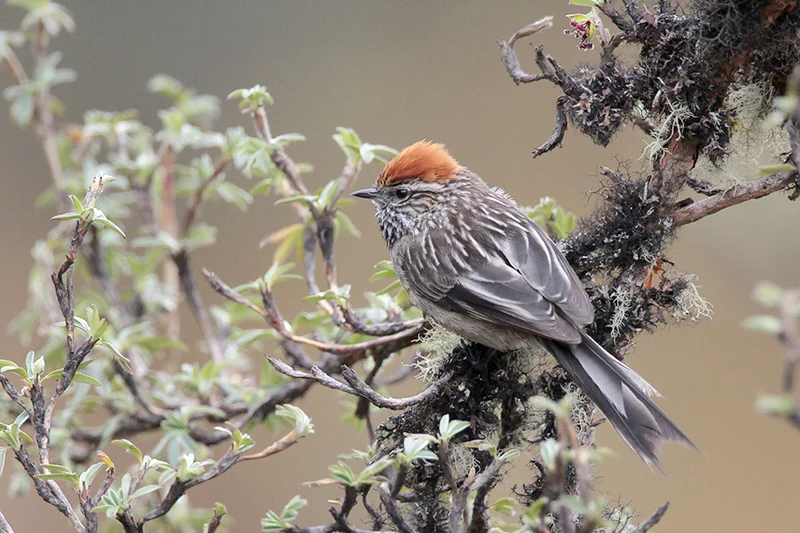
The White-browed Tit-Spinetail is a small, gray-brown bird notable for its reddish cap, white supercilium (eyebrow), and mottled black and white face, throat, and upper chest. It has a short, thin bill and a long, dark tail with graduated feathers that give it a spiny appearance. This tail is as long as the bird’s body!
A gray-brown back and wings with narrow white streaks are other field marks of this Andean specialty. The sexes look alike.
Sounds
The White-browed Tit-Spinetail is a vocal species, whose song is a dry descending trill, described as tjit tjit trrrrrrreeeeeeeeuuu. Pairs often call to each other with a note that sounds like check or tjit, and agitated individuals give a shrill tleet call.
Peter Boesman, XC225012. Accessible at www.xeno-canto.org/225012.
Peter Boesman, XC225014. Accessible at www.xeno-canto.org/225014.
Niels Krabbe, XC47660. Accessible at www.xeno-canto.org/47660.
Habitat
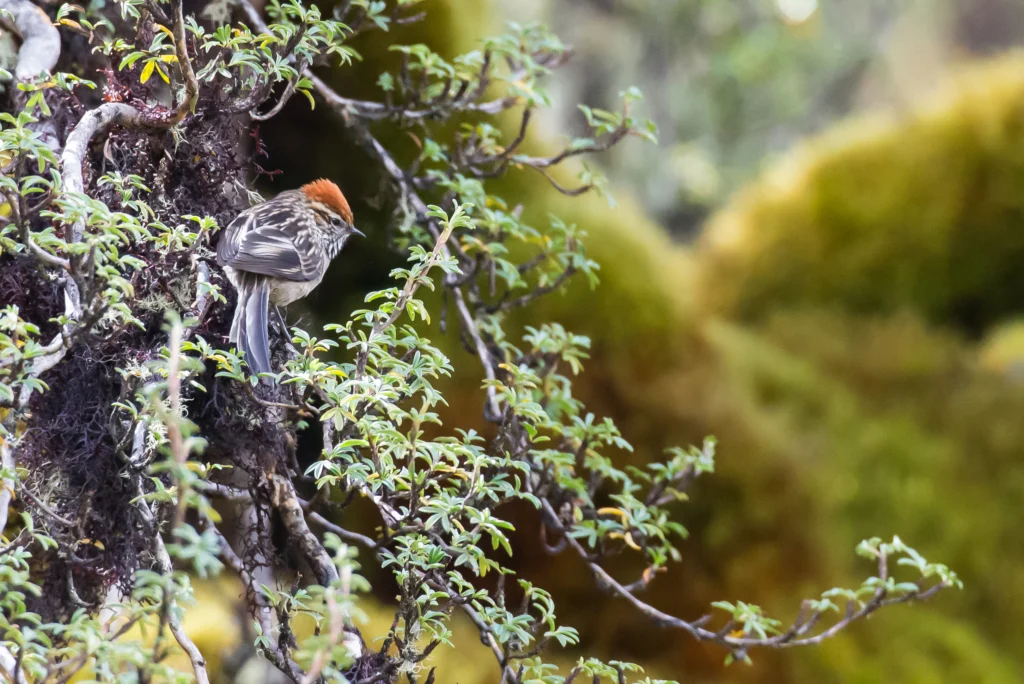
The White-browed Tit-Spinetail prefers areas of untouched Polylepis forest with dense cover, but is able to tolerate smaller patches of this habitat.
- Inhabits Polylepis forests occurring at an altitude of 15,000 feet in the Andean Mountains
- May also be found in montane scrublands
Range & Region
Specific Area
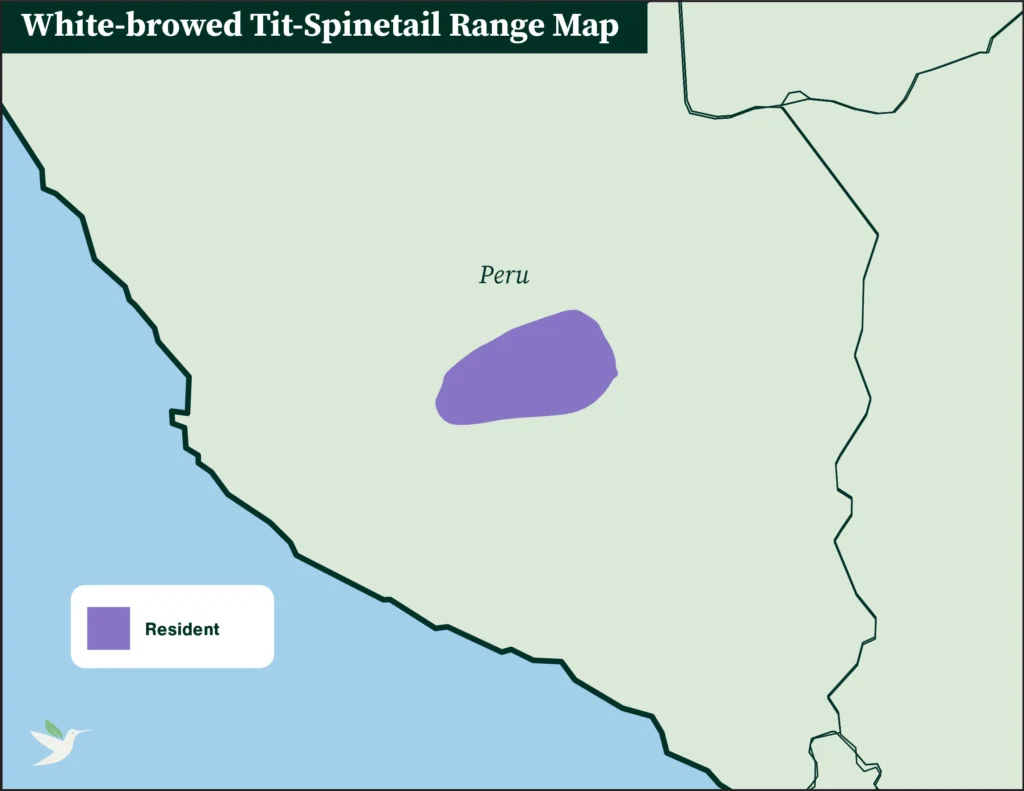
Andean Mountains of south-central Peru
Range Detail
The White-browed Tit-Spinetail is restricted to a few highly fragmented and rapidly disappearing forests in the Andean Mountains of south-central Peru. It’s known from only a handful of sites.
Did you know?
Today, once numerous Polylepis forests cover a mere three percent of their former range. Unsustainable harvesting of wood, land clearing, and cattle grazing have severely impacted the trees, which are the highest-growing flowering trees found anywhere on Earth — Polylepis can grow in habitats up to 16,400 feet above sea level. The trees are vital for birds like the White-browed Tit-Spinetail and Royal Cinclodes.
Life History
The medium-sized, long-tailed White-browed Tit-Spinetail forages on the outermost branches of Polylepis trees in pairs or small groups, while following mixed-species flocks. Highly arboreal and highly vocal, the species moves quickly through trees, singing and trilling as it goes.
Diet
Adult White-browed Tit-Spinetails are active and acrobatic feeders, gleaning the leaves, twigs, bark, and flower clusters along the outer branches of Polylepis trees while searching for prey. Like other birds in their genus, they are insectivorous, their prey consisting of beetles, grubs, flies, spiders, and moths.
Courtship
The White-browed Tit-Spinetail is thought to form monogamous pairs during the austral breeding season, which lasts from October through December. Males may court females with singing or flight displays.
Nesting
Both members of a White-browed Tit-Spinetail pair gather bark fibers, lichen, and mosses to build a cup-shaped nest within a natural cavity in the main trunk of a Polylepis tree, roughly 7 feet above ground.
Eggs & Young
The female lays a clutch of two pale eggs. After hatching and fledging, the young birds remain with their parents and regularly forage with them. Unlike adults, the young birds seem to feed in the more protected interior areas of Polylepis trees.