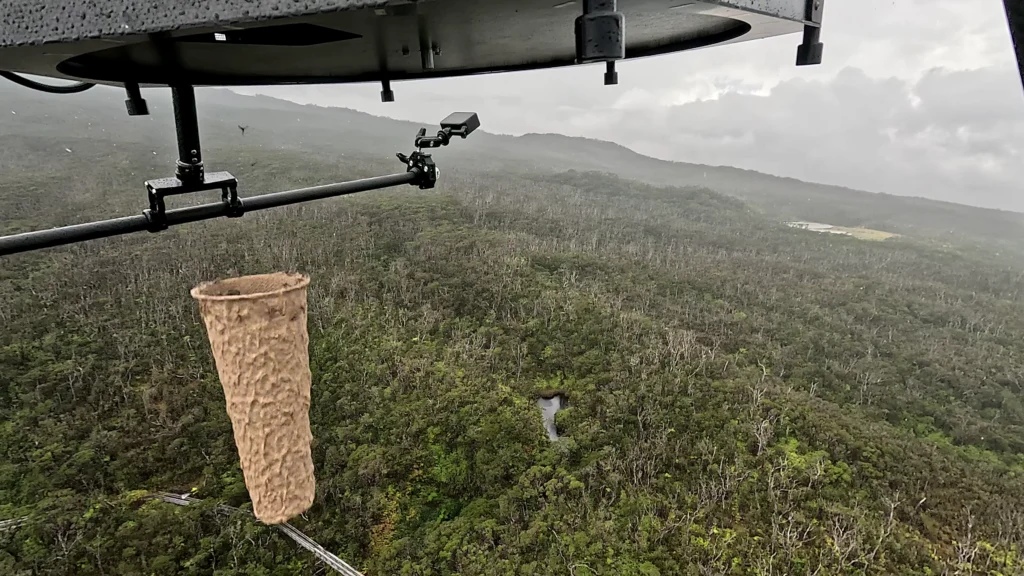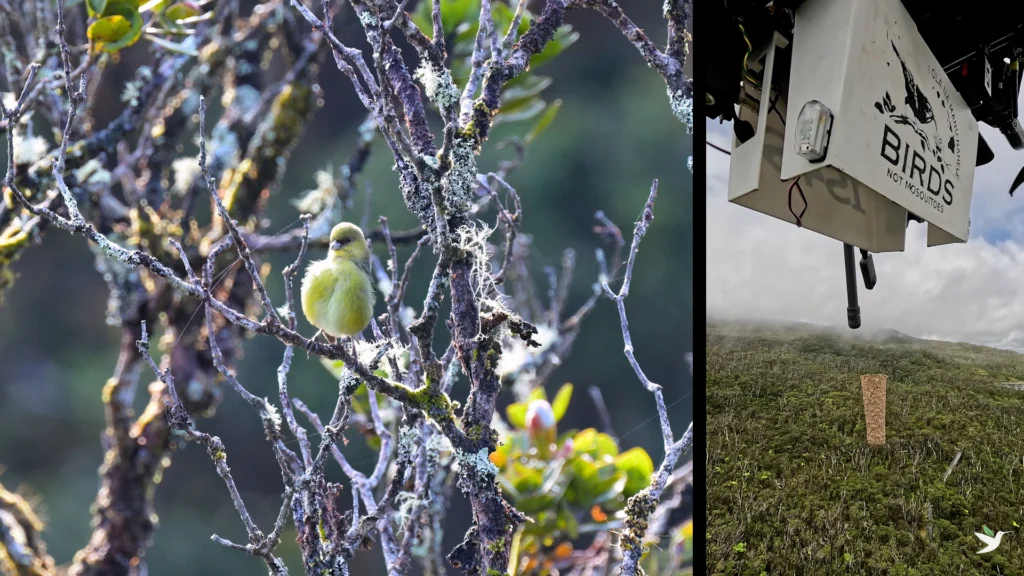
In a race to protect rare Hawaiian honeycreepers from extinction, American Bird Conservancy (ABC) and members of the multi-agency Birds, Not Mosquitoes (BNM) partnership have started using drones to combat deadly avian malaria, spread by non-native mosquitoes. The drones are expected to expedite an innovative solution to this urgent threat: They deliver non-biting, lab-reared male mosquitoes carrying a common bacteria that results in sterile eggs when the males mate with wild females. Over time, the invasive mosquito population will be reduced, and native bird populations will have the chance to recover.
Part of a multistep honeycreeper conservation plan that began with helicopter deployments, the male mosquitoes are delivered in biodegradable pods, each of which contains about 1,000 insects. This effort marks the first known instance of specialized mosquito pods being dropped by drones.
“It’s extremely exciting to have reached this project milestone,” said Adam Knox, who is the drone pilot and Aerial Deployment of Mosquitoes Project Manager for ABC. “The first drone deployments took place in April 2025. It took a lot of hard work and reliance on strong partnerships to reach the point where we could successfully demonstrate the utility and potential of drone aircraft as a tool for this important work, especially in one of the more challenging environments in the world. This opens up a lot of possibilities now and into the future. With a drone, we have more flexibility with deployment timing in areas that generally have very unpredictable weather, and it’s safer because no humans need to ride in the aircraft as pilot and crew to deploy the mosquitoes.”
“Without significantly reducing invasive mosquito populations, multiple native bird species will disappear forever in the near future,” said Dr. Chris Farmer, ABC’s Hawai‘i Program Director. “At least 33 species of honeycreeper are now extinct, and many of the 17 that remain, including the Kiwikiu and ʻĀkohekohe on Maui, and ʻAkekeʻe on Kauaʻi, are highly endangered. Last year, the ʻAkikiki became functionally extinct in the wild, and mosquitoes could cause other species to quickly decline and vanish if no action is taken.”