Overview
About
The Horned Lark is the only lark species native to the Americas. However, it is also found across much of the Northern Hemisphere, from Morocco to the Balkans, Scandinavia, the Middle East, Central Asia, and Siberia. Perhaps its widespread distribution is related to the Horned Lark’s adaptability; essentially, any habitat with low vegetation will do. The English nickname of “shorelark” derives from this bird’s willingness to spend both breeding and nonbreeding seasons on beaches and dunes, while the Latin species name given to it by Linneas literally means “of the Alps.” This bird is also happy to spend its days in deserts or tundra.
Although widespread and common in many treeless landscapes, the Horned Lark doesn’t always prove easy to find. Despite bold head patterns, they are otherwise cryptically colored, their tan-to-gray backs shielding them from view among similarly colored soil, stubble, and stone. Across expansive fields and plains, even active flocks are hard to notice as they forage, walking or running in erratic patterns as they glean seeds and pursue small insects.
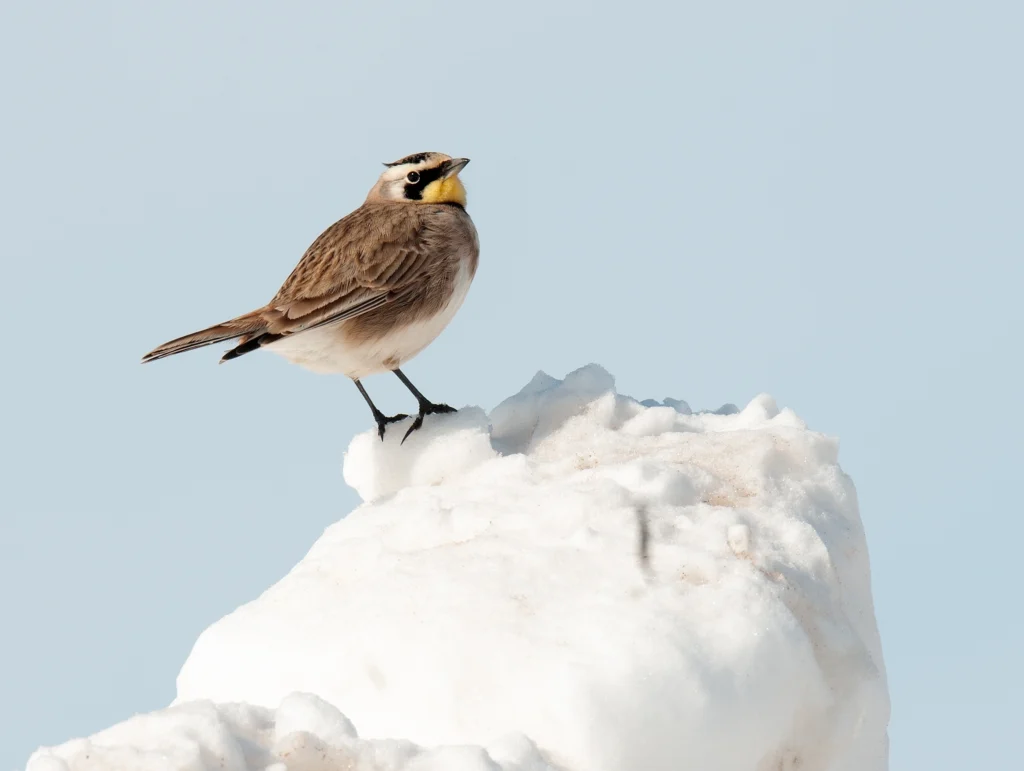
Horned Larks are often easier to spot in winter when snow covers the ground, and the birds stand out against the white backdrop, frequently in flocks with Lapland Longspurs and Snow Buntings. The larks often forage along roadsides, in feedlots, and in fields where manure and waste grain are spread, especially when snow cover is heavy. During the breeding season, however, the easiest way to locate larks is by ear, thanks to their distinctive and pleasing song. Even if a landscape seems birdless, the lark’s presence is undeniable when its tinkling song is heard.

Threats
Birds around the world are declining, and even species as widespread and abundant as the Horned Lark face uncertain futures. The Partners in Flight coalition classifies the Horned Lark as a Common Bird in Steep Decline. Other common birds in similar straits include the Northern Bobwhite, Common Nighthawk, and Yellow-billed Cuckoo.
Pesticide Poisoning & Insect Depletion
For most of the year, Horned Larks are primarily seed-eaters, and often forage in agricultural fields in the nonbreeding season. This puts them at high risk of ingesting pesticides that are commonly applied to commercial crop seed. When their diet shifts primarily to insects in the breeding season, adults and young are at risk of eating contaminated insects or of running out of food if pesticides have taken a toll on insect populations.
Vanishing Prairies & Grasslands
Ongoing habitat loss is one of the greatest threats to species like the Horned Lark, which depend on treeless landscapes, such as grassland and prairie. These habitats are frequently developed or converted for agriculture. While Horned Larks do well on agricultural lands in the nonbreeding season, these areas can act as ecological traps for breeding birds; birds raise fewer young due to tilling and exposure to pesticides. The prairies that support this species over much of its North American range are drastically depleted, having previously been maintained by fire and grazing by bison and prairie dogs, all of which have been severely suppressed over the last century.
Collisions with Poorly Sited Wind Turbines
The switch to renewable energy sources is better for our planet’s fragile climate, but without proper siting, it can come with steep costs to birds. Wind farms are often sited in open habitat such as grassland and prairie, making them especially dangerous for birds like the Horned Lark that rely on these areas.
Conservation Strategies & Projects
Birds need our help to overcome the threats they face. To mitigate the impacts of environmental degradation, pesticides, and other risks to birds, ABC works with stakeholders across the spectrum to protect birds and the ecosystems they depend on.
Understanding & Addressing Pesticide Impacts
ABC works with partners at the state and federal levels in the U.S. to call for the regulation or cancellation of the pesticides and toxins most harmful to birds. We develop innovative programs, like working directly with farmers to use neonicotinoid coating-free seeds, advancing research into pesticides’ toll on birds, and encouraging millions to pass on using harmful pesticides.
Partnering for Improved Prairies & Grasslands
A range of natural and modified habitats can support Horned Larks in the nonbreeding season, but nesting birds are most successful in native desert, tundra, and prairie. To help these and other grassland species thrive, ABC partners with other conservation groups, government agencies, ranchers, private landowners, and industry representatives to make sure vital habitats persist into the future.
Encouraging Bird-Smart Wind Energy
If not sited properly, wind turbines can spell disaster for migrating birds, as well as species that rely on habitat where wind turbines are built. ABC’s science-backed approach to Bird-Smart wind energy identifies the most critical areas for birds and provides guidance to the wind industry to support safer wind solutions for birds.
Bird Gallery
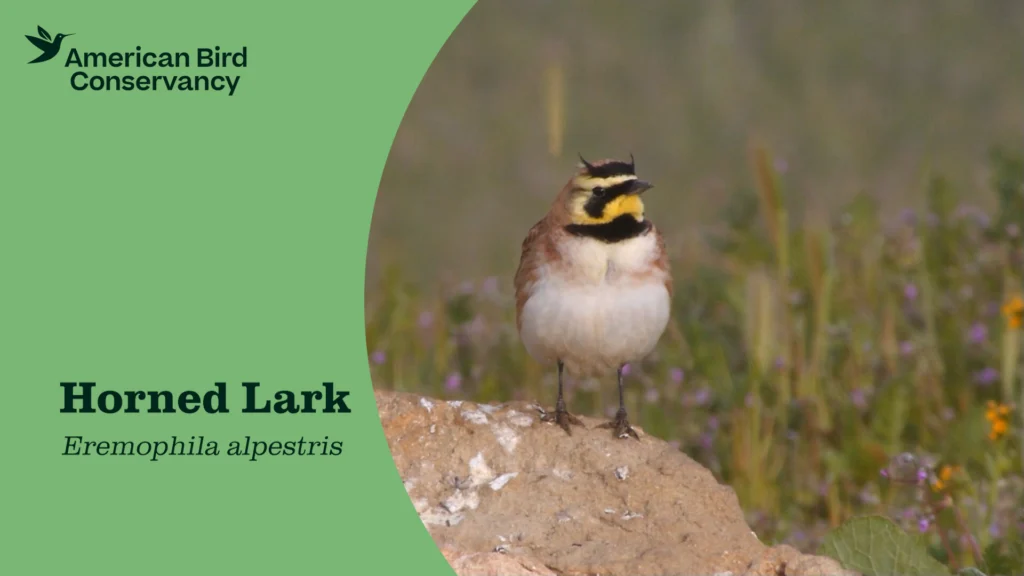
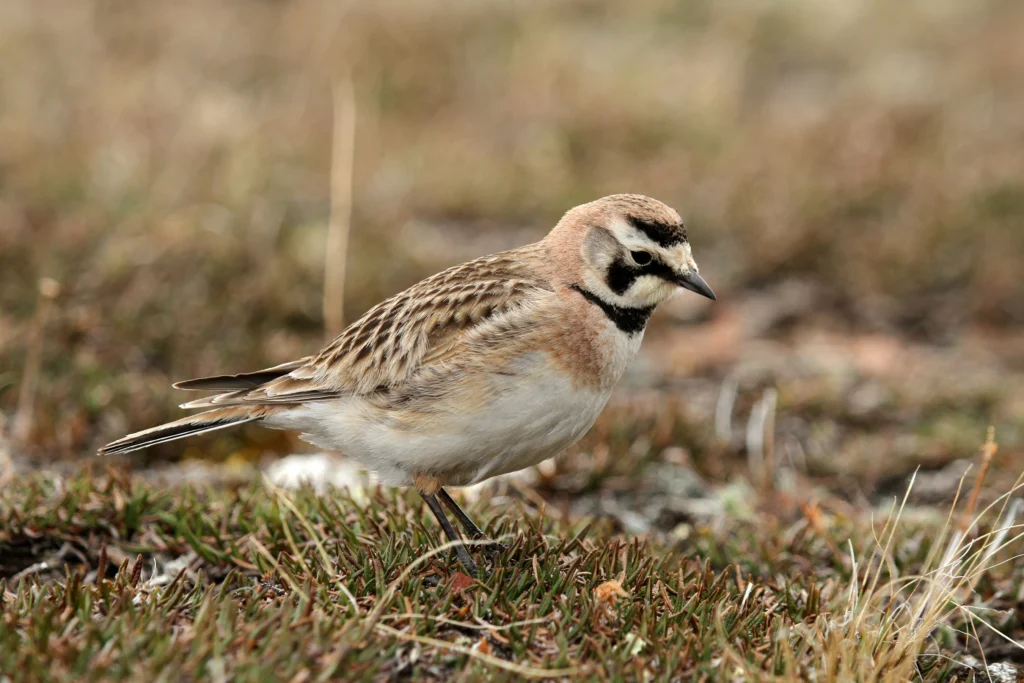
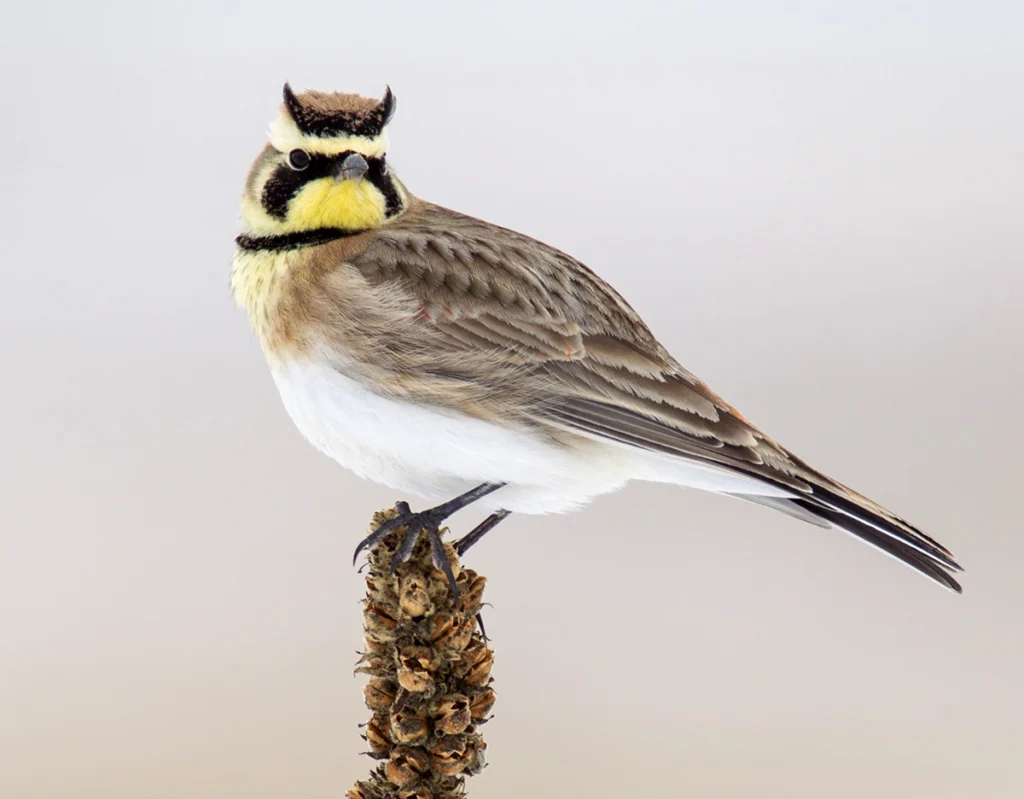
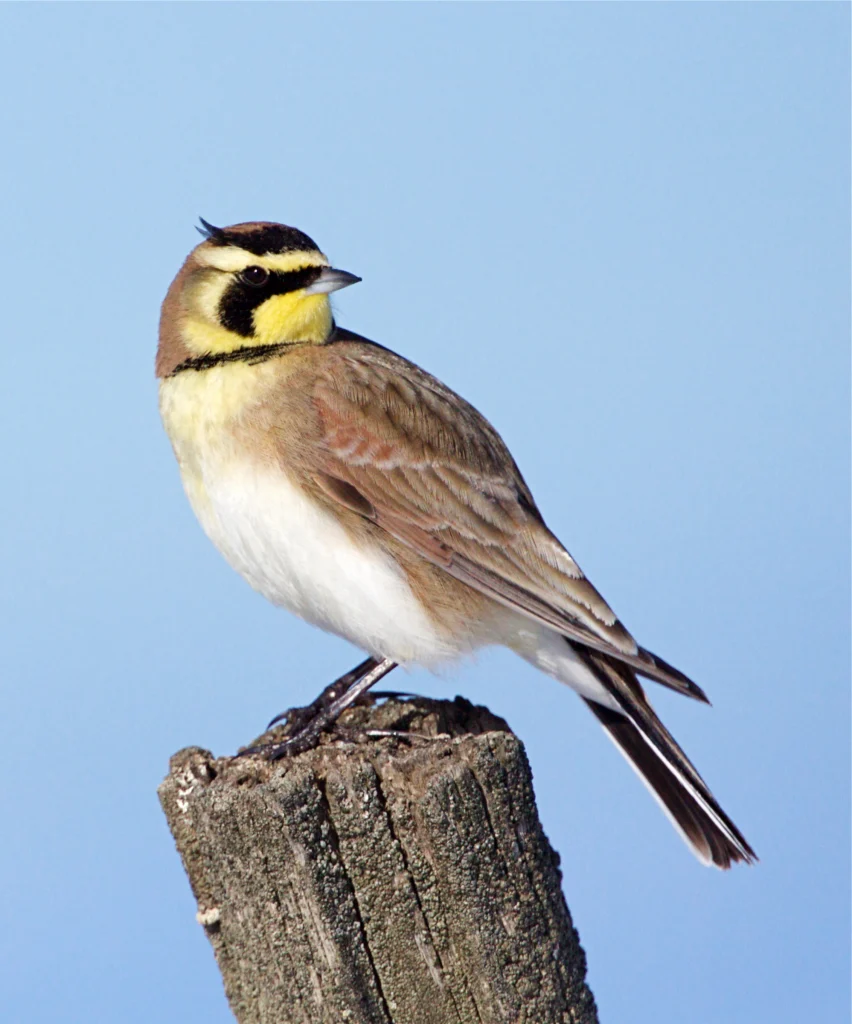
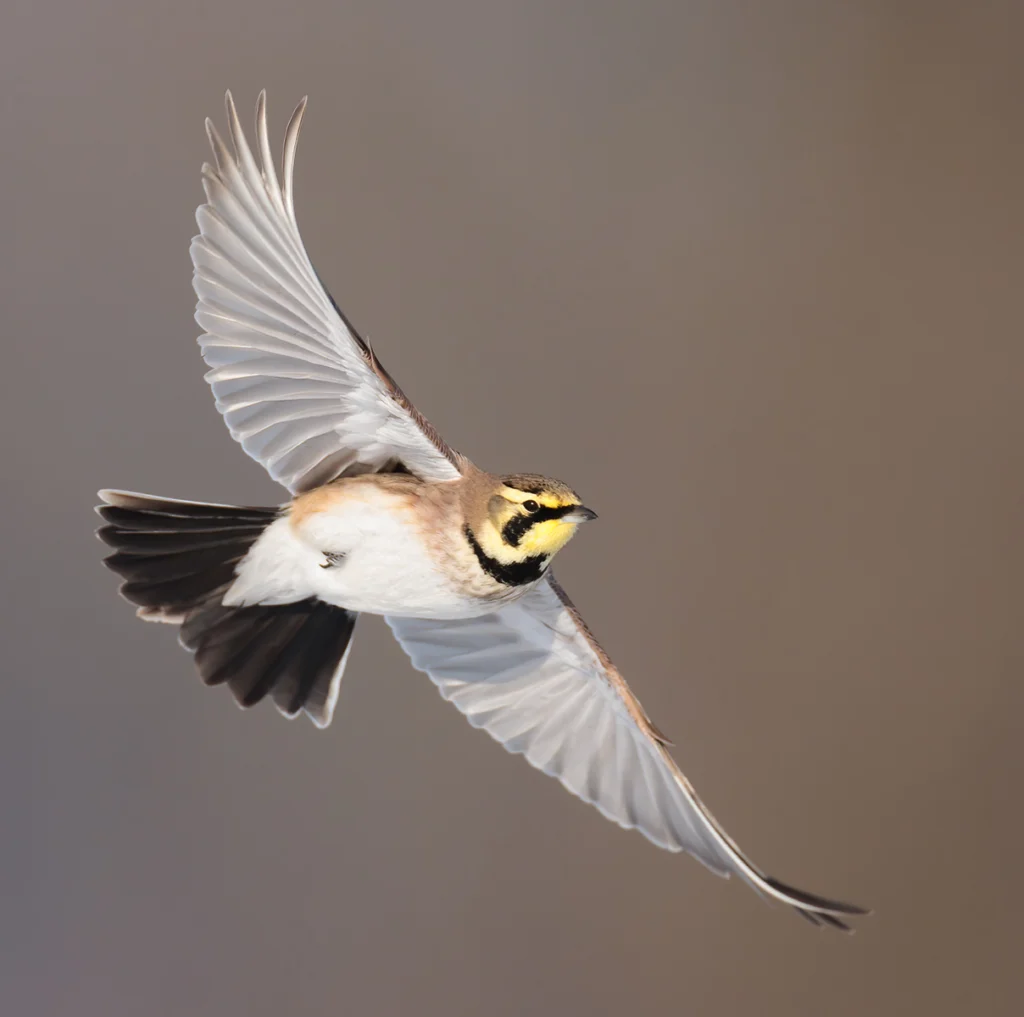
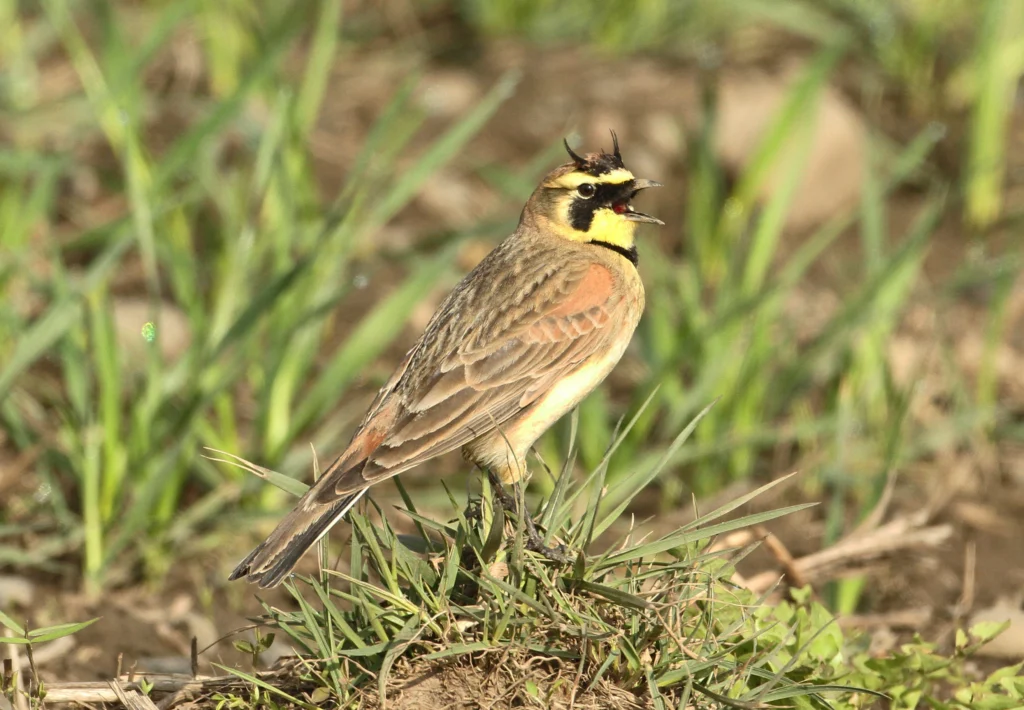
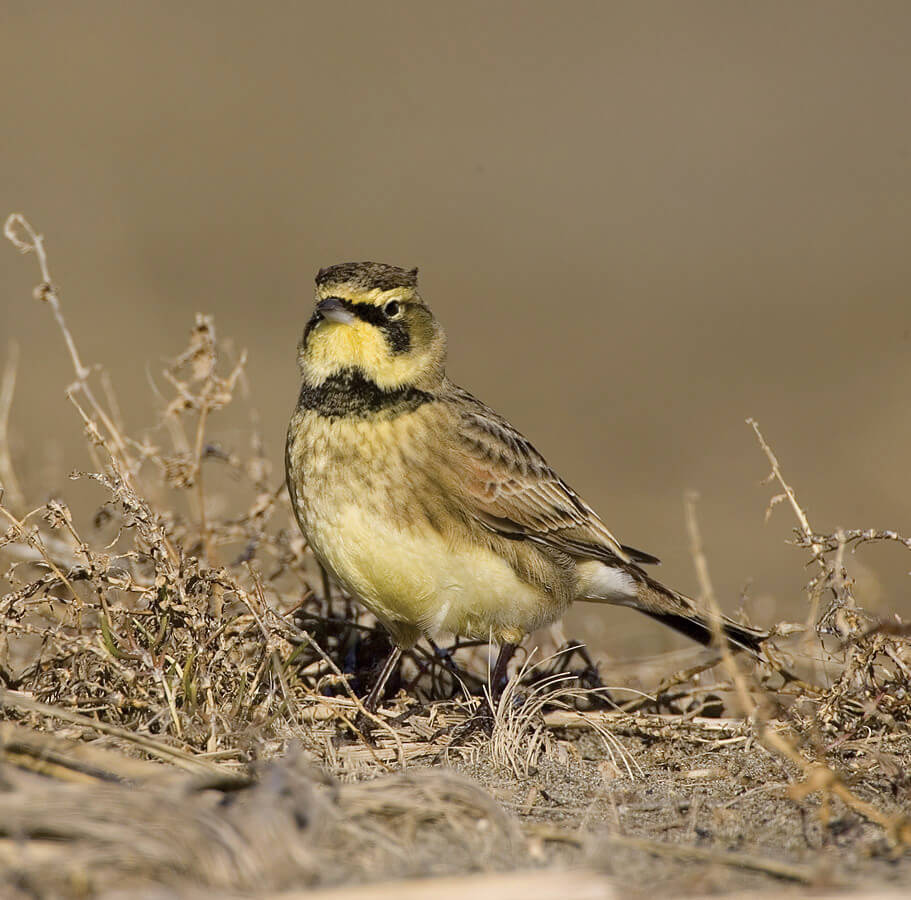
This bird’s namesake “horns” are actually curled tufts of feathers that can be erected, and are usually visible only at close range. Male birds sport these little tufts of black during the breeding season, at times raising or lowering them expressively. The Horned Lark is most recognizable for the bold patterning on the face and throat, in motifs of black and yellow or white. The black bib, cheeks, eye stripes, and pointed “horns” contrast with the bright yellow-to-white throat and forehead. Underneath, the bird is mostly white. From above, the bird’s coloration matches the environment, from sandy gray to cinnamon brown. The tail is a contrasting black or dark brown, with obvious white outer tailfeathers.
Sounds
The male Horned Lark sings his sweet, tinkling song from a low perch, or as part of a dramatic flight display. Starting relatively slow, his lilting song speeds up rapidly toward the end, quickly rising in pitch before abruptly stopping. One- and two-noted calls have a characteristic sweet quality and are most often heard in fall and winter.
Credit: Ed Pandolfino, XC482274. Accessible at https://xeno-canto.org/482274.
Credit: Paul Driver, XC70543. Accessible at https://xeno-canto.org/70543.
Habitat
Horned Larks prefer habitats with bare ground or very short vegetation in both breeding and nonbreeding seasons. Across North America, this includes a wide variety of treeless landscapes, from sea level to high in the Rockies.
- On coasts, will spend breeding and nonbreeding seasons on beaches and sand dunes
- Inland, occupies deserts, steppe, grassland, tundra, and alpine habitat
- Also uses pasture and agricultural land, as well as mowed areas in airfields
Range & Region
Specific Area
Canadian Arctic Archipelago south into Baja California, central Mexico, and Florida; southern Mexico; central Colombia
Range Detail
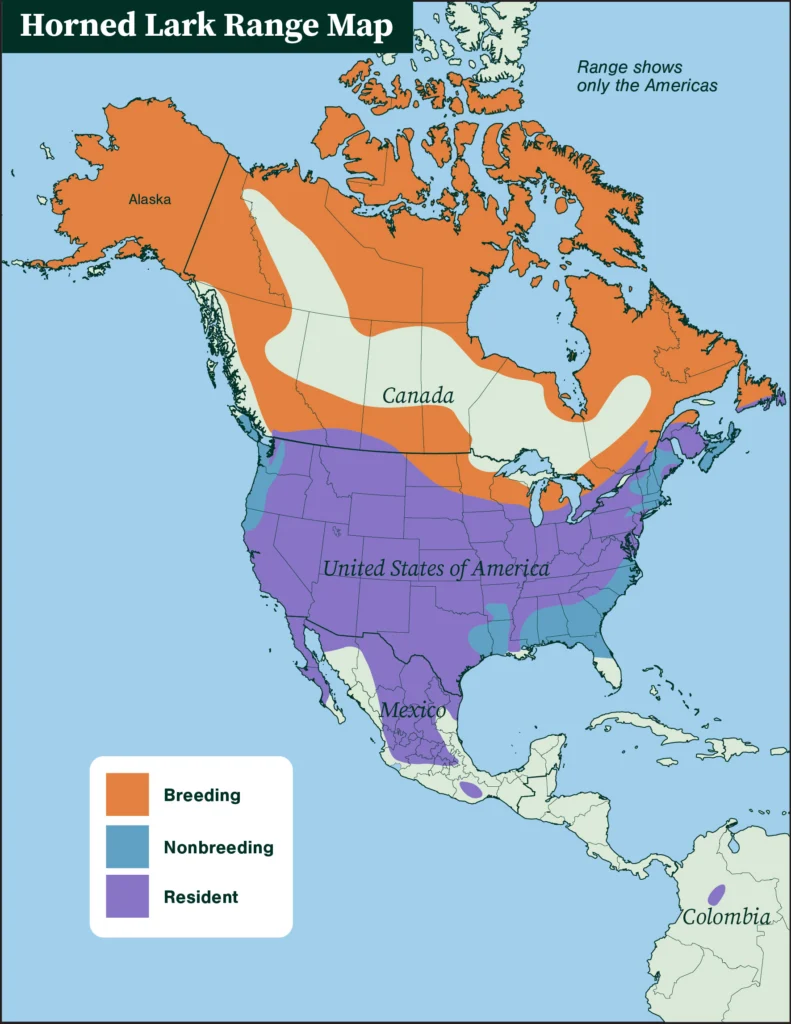
In North America, the Horned Lark is a spring and summer nester across Alaska and in much of Canada (outside the country’s boreal-forest belt), retreating southward in fall. Across much of the lower 48 U.S. states, this bird can be found year-round. One exception: much of the Southeast, where this bird is known mostly as a winter visitor. The Horned Lark also occurs year-round in northern and central Mexico, and there are isolated populations in southern Mexico and central Colombia.
Did you know?
The Horned Lark is a variable species, divided into 42 subspecies worldwide! Twenty-one of these subspecies occur in North America. One of them, the Streaked Horned Lark of the Pacific Northwest, is listed as Threatened under the Endangered Species Act. One key factor differentiating subspecies is the color of the plumage as viewed from above, which has evolved to match the color of the substrate. Desert subspecies in the Southwest are paler than their cousins in the more humid Northeast.
Life History
The Horned Lark is mostly confined to the ground, where they nest, forage for seeds and insects, and shelter from predators and environmental extremes. This bird will often fly just above the ground as well. However, similar to other birds of open, flat landscapes, like the Red Knot and Chocolate-vented Tyrant, the Horned Lark performs a flight display in courtship that takes it to dramatic heights.
Diet
Horned Larks primarily eat seeds, especially from grasses. Adults feed their young almost exclusively with insects during the breeding season, especially grasshoppers, beetles, and caterpillars. At this time, adults will eat some insects themselves as well, but still subsist primarily on seeds. During the nonbreeding season, larks may feed extensively in agricultural fields or feedlots.
Courtship
The courtship flight of the male Horned Lark illustrates much of what we love about birds: beauty, song, and feats of athleticism humans can only dream of. The male Horned Lark climbs steeply and silently into the sky, ascending hundreds of feet above open fields. Then, he fills the sky with a tinkling cascade of notes before plunging toward the ground in pursuit of the female’s attention. Males also perform a courtship display on the ground, extending wings and tail, fluttering, and strutting in front of the female. A female shows her readiness to mate with a display that involves crouching, drooping her wings, and vibrating her tail.
Nesting
The female chooses a nest site on bare ground, either a natural depression or one she excavates herself with her bill and feet. She weaves her nest into the depression, using grasses or other vegetation, then lines the interior with rootlets, fur, feathers, or other fine materials. She often adds a flat “doorstep” of pebbles, corncobs, or dung on one side. The purpose of this “paved” area is still unknown, although some scientists suspect that it serves to cover the fresh dirt from nest excavation, helping to conceal the site. Additionally, these heavier objects may shelter lighter materials from harsh wind during nest construction.
Eggs & Young
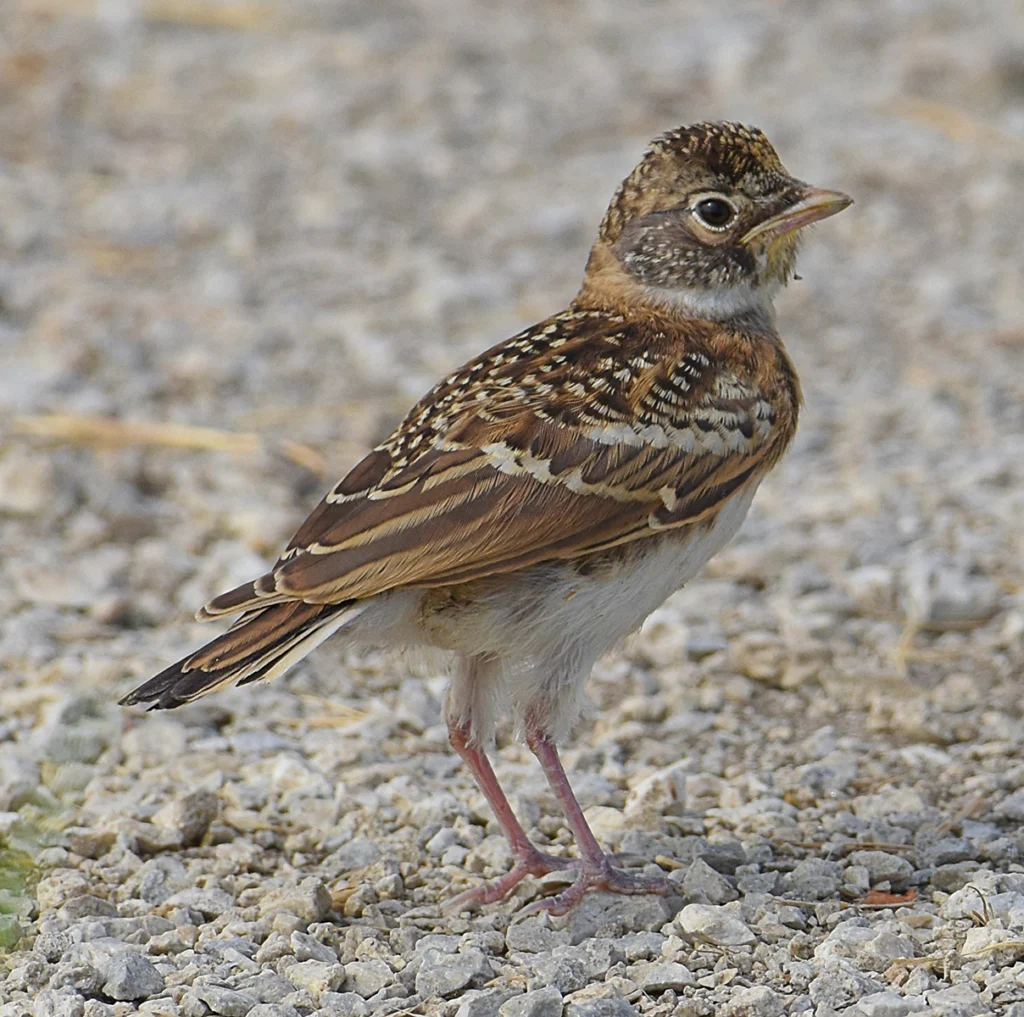
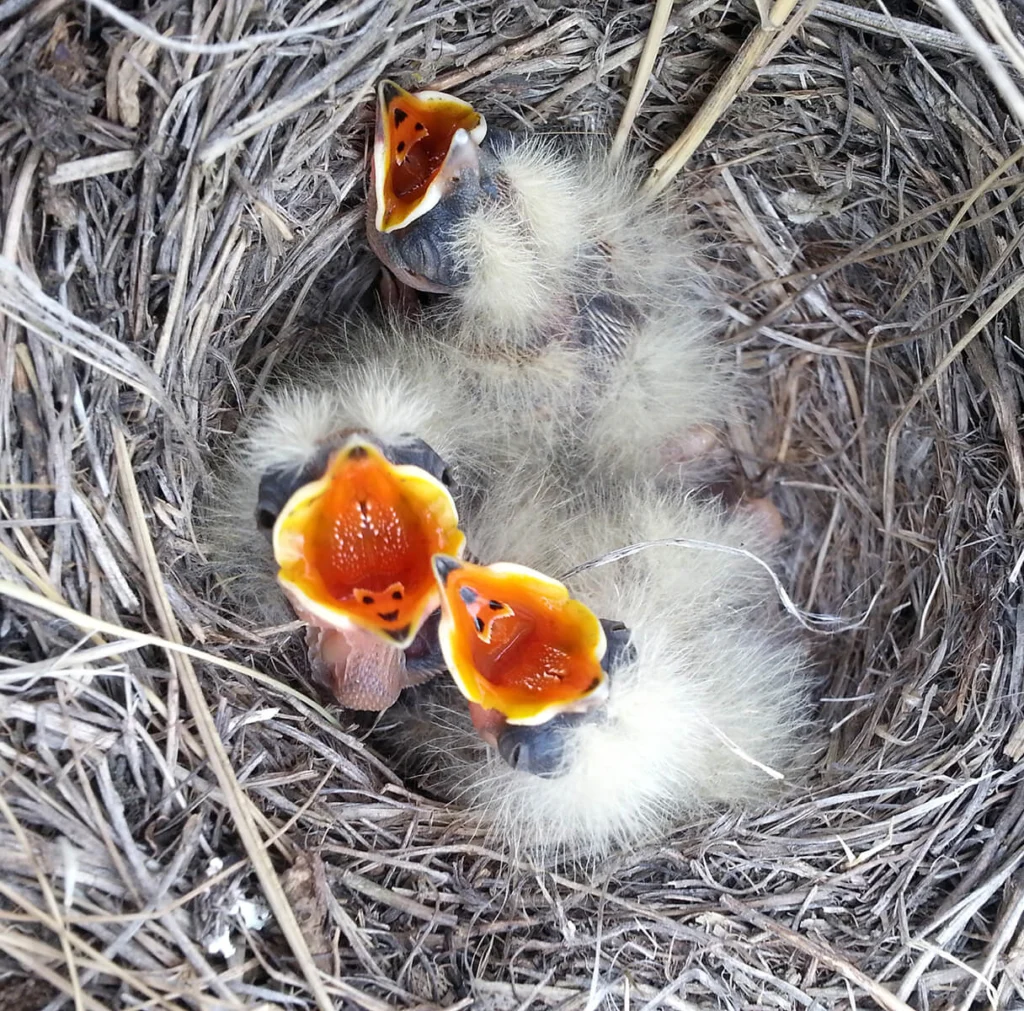
The female lays three to four eggs, pale and evenly spotted brown. She incubates her eggs for 11 or 12 days, shading the nest with her wings in high temperatures. After hatching, both parents feed their young at the nest, also for up to 12 days. Similar to other ground-nesting birds, the legs of Horned Lark nestlings grow quickly, and young are able to move comfortably on the ground even before they are able to fly. This gives fledglings an advantage in avoiding terrestrial predators, which pose a greater threat to young birds starting off on the ground than those in elevated nests. These vulnerable nests are documented to have been preyed on by some usually harmless species, including insectivorous shrews, omnivorous deer mice, and even the otherwise herbivorous meadow vole!