Overview
About
The Common Loon is the largest and most widespread of the five loon species found in North America. A formidable swimmer and diver, this handsome waterbird is a veritable avian submarine, beautifully adapted to a life in and on the water.
Common Loons often vocalize at night, adding an otherworldly dimension to their sounds. Ornithologist Arthur Cleveland Bent observed:
“The woodland lakes would be solitudes, indeed, did they lack the finishing touch to make the picture complete — the weird and mournful cry of the loon, as he calls to his mate or greets some new arrival. Who has ever paddled a canoe, or cast a fly, or pitched a tent in the north woods and has not stopped to listen to this wail of the wilderness? And what would the wilderness be without it?”
Common Loons are unusual in that their migration takes them not only from inland to the sea, but also, for some birds, from the Western to the Eastern Hemisphere, spending winters along the Atlantic coasts of mainland Europe from Portugal to Scandinavia, the British-Irish Isles, and Iceland. The Latin species name for the Common Loon, immer, is related to the Icelandic word himbri, which translates roughly to “foam roarer” — a reference to its seacoast habitat in the northern winter. Other European names reference the loon’s appearance in winter, its coal-colored nonbreeding plumage, and even its clumsiness on land.
The Common Loon, Maang, holds a place of special importance in Ojibwe culture, owing to the loon’s ability to move between the two worlds of water and land, the former identified with the spirit world. The pivotal importance of the Common Loon is also seen in the night sky, where the constellation Maang contains the North Star Giwedin’anung. This constellation is made up of the same stars as the English Little Dipper, and is the figure around which all other constellations move. The Common Loon is a truly iconic bird, important in human culture as well as the ecology of the lakes and seas it calls home.
Threats
Common Loon populations are considered stable, but in North America, their breeding range has retracted considerably. Formerly nesting in much of the Midwest, the Common Loon has disappeared from breeding grounds in Iowa, Illinois, Indiana, and Ohio, and from the southern parts of Minnesota, Wisconsin, and Michigan. Because of its sensitivity to environmental factors like pollution and underwater visibility, the Common Loon is a useful indicator of the health of aquatic habitats.
Pesticides & Toxins
Common Loon populations in the continental United States have declined drastically in the face of pollution from coal-burning power plants. Like the Bald Eagle, Common Loons are apex predators, so they receive the highest dose of toxins such as mercury, along with other metals freed up from the substrate by acid rain. These metals accumulate up the food chain, reaching high levels in the loons. Lead poisoning is another major cause of mortality, caused by the fishing sinkers that loons sometimes ingest along with grit.
Wind Turbines & Energy
The switch to renewable energy sources is better for our planet’s fragile climate, but without proper siting, it can come with steep costs to birds. Wind turbines placed within migration pathways put huge numbers of birds, like the Common Loon, at risk.
Fisheries
Common Loons, along with many other ocean-going birds, are harmed by unsustainable fishing practices. Each year, hundreds of thousands of birds are victims of bycatch when they become entangled in fishing nets and lines. Loons are commonly caught in fishing nets on coastal waters and in the Great Lakes during the nonbreeding season.
Habitat Loss
Habitat loss and degradation can cause major declines in Common Loon populations. Shoreline development, especially on lakes, reduces suitable nesting habitat by removing vegetation, while also increasing disturbance due to human activity and increasing the numbers of nest predators like raccoons.
Conservation Strategies & Projects
Even iconic birds like the Common Loon need our help to overcome the threats they face. At ABC, we’re inspired by the wonder of birds and driven by our responsibility to find solutions to meet their greatest challenges. With science as our foundation, and with inclusion and partnership at the heart of all we do, we take bold action for birds across the Americas.
Support Petitions & Advocacy
Through advocacy, ABC ensures birds have a seat at the table. ABC advocates for non-lead exchanges, giveaways, and education on the harmful effects of lead shot and fishing tackle on birds, especially the Common Loon on their breeding waters. We also launched SPLASh (Stopping Plastics and Litter Along Shorelines) along with several partner organizations to clean up trash on the Texas Gulf Coast, important nonbreeding habitat for loons.
Rethinking Wind Turbines
If not sited properly, wind turbines can spell disaster for migrating birds. ABC encourages wind developers to plan their projects with Bird-Smart Wind Principles in mind. We create resources such as our Wind Risk Assessment Map to help developers make informed decisions about where their projects are located, and we advocate at the state and federal levels for policies that align with our Bird-Smart Wind Principles.
Addressing Fisheries
A huge number of bird species rely directly on the ocean, whether year-round or, like the Common Loon, specifically during the nonbreeding season. ABC works with partners throughout the Western Hemisphere to address the problems of fisheries bycatch, overfishing, the overwhelming presence of plastics in our waterways, and to help fragile ecosystems and the birds they support become more resilient.
Bird Gallery
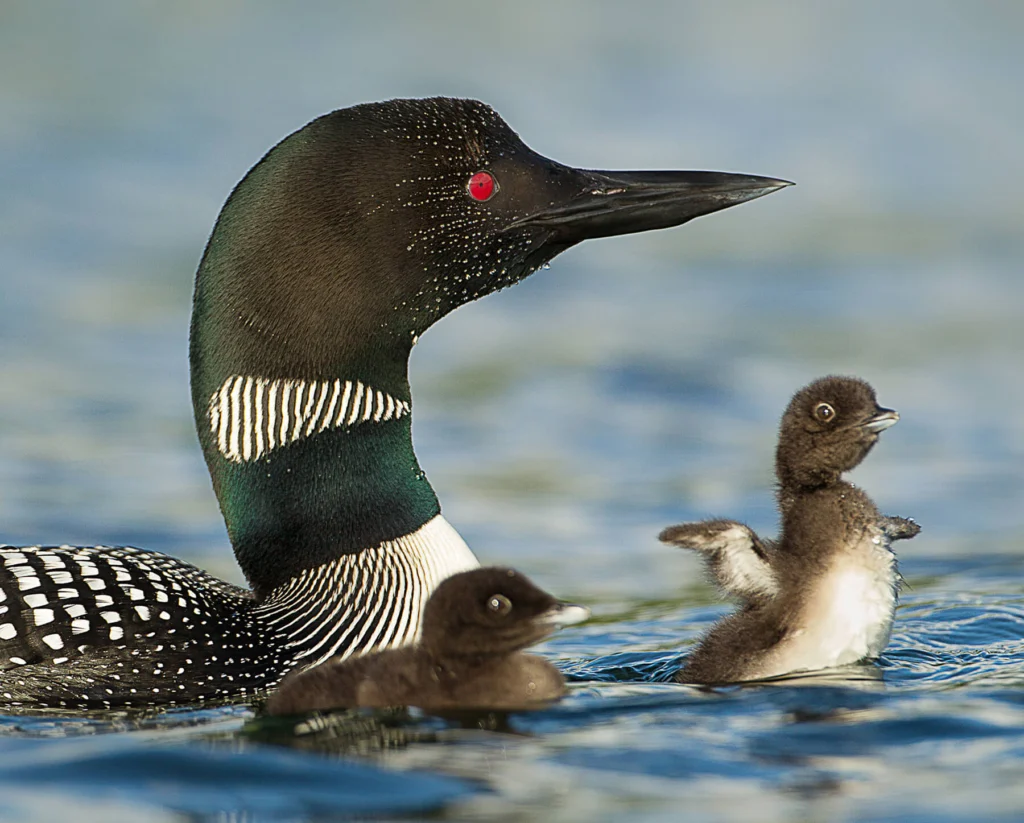
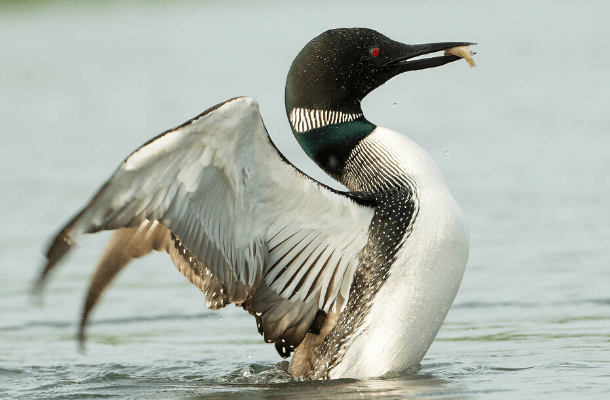
The Common Loon is an elegantly handsome bird. In breeding plumage, both male and female are most notable for the stark contrast of pitch black and pure white patterns. The back is a grid of minute squares, surrounded by fine white spots on the black outer wings, sides, and tail. The breast is framed on either side with intricate pinstripes, repeated in another band around the neck. A band of black iridescing to blue sits above the breast, and the black head and back of the neck are a similar iridescent black and green. In nonbreeding plumage, the bold patterns turn to a flat charcoal gray, while the underside and throat remain white. In all plumages, the bill is heavy and knife-like, and the eye is a striking blood red.
Sounds
Few voices are more evocative of the wild than that of the Common Loon. Eerie and otherworldly, these calls are often given at night and at high volume, carrying great distances across the lakes where they breed. Common Loons produce a number of distinct calls in different contexts and for different purposes, many of which are quite well-known. The fluttering tremolo call, sometimes compared to crazed laughter, is given when loons feel threatened, particularly in the vicinity of their nests. The eerie wail seems to function as a contact and gathering call. The yodel is given only by males during territorial defense, and may tell other loons about the size and fighting condition of the male.
Credit: Jorge Valella Robledo, XC1061801. Accessible at https://xeno-canto.org/1061801.
Credit: Richard E. Webster, XC190344. Accessible at https://xeno-canto.org/190344.
Credit: Fernand Deroussen, XC138264. Accessible at https://xeno-canto.org/138264.
Habitat
Year-round, the Common Loon is a bird of large bodies of open water. Loons nest on lakes in the boreal forest and tundra, migrating south to overwinter on coastal waters, and some large lakes and reservoirs.
- Breeds in large lakes, especially with islands and coves for nesting and cover
- Clear water is required for underwater hunting
- Fishes coastal waters in nonbreeding season, from nearshore to about 90 miles offshore
Range & Region
Specific Area
Northern contiguous United States, Canada, Alaska; Atlantic and Pacific coasts of North America, Greenland, Iceland, and Atlantic coast of Europe
Range Detail
The Common Loon breeds from the boreal zone into the Arctic tundra of Iceland, Greenland, and North America. At the end of the breeding season, loons migrate to North America’s Atlantic and Pacific coasts as far south as Mexico, and to the Atlantic coast of Europe.
Did you know?
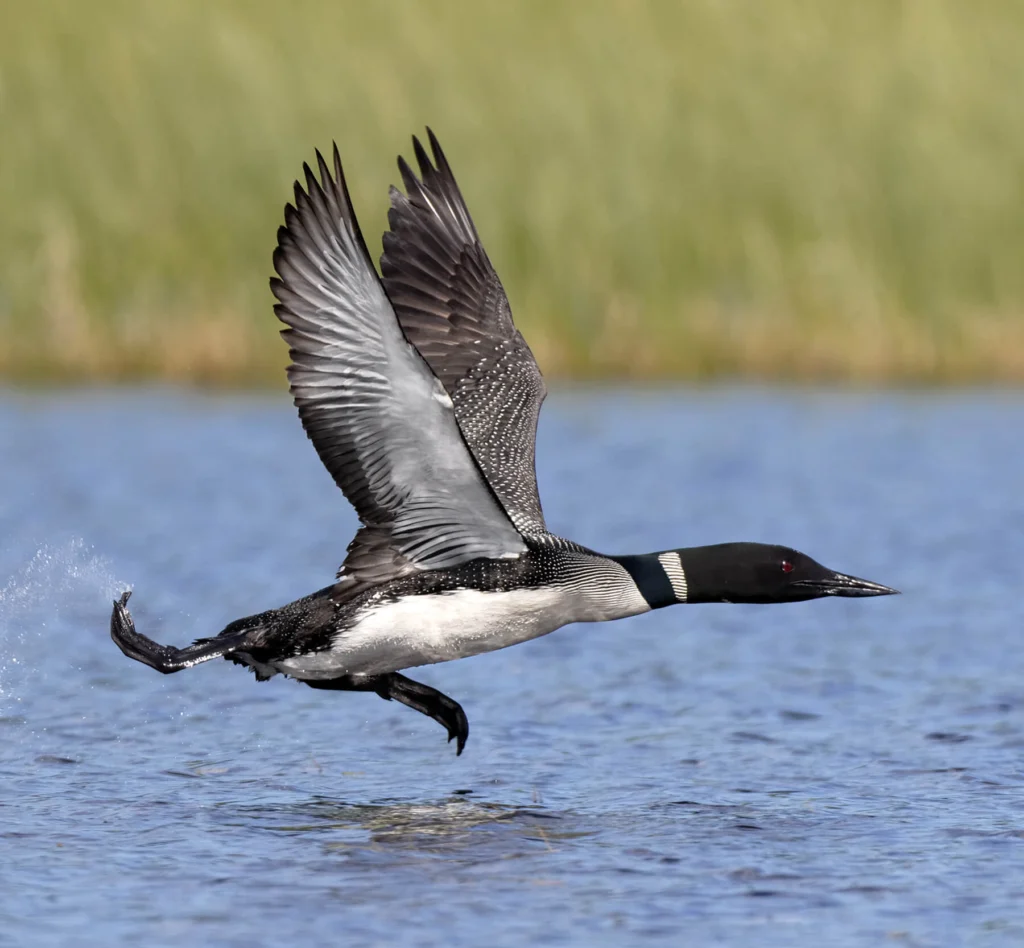
Loons require extensive open water to breed, in part because they are so clumsy getting out of the water. Common Loons are quite heavy for a bird, and their legs are set especially far back on their bodies to give the greatest forward momentum while diving, similar to a propeller. However, this makes taking off a challenge, and loons require a long distance to build up the speed needed for takeoff. When landing, the Common Loon performs an inelegant belly flop, then skims along the water on its belly to slow down.
Life History
The Common Loon is conspicuous whether during the breeding or nonbreeding season, and extremely vocal on its breeding grounds. Pairs will aggressively defend their territory, the entirety of a small lake, or a sheltered bay of a larger lake. Contests between territorial loons and interlopers can be intense, with birds gripping each other by the throat with their beaks, beating each other with their wings, holding each other’s heads underwater, and attempting to swim underneath and impale their competitor.
Diet
The Common Loon is an underwater hunter, similar to the Double-crested Cormorant, darting through the water like a torpedo and turning on a dime in pursuit of small fish. Loons will hold their breath for up to five minutes, and can dive up to 200 feet in search of prey. Though they prefer small fish, loons will also eat crustaceans and other invertebrates when fish are scarce or when the water is too murky to hunt efficiently.
Courtship
The Common Loon is monogamous, and though males and females spend the nonbreeding season at different sites, they will both return to the same territory and mate for years. Courtship involves a loosely coordinated dance, incorporating various stereotyped display behaviors. These include dipping the bill or face into the water, diving, swimming together in tight circles, and rearing up from the water and paddling with the legs.
Nesting
Male loons choose the nesting site, either an island in the lake or a sheltered area on the shore. Loons prefer nest locations where the water is deep enough that they can approach the nest from underwater, presumably to avoid being spotted by predators. The female and male will each contribute to building the nest, a mound of vegetation pulled from the bank nearby or from underwater.
Eggs & Young
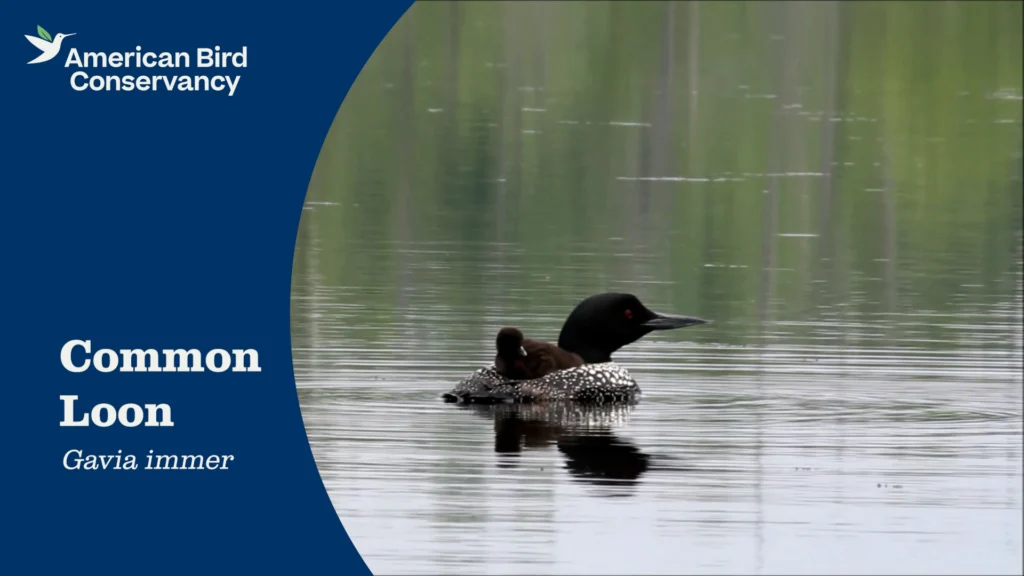
Female loons generally lay two eggs, with the color ranging from olive green to pale brown to deep bronze, spotted with dark brown or black. Both parents will incubate the nest for about four weeks. Chicks are semi-precocial, hatching covered in black down and leaving the nest within a day, but remain reliant on their parents for food for several weeks. Young chicks will often ride around on their parents’ backs rather than swim.