Overview
About
The petite, quail-sized Marbled Murrelet has been called the “enigma of the Pacific.” So much about this stub-tailed seabird is unusual and remains poorly known. The bird’s range extends from Alaska to California; in northern treeless areas, it nests on the ground, but in the rainforests of the Pacific Northwest, it flies inland as far as 55 miles to nest high in trees. Its nesting habits remained one of North America’s great bird mysteries until 1974, when a tree surgeon working 147 feet up in a 200-foot-tall Douglas fir found an active nest. The only other bird in the alcid family that shares this nesting behavior is the murrelet’s close cousin, the Long-billed Murrelet, found in Asia.
Marbled Murrelet populations are in steady decline, due in part to the clearing of old-growth temperate rainforests, habitat shared with the imperiled Northern Spotted Owl. But nest predation by clever corvids like Steller’s Jays and Common Ravens can also adversely impact murrelets. These birds gather where people enjoying the Pacific Northwest’s forest leave garbage behind — the picnic areas and campsites more than 100 feet below nesting murrelets — making it all the more important to clean up and pack out what you bring in.

Threats
Seabirds are declining faster than any other bird group. The Marbled Murrelet faces many of the threats that endanger all seabirds, but the loss of its old-growth forest nesting habitat is unique among seabirds. Listed as Threatened under the Endangered Species Act in 1992, the Marbled Murrelet is also listed as a Yellow Alert Tipping Point species by Partners in Flight, a result of the loss of more than 50 percent of its population in the past 50 years.
Habitat Loss
The forests used by Marbled Murrelets for nesting have experienced significant development and logging, not only reducing habitat but also fragmenting what remains. That fragmentation leaves murrelet nests more vulnerable to predation by corvids.
Pesticides & Toxins
Marbled Murrelets forage close to shore, making them one of the bird species most vulnerable to oil spills. Oiling can cause direct mortality, and it can also have other long-term negative impacts on birds’ health and reproduction, and prey availability. Oil spills on a larger scale could render murrelet habitat unusable.
Fisheries
Like many seabirds, Marbled Murrelets can fall victim to bycatch from fisheries. Thousands of murrelets have been documented becoming entangled in gillnets, vertical fish netting hanging from floaters used to catch species such as cod and haddock, which leads to drowning.
Conservation Strategies & Projects
Birds like the Marbled Murrelet need our help to overcome the threats they face, both at sea and on land. Working with a diverse range of partners and driven by our responsibility to conserve birds, we are taking action and finding solutions to help this fascinating seabird survive.
Support Petitions & Advocacy
ABC and our partners advocate for policies that support birds and the habitat they need to thrive. We fight to preserve and strengthen landmark legislation like the Migratory Bird Treaty Act and the Endangered Species Act. We also speak up for conservation action at the state and federal levels, calling for comprehensive, landscape-scale approaches to managing land.
Maintain Habitat
The spectacular old-growth forests of the Pacific Northwest host not only murrelet nests but thousands of campers and hikers every year. The trash they leave behind is a big draw for corvids that prey on murrelet nests. ABC is helping to expand the “Crumb Clean” campaign launched by California State Parks that offers education and better ways to dispose of waste, including wildlife-proof garbage cans and dishwashing stations.
Address Ocean/Island Issues
ABC works with partners throughout the Western Hemisphere to address the problems that are contributing to the decline of many seabird species: fisheries bycatch, overfishing, and the overwhelming presence of plastics in our waterways. Together, we are helping fragile ecosystems and the birds they support become more resilient.
Bird Gallery
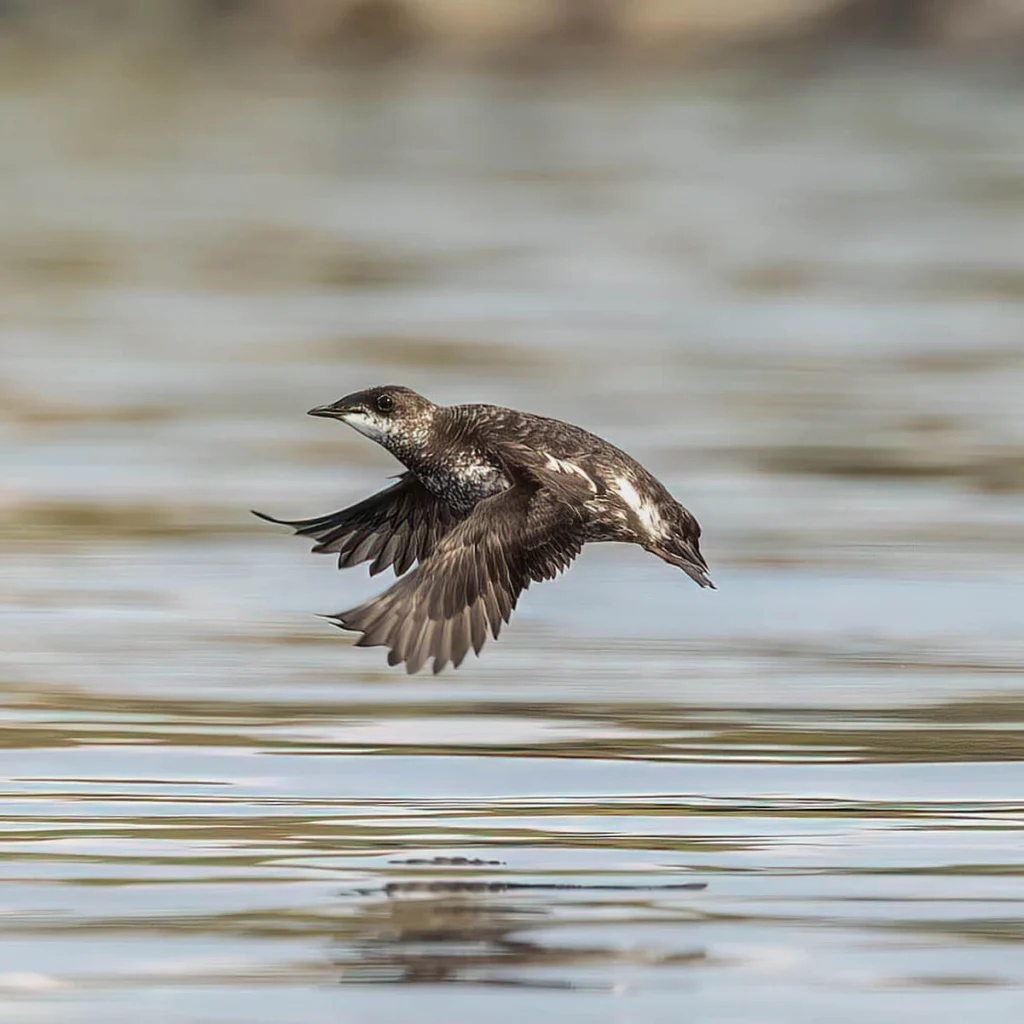
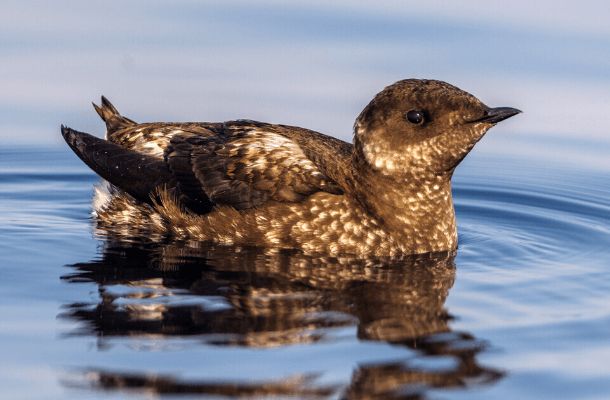
Overall, this murrelet is tiny but plump, with a very short tail and narrow wings. The birds use their narrow wings to swim to depths of up to 200 feet while searching for prey. The Marbled Murrelet gets its name from the mottled, scalloped chocolate-brown and white plumage of adults in the breeding season. The upperparts are dark brown, almost black, offset by reddish scapulars (the feathers covering the base of the wing). The murrelet’s underparts are a lighter mottled brown.
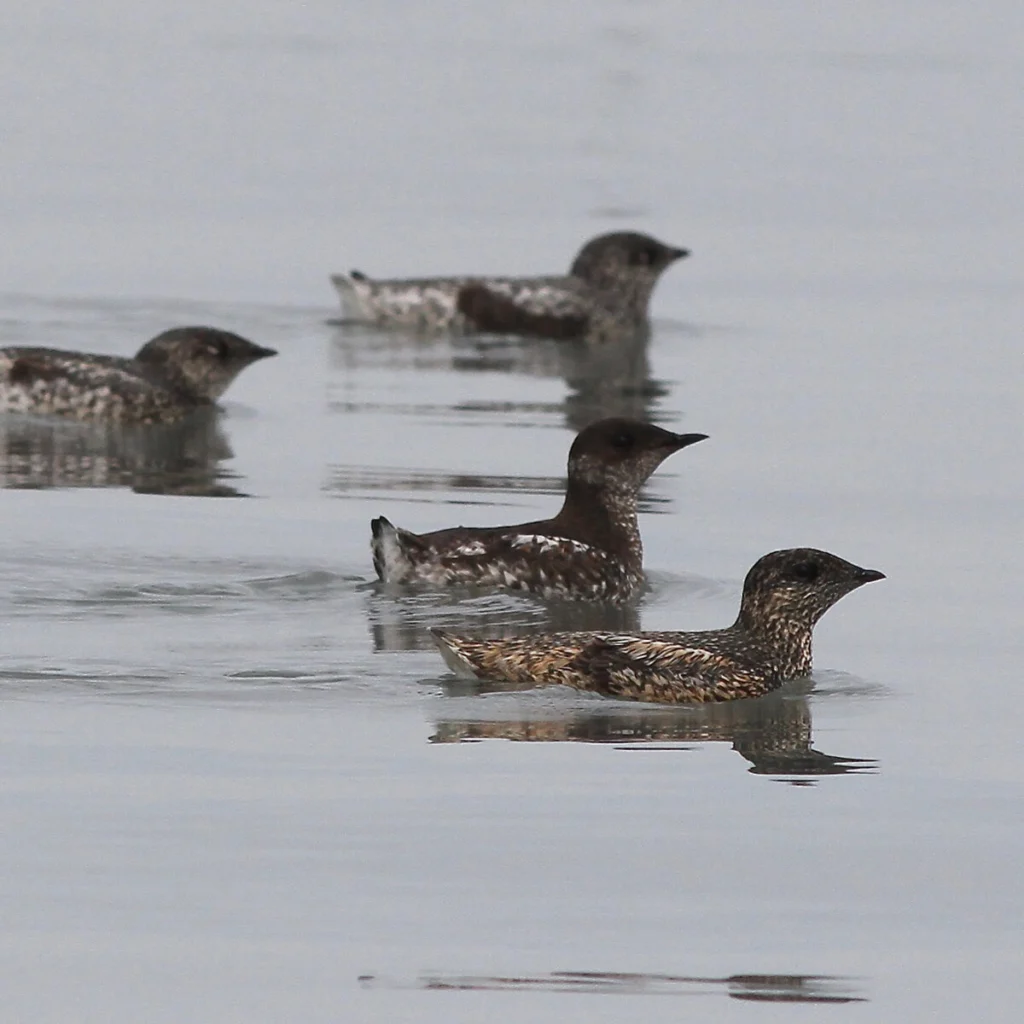
Outside of the breeding season, adults and juveniles look similar: dark above and white below. The white collar that extends almost all the way around the bird’s neck is a helpful feature for identifying this chunky little seabird.
Bird Sounds
Although the Marbled Murrelet doesn’t sing, it sounds off in a variety of ways, both when flying over forest breeding habitat and while at sea. Its vocalizations include a variety of keer calls, whistles, and sometimes a drawn-out groan.
Credit: Andrew Spencer, XC568611. Accessible at www.xeno-canto.org/568611.
Credit: Kayla Brown, XC749445. Accessible at www.xeno-canto.org/749445.
Habitat
A seabird with a twist, the Marbled Murrelet tends to forage close to the shoreline (although some have been observed 180 miles offshore). It was only discovered in the 1970s that they use coniferous forests near coasts for nesting throughout much of their range. More northern populations nest on the ground or on cliffs.
- Nests in moist and misty coniferous forests where large trees are abundant, such as old-growth forests, and where epiphytic moss is plentiful
- Commonly nests in Douglas fir, Alaska yellow cedar, mountain and western hemlock, western redcedar, and coast redwood trees, selecting broad, sturdy limbs with canopy openings
- May nest at elevations up to approximately 4,000 feet, though more often found close to sea level, and usually within several miles of the coast
- In Alaska, nests are on the ground among slopes, cliffs, or areas with light vegetation
- Habitat at sea is less known, but it typically forages within a few miles of shorelines in areas where prey are concentrated, such as at tides and river currents
Range & Region
Specific Area
Pacific Coast of North America
Range Detail
The Marbled Murrelet breeds from Alaska’s far-western islands along the Pacific coastline to central California (where it is now a scarce breeder). Across much of the species’ range, the birds spend the winter in sheltered waters not far from nesting areas. In parts of Alaska and British Columbia, however, many birds leave to spend the nonbreeding season elsewhere. Marbled Murrelets rarely stray to southern California and northernmost Mexico.
Did you know?
Most Marbled Murrelets stay near their breeding grounds throughout the year, but some fly south, gathering in small numbers along southern California’s coast.
Researchers are eager to learn more about how the murrelets communicate — about new breeding areas, what calls mean as they fly through the woods, and how they find each other on the ocean. Cracking these secrets could help conservationists better monitor breeding activity and potentially use playback of murrelet calls to attract birds to new breeding sites.
Life History
This mysterious seabird has been known to fishers and loggers as the “fog lark” for their habit of calling frequently, even while at sea along the foggy, misty coasts. At sea, they can afford to make their presence known, but on land during the breeding season, they are much more secretive. They access their nests high in the trees in the dark or under low light to avoid attracting the attention of predators. When the breeding season comes to a close, they sometimes form large flocks of some 5,000 birds in the northern part of their range. Because of their frenzied, constant flapping, they’ve been compared to bumblebees skimming the water’s surface.
Diet
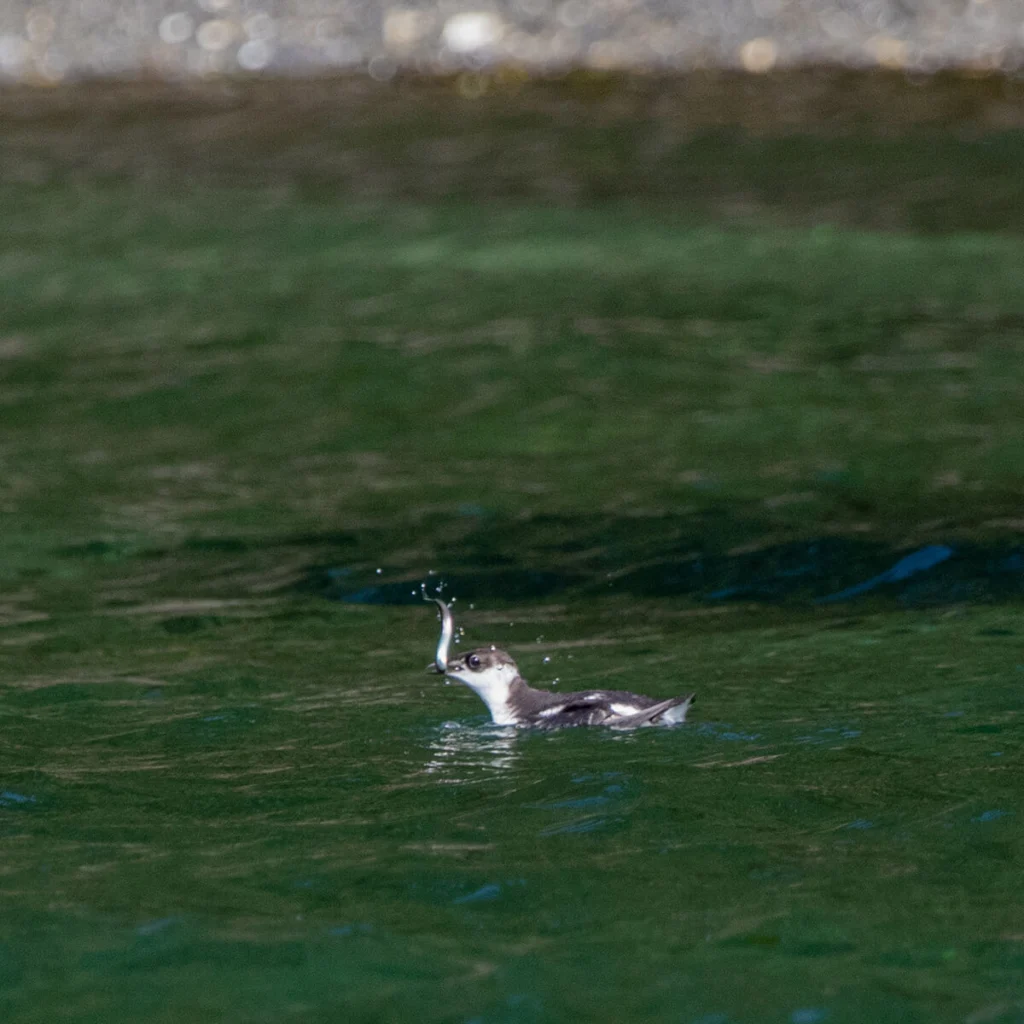
Like other alcids, the Marbled Murrelet has short wings, which it uses to swim up to 200 feet deep in search of small fish and invertebrates. This bird’s diet varies depending on local prey availability and season. Important food sources include sand lance, anchovies, herring, sardines, seaperch, krill, and squid.
Courtship
Marbled Murrelets form monogamous pair bonds that they may maintain even beyond the breeding season. They court at sea, with birds (probably the males) raising their wings to a V-shape and issuing a whiny call while swimming. Their partner joins them at their side, and they swim together, calling in unison and pointing their bills up to the sky before diving under the water.
Nesting
The Marbled Murrelet flies as far as 55 miles inland in search of suitable nesting habitat. It often nests high up in a tall tree, on a soft carpet of lichen or moss adorning a large, horizontal branch. They typically select the largest tree around, selecting a sturdy limb 40 feet or more off the ground. The adults’ weight creates a depression where the female lays the pair’s single egg. Less often, murrelets nest on the ground.
Eggs & Young
Both parents take turns incubating the egg, alternating day-long shifts swapped under the cover of darkness. The egg hatches after about 30 days. The parents’ mottled brown and white breeding plumage provides camouflage in the dappled forest canopy. Parents shuttle between ocean and nest to feed their nestling, which remains in the nest for four to almost six weeks. Much of this time, but for occasional meal delivery, the chick is left unattended. Nestlings molt into black and white juvenile plumage before leaving the nest and flying directly to the ocean.