Ocellated Turkey

Meleagris ocellata

Ucutz il chican (Mayan)

Ocellated Turkey

Meleagris ocellata

Overview

Conservation Status
Population Trends
Decreasing
Population Size
20,000-50,000
Family
Turkeys
Location
North America
Migration Pattern
Nonmigratory
Migration Distance
Nonmigratory
Also Known As
  • Guajolote Ocelado (Spanish)
  • Pavo ocelado (Spanish)
  • Ucutz il chican (Mayan)

About

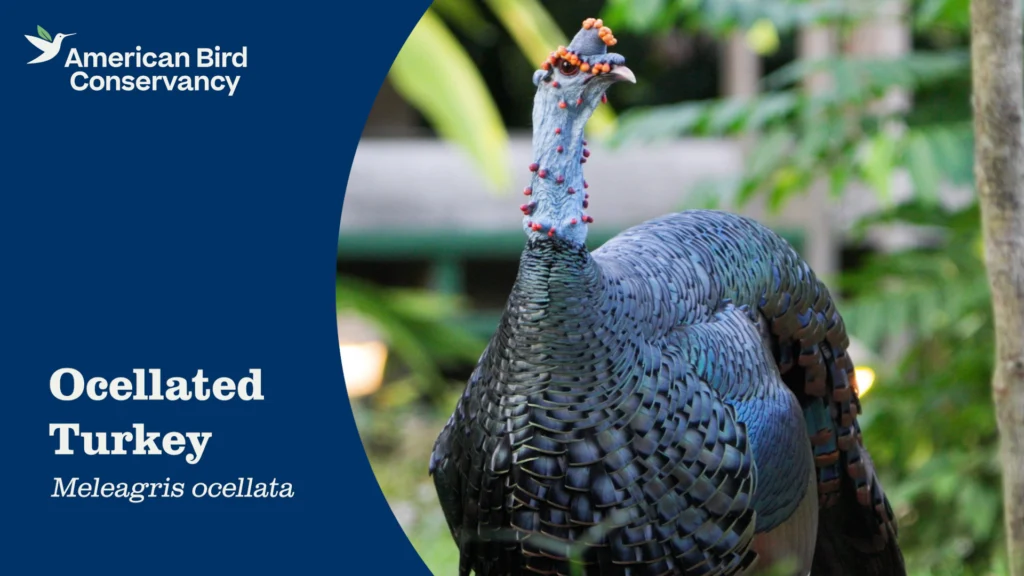
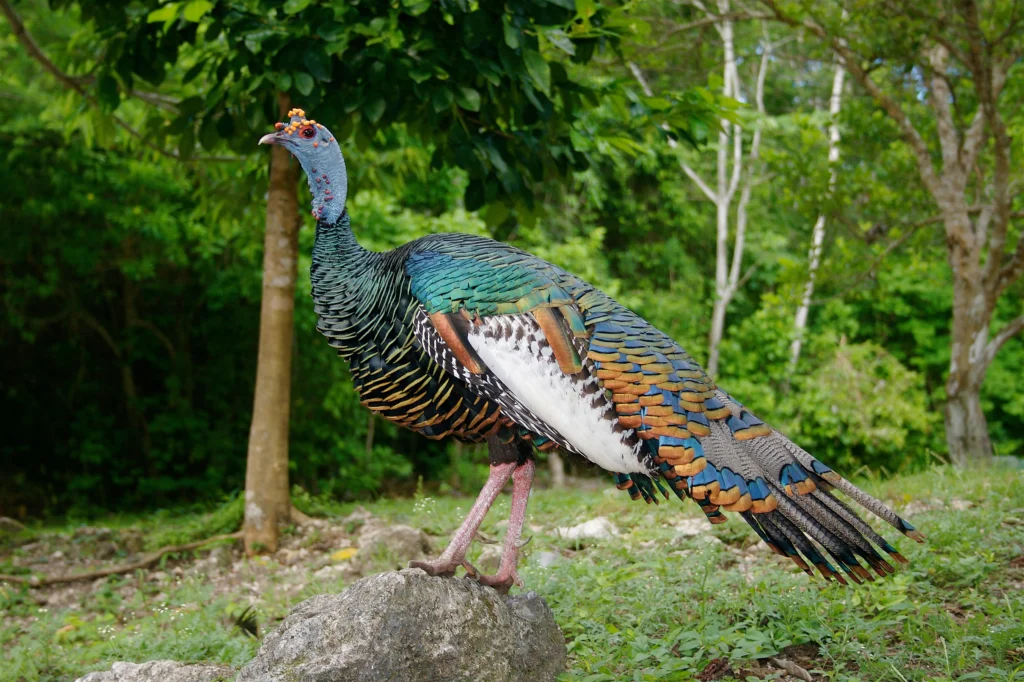
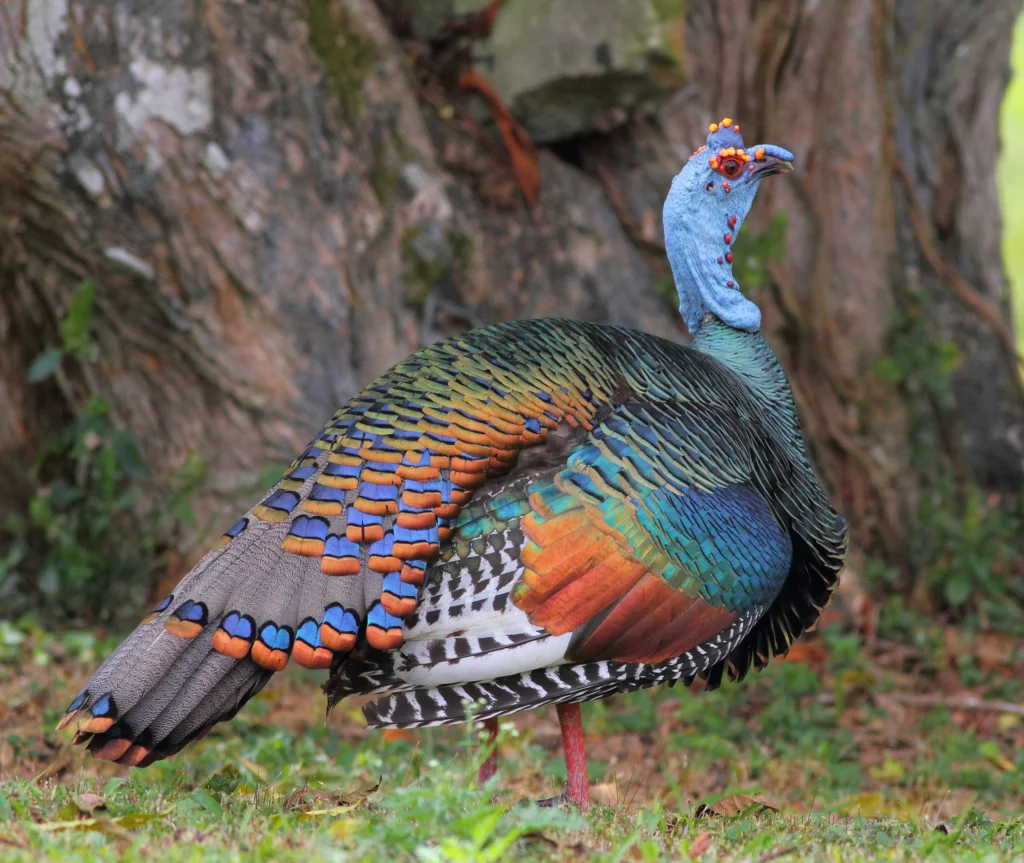
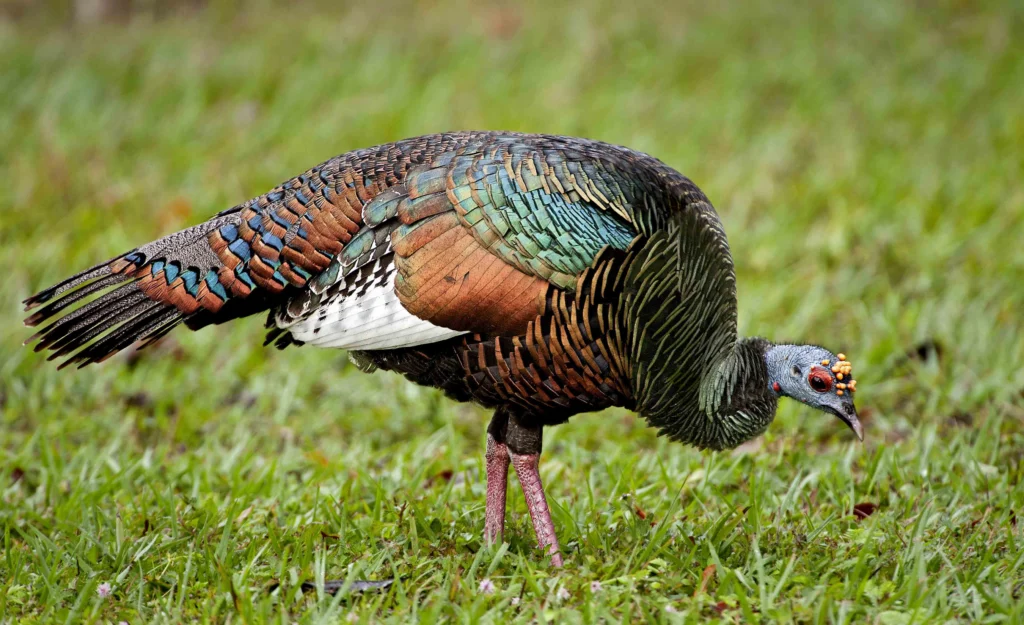
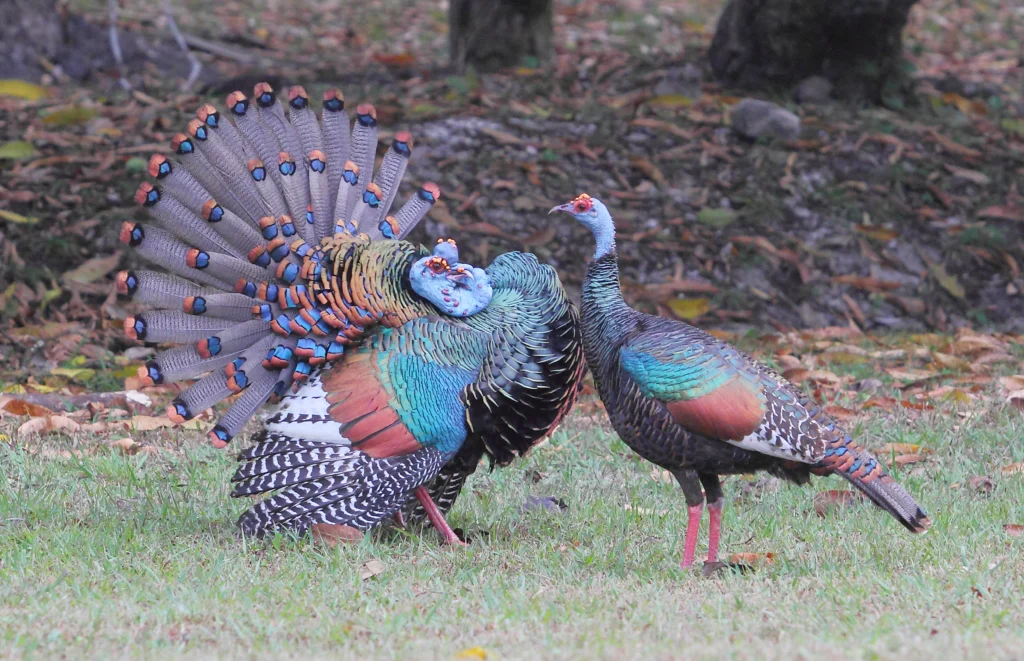
The Ocellated Turkey is the gaudier tropical cousin of the world’s only other turkey species, our familiar Thanksgiving bird. Watching a strutting male display is like seeing a Wild Turkey through a colorized filter: The baby-blue head is dotted with red and orange wart-like bumps. Metallic body feathers shimmer in colors from electric blue to green, growing more vivid on wings also banded with bronzy-orange and white. Its striking tail recalls the peacock’s famous plumes. (In Spanish, this bird is sometimes called pavo real, a term both for peacock and “royal turkey.”)

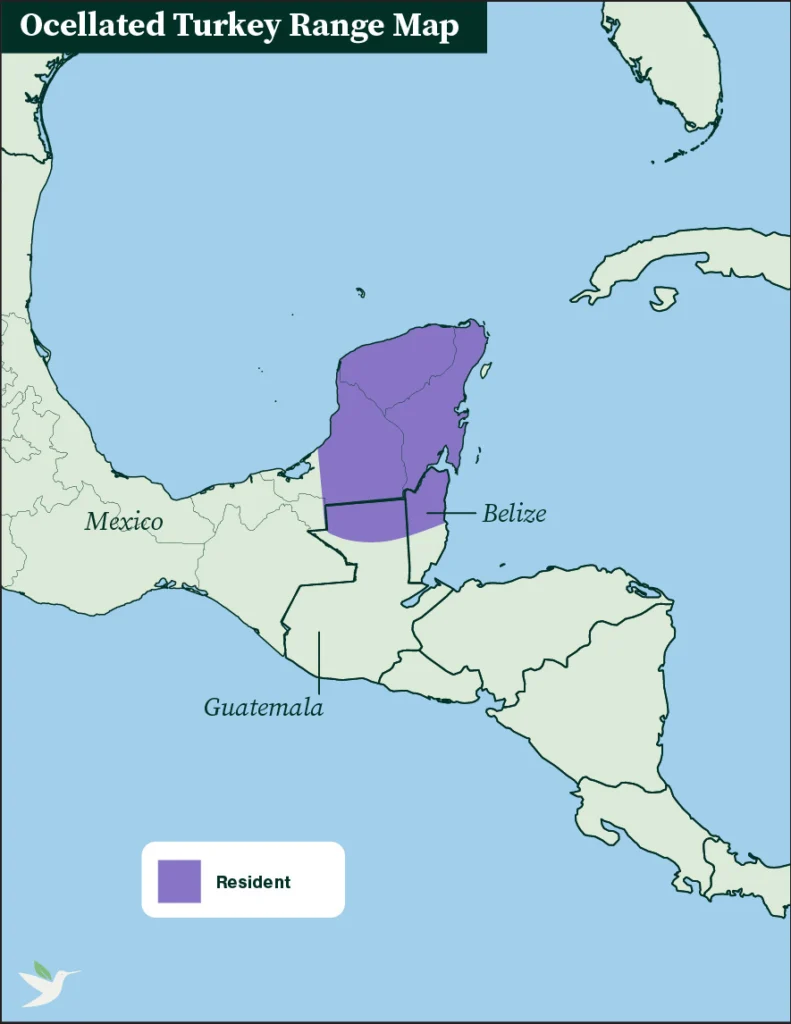
Unlike its northern relative, the Ocellated Turkey does not have a broad range. It’s only found on the Yucatán Peninsula, which embraces a few Mexican states, the northern half of Belize, and Guatemala’s northern Petén region. Despite its size and eye-popping plumage, this bird lurks mostly unseen amid thick foliage, like other turkey-like birds such as the Great Curassow. The peninsula’s remaining forests also support a number of wild cat species. And in fact, the turkey has something in common with one of these slinky felines.

Spotting Similarities

Particularly within large expanses of undisturbed habitat, the Ocellated Turkey must keep a wary eye out for wild cats, including the jaguar, puma, jaguarundi, margay, and ocelot, with which the bird shares part of its name. The word “ocellated” derives from Latin for “having eye-like markings.” In the turkey’s case, this refers to rows of large metallic-blue and orange spots on its tail feathers. The same root occurs in the name ocelot, referring to the outsized, two-toned spots adorning this cat’s fur.

Both the Ocellated Turkey and the ocelot, unfortunately, have something else in common: Both are declining and face heavy hunting pressure and habitat loss in most of their range.

Threats

Birds around the world are declining, and many of them, like Hawaiian honeycreepers, are facing urgent, acute threats. But all birds, from the rarest species to familiar backyard birds, are made more vulnerable by the cumulative impacts of threats like habitat loss and invasive species.

Pesticides & Toxins

Besides killing Ocellated Turkeys outright, pesticide use can poison their insect food, as well as reduce food abundance and availability.

Pesticides & Toxins

Conservation Strategies & Projects

Birds need our help to overcome the threats they face. At ABC, we’re inspired by the wonder of birds and driven by our responsibility to find solutions to meet their greatest challenges. With science as our foundation, and with inclusion and partnership at the heart of all we do, we take bold action for birds across the Americas.

Avoiding Pesticides & Toxins

ABC continues to advocate for the cancellation of dangerous pesticides that threaten insect-eating birds like the Ocellated Turkey.

Pesticides & Toxins

Bird Gallery

Sounds

Wings shaking and occasionally rapped on the ground, the male Ocellated Turkey suddenly bursts into a rapid series of gobbles shallower than his larger relative — sounding like a barnyard goose trying to imitate a turkey.

Song

Paul Driver, XC522868. Accessible at www.xeno-canto.org/522868.

Habitat

Range & Region

Specific Area
Neotropics

Range Detail
The Mexican Yucutan Peninsula, Petén Region of Guatemala, and Northern Belize

Did you know?
The ancient Mayans revered turkeys. They considered them powerful and valued their iridescent feathers and impressive leg spurs. They traded for Wild Turkeys from the north, which they domesticated. But they also greatly appreciated the local Ocellated Turkeys living in forests just outside their settlements. Both species were eaten, sacrificed, and worshiped. On his epithet, a Mayan leader was even honored as Chak Ak’ach Yuhk, translated by archaeologists to mean “Great Male Turkey, Shaker of Cities.”

The Ocellated Turkey is still an iconic species of the Yucatán Peninsula’s tropical forests, including around major Mayan ruin sites such as Guatemala’s world-famous Tikal National Park.

Range
North America
Migration Pattern
Nonmigratory
Migration Distance
Nonmigratory

Life History

Male turkeys are called toms or gobblers, while females are known as hens.

Diet

Ocellated Turkeys usually forage under thick cover within forest and scrub-forest, but will venture into clearings and adjacent farm fields for waste corn and other feeding opportunities. They spend much of their time seeking seeds, fruits, leaves, and insects and other small creatures.

Courtship

Ocellated Turkeys breed starting in March. A displaying male strides through a group of females, his tail spread wide and his head tilted back, resting on his fluffed back feathers. Wings shaking and occasionally rapped on the ground, he suddenly bursts into a rapid series of gobbles shallower than his larger relative — sounding like a barnyard goose trying to imitate a turkey. A dominant male may mate with many females, thwarting attempts by other males to mate with them.

Nesting

Nesting occurs starting in April. The hen lays eight to 15 eggs in a scrape on the ground, then incubates the clutch for four weeks. Young are precocial, meaning that they can scamper off as soon as they hatch. The chicks stay with the hen until the start of the next breeding season.

Eggs & Young

Clutches can be quite large with 8 to 15 eggs in total. Young turkeys, called poults, are precocial, meaning that they hatch fully feathered, with eyes open, and are able to scramble after adults mere hours after hatching.