Budgets, Bills, and Birds
What do the Long-billed Curlew, Canada Warbler, and ‘Akeke‘e have in common? They all benefit from funds coming from the U.S. federal budgeting process.

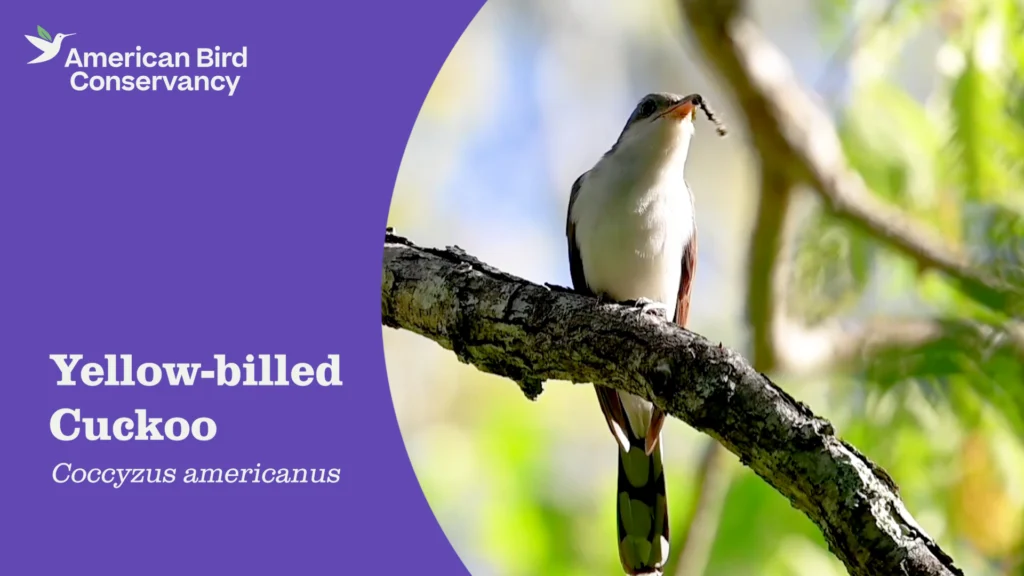
Coccyzus americanus
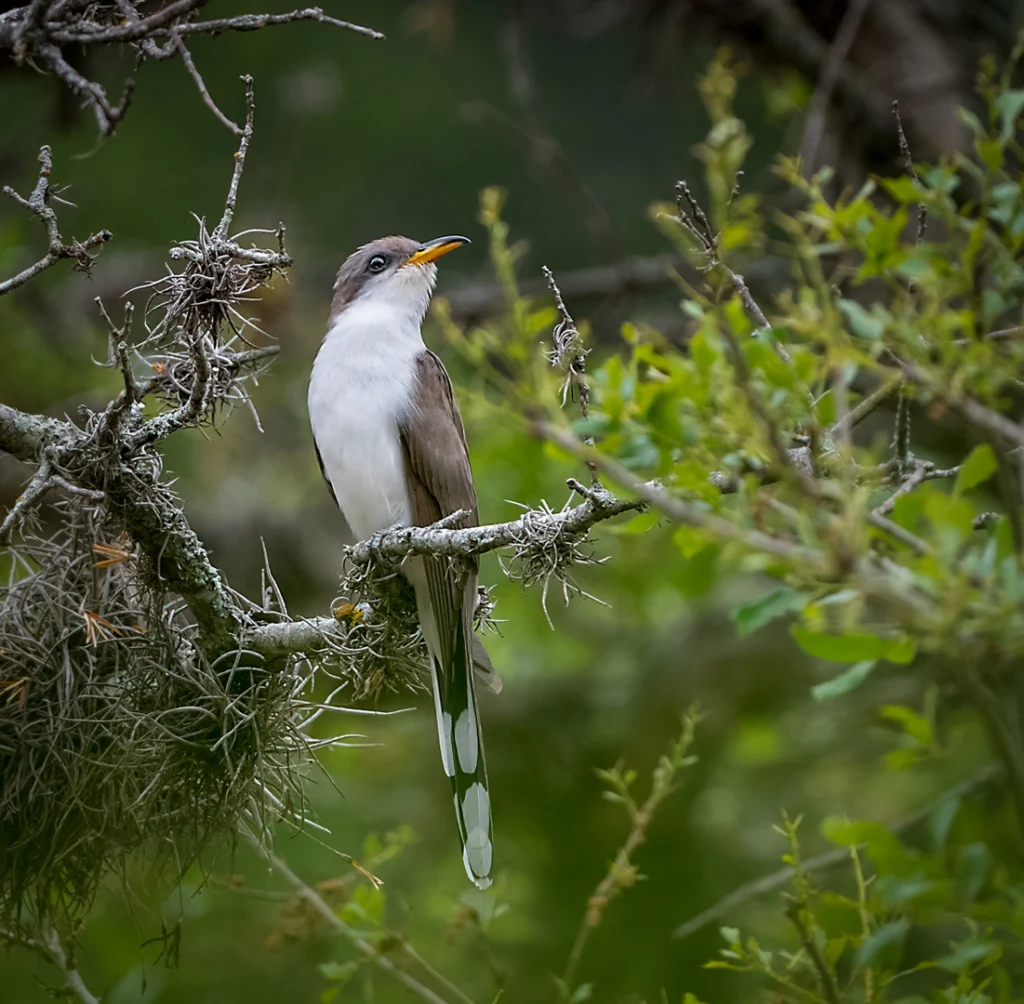

The Yellow-billed Cuckoo is a slender, big-billed bird that easily slips through trees on long, pointed wings. Like other cuckoos, it has two forward-facing toes and two backward-facing toes — an arrangement most common in birds that climb tree trunks or clamber through foliage.
Yellow-billed Cuckoos are stealthy hunters, sitting motionless on a hidden perch as they wait for their prey to move — then they pounce. They are among the few birds able to eat tent caterpillars and other hairy caterpillars. During tent caterpillar outbreaks in the East, cuckoos gorge on them, eating as many as 100 at a time. This bird’s croaking call — often sounding on hot summer days before storms — led to its folk name, “rain crow.”
The bird’s small western population is tiny compared to the fairly common eastern population. The bird is now nearly gone from most of its historical range across portions of 12 western states, with no recent sightings in Oregon, Washington, or Montana. Listed in 2014 under the federal Endangered Species Act, the species needs immediate conservation action.
Across the world, bird populations are experiencing declines. All birds, from the rarest species to familiar backyard birds, are made more vulnerable by the cumulative impacts of threats like habitat loss and invasive species, but for species with restricted ranges or small populations, those threats can be acutely felt.
Habitat loss is a major cause of Yellow-billed Cuckoo declines, especially in the West. Here, riparian breeding areas have given way to farms and housing. Invasive, non-native vegetation such as salt cedar displaces native trees and shrubs along western rivers, while wildfire and drought exacerbated by climate change also degrade this essential habitat.
As long-distance nocturnal migrants, Yellow-billed Cuckoos are often victims of collisions with tall buildings, cell towers, radio antennas, wind turbines, and other human-made structures.
DDT and other contaminants such as lead are a significant threat to this species. Pesticides can affect the Yellow-billed Cuckoo either directly, by spraying active nests, or by contaminating preferred prey such as caterpillars and tree frogs. DDT has been shown to thin cuckoo eggshells, and researchers have noted bioaccumulation of lead in birds nesting near smelting facilities.
At ABC, we are most concerned about the western population of the Yellow-billed Cuckoo, which has been reduced to fewer than 500 pairs each in the U.S. and Mexico. This population was listed as Threatened in 2014 under the federal Endangered Species Act; since then, proposals to delist it have been denied and, in 2021, the U.S. Fish and Wildlife Service designated nearly 300,000 acres in seven states as critical habitat for the bird.
The western population especially needs riparian habitats (e.g., cottonwoods and willows) to be restored. In addition, western rivers and streams should be maintained, enhanced, or restored to more natural flows to boost the bird’s habitat.
Collisions take an enormous toll on birds; more than a billion birds die in the U.S. each year in collisions with buildings and communication towers, and Yellow-billed Cuckoos are frequent victims. ABC researches solutions to prevent collisions, advocates for bird-friendly policies, and encourages the treatment of windows from skyscrapers to single-family homes.
More research is needed about the Yellow-billed Cuckoo’s nonbreeding grounds and how birds fare during migration. Management actions should be tailored to curb mortality and habitat declines throughout the bird’s range and especially in its nonbreeding and migration areas.
The Yellow-billed Cuckoo is about the size of a Mourning Dove. It is slimmer in shape, with pointed wings and a long tail that has a distinctive black-and-white spotted pattern below. The bird is plain grayish-brown on the back and white underneath, with contrasting reddish-brown wing feathers (primaries) that show a flash of color as the cuckoo flies. True to its name, it has a stout, downcurved, mostly yellow bill. A closer look at its face shows a narrow black mask and a contrasting yellow ring of skin around its eye, known as an orbital ring. Males and females look alike, although the female is slightly larger.
Cuckoo feet have two forward-facing toes and two backward-facing toes, known as a zygodactyl arrangement. This foot configuration, also seen in woodpeckers ranging from the Downy to the Pileated Woodpecker, is most common in birds that climb tree trunks or clamber through foliage.



The most frequently heard call of the Yellow-billed Cuckoo consists of 8–12 hollow-sounding syllables: ka-ka-ka-ka-ka-kow-kow-kowlp-kowlp-kowlp-kowlp, beginning quickly and slowing through the last syllables. This call is usually only given by the male. Cuckoo pairs alternate giving a rapid, rattled call sounding like kow-kow-kow-kow-kow while on or around their nest. A third call consists of 5–11 soft, repeated notes: coo-coo-coo-coo-coo-coo-coo. The cuckoo’s gular (throat) region inflates and collapses as it gives this call.
This species is most vocal during its nesting season and on cloudy days (hence the nickname Rain Crow).
In its breeding range, the Yellow-billed Cuckoo relies on wooded areas with water nearby. In its nonbreeding range, the bird is found in a wider variety of habitats, including coastal scrub, hedgerows, forest edges, humid lowland forest, and second-growth woodlands.
Open deciduous woods, clearings, and edges near water. Also riparian woodlands, early successional woods of oak, beech, hawthorn, ash, cottonwood, and elm, and overgrown orchards. Lives in mature tropical forests in the nonbreeding season.
Breeds in riparian willow and dogwood thickets or other open habitats with dense scrub such as late successional fields and abandoned farmland. Also found in dense scrub during migration and in winter.

Specific Area
North America, South America
Range Detail
The Yellow-billed Cuckoo breeds in open deciduous woodlands from southern Canada through much of the eastern and central United States, as well as in riparian habitats in Mexico. It may also breed in Guatemala and El Salvador, and is an uncommon breeder in the Greater Antilles of the Caribbean. During the nonbreeding season, it is found east of the Andes in South America.
The western population of the Yellow-billed Cuckoo, which breeds in riparian forest corridors in arid regions, is uncommon and threatened in California, Arizona, New Mexico and west Texas.
Did you know?
This species migrates at night, sometimes in small groups.
The Yellow-billed Cuckoo is a widespread forest bird that can be relatively easy to hear but difficult to spot, especially in dense woodlands. The species nests in areas of hedgerows and other thick foliage and sometimes raises two broods of chicks per summer. Birds of the rare western population breed later in the summer than their eastern cousins and primarily raise only one brood per year.
Caterpillars are a favorite food of the Yellow-billed Cuckoo, and an individual cuckoo can eat thousands of them per season. It readily takes advantage of annual outbreaks of other types of large insects such as cicadas. Most birds avoid caterpillars covered with irritating or toxic hairs, but not this cuckoo. The cuckoo removes some of the hairs by rolling, shaking, or beating the caterpillar against a hard surface. When enough hairs accumulate in the cuckoo’s stomach, it simply sheds the lining, regurgitating it as a pellet.
The Yellow-billed Cuckoo is generally monogamous. Prior to mating, the female pumps her tail up and down before the male presents her with a short twig freshly snapped off a nearby branch. Researchers have noted a few instances of serial polyandry, where female cuckoos left their young to be raised by their mates while they moved on to begin another nesting attempt with a new male.
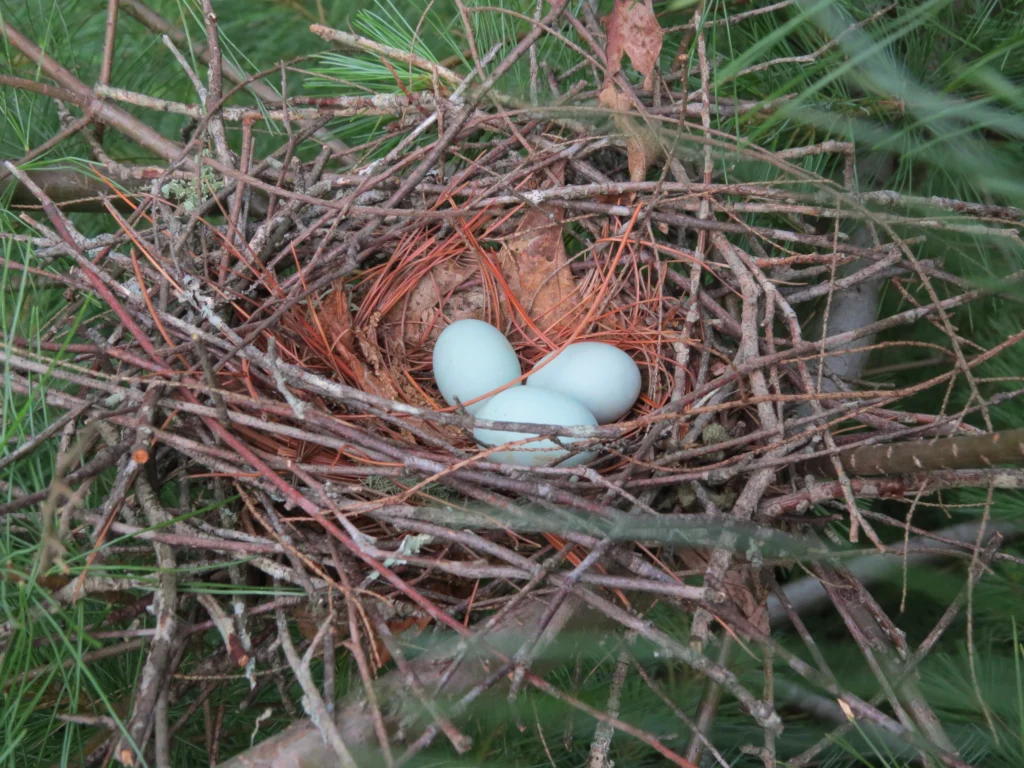
Yellow-billed Cuckoo pairs often visit several potential nest sites before selecting one and beginning to build a nest. The site is well-concealed on a horizontal branch or vertical fork within a thick shrub or low tree, usually less than 20 feet from the ground. Both partners work to build the nest, a flat, rather flimsy platform of sticks and twigs lined with bark strips and dried leaves.
The female Yellow-billed Cuckoo lays a clutch of one to five pale bluish-green eggs (average clutch size is two to three eggs). Both male and female take turns incubating the clutch, and the eggs hatch after only nine days. The cuckoo chicks grow amazingly quickly, and are feathered and ready to fledge only about a week after hatching. This rapid turnaround time from egg to fledgling is among the shortest for any bird species. Although not wholly a brood parasite like its Eurasian cousins, the Yellow-billed Cuckoo will sometimes lay eggs in other birds’ nests.
Related News & Stories
Join the flock! Your donation helps conserve the habitats that birds need to survive and thrive.