Forest by Irek Marcinkowski, Pexels

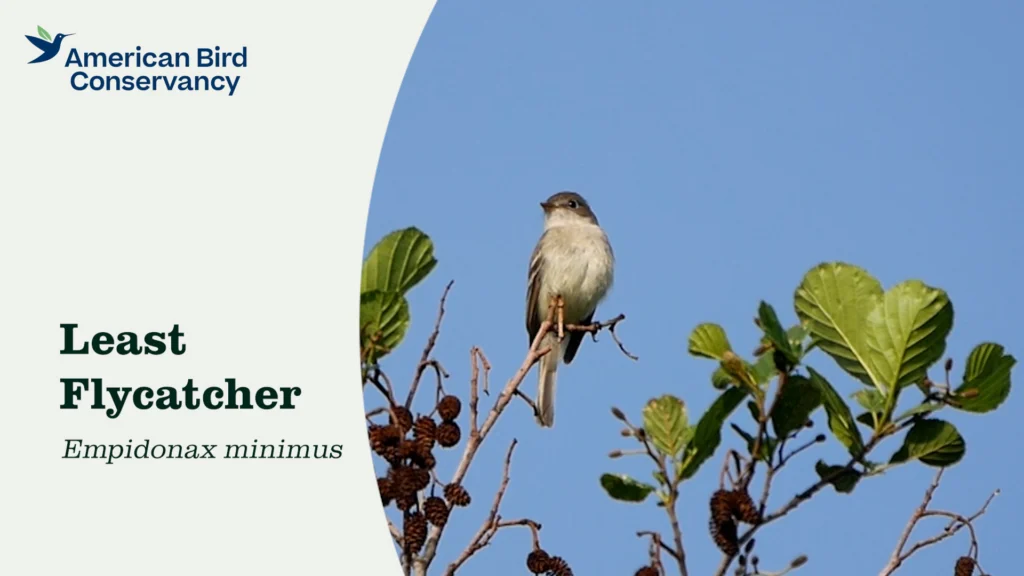
Least Flycatcher

Empidonax minimus

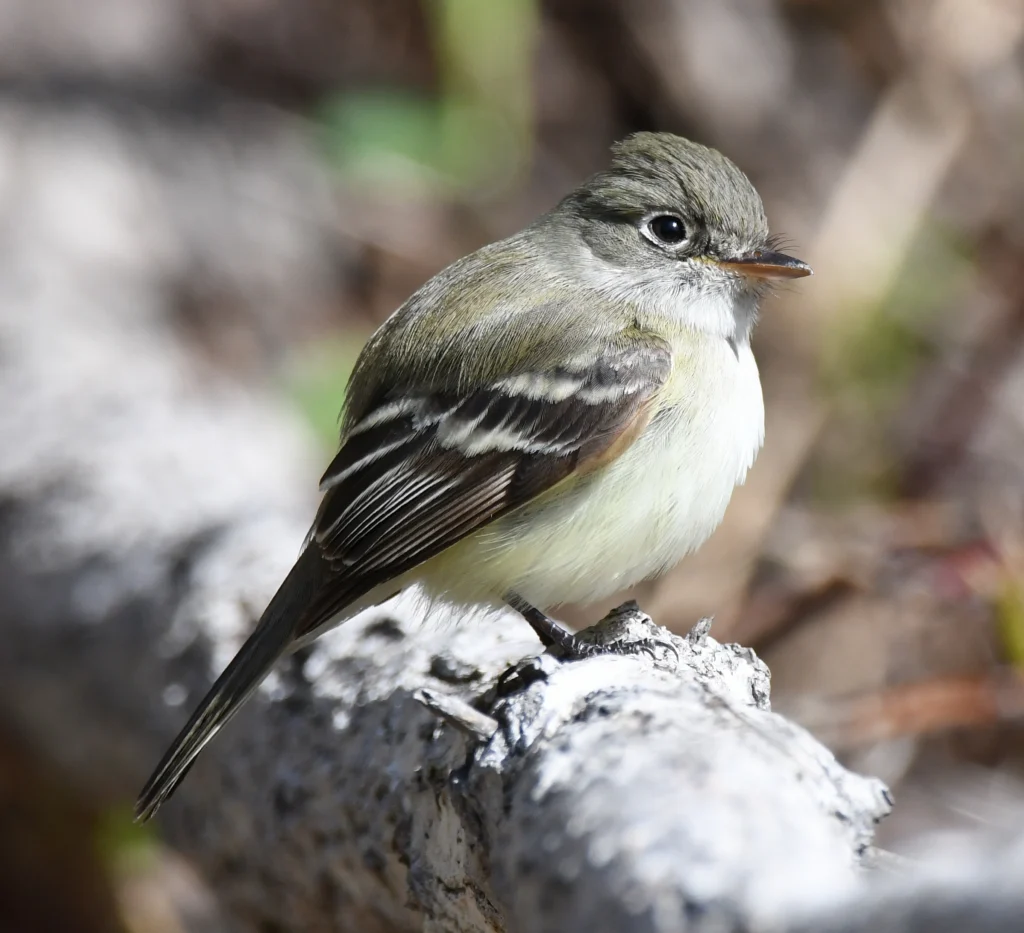
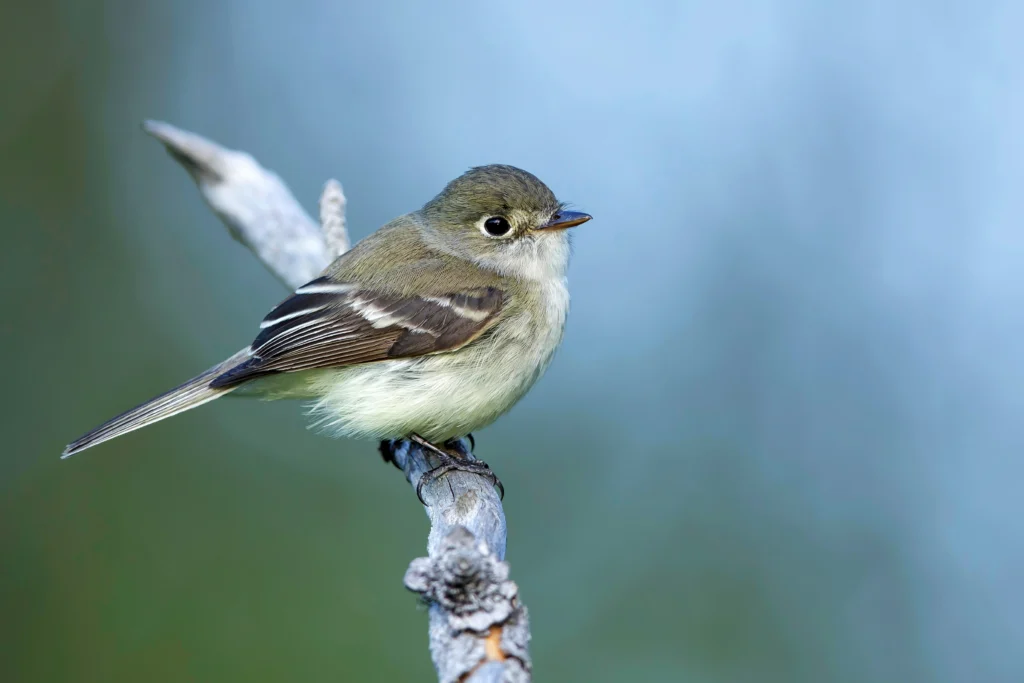
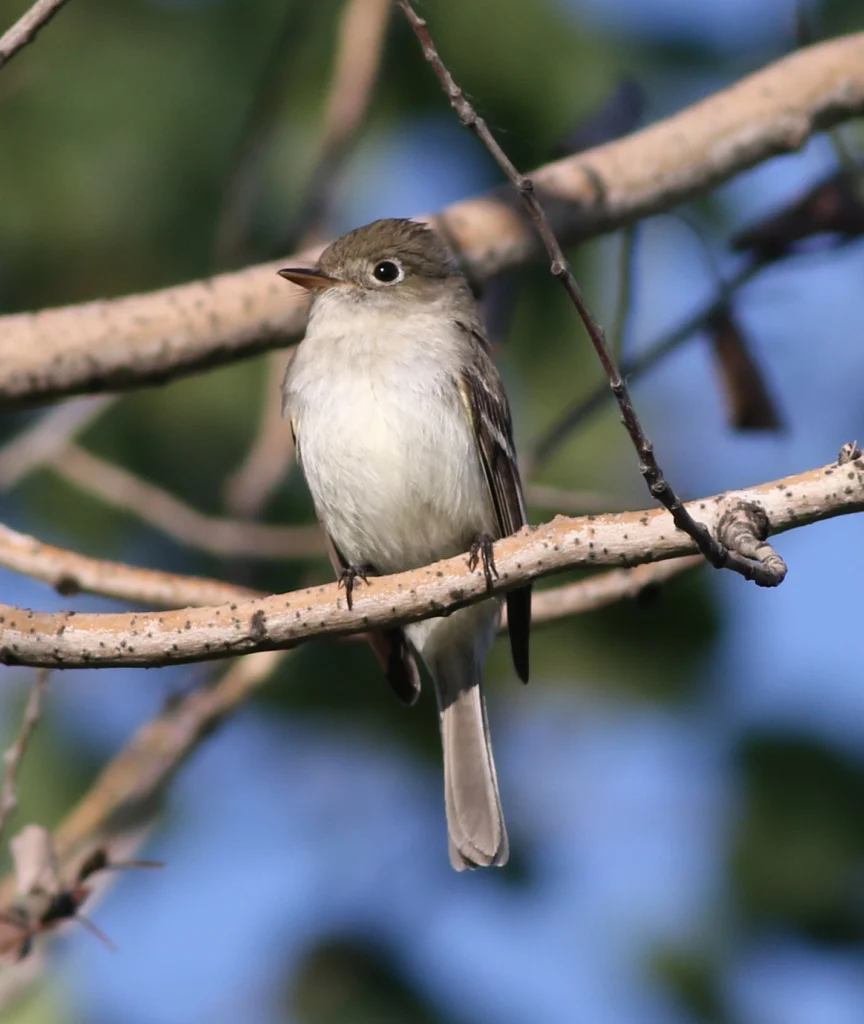
Least Flycatcher. Photo by Michael J. Parr.

Least Flycatcher

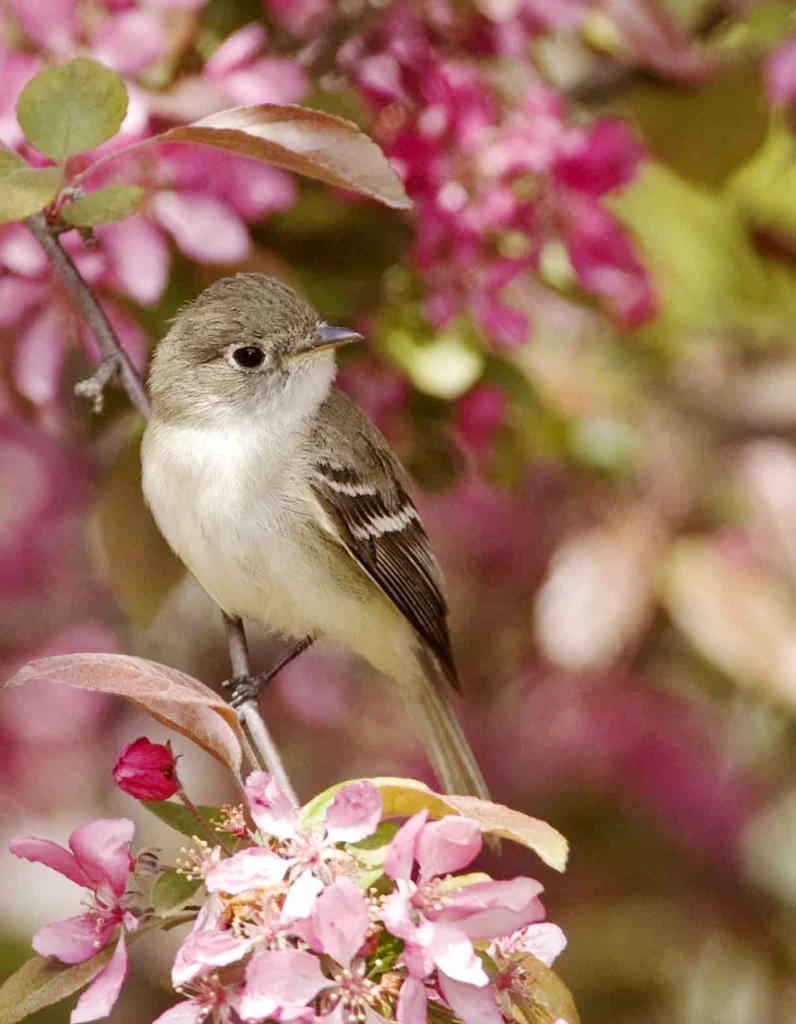
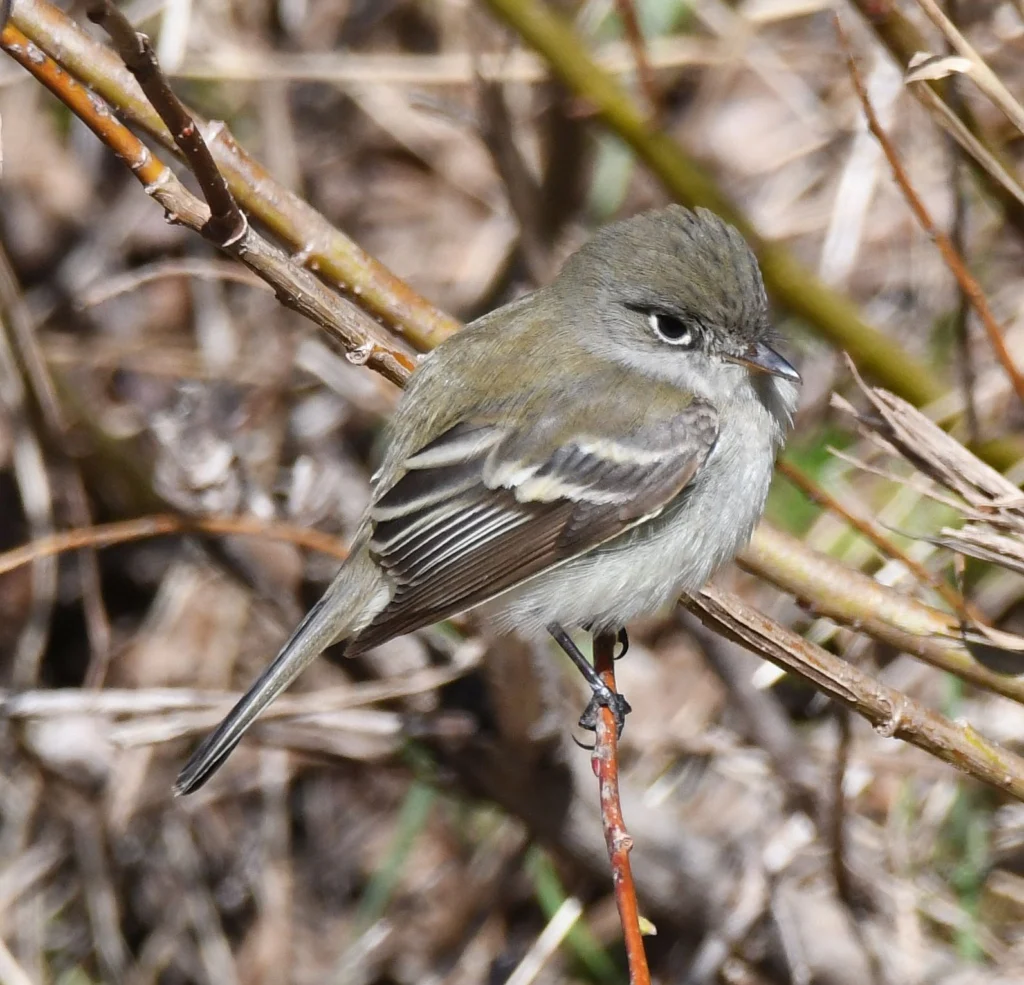
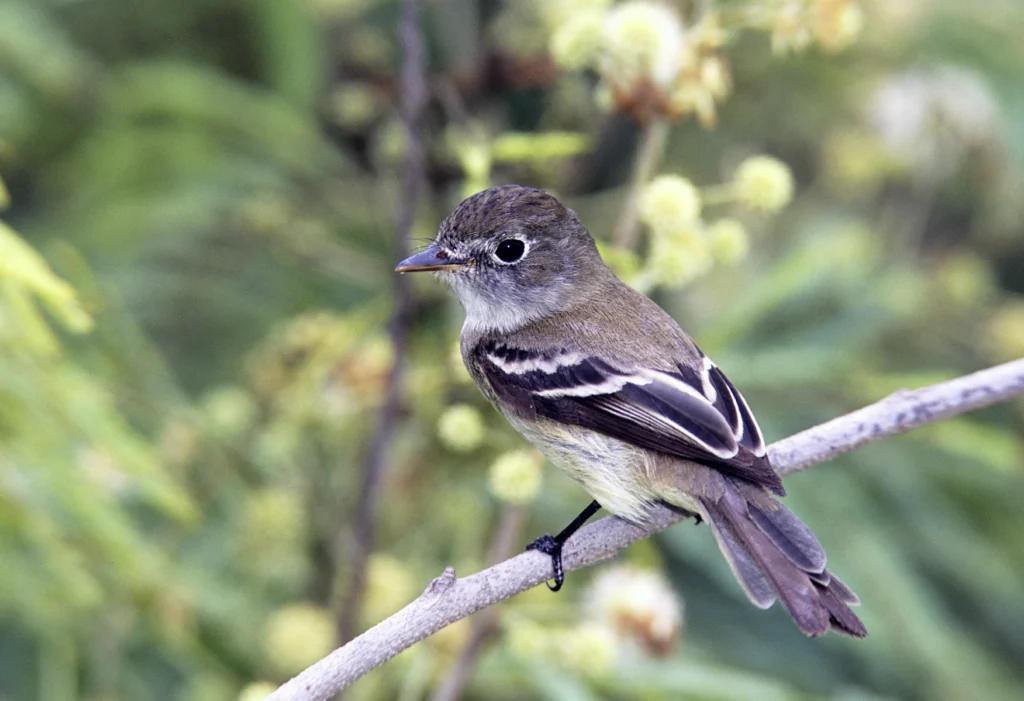
Least Flycatcher. Photo by Michael J. Parr.

Empidonax minimus

Overview

Conservation Status
Population Trends
Decreasing
Population Size
27 million
Family
Flycatchers
Location
North America
Migration Pattern
Latitudinal
Migration Distance
Medium Distance
Also Known As
  • Chebecker
  • Mosquero Mínimo (Spanish)
  • Mosquerito Chebec (Spanish)
  • Papamoscas Chico (Spanish)

About

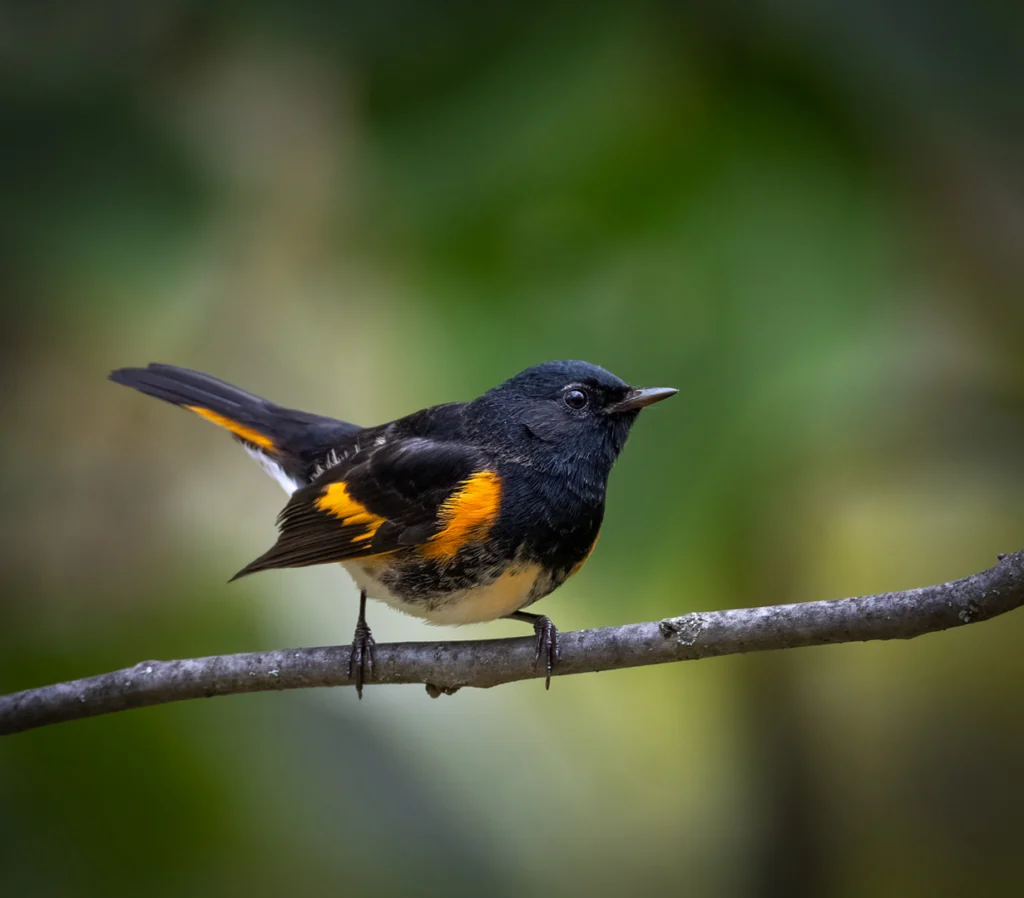
The Least Flycatcher is a small but fierce bird of North American forests, known for its fearlessness in confronting birds much larger than itself, including formidable foes like Blue Jays and even hawks. They often share habitat and compete with American Redstarts, a fly-catching warbler, which they exclude from the best habitat through repeated chases and attacks. Of course, Least Flycatchers defend their territories from their neighbors as well.

However, despite their intense territoriality, these flycatchers are widely known to form dense clusters of breeding territories, even in areas with plenty of suitable habitat. Interestingly, the males closest to the center of a cluster are the healthiest, and the first to find mates. Conversely, birds that don’t join a cluster usually do not mate at all that season. While other factors may contribute to this pattern, the main influence seems to be that it facilitates birds mating with their neighbors in addition to their social mate.

Least Flycatchers are socially monogamous, pairing with a single bird during the breeding season with whom they defend a territory and raise young. But these birds are also quite promiscuous. More often than not, the nest of a mated pair will have at least one nestling sired by another male. “Spreading the love” in this way benefits both males and females — females end up with more genetic diversity in their nests, while males don’t have all their eggs in one “basket,” in case a nest fails. This breeding system, where territories are clustered together, females seek matings outside of the pair, and paired males compete for each other’s mates, has been described as a “hidden lek.” In some ways, this system is quite similar to the communal display areas, or leks, where birds like Lesser Prairie-Chicken and Greater Sage-Grouse defend small arenas to display for females.

One big difference between a classic lek and the so-called “hidden lek” of Least Flycatchers is that both the male and female in a pair are looking to mate with other birds without their own mate knowing about it. Also, the displays are a bit less dramatic. Rather than elaborate plumages, dances, and bizarre methods of sound production, these drab males instead opt to sing the same monotonous two-note song several thousand times an hour.

Threats

Though fairly common in appropriate habitat, Least Flycatcher populations have been declining since the 1970s. There are now a little over half as many Least Flycatchers as there once were. As such, Partners in Flight lists them as a Common Bird in Steep Decline. More research is needed to better understand the causes of this decline, but factors affecting the structure and health of forests probably play an important role.

Degradation of Forests

Least Flycatchers prefer to breed in the forest interior, and disturbances that cause forest gaps or openings can prevent nesting in previously suitable habitat. As such, any event which causes large forest gaps can have a negative impact on breeding populations. This can include timber harvest as well as extreme weather or dieback from disease.

Habitat Loss

Loss of Forest Patches

Although small wooded areas may not be suitable for breeding, Least Flycatchers and many other species use highly fragmented or isolated forest patches in migration. While not always prioritized, these small islands of habitat in urban landscapes can be very important for migrating forest birds.

Habitat Loss

Loss of Forest Understory

Across much of the Least Flycatcher’s range, the suppression of native predators has allowed populations of white-tailed deer to grow unchecked. Deer browse the understory where Least Flycatchers and many other birds nest, in some cases eliminating it entirely. This leaves breeding birds with few options in forests that might otherwise provide good habitat.

Habitat Loss

Conservation Strategies & Practices

Many common birds, like the Least Flycatcher, are declining and need our help to overcome the threats they face. At ABC, we’re inspired by the wonder of birds and driven by our responsibility to find solutions to meet their greatest challenges. With science as our foundation, and with inclusion and partnership at the heart of all we do, we take bold action for birds across the Americas.

Improve Habitat

Least Flycatchers will use a range of forest types with ample understory. As such, these birds benefit from forest recovery efforts for other species, like the Golden-winged Warbler. These warblers prefer second-growth forest, which provides understory cover suitable for both species. In Minnesota, with funding from the Outdoor Heritage Fund, ABC has improved more than 2,500 acres of habitat for American Woodcocks and Golden-winged Warblers.

Improve Habitats

Bird Gallery

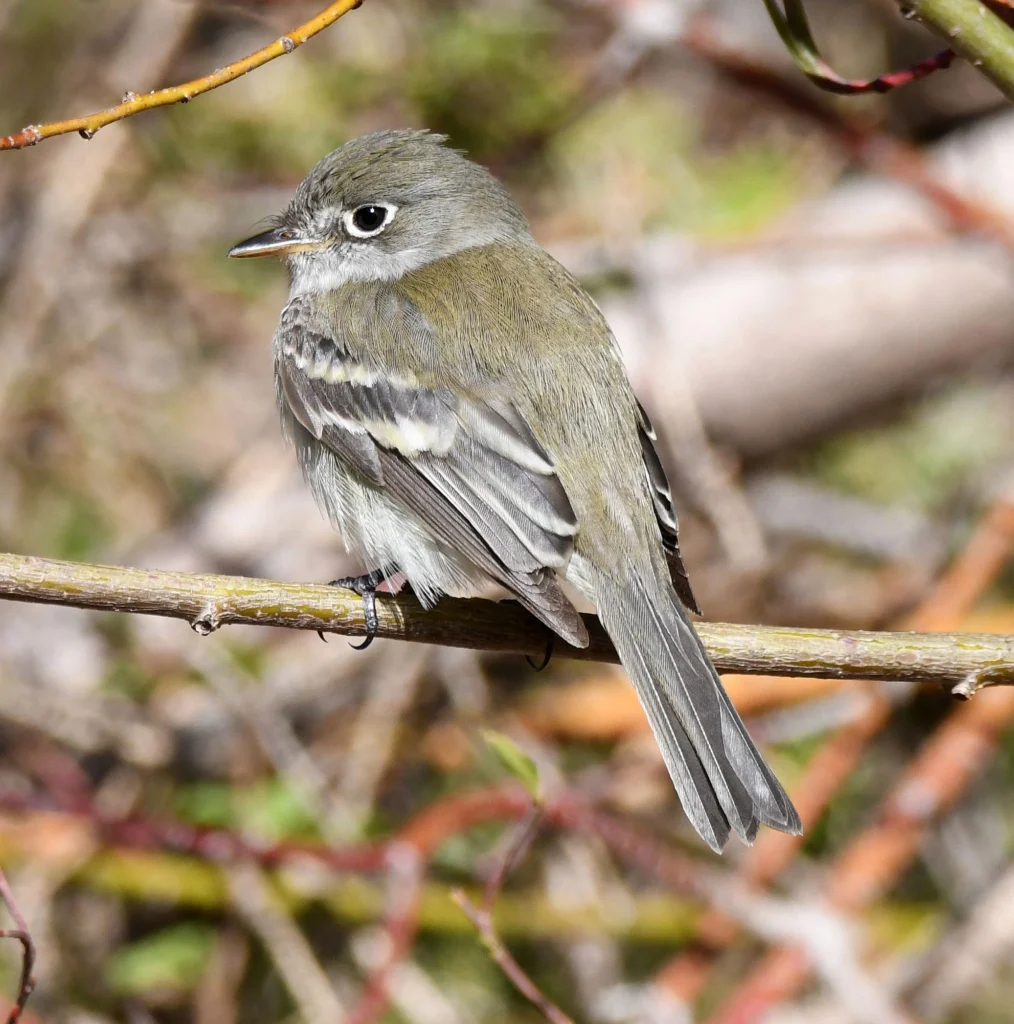
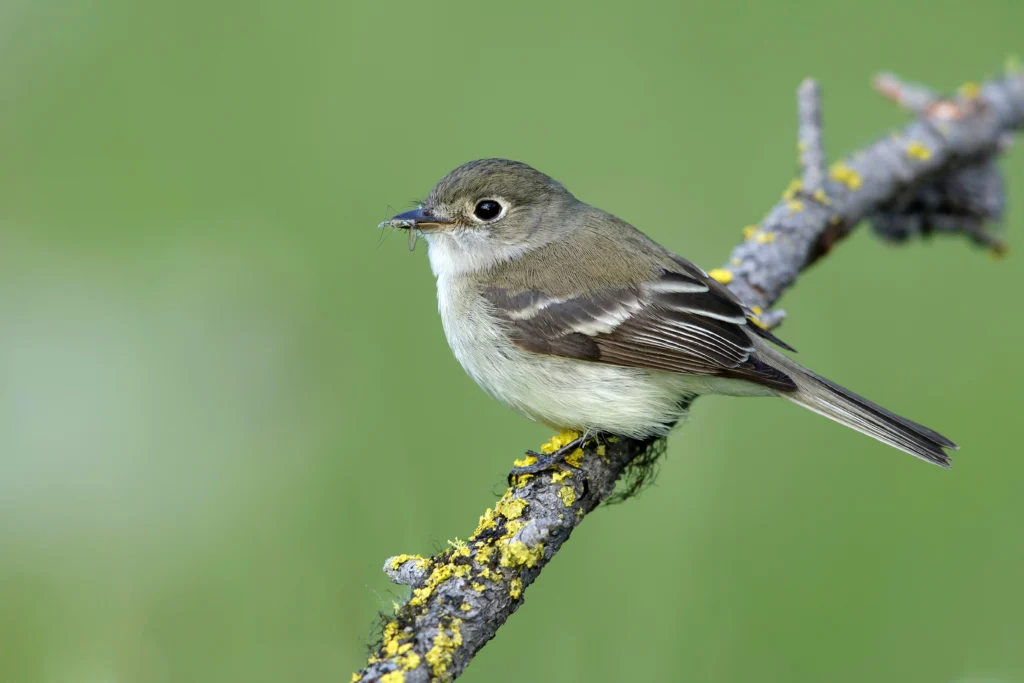
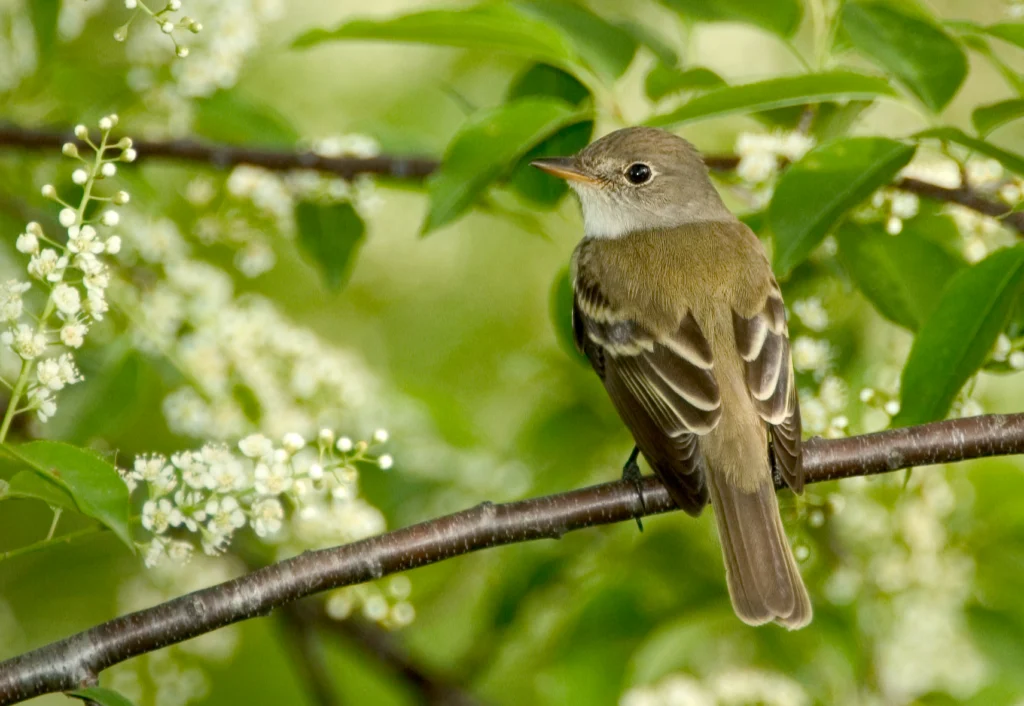
The Least Flycatcher is a member of the notorious Empidonax genus, a diverse group of nearly-identical-looking birds. Male and female Least Flycatchers in all plumages are olive-gray above and white to pale yellow below, with a white throat and pale gray breast, sometimes with a narrow patch of white down the center. The wing and tail feathers are a dark chocolate brown, edged with white. They have two white wingbars on each shoulder and a strong white eyering. The top mandible of the bill is dark, almost black, while the lower mandible is a mix of dark and orange. Compared to other similar flycatchers, the Least is relatively small, with a shorter beak and more prominent, complete eyerings, and closed wings not extending as far past the rump as other species. However, like all the Empidonax flycatchers, this species is best distinguished by its voice.

Sounds

This species is highly vocal during the breeding season, with males and sometimes females giving their rapid chebec song, a snappy two-note phrase, with the first note clearer and the second note burry and at a slightly lower pitch. Both sexes also give a variety of calls, the most common being a quick, soft whit, as well as rapid bill-snapping during aggressive chases.

Song

Credit: Ken Hall, XC509615. Accessible at https://xeno-canto.org/509615.

Whit Call

Credit: Stanislas Wroza, XC1013078. Accessible at https://xeno-canto.org/1013078.

Habitat

On both their breeding and nonbreeding grounds, Least Flycatchers prefer deciduous forest, especially with substantial understory vegetation.

  • In breeding season especially, prefers younger forest with dense understory
  • In migration and on nonbreeding grounds, will use a wider variety of habitats, including windbreaks, riparian channels, and brushlands

Range & Region

Range & Region


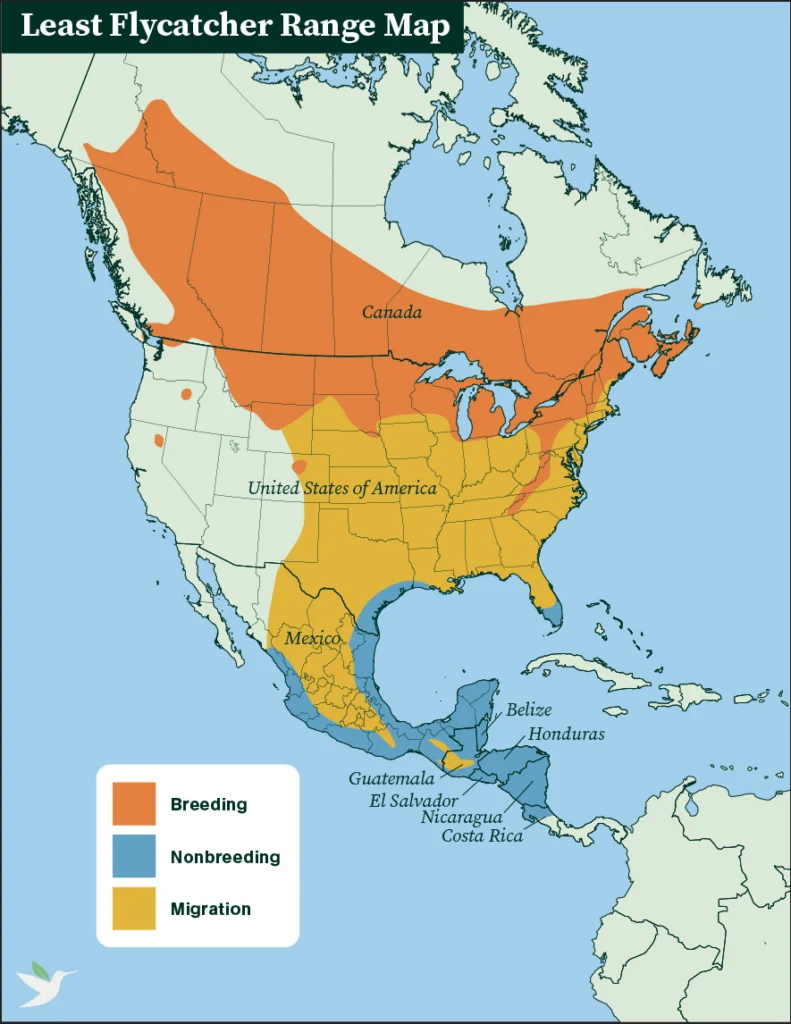
Least Flycatcher range map

Specific Area
Canada, Montana, Wyoming, eastern and midwestern United States, Mexico to northern Costa Rica

Range Detail
The Least Flycatcher breeds across much of Canada, from southern Yukon and the Northwestern Territories south and west through Montana and into northern Wyoming, and east from Montana through the northern United States to New York, and south following the Appalachian Mountains to North Carolina. At the end of the breeding season, these birds move south to southern Florida, the Gulf Coast of Louisiana, Texas, Mexico, and throughout the Central American isthmus to northern Costa Rica, as well as the Pacific Coast of central and southern Mexico.

Did you know?
Least Flycatchers have a surprisingly short breeding season. Between when they arrive on their breeding grounds and when they leave, these birds only have about 64 days to pair up, mate, and raise their young. Given that it takes them about 58 days to complete their nesting cycle, these little flycatchers have no time to waste!

Range
North America
Migration Pattern
Latitudinal
Migration Distance
Medium Distance

Life History

Least Flycatchers are aggressively territorial, and will attack not only other Least Flycatchers, but essentially any small- or medium-sized birds, including Blue Jays and American Robins that are many times their size. Some researchers suggest this defensive behavior may explain why their nests are so infrequently parasitized by Brown-headed Cowbirds, a brood parasite that lays its own eggs in other bird species’ nests.

Diet

Typical among other flycatchers, the Least Flycatcher eats mostly insects, most often using a hunting technique known as “flycatching,” wherein the bird flies from a perch to catch insects midair, returning to the same perch to eat or process them. Least Flycatchers will also glean insects from foliage while perched or hovering, and will rarely eat seeds or small fruits.

Courtship

Males attract females to their territories by singing incessantly, giving up to several thousand songs per hour! When a female is interested, she will approach a male on his territory. Courtship involves a simple “dance” where either the male or both birds together perform a series of 180-degree hops on their branch. Then they will move around together, giving a specific trilling call, and eventually copulate. If at any point the female leaves, the male goes back to singing.

Nesting

Both members of a pair will choose the nest site together, with the female “trying out” different tree branch crotches and forks before deciding on one. The female alone builds the nest, a neat, open cup woven from bark strips, grasses, and other fibrous materials, and lined with hair, feathers, fine grasses, or down from willow or thistle seeds. Females are known to steal materials from other nests, active or not, from their own species or from others.

Eggs & Young

Females usually lay four eggs, which are whitish and unmarked. She incubates her eggs for about two weeks. Both parents feed the nestlings, which fledge after another two weeks. Both parents continue to feed their fledglings for two or three weeks, making repeated foraging trips while the young attempt to catch their own food, or huddle up next to each other on a branch while they wait for the next delivery.