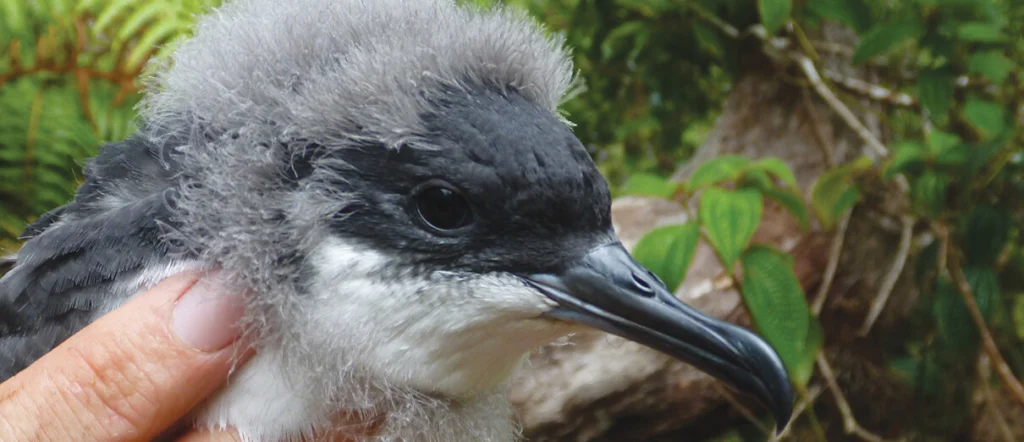
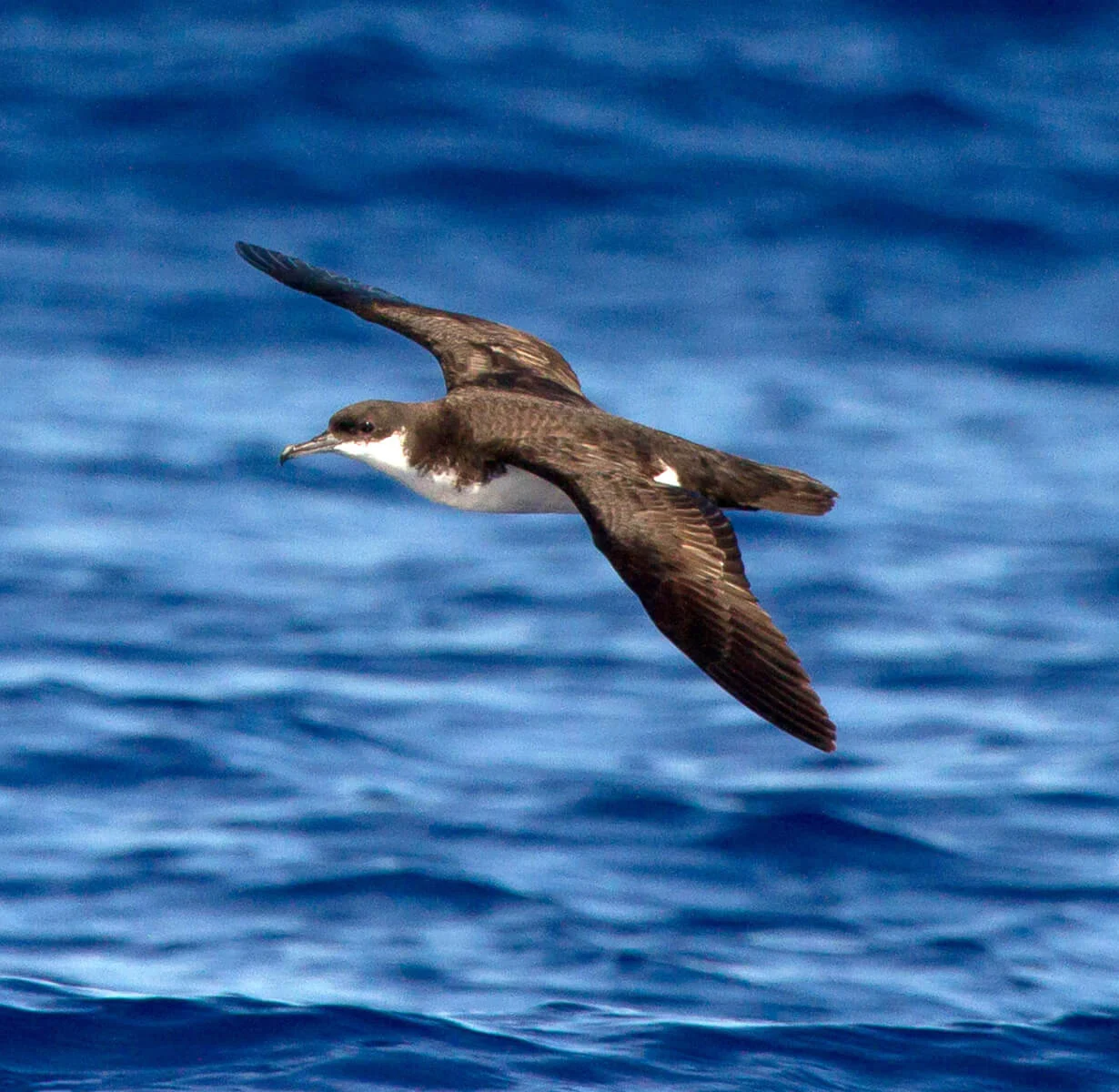
Above Kaua‘i’s remote northwest coast, an unlikely whine fills the air. A helicopter glides out of the sky and hovers just above impassable, 3,000-foot-high cliffs that are preferred nesting grounds for the world’s remaining colonies of the ʻAʻo (Newell’s Shearwater) and Hawaiian Petrel. The seabirds, endemic to Hawai‘i, face pressure from all sides. Development has carved up much of their habitat. Predators from Los gatos salvajes y los cerdos salvajes matan a miles de aves cada año.. And powerlines and urban lights on the island often prove deadly.
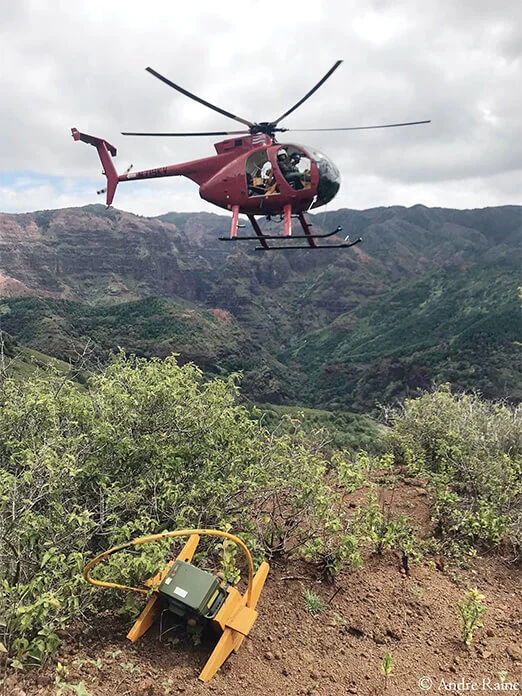
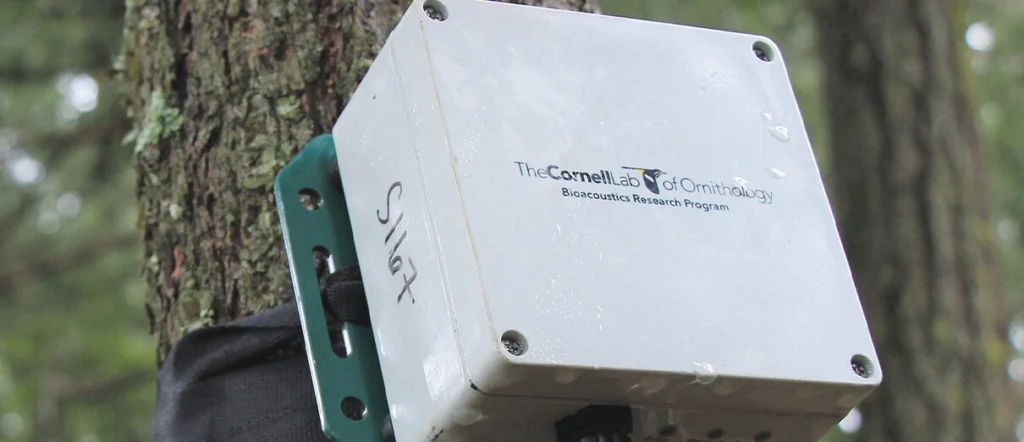
The chopper helps biologists keep tabs on the health of remote seabird populations. Distributed among the colonies here are dozens of textbook-sized bioacoustic sound meters, placed there before the birds returned to nest. No part of the treacherous terrain is out of reach. These devices record vocalizations until nesting season ends. Then, it’s time to deploy the helicopter to collect them for their sound data. Dangling from 100 feet of rope, a grappling hook descends from the stationary chopper until it snags and carefully lifts a three-pound wooden basket containing a sound meter.
Innovación, en el último momento
Más del 94 por ciento de las pardelas y el 78 por ciento de la población de petreles habían desaparecido cuando... Kauaʻi Endangered Seabird Recovery Project heard about sound meter recording and processing technology in 2012. They thought this new innovation might help with a rescue plan they were drawing up with partners, including ABC. The new technology and techniques are part of a developing field called bioacoustics. As its name suggests, bioacoustics couples life sciences with acoustics, using sound to study the environment. It has its roots in tracking submarines and whales. In the last decade, the precision of bioacoustics has accelerated with advances in digital sound and machine learning. It has proven a particularly effective tool for researching nocturnal and cryptic birds, since most species, seabirds among them, are so vocal. Among bioacoustics’ great advantages: Allowing scientists to monitor sensitive bird species without disturbing them — and reaching places people can’t.
“This was the missing piece of the puzzle for monitoring the colony,” said André Raine, project coordinator for the recovery program, which works with a consortium of government, university, and nonprofit organizations on a state-of-the-art conservation mission. ABC and Métricas de conservación Han sido socios clave en este trabajo. La estrategia incluye combatir a los depredadores, construir cercas impenetrables para aislar las colonias de aves marinas, negociar con las empresas de servicios públicos la remediación de las líneas eléctricas y monitorear constantemente el progreso para guiar el trabajo.
After the sound meter data is collected by helicopter pickup and the data gets back to the Conservation Metrics lab in California, the analyses track key indicators such as population counts, predator encounters, and even levels of breeding success.
“These little units are just fantastic for this,” said Hannah Nevins, former Seabird Program Director for ABC, who was part of the project. Eight years after bioacoustics first went into place in Hawaiʻi, researchers are seeing, through bioacoustics monitoring, that their recovery efforts caused decided shifts in the health of the seabird species. Breeding is up significantly as a result of predator control, and song meters are indicating increases in activity around the colony.
Este método se está utilizando ahora también en la remota y deshabitada isla Nihoa, donde los investigadores del ABC utilizan medidores de sonido para buscar posibles zonas de reproducción de la pardela cenicienta, una especie en peligro crítico de extinción con una población estimada de menos de 250 aves adultas.
The outcomes in Hawaiʻi are among the most impressive in a long list of projects worldwide that integrate bioacoustics. Scientists are asking a new question: How far can this field of study go toward reshaping avian research and conservation?
Como ocurre con cualquier cuestión científica, abundan las opiniones al respecto. Algunos afirman que, como suele ocurrir con las nuevas tecnologías, la promesa es exagerada. Los escépticos se preocupan por la precisión con la que se descifran las decenas de miles de cantos de aves mediante máquinas. Otros afirman que el uso del sonido solo es adecuado para situaciones específicas donde las aves son más vocales y el sonido es más claro. No todos los científicos están adoptando la nueva tecnología, en particular algunos investigadores comprometidos con la observación de campo tradicional. Pero una nueva generación de científicos que se está formando con herramientas digitales sin duda las está adoptando.
“The next generation is definitely using this more because they’re more comfortable with technology and programming,” said ABC’s Nevins. “There are always going to be people who are early adopters, and those who never change because that’s how they’ve always done it.”
Quienes trabajan con bioacústica afirman que estas técnicas se encuentran en sus primeras etapas y que están evolucionando rápidamente. Además, afirman que el trabajo de campo tradicional basado en la observación humana siempre será importante. Pero al incorporar la bioacústica, el resultado es una combinación potente con un alcance mucho mayor, especialmente en zonas remotas del mundo.
“I’m well aware that you can talk to any scientist from any time period and they’ll say we’re right on the cusp of something extraordinary,” said Justin Kitzes, a computational ecologist with the University of Pittsburgh. “But there’s a convergence of a lot of things right now that in the next 20 years are going to be very important.”
De la detección de submarinos a la revolución digital
Los orígenes de la bioacústica se remontan a experimentos militares de rastreo de submarinos enemigos durante la Primera Guerra Mundial. Durante años, la investigación sonora se utilizó principalmente en el océano, incluyendo el monitoreo de ballenas mediante sus cantos evocadores. Los resultados fueron dispares, a menudo obstaculizados por equipos rudimentarios y la dificultad de analizar horas y horas de grabaciones.
Dan Saenz, a research wildlife biologist with the Servicio Forestal de los Estados Unidos in Texas, was among the first to apply bioacoustics to wildlife on land. About 20 years ago, he built his first sound meter in his garage, using a plastic toolbox and parts from a nearby electronics store.
“It was really primitive,” he said, and so was his method for analyzing the audio. “I would take it home at night and listen to them (the recordings) and write the results down on a pad.”
La tecnología comenzó a mejorar con la era digital. El gran avance se produjo en la última década, cuando Google y Facebook compartieron los algoritmos que desarrollaron para las búsquedas web. De repente, los investigadores pudieron clasificar grandes cantidades de datos al instante con la ayuda de la inteligencia artificial.
“That really unleashed the power of these recordings,” said Holger Klinck, Director of the Centro de Bioacústica para la Conservación En el Laboratorio de Ornitología de Cornell, es un referente en el campo. Cornell vio el potencial de la bioacústica para impulsar considerablemente la investigación aviar y no solo creó el centro, sino que también fabricó equipos, comenzó a colaborar con socios y compartió sus hallazgos gratuitamente. Actualmente, decenas de proyectos están en marcha. A medida que el campo madura, el laboratorio comparte su trabajo y sus avances en una cultura de código abierto.
The process is fairly simple, starting with converting the bird calls under study into digital imprints called spectrographs. “You make a spectrograph of the sound you’re looking for,” said Matthew McKown, whose company Conservation Metrics provides equipment and computational analyses for the Kaua‘i team and many researchers around the world. “Then you slide that template over the background sound, and it flags whenever there’s a correlation.”
Researchers from the University of California at Davis are using bioacoustics to study the impacts of forest fires on bird populations in the West. In Florida, the U.S. Air Force uses song meters to study how federally listed Red-cockaded Woodpeckers, Florida Grasshopper Sparrows, and Arrendajos de Florida are affected by military maneuvers. In Pittsburgh, the Powdermill Nature Reserve is using song meters to collect flight calls to study migration, long a problematic research subject because so much happens at a distance and at night.
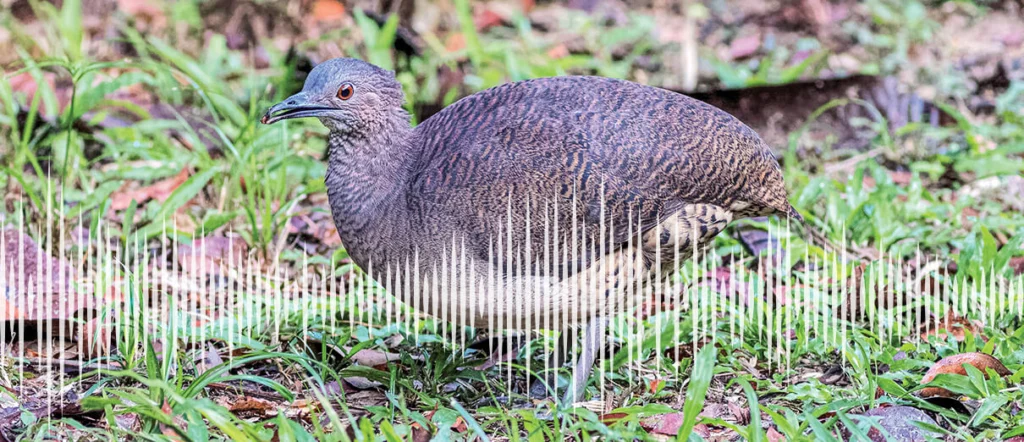
Algunas de las aves más esquivas están ahora en la mira de los científicos. Por ejemplo, el equipo bioacústico ayuda a un ornitólogo a estudiar al merodeador tinamú, una especie en peligro de extinción, en los Andes peruanos, y los investigadores del noroeste del Pacífico utilizan la bioacústica para comprender los patrones de reproducción de esta especie, considerada una especie amenazada a nivel federal. mérgulo jaspeado, a tree-nesting seabird that until now had been almost impossible to track, and to census the old-growth-reliant Northern Spotted Owl, a federally Threatened subspecies declining from habitat loss and competition with range-expanding Barred Owls.
Following a series of studies in the past year alone that document a developing crisis in avian populations, calls for research are growing. Scientists say there’s an imperative need for new and economical approaches to research and targeted conservation.
“There’s a lot of research in front of us,” said John Fitzpatrick, Director of the Laboratorio de Cornell, who is a big supporter of bioacoustics. “This will be profoundly important.”
Regresos vía reproducción
Los proyectos que utilizan bioacústica ahora están pasando de los recuentos básicos de aves a objetivos de investigación más complejos.
En la Universidad de Pittsburgh, investigadores están experimentando con maneras de calcular con exactitud la ubicación de las aves en sus entornos. Han construido una cuadrícula gigante de grabadoras que registra el volumen relativo de llamadas y cantos. Luego, utilizan las diferencias en el volumen del sonido para calcular la ubicación de las aves. Planean crear un gráfico en el que aparecerán burbujas de colores que representan a las aves al desplazarse por el mapa.
En un experimento en Latinoamérica, investigadores de Cornell utilizan sonómetros para estudiar cómo reaccionan las aves a diferentes enfoques de cultivo de café: por ejemplo, cómo se comportan en entornos sombreados y soleados. Esperan que los hallazgos conduzcan a las mejores prácticas agrícolas para proporcionar un entorno saludable para las aves sin reducir la producción de café.
Ornithologists have turned the sound meter concept around to use broadcasts of bird vocalizations to lure species back to former, or into new, habitat by coaxing them into thinking they were joining others of their kind. With these techniques, conservationists attracted Atlantic Puffins back to Maine nesting islands, drew back Peruvian Diving-petrels to a Chilean reserve, and, just this year, helped to relocate a tern and gull nesting colony displaced by bridge construction in Hampton Roads, Virginia.
Aunque avanza rápidamente, la bioacústica se ha quedado atrás de campos relacionados como el reconocimiento de voz y la búsqueda digital, que cuentan con aplicaciones comerciales para financiar su investigación. Esto también podría cambiar con un uso más sofisticado del sonido. A medida que mejoran la economía y la precisión de la bioacústica, se prevén usos que trasciendan la investigación. Entre otras posibles aplicaciones de la bioacústica se encuentran: monitores que detectan fallos en la maquinaria de fábricas y electrodomésticos; dispositivos que ayudan a las personas ciegas a orientarse; y sonómetros que ayudan a detectar amenazas para las aves y sus hábitats, como la caza furtiva, mediante el monitoreo de los sonidos de disparos y motosierras.
Bibliotecas de paisajes sonoros
The greatest potential for bioacoustics in conservation, said Cornell’s Klinck, is for monitoring environments in parts of the world where little is known about the health of species. “It’s all about developing these methods that allow us to do a comprehensive job in assessing what’s going on in these remote areas,” he said. “That’s the end goal.”
Al mirar hacia el futuro, los científicos imaginan un tiempo en el que la captura de paisajes sonoros será tan económica y rutinaria que se volverá tan común como los datos meteorológicos. Las grabaciones, afirman, se convertirán en libros, conservados a lo largo del tiempo en numerosas plataformas públicas y consultados para todo tipo de proyectos de investigación.
“These data will be the museum specimens of our century,” said the University of Pittsburgh’s Justin Kitzes. “These are things we should be archiving. Future generations will return to them, with better methods, better equipment, and new questions we can’t even think of today. They are going to be very thankful to us for preserving this.”
La bioacústica también puede ser una herramienta para fomentar el apoyo público a la conservación. Muchos de los paisajes sonoros de especies en peligro de extinción se encuentran en lugares exóticos, donde los sonidos por sí solos podrían ser una herramienta educativa poderosa y accesible.
André Raine will always remember the day he struggled through the thick underbrush on Kauaʻi to reach the top of a cliff in the Hono O Nā Pali Natural Area Reserve, where he found the largest Hawaiian Petrel colony he’d ever seen. “It was absolutely amazing,” he said. “There were birds everywhere, like going back in time.”
The sound of such scenes could help make the case for conservation, say researchers. ABC’s Nevins, who worked on the Hawaiʻi project, sees a day when capturing that cacophony would help the cause. “Can we bring some of this back to share as an educational experience, so people can hear what it sounds like?” she asked.
Meanwhile, back in the field, bioacoustics continues to change the game for many researchers, including Connor Wood, a Ph.D. candidate at the University of Wisconsin. Wood censuses the Northern Spotted Owl in the expansive Sierra Nevada mountains. “We can cover thousands of square miles,” he said. “The data is just raw sound, so it’s up to you as a scientist to be creative and think, ‘How can I get the most out of this data?’ I think it can be a really powerful way to both advance the species’ conservation and conduct the basic science.”
Commentary: Bioacoustics Make Life Better for Birders
Una herramienta muy solicitada ha sido una aplicación para smartphones que permita a los observadores de aves identificar aves al instante por sus cantos, similar a la popular aplicación Shazam para la música. Varias de estas aplicaciones han llegado al mercado en los últimos años, pero ninguna ofrece una gran fiabilidad ni permite identificar un gran número de especies.
Como dice John Fitzpatrick, director del Laboratorio de Cornell: “Si tuviera un dólar por cada vez que alguien me pregunta cuándo vamos a tener un Shazam para pájaros, podría financiar toda esta investigación solo con eso”.”
Ese día finalmente llegará: Cornell lanzó el año pasado una aplicación para teléfonos Android que utiliza la misma tecnología que el laboratorio desarrolló para registrar e identificar especies para investigación. Red de aves, Se espera que, con cerca de medio millón de descargas, esté disponible para teléfonos Apple este año. Podría incorporarse a Merlin, la aplicación de identificación de aves de Cornell.
Cornell ha desarrollado materiales de identificación para 6.000 de las aproximadamente 10.000 especies del mundo. El laboratorio pone su tecnología a disposición de todos. Con el crecimiento de las bibliotecas de sonidos y la mejora de la tecnología, los observadores de aves pueden esperar que Cornell, así como sus socios y competidores, mejoren continuamente sus aplicaciones.
Se está desarrollando una herramienta de identificación más compleja que utiliza las mismas herramientas de investigación. Permitirá a los observadores de aves usar la bioacústica para rastrear en tiempo real a todas las aves cercanas, por ejemplo, en sus jardines. Este proyecto, que Cornell está desarrollando junto con Loggerhead Instruments, con sede en Florida, recopilará todos los cantos y llamadas de las aves y enviará listas de identificación a su computadora.
El dispositivo, que debería estar disponible este año, se llamará Haikubox y su diseño se asemejará a una pajarera de madera. Su alcance dependerá del ruido ambiental, el nivel de viento y el volumen del canto, pero debería ser capaz de identificar aves a una distancia de entre 90 y 180 metros, según Holger Klinck, director del Centro de Bioacústica para la Conservación de Cornell.
Estos productos deberían aportar una nueva dimensión a la identificación de aves. Al mismo tiempo, los datos recopilados se compartirán con Cornell, lo que incrementará el alcance y la eficacia de la investigación del laboratorio y ampliará nuestro conocimiento sobre el movimiento y la distribución de las aves.