New Argentina Reserve Will Help Protect Grassland Home of Rare Saffron-cowled Blackbird

Protection of this Key Biodiversity Area Will Also Ensure Fewer Threats From Exotic Timber Expansion

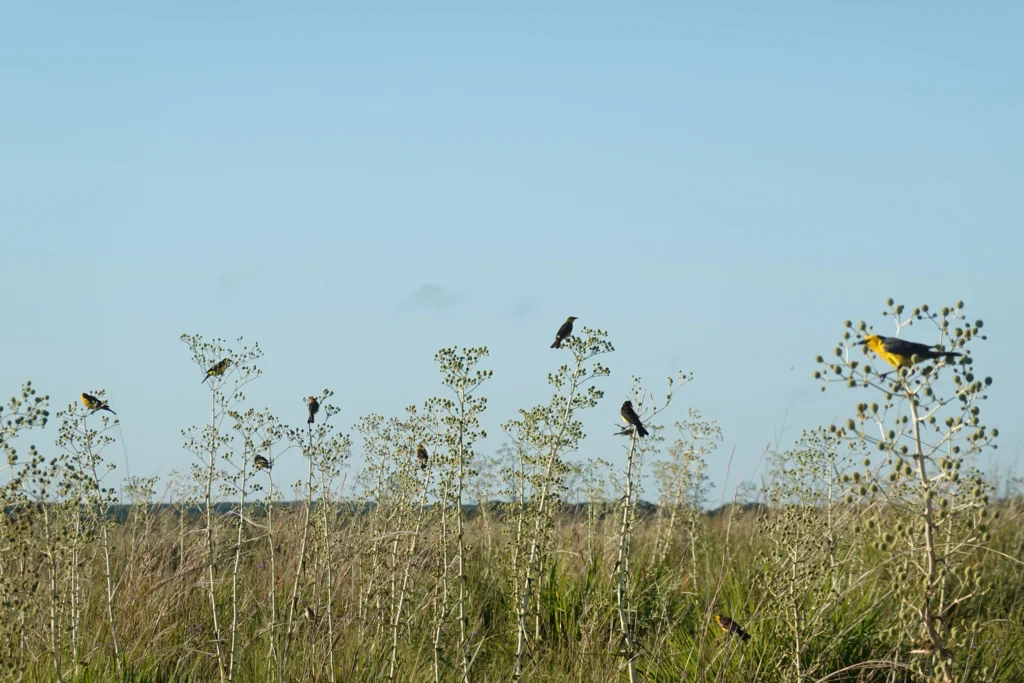
Saffron-cowled Blackbird. Photo courtesy of Aves Argentinas, © Bob Meese.

New Argentina Reserve Will Help Protect Grassland Home of Rare Saffron-cowled Blackbird

Leer En Español
Project Updates
Listen to this article

American Bird Conservancy (ABC), Aves Argentinas, and BirdLife International announce the acquisition of a section of Estancia La Rosita in northeastern Argentina, a vital sanctuary for the Saffron-cowled Blackbird and other threatened species. The newly protected area, 12 miles from the town of Alvear in the northeastern province of Corrientes, spans nearly 3,200 acres.

Securing this land for conservation marks a significant milestone in the preservation of one of the most threatened and least protected grassland and wetland ecosystems in Argentina. The reserve is now official and operational. Ongoing fundraising will support remaining costs associated with land acquisition in this first phase, as well as plans to expand the reserve through additional agreements with landowners to protect Estancia La Rosita in its entirety.

“With the support of our donors and partners, we are helping to ensure that species that depend on well-preserved grasslands do not disappear as exotic timber production expands in the region,” said Hernán Casañas, Executive Director of Aves Argentinas.

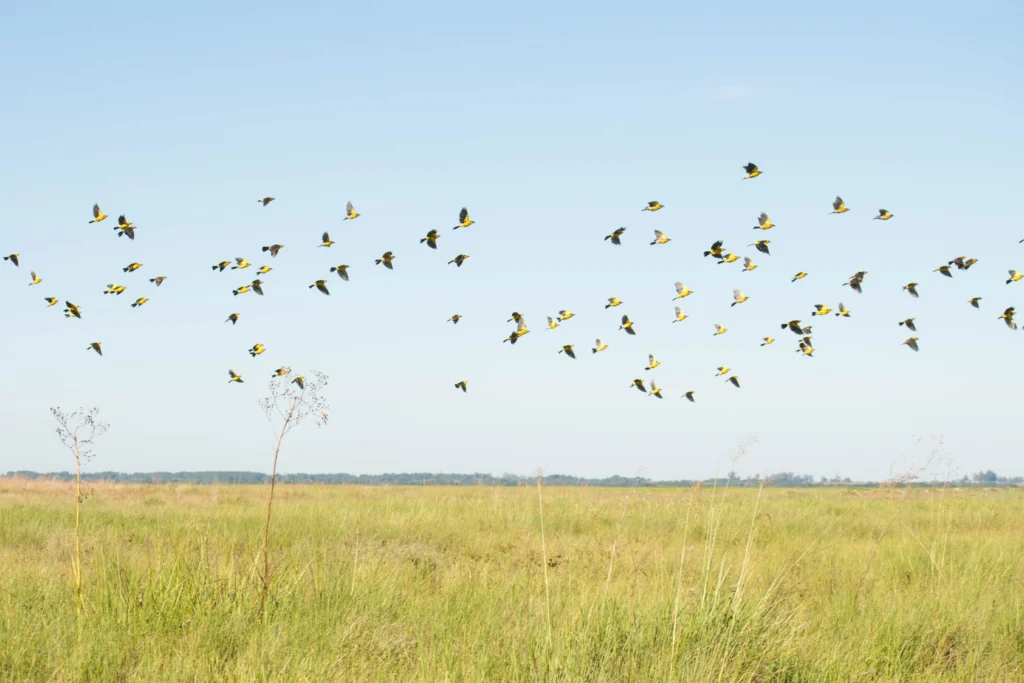
Estancia La Rosita is home to unique and globally threatened biodiversity, including one of the largest breeding colonies of the Saffron-cowled Blackbird, a species that numbers fewer than 10,000 worldwide. In addition to this blackbird — a symbol of conservation and sustainable development of grasslands throughout Argentina — the reserve will ensure protected habitat for other at-risk species such as the Iberá Seedeater, Black-and-white Monjita, and the Strange-tailed Tyrant. More than 180 bird species have been documented at the location, in addition to declining mammals such as the marsh deer and the maned wolf.

Saffron-cowled-Blackbird. Photo by Agustina Rivero.
Saffron-cowled-Blackbird flock at La Rosita Reserve. Photo by Agustina Rivero.

Estancia La Rosita is located in the Aguapey River basin, one of Argentina’s most critical Key Biodiversity Areas (KBA), where only 0.1 percent of grasslands and scrublands are currently legally protected at the national level. They face landscape transformation, mainly due to pine and eucalyptus plantations that fragment and degrade natural grassland habitats.

“We celebrate this achievement together with our partners because the subtropical grasslands that are still preserved in Aguapey contain some of the largest numbers of globally threatened grassland bird species,” said Daniel Lebbin, ABC’s Vice President of Threatened Species. “Protecting part of this Key Biodiversity Area in Argentina is rewarding, important, and will result in a better future for threatened birds in the region.”

This reserve creation now takes on even greater importance with the United Nations (UN) having declared 2026 the International Year of Rangelands and Pastoralists. Building on the work that Aves Argentinas already carries out in collaboration with food producers across the country through the Grassland Alliance, the reserve will also support the production and broader adoption of sustainable livestock practices.

Together with the Centre for Applied Ecology (CECOAL-CONICET), Aves Argentinas will continue to coordinate the Saffron-cowled Blackbird Project, which has had a positive impact on the reproductive success of this iconic species. In addition, carbon capture tests will be conducted in the region’s natural grasslands under various livestock densities, in an effort to recognize and prioritize systems in which food production and wildlife conservation are compatible.

Saffron-cowled-Blackbird flock at La Rosita Reserve. Photo by Leandro Bareiro.

“It is key that both forestry companies and agricultural establishments promote biodiversity sanctuaries on their land that are used by threatened species, to create a conservation and development corridor that benefits everyone,” added Casañas.

Once all phases of the project are complete, Estancia La Rosita will be open to the public. The site will also have renovated infrastructure to welcome researchers, volunteers, and birders, while promoting nature tourism as a benefit for local economies.

“As we approach the 20th anniversary of the Grassland Alliance promoted by BirdLife and its partners in the region, the effective protection of a site as outstanding as the Aguapey basin is probably one of the best ways to celebrate it,” said Ian Davidson, BirdLife’s Regional Director for the Americas. “Networking has been key to achieving this global milestone, and we now intend to continue scaling up the project so that new partners can contribute to protecting this fragile and threatened site.”

Creating protected nature reserves has been a hallmark of ABC since its founding over 30 years ago. Together with partners and local communities, ABC has helped protect over 1.3 million acres of land in more than 130 reserves spread across 15 countries, benefiting over 3,000 bird species to date. Explore ABC’s new and improved website to learn more about our work across the Western Hemisphere.

ABC gratefully acknowledges Richard H. Rosen, Randall T. Cox, the March Conservation Fund, the Marshall-Reynolds Foundation, and the Weeden Foundation for their support of this ongoing project.

American Bird Conservancy

American Bird Conservancy (ABC) takes bold action to conserve wild birds and their habitats throughout the Americas. Inspired by the wonder of birds, we achieve lasting results for the bird species most in need while also benefiting human communities, biodiversity, and the planet’s fragile climate. Our every action is underpinned by science, strengthened by partnerships, and rooted in the belief that diverse perspectives yield stronger results. Founded as a nonprofit organization in 1994, ABC remains committed to safeguarding birds for generations to come. Join us! Together, we can do more to ensure birds thrive.
American Bird Conservancy - Media Contact

Journalists, get breaking bird conservation news delivered right to your inbox by joining ABC’s media list. Get in touch by emailing media@abcbirds.org

Aves Argentinas

Aves Argentinas is a national organisation with more than 4,000 members and over 100 years of history, dedicated to protecting wild birds and nature in Argentina. It is a member of BirdLife International, the world’s largest network of organisations dedicated to nature conservation.

Aves Argentinas works on behalf of more than 1,000 species of wild birds and their environments, with conservation, research, education and outreach projects and actions together with researchers, volunteers, technicians and a wide network of volunteers and more than 80 Birdwatching Clubs.

It contributes to habitat conservation by identifying, monitoring and restoring areas important for bird conservation. It protects sites and promotes the care of these key areas for biodiversity, promoting public policies and creating urban reserves and national parks. It carries out environmental conservation projects in Patagonia, the Atlantic Forest and the Pampas.

It works to prevent species extinction, improve the conservation status of threatened birds and prevent an increase in endangered species in our country. In recent years, it has been actively involved in the conservation of threatened species such as the rufous-bellied toucanet, the yellow thrush, the black-browed albatross and the yellow cardinal, among others.

All conservation projects incorporate education, outreach and research components with a strong emphasis on relationships with local residents.