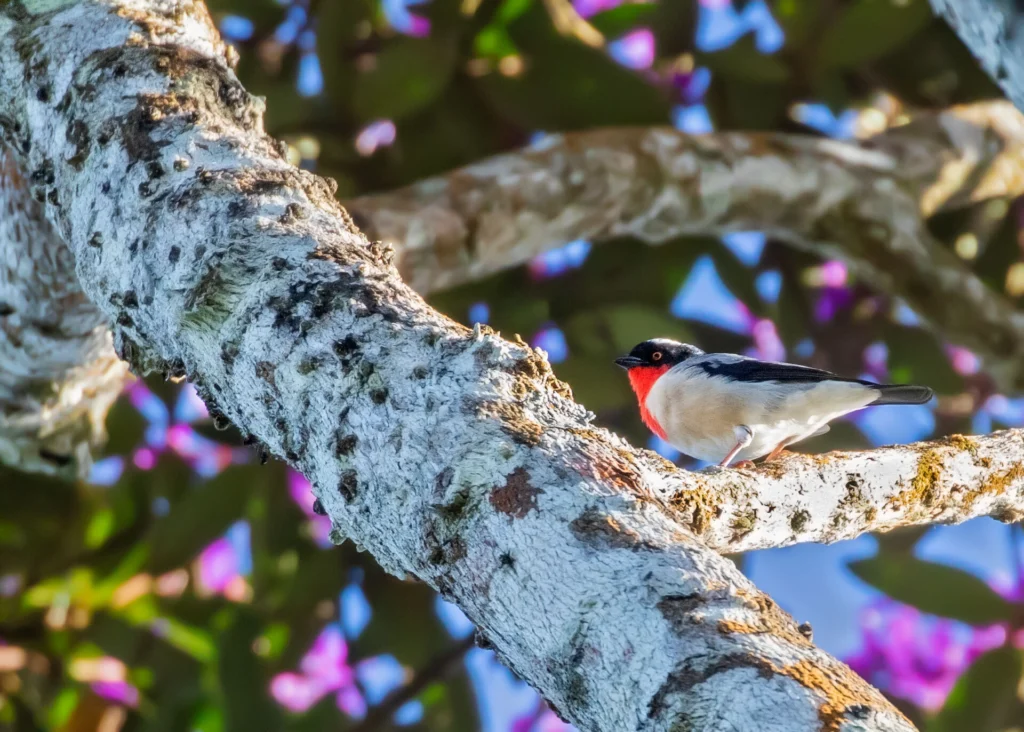
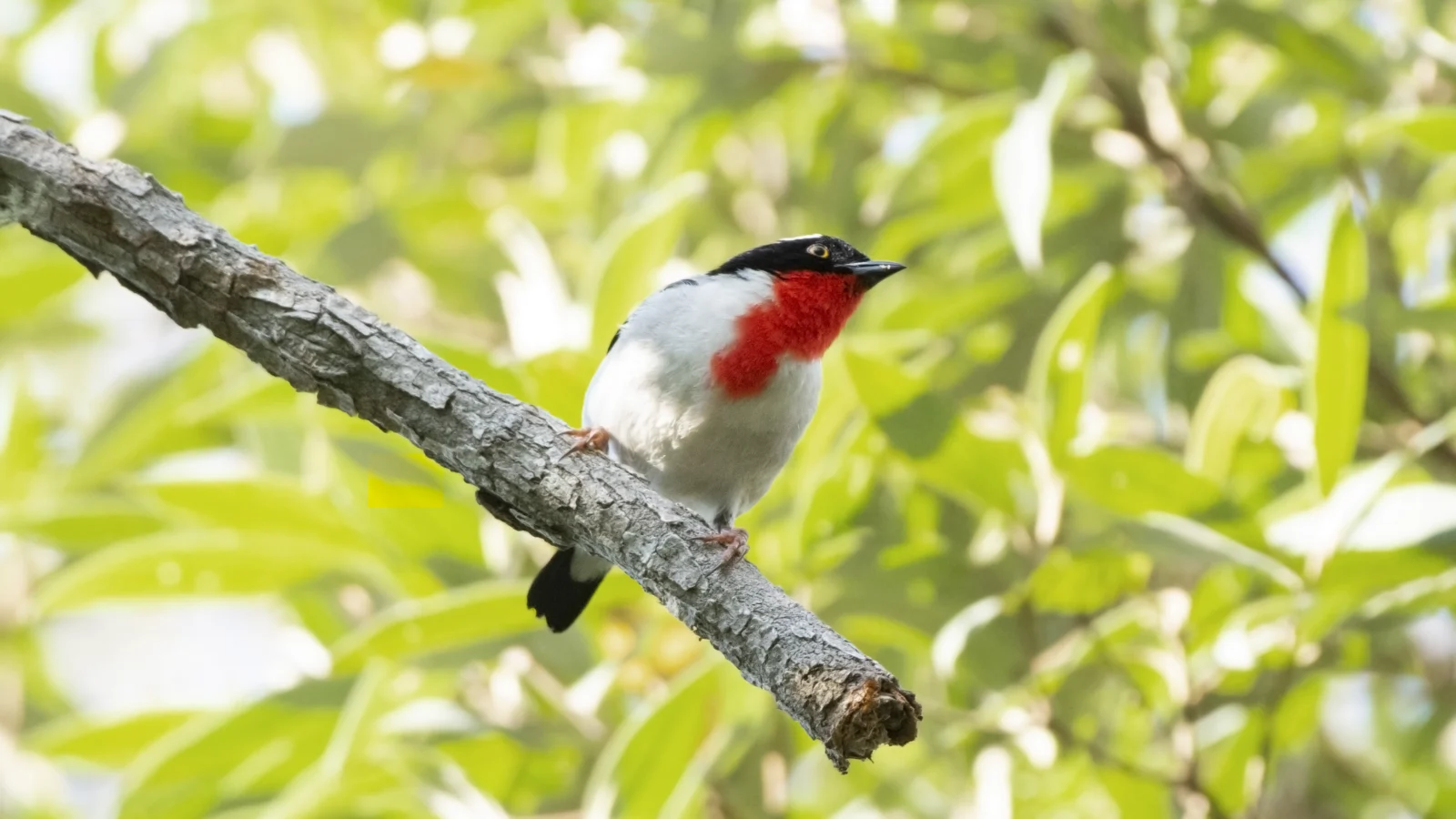
A Cherry-throated Tanager perches on a branch against a leafy green background. American Bird Conservancy partners with Instituto Marcos Daniel in Brazil to protect habitat in the species’ Atlantic Forest range. Photo by Renan Betzel.

Patching the Wounds of the Stabbed Tanager

Cherry-throated Tanager. Photo by Renan Betzel.

Patching the Wounds of the Stabbed Tanager

Leer En Español
Project Updates
Listen to this article

Hidden in the canopy of Brazil’s Atlantic Forest, the Cherry-throated Tanager has a dedicated team of researchers on its tail, trying to unravel its habits and mysteries. On a sunny Saturday in March, I joined them to help out and try my luck at spotting this exceptionally elusive bird.

I headed to the Kaetés Reserve, the heart of the conservation program aimed at saving the Critically Endangered species, in the mountainous region of Espírito Santo state, in southeastern Brazil. And just a few minutes out of the car, still taking in the fresh, cold breeze of the morning, I grasped the bird’s tricky rarity.

“We saw it four times,” biology student Leticia Maia told me as she was exiting the reserve. “We stayed here for 30 days,” she continued, crushing my brief enthusiasm. “It was unforgettable.”

The local guide cheered me up: “It showed up four days this week,” said Matheus Henrique Clemente, a long-haired agronomer-turned-guide and educator.

For a bird whose global population numbers fewer than 20 individuals, it is important to keep expectations in check. Its local name also adds to the drama and has nothing rosy about it. Here we call it saíra-apunhalada, or “stabbed tanager,” a nod to the striking red feathers trickling down its white neck, like blood after a blow.

At the reserve, biologists and researchers have spent the past six years working to patch the wounds surrounding the species. The conservation program is run by the local nonprofit Instituto Marcos Daniel (IMD) and is supported by international organizations, including American Bird Conservancy (ABC).

A Needle in a Haystack

To arrive at the Kaetés Reserve, I left the pristine beaches of Espírito Santo and drove up a two-lane winding road into the mountains. During the three-hour journey, signs of deforestation were everywhere: eucalyptus plantations growing on the horizon and heavy machinery digging land for new condos. The last 7.5 miles is a muddy road leading to the reserve’s main building, a two-story research station.

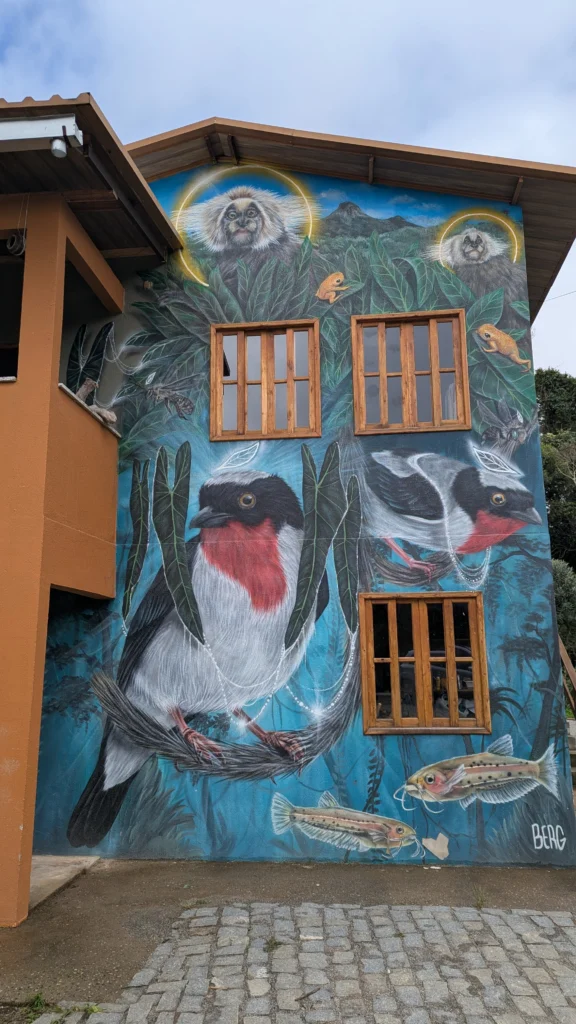
Its front wall is covered by a massive mural depicting two Cherry-throated Tanagers. They’re draped with shiny necklaces, hinting at their status as elusive figures protecting all the hidden treasures in the forest. Indeed, the reserve is home to 16 other threatened species, some of which are also shown on the mural: the buffy-headed marmoset, the plant Philodendron spiritus-sancti, a bright orange toadlet no bigger than a couple of centimeters called pingo-de-ouro (or “drop of gold”), and the Kaetés catfish.

So although the Cherry-throated Tanager is a needle in a haystack, the mere creation of the reserve in its name helps protect a highly diverse habitat with 370 bird species, including other colorful tanagers such as Gilt-edged, Rufous-headed, Brassy-breasted, and Azure-shouldered. The site’s iNaturalist project has recorded nearly 1,660 species — from birds to plants to insects and more.

A mural at the Kaetés Reserve depicts the Critically Endangered Cherry-throated Tanager, the buffy-headed marmoset, and other threatened species found in the reserve, which is managed by Instituto Marcos Daniel and supported by American Bird Conservancy. Photo by Fernanda Ezabella.
Mural at Kaetés Reserve. Photo by Fernanda Ezabella.

“No one ever leaves empty-handed,” said Marcelo Renan de Deus Santos, IMD’s former President and the General Coordinator of the Cherry-throated Tanager Conservation Program. “There is an increasing number of people seeking out the reserve to carry out their research projects on different endangered species.”

The IMD is named after Santos’ father, Marcos Daniel Santos, a famous Brazilian hematologist who presided over the nonprofit until his death in 2006. He never learned about the saíra-apunhalada, and his son only became aware of it in 2016, when he took part in a survey to confirm the existence of the bird in the Kaetés forest. Santos comes from the turtle world, the focus of his master’s and doctoral work; IMD also has conservation programs benefiting Brazilian sea turtles and broad-snouted caimans.

In 2021, IMD acquired 704 acres of land to create the Kaetés Reserve with the help of ABC, Rainforest Trust, and World Land Trust. The site has already expanded twice, to 1,920 acres, and includes a 121- foot observation tower, the highlight of any visit.

Kaetés comes from an Indigenous word meaning “true forest.” The area is believed to consist mostly of mature secondary Atlantic Forest, following decades of natural regeneration after charcoal production ended in the 1970s.

Bennett Hennessey, who coordinates ABC’s conservation programs in Brazil, said the Cherry-throated Tanager is a high priority for the organization, as part of its mission to prevent bird extinctions and protect critical habitats across the Americas. Finding a strong local partner such as IMD was a crucial step.

“The knowledge they have of the species is phenomenal compared to just a few years ago,” said Hennessey, a Canadian who has lived in South America for 32 years. “If everything they are doing can be continued, in the next 10 years the species can be saved from extinction. This is all happening right now.”

A vast area of Brazil’s coast was once covered by the Atlantic Forest biome, one of the world’s most biodiverse regions. Less than a quarter of it remains, and a 2025 study reported that tens of thousands of its forest acres continue to be lost annually. The tanager largely depends on old-growth cloud forest for nesting. Still, Hennessey’s belief in the species’ recovery comes from the fact that enough old-growth forest remains to support the bird.

Rising temperatures, however, are worrisome. “It’s a conflicting situation,” he said. “We have forest areas developing into the ideal old-growth habitat needed, but, at the same time, we have increased dryness in old-growth forests from climate change.”

Hennessey is also a member of the reserve’s advisory board, as well as a “godfather” of the program, according to Santos. “It’s a true partnership built on trust,” he said. “Bennett helps us think things through. It’s almost like mentorship.”

Only on his third visit to Kaetés was Hennessey able to spot Cherry-throated Tanagers, when a group of eight individuals moved through the trees along the forested road for 10 minutes. “It was astounding to see this behavior for such a long period,” Hennessey said. “The loose flock leap-frogged around each other searching for insects just below the forest canopy.”
Two Populations Remain

The Cherry-throated Tanager has always been rare. It was first described by a German ornithologist in 1870, from a single specimen collected in Brazil. While a few unconfirmed sightings occurred over the next 125-plus years, most ornithologists presumed the species was extinct. Then, in February 1998, biologist Cláudia Bauer had the good fortune of rediscovering the bird.

She had been conducting a bird census of various sites in southern Espírito Santo as part of her master’s dissertation with a team of five colleagues. While visiting a fazenda, or plantation, during Carnaval, Brazil’s national annual festival, Bauer spotted a tanager, and immediately knew it was the Cherry-throated. Her group saw at least three individuals for about 20 minutes that day and returned a few days later, when they encountered four individuals in a mixed flock. They studied the species for the next several months and determined that the local population held about 10 birds. The rediscovery prompted a race to find more populations and secure the tanager’s habitat.

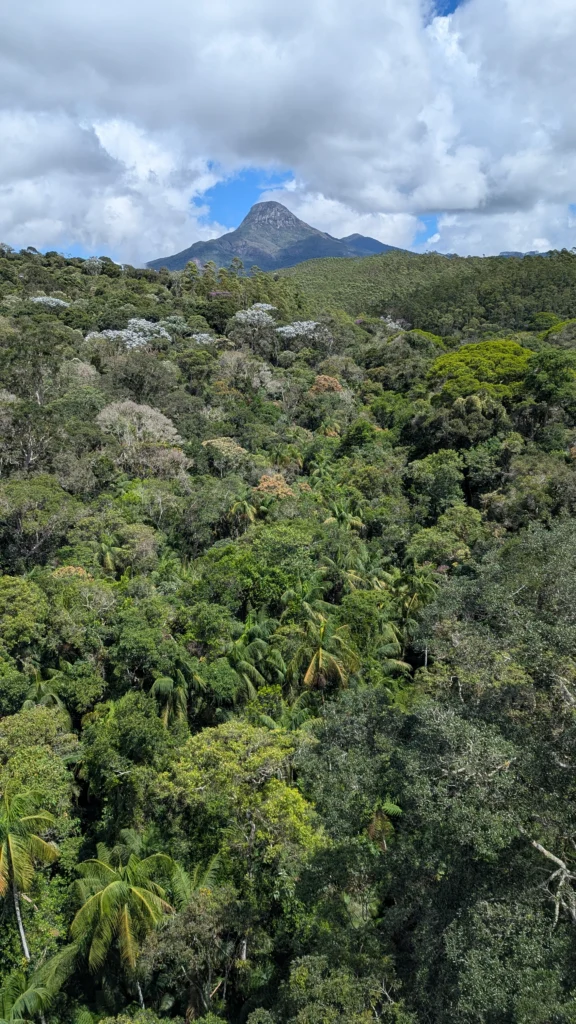
The dense forests of the Kaetés Reserve, with 6,690-foot Forno Grande Peak in the distance. Photo by Fernanda Ezabella.

Despite the overall fragmentation of the Atlantic Forest, the Kaetés Reserve is part of a green corridor encompassing three state parks and two other reserves, making up 12,355 acres of connected forests. Within those green spaces are about 2,820 acres of protected forest that are critical for the tanager, including the Kaetés. At the end of 2025, a 580-acre state park was added, fittingly named Saíra-Apunhalada State Park, after the bird’s Portuguese name. It is just next door to Kaetés, following years of advocacy by IMD.

And this year, IMD, working with ABC, Rainforest Trust, and World Land Trust, purchased the 301-acre Veneto Farm adjacent to Kaetés. The purchase means that nearly 95 percent of the bird’s known habitat is under long-term protection. In addition to the tanager, the area shelters the Endangered southern maned sloth and rare endemic amphibians and fish.

Today, the only two known populations of Cherry-throated Tanager are found between 2,800 and 4,100 feet in elevation. Kaetés is home to one population. The second site, the 8,768-acre Augusto Ruschi Biological Reserve, which is administered by the federal Chico Mendes Institute for Biodiversity Conservation, is about 50 miles northeast of Kaetés. The highest ever unofficial tally of Cherry-throats — 22 individuals — occurred in 2022. Although experts assume 20 individuals are left today, nest monitors during the 2024 and 2025 breeding seasons counted just four individuals total: two in each location.

“Since its discovery, the bird has disappeared from specific locations several times, which suggests groups can radically change their foraging areas,” Hennessey said. He added that researchers do not have permission to enter all private lands where the species might be found.

Monitoring Is Vital

A critical step for the conservation program has been to flood the forest with eyes and ears — scientists, volunteers, birders, and autonomous audio recorders — to find the bird and better understand its behavior and biology, in order to prioritize conservation actions. For several years, a team of four field researchers has monitored the two populations every week. Between 2020 and 2023, they observed 10 nests and witnessed 18 fledglings.

Then, in 2025, outside of the official census period, they also found a group of six individuals, including three recently fledged immature birds, relatively close to the research station in the Kaetés Reserve. The biologist who found them described the encounter as one of the best moments of his career. “It was a great relief,” said Victor Vale, the program’s supervisor.

“I was deeply concerned about the scarcity of sightings. Yet, on our very first trip back into the field in 2025, we encountered this group, large chicks being fed by their parents,” said Vale. “It was a real boost of hope.”

Cherry-throated Tanager. Photo by Caio Brito.

In 2024 and 2025, no nests were found. The reason might be related to record droughts in the area, as the birds depend on beard lichen to build nests, and the beard lichen relies on a humid environment to be flexible; if it’s too dry, it breaks. Nonetheless, the nest architecture is simple: The birds bind the lichen with spider silk, forming a cup in the fork of tall trees.

“The lack of nests could also be linked to lower bird fitness, which in turn impacts reproductive success,” said Santos.

All the monitoring efforts are paying off, and the team has learned a lot, filling gaps in understanding of the species. For example, adults and juveniles help to bring food to a single brood of nestlings — a behavior known as cooperative breeding. The breeding strategy occurs in a few hundred bird species worldwide, yet it’s uncommon among tanagers.

Cherry-throats feed primarily on insects and can be remarkably selective. “It’s not an easy bird to please,” Santos said, explaining that his team tried to feed the tanagers mealworms with no success. “We offered them on a log near a nest. They landed on it, looked at the larvae, decided they didn’t trust them, and flew away.” A reliance on insects is uncommon for tanagers, which typically feed heavily on fruit, Hennessey added. “This shows the high specialization of this species,” he said. “But we also know that insect populations in fragmented forests are declining, most likely from climate change,” which may contribute to the tanager’s rarity. “By having nest helpers as well, this species has separated from the typical tanager life history.” Now, researchers are studying whether the tanagers disperse outside the breeding season and rejoin breeding flocks in the spring.

Keeping Watch

To expand the eyes in the forest, the conservation program started a 30-day volunteer program in November 2025. As of July 2026, it had received 19 volunteers, mostly biology students from around Brazil, as well as a few occasional artists and people from the tourism industry. In the first week, the volunteers receive training, and in the second week they start following the field researchers. They collect information not only on the tanager but on a range of other birds, animals, and flora.

“The volunteers maintain a positive attitude and a sense of wonder about everything they see. It renews our own motivation,” said Santos.

Maia, the biology student I encountered when I arrived at Kaetés, was a volunteer and is already planning to return. The 24-year-old, who had arrived skeptical that she would ever see a Cherry-throated Tanager, spotted it in her first week. After spending the morning searching the trails, she climbed the observation tower with a couple of tourists, and there it was. Like so much about the tanager, it was a dramatic encounter.

“We heard it calling nearby. And when it perched on a blooming quaresmeira tree, at that very moment, lightning struck close to the tower,” she recalled. “We had to climb down. A big summer storm was rolling in.”

Maia specializes in botany and spent a lot of time in the reserve nursery, which functions as a plant hospital. She collected epiphytic plants — species that grow on trees rather than in the soil — that had fallen along the trails and nursed them back to health. She was captivated by the area’s rare plants, such as the climbing aroid Philodendron spiritus-sancti, regarded by many collectors as the “holy grail” of houseplants. (Plant poaching, especially of palm trees, disturbs the local ecology throughout the region but is not a direct threat to the Cherry-throated Tanager.)

The reserve is also home to the vibrant orange orchid Cattleya neokautskyi, endemic to Espírito Santo, and groves of endangered tree ferns (Dicksonia sellowiana).

Along with researchers and volunteers, the reserve also enlists tourists and birders to help in the monitoring. In 2025, the reserve welcomed 95 visitors from 17 countries. About 30 percent managed to see or hear the Cherry-throated Tanager. “We say tourists here are scientific tourists,” said Clemente, a 30-year-old local guide, who noted that using playback to attract the bird is not allowed.

Visitors normally stay for up to three days in the research building. In the coming months, they will have a new lodging option, Kaetés Lodge, housed in a renovated dairy farmhouse at the recently acquired Veneto Farm.

The plan is to also transform the property’s old cattle corral into a school of forest restoration. IMD wants to teach rural landowners how to restore native vegetation, or hire trained local workers, to meet environmental regulations and create jobs. The school will expand an educational program IMD has provided for six years, which has already reached more than 1,500 students from 15 schools.

Sounds of the Forest

Clearly, much is happening at the Kaetés Reserve, and visiting the site is an immersive experience. To reach the reserve’s 121-foot observation tower, we walked along a flat shaded trail. We sampled the purple fruit of the juçara palm, which has long been targeted by illegal palm heart harvesting. Its fruit feeds more than 70 species of wildlife and is often described as the Atlantic Forest’s equivalent of the Amazonian açaí berry.

We also encountered a venomous jararaca pit viper and one of its young sunbathing by the trail, unbothered by the chatty group of humans passing by.

From the top of the tower, as I was catching my breath after climbing the stairs, I spotted a solitary Gilt-edged Tanager jumping branches. A rush of hope went through me. The blue-and-yellow bird is number one on a list of birds that are sometimes seen with the Cherry-throated Tanager. I scanned the trees with my binoculars but found no saíra-apunhalada.

Yet there was no time for whining with a sea of green canopy spread out below me. Far away, the bare granite peak of Forno Grande stuck out above the trees, the second-highest point in Espírito Santo. In some ways, I felt lucky just to be here.

A 121-foot observation tower rises through the trees of Brazil’s Kaetés Reserve. Photo by IMD Archive.

The Gilt-edged Tanager continued to access the flowers and leaves a few meters away. The bird showed up in a recent study — sponsored by ABC and Germany’s Zoological Society for the Conservation of Species and Populations — that analyzed 40 audio recordings of Cherry-throated Tanagers collected between 1998 and 2026.

“We found 30 species vocalizing at the same time as the Cherry-throated Tanagers, but we know not all were in the mixed flock,” said IMD biologist Gabriel Falquetto.

The recordings came from the monitoring efforts and from the website WikiAves, Brazil’s largest community science platform for birds. Three additional audio files have been collected from 15 recorders that were installed in the forest last February and donated by Idea Wild, a Colorado-based nonprofit.

Other common birds in the mixed flocks were the Rufous-headed Tanager and Sibilant Sirystes, a large grayish flycatcher. “We use these birds as bioindicators of the saíra-apunhalada,” said Falquetto. “The data provides invaluable information for advancing the search for the saíra and potentially running models to locate new populations.”

Hennessey noted that outside of the breeding season, many of the area’s common songbird species always move in mixed flocks while the Cherry-throated only does so occasionally. “If they are foraging in an area where there is another foraging flock, they will join in — for better security and perhaps to take advantage of a good foraging location — but they also have no problem going off on their own,” he said.

Banding the Cherry-throat and other traditional ways of monitoring birds have proved difficult. So far, only four have been fitted with bands. Since it’s a canopy-dwelling bird, a net has to be placed at treetop level, and the birds learned fast to avoid the apparatus. Of the four banded, only one stayed in the reserve. A second one made an appearance after two years, along with the tagged bird that stayed. It was a surprise Santos remembers well.

“They had three offspring,” said Santos. “The bird returned to reproduce and then disappeared again.”

The Brazilian knows his team is working against the clock to keep the Cherry-throated Tanager from vanishing completely. But meeting all these people committed to conservation and supporting their work has been a great way to fuel his optimism. “They believe that all our efforts are not in vain,” said Santos. “And that together we can dream, plan, and make things happen.”


A version of this article was first published in the Fall 2026 issue of Bird Conservation, the member magazine of American Bird Conservancy. 

Fernanda Ezabella is a Los Angeles-based journalist who writes about arts, entertainment, and nature for Folha de S.Paulo, one of Brazil’s largest newspapers. She has also written for Living Bird magazine and is the former editor of The Wrentit, the newsletter of the Pasadena Audubon Society.

Acknowledgments

ABC thanks March Conservation Fund, Randall T. Cox, C. David Cook, Robert Campbell, Shearwater Foundation, and the Lenton PARKS Fund for supporting the Kaetés Reserve. ABC also collaborated with funders Rainforest Trust and World Land Trust to make the recent reserve expansion possible.