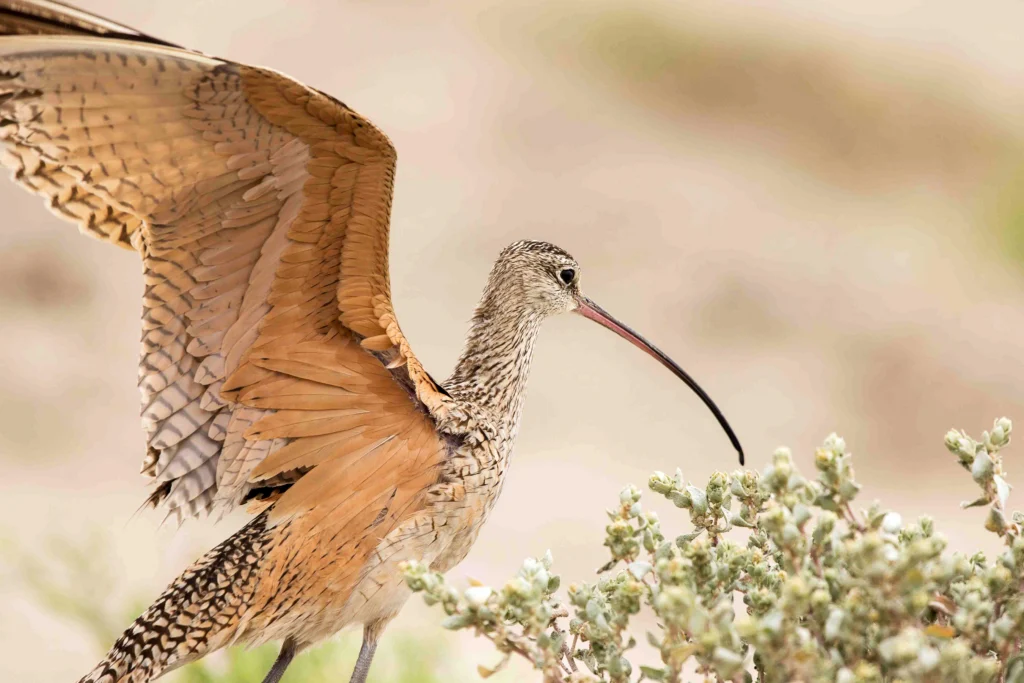
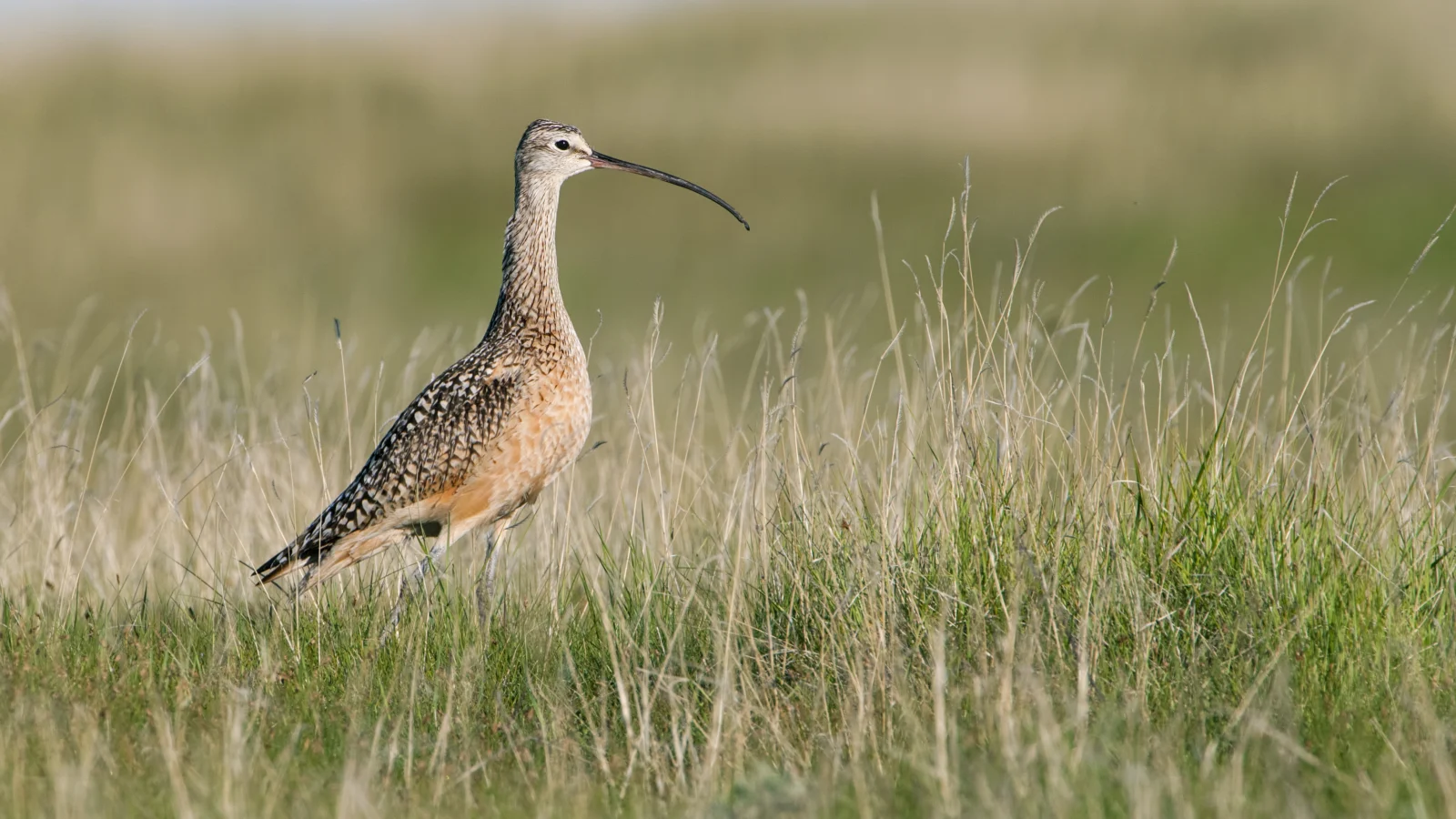
A Long-billed Curlew stands in a grassy field. The curlew is the subject of “The Grassland Queen” now available from Princeton University Press.

An Excerpt from “The Grassland Queen: An Avian Love Story in the American Plains”

Long-billed Curlew. Photo by Tim Zurowski/Shutterstock.

An Excerpt from “The Grassland Queen: An Avian Love Story in the American Plains”

Leer En Español
Bird Stories
Listen to this article

The Grassland Queen: An Avian Love Story on the American Plains by naturalist  Priyanka Kumar blends fieldwork and storytelling to capture the epic migration of the Long-billed Curlew. Kumar tags along on the journeys of the curlew, a graceful-looking shorebird reliant on the grasslands that once dominated much of the western United States. The Grassland Queen offers an immersive window into the lives of Long-billed Curlews and their complex, fascinating, and imperiled grassland ecosystems.

American Bird Conservancy (ABC) has improved more than 600,000 acres across the Northern Great Plains, working with a wide range of partners to revitalize and conserve grasslands in the heart of the Long-billed Curlew’s breeding range. Weaving science and a sense of wonder, Kumar gives readers a bird’s-eye view of life on the sweeping prairies and an intimate look at the lives of curlews nesting in this vulnerable and changing habitat.

“Ms. Kumar draws attention to the needs of birds. It is a very important aspect of conservation. To care about a thing, we must first know about that thing. We certainly can’t expect people to help things unless they develop an appreciation for them,” said Steve Riley, ABC’s Vice President of Conservation Programs. “Much of what is written that aims to fix things like habitat loss is prepared for scientific audiences and for those who already have a working knowledge. Kumar reaches a broader mainstream audience with a message of both alarm and hope.”

Read an excerpt of The Grassland Queen: An Avian Love Story on the American Plains by Priyanka Kumar, available now from Princeton University Press.

The Grassland Queen — Chapter 5 Excerpt

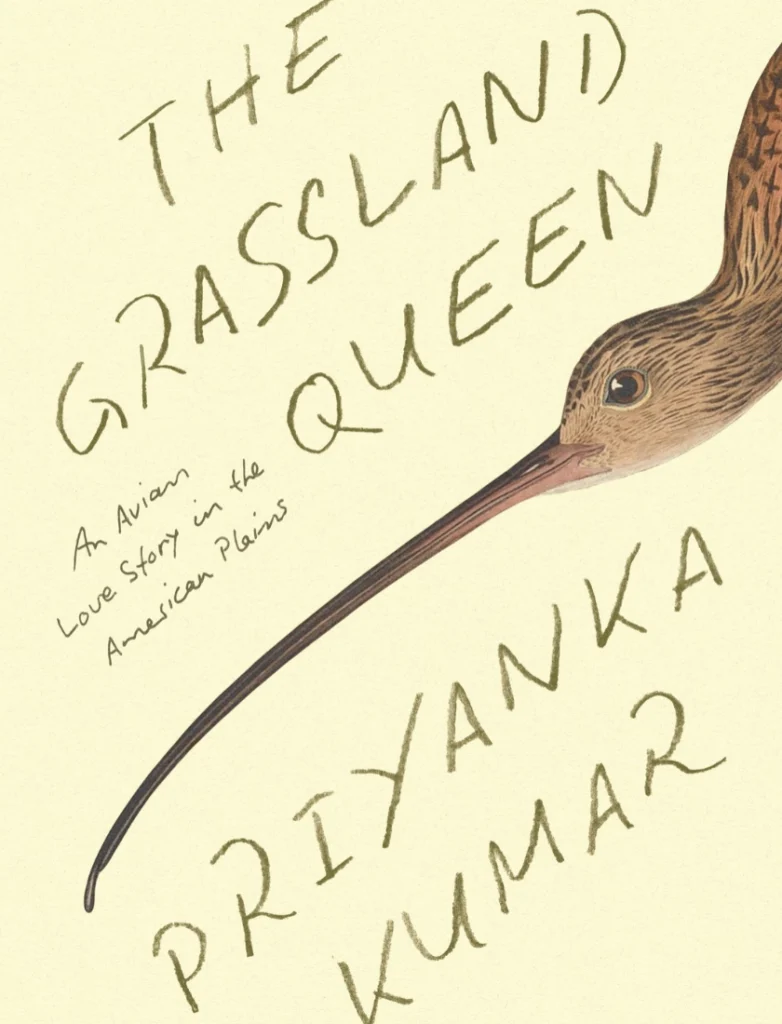
Cover of The Grassland Queen by Priyanka Kumar.
The Grassland Queen by Priyanka Kumar.

Exploring the New Mexico grasslands and coming up empty, I sometimes remind myself how small the long-billed curlew population is, some 140,000 individuals scattered across western North America.

These summer days when I close my eyes to rest briefly after a long day-trip, I see a curlew, sometimes two, moving about in the vast prairie. The small head gives the large bird a fragile air. The bill is like a thin, steely projectile with a dab of pink at the base. The body has precisely the right colors to blend in with the dry prairie. The legs are bluish gray. Mostly I see curlews in profile, moving about and using keen perception to raise chicks while facing multiple threats. They do not know how many complex forces, including the decisions that humans make, are stacked against them. The buffy chicks, tiny blobs, have so much growing to do. To raise a chick that is little bigger than a fluffball at birth to a fully functional juvenile must be a daunting job for a curlew parent. In the coming days, the parents must forage in a field with the right topography so that the chick can learn to forage without being too exposed to danger. Yet there is no way to truly insulate the chick from danger. The chick must forage for herself and eat enough to grow into a self- sufficient juvenile in two months.

The grasslands are nowhere near as wet as they were at the beginning of May. In the thick of summer, the grasses begin to look sun bleached.

Wildflowers still bloom—at least a scattering of Indian paintbrush and fleabane. The prairie birds on their spring migration path, vividly present and audible in the first half of May, have long since left, and the fields are bleakly quieter. This silence is more barren than three hundred years back. Before Europeans colonized North America, there was an abundance of grassland birds. Since 1970 alone, seven hundred million breeding grassland birds across thirty- one species have vanished—among breeding biomes, they have “the largest magnitude of total population loss.”

A bold chuckling sound pulled me out of my grim thoughts. Startled, I turned to check whether a meadowlark had surreptitiously landed on my shoulder and realized that he had just flown from a nearby fence post. Now that the uncommon migrants have left or thinned out, the meadowlark can shine bright with his boat-shaped body, forward-pointed head, and splash of golden sun on his chest. Even when passing clouds darken the skies, the bird’s silhouette is a dead giveaway.

A Long-billed Curlew stands with wings outstretched next to a patch of white flowers.
Long-billed Curlew. Photo by Rick Derevan/Flickr.

The horned lark had a muted presence today, with only an occasional individual watching from a barbed wire fence. While the horned lark’s nesting range is nearly continent-wide, a significant portion of the population nests in the southern Great Plains. Abruptly, a pair in the field dazzled, rising from the grassy ground into the air, meeting at the tip of their arcs like a tease before arcing back down to the ground. Was this a relationship-maintenance dance? For this species, most fights occur in flight: With a strong su-wheet call, two males fly straight up, pecking and clawing, and resolve the fight in under a minute. Or else they fly back into the air once more. After a fight is resolved, the males sometimes land on a perch and belt out a song. What a great way to say: No hard feelings!

Before we entered the Curlew Zone, I experienced familiar anxiety mingled with excitement. Would we find the birds? Or had I used up my luck? On days like today when we aren’t overnighting nearby, we rise very early, do a surprising amount of prep work to pack our picnic, corral the kids, and then drive a significant distance—all to get to this precise moment. I searched with all the concentration I could muster but saw only a sea of tawny bleached grass. Not even the slightest movement.

Silence and patience are allies in developing a connection with the natural world; this connection is essential, for it gets us to recognize when the rhythms of nature abruptly change. Since the dawn of the industrial age, human connection to nature has declined by 60 percent. One reason for this decline is that older generations aren’t passing on their “nature traditions” to kids. I try to bring the girls along on field trips when possible. Something like the simple joys in life seem to be ours as we tromp through the prairie with no fixed aim but to encounter a species who has become an old friend. Most of us no longer live close to the woods, and it takes a conscious effort to keep kids and ourselves fluent in the language of nature. In order to read the evolving story of our planet, it helps to know the names, patterns, habits, and needs of the wild animals who live here. In large part, our connection to nature gets us to care about the ways in which our planet is degrading. I have spent many hot June afternoons observing birds and writing, while living in a state with the sixth highest wildfire risk in the country. This summer, dozens of out-of-control wildfires raced through the Canadian prairies in the provinces of Manitoba and Saskatchewan, with smoke blanketing more than a third of the US.

When we aren’t engaged with the fate of our planet, we are left simply to recognize with a rude shock when climate change bangs at our doorstep, in the guise of ever hotter wildfires or wilder-than-ever hurricanes. Family friends from northern New Mexico had to evacuate when a wildfire threatened their home, and they stored their belongings and vehicle with us for a month. Their house was left intact though many others were destroyed. Later when I drove past the charred homes, I wondered whether it’s possible to hold beauty in one’s heart amid the losses that so many are experiencing. In my own neighborhood in Santa Fe, the fire department now tags trees that must be cut down to reduce wildfire risk. Our next-door neighbor is worried after his last phone call with his insurance agent. He was told to cut down some beloved trees or else lose his home insurance. The threat is real. Over three recent years, home insurers decided not to renew some ten thousand policies in the state.

The days are gone when it was possible to look away. Climate change has introduced serious disruptions into our planetary story. I read nature so that I might recognize the glitches that are intensifying. Spending time with grassland birds, I care that their populations are in severe decline. Long-billed curlews are not alone in facing climate crises, habitat loss, and illegal shooting, but the consequences have been stark in their case. In 2009, when scientists began to research long-billed curlews on BLM land in southwestern Idaho, the population was down 85 percent in the previous thirty years. By 2019, 95 percent of the population had been lost in the previous forty years.
The prairie looks flat until you see animals move about in it; then you recognize its topography—all the mounds, burrows, inclines, and dips that your eye may have previously missed.

Curlew chicks must navigate all the challenges that humans have thrown in their path: First the grasslands were plowed up for crops and then degraded for oil and gas drilling, and now in a time of water crisis even dry shortgrass prairies are being put to work to grow water-intensive crops—and this is in addition to amped-up urban sprawl. Our fragmented grasslands struggle to function as a healthy ecosystem; while simultaneously shrinking and warming, they can scarcely support the dynamic birds who make their living here.

In the thirteenth century, the Japanese Zen monk Dogen once came upon an elderly tenzo, the head cook at a monastery, who was drying mushrooms on a rooftop on a hot sunny afternoon. Pitying the sweating old man, Dogen asked him why he was personally drying the mushrooms. Why didn’t he delegate the task to someone else?

“If I don’t do it, who will?” the tenzo said decisively.

In my life as a naturalist, I have translated this philosophy to mean: If I don’t care about these grassland birds, who will?

The prairie looks flat until you see animals move about in it; then you recognize its topography—all the mounds, burrows, inclines, and dips that your eye may have previously missed. The pronghorn father with handsome antlers gazed curiously at us as we drove by. The sensitivity of both pronghorn and curlew parents takes my breath away. Their heightened sense of alertness is of course necessary, as are their multifaceted responses, especially considering the everyday dangers that curlews face. Still, the complexity of curlew responses—almost humanlike in their strategizing—is nothing short of extraordinary.