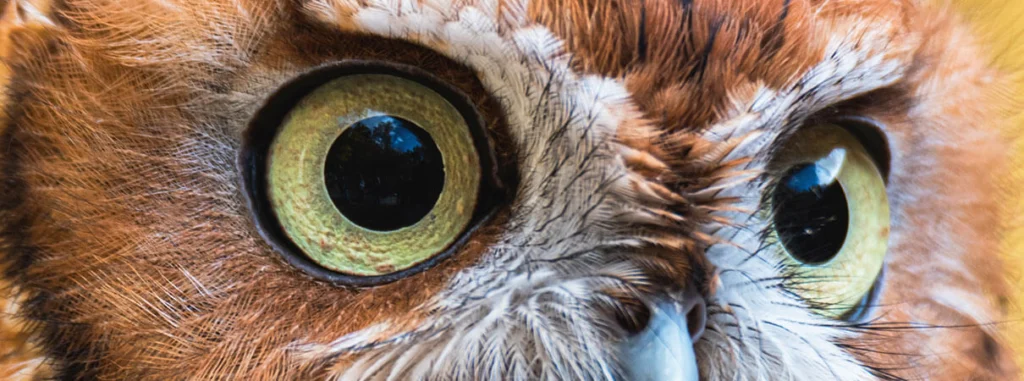
Forward-facing eyes and extra eyelids aren’t the only optical advantages that owls possess. They have one important habit that sets them apart from other avian predators: Most of them hunt at night. And that means they need to be really, really good at seeing in the dark.
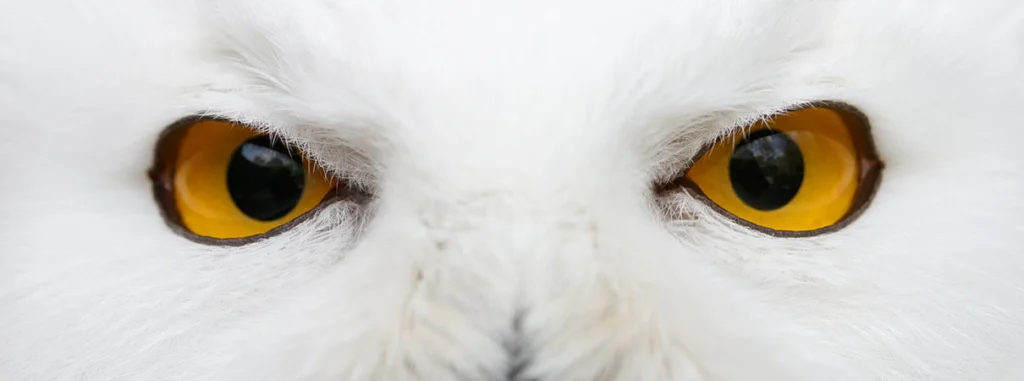
Owls’ enormous eyes help them take in enough light to see, even after the sun sets. Owl eyes make up as much as 5 percent of these birds’ total body weight. That may not sound like a lot, but for comparison, your eyeballs are about 0.0003 percent of your total weight.
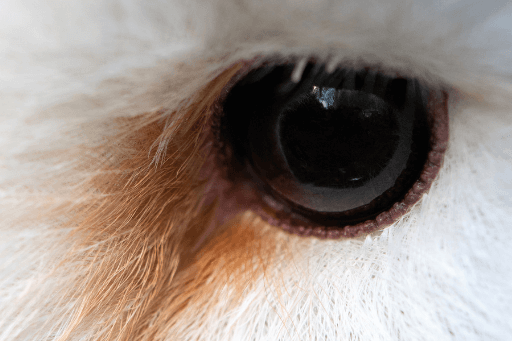
In addition to their out-sized eyes, owl pupils dilate extremely wide to let as much light as possible hit the light-sensitive retina at the back of the eye.
Like us, owls have two different types of light-sensitive cells in their retinas — rods (which detect light and movement) and cones (which distinguish color). Humans have about 20 rods for every cone, but in owls that ratio is more like 30 to one, making them exceptionally good at picking up movement even when it’s dark.
If you’ve ever been out at night and seen owl eyes shining back from your flashlight beam, you no doubt noticed their reflective power, which is yet another way that owls enhance their night vision.
Behind an owl eye’s rod-packed retina is another layer called the tapetum lucidum, which catches any light that may have passed through the retina and bounces it back to those sensitive rods. All of these adaptations add up: Some owl eyes may be as much as 100 times more sensitive in low light than ours. The one downside is that owls tend to be farsighted and experience difficulty focusing on objects at close range, but sensitive bristles around their beaks make up for this a bit, giving them another way to sense objects close to their faces.