A forested landscape with rolling hills and clouds.

Tropical Forests: Hot, Humid Biodiversity Powerhouses

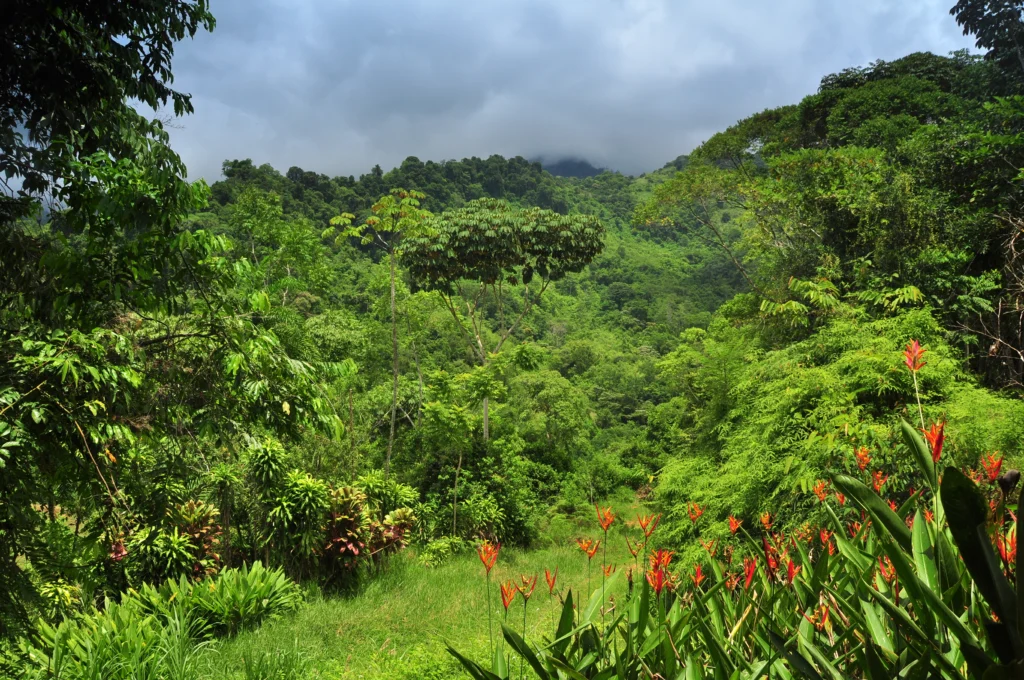
Costa Rican tropical forest. Photo by Ivalin/Shutterstock.

Tropical Forests: Hot, Humid Biodiversity Powerhouses

Leer En Español
Bird Stories
Listen to this article

The forested habitats that cover the Western Hemisphere are as varied as the birds that frequent them, from towering conifers near the North Pole to lush and steamy rainforests spanning the equator. Three major forest biomes — tropical, temperate, and boreal — are defined latitudinally, or by their proximity north or south of the equator. It’s latitude that creates the conditions for the steady and steamy heat of the tropics, the constantly shifting seasons of temperate forests, and the chilling cold of the boreal forest’s winters.

Some forest birds stay put year-round. A Toco Toucan wouldn’t leave the tropics — why would it, when its beak diffuses heat and the berries are abundant? Others, like the Blackpoll Warbler, experience all three forest biomes in a single year, migrating to find a steady supply of food seasonally. These tiny warblers arrive in the tropics after each breeding season in greater numbers, as young birds, just hatched a few months prior, make the first journey to their non-breeding grounds.

Located along the equator, tropical forests are the most biodiverse habitats in the world. The relative stability of these lush habitats, where temperatures rarely fluctuate and rainfall remains steady or cyclical, creates the perfect conditions for life to flourish. And does it ever! Despite covering only about 12 percent of the Earth’s surface, tropical forests are home to an astounding number of species — as much as 80 percent of all biodiversity can be found within tropical forests. Protecting this treasured habitat from deforestation and degradation is vital, and much more needs to be done.

Araripe Manakin. Photo by Ciro Albano.
Photo by Ciro Albano.

Tropical Rainforests: Refuges in the Rain

The sprawling canopies of evergreen tropical rainforests provide continuous and closed cover, with the humidity from the region’s plentiful rainfall creating the hot, sauna-like conditions for which these forests are famous. Dappled light filters through the treetops and encourages the growth of orchids, bromeliads, and ferns, as well as crops such as cacao. Many rainforest plants tend to be shaped in such a way that they can hold onto moisture. Humidity is the hallmark of tropical rainforests.

These lush conditions make tropical rainforests a powerhouse of species diversity. One 220-acre area of rainforest can host as many as 250 bird species (for perspective, one acre is about the size of a football field). And the birds found there are every bit as diverse as they are abundant.

Birds in these habitats are also in trouble: More than 150 bird species classified as Endangered or Critically Endangered are found in tropical rainforests in the Western Hemisphere, making these forests a refuge for some of the world’s rarest birds. American Bird Conservancy (ABC) works with a network of dozens of partners to prevent more of this critical habitat from vanishing. Protecting habitats like Brazil’s Atlantic Rainforest is our most powerful tool for saving the birds that live there, including the world’s remaining Cherry-throated Tanagers, numbering fewer than 30 birds.

The Araripe Manakin, first documented in 1996, occupies an oasis of lush forest in an otherwise dry shrubland. The population of the Araripe Manakin numbers only about 800 individuals, and all are found in this tiny pocket of forested land. With a population so small and a range so restricted, the species is Critically Endangered, and habitat loss remains its biggest threat.

“This highly specialized species only lives in a thin line of forest fed by water springs along the base of an escarpment,” said Bennett Hennessey, ABC’s Brazil Conservation Program Coordinator. “ABC has been helping the Araripe Manakin project by creating reserves, forest fire protection, sustainable tourism, reforesting areas, and public environmental protection. The future for this species is improving with the dedication of the Aquasis team.”

The ABC-supported Fundación para la Conservación de los Andes Tropicales (FCAT) Reserve is located in a tropical moist forest in Ecuador. Receiving less rainfall than rainforests, tropical moist forests may also have seasons of monsoon-like or savanna-like conditions. The FCAT Reserve protects a portion of what remains of Ecuador’s Chocó forest. Deforestation and the conversion of land for agricultural use reduced the forest to a mere two percent of its original size.

The FCAT Reserve is small but mighty. At only 1,546 acres (slightly less than twice the size of New York City’s Central Park), it protects a hotspot of biodiversity that provides contiguous, intact habitat for many endangered species, including the Vulnerable Long-wattled Umbrellabird and the Endangered Banded Ground-Cuckoo, along with scores of other plant and animal life.

Learn about efforts to conserve the Critically Endangered Araripe Manakin and its forest habitats — also available in Spanish.

Palila. Photo by Alexander Clark.

Tropical Dry Forests: Ready for Downpours and Droughts

A few thousand miles away in the Pacific Ocean, Hawaʻi’s Mauna Kea Forest Reserve is a high-altitude tropical dry forest with a distinct rainy season from November through March and little to no rainfall the rest of the year. It is also the last holdout of the Critically Endangered Palila, a vibrant yellow honeycreeper with a thick bill perfectly adapted to ripping open the māmane tree’s tough seedpods. Hawaiʻi has no native land mammals, and the introduction of sheep and goats significantly altered ecosystem dynamics in māmane forest habitat. Introduced cats and rats are a direct source of mortality from predation that the Palila had not previously faced.

Today, the Palila’s numbers are threatened further by climate change, which is altering weather patterns and increasing drought in the region, resulting in less food and lower reproduction. Climate change also poses another threat: as temperatures warm, introduced malaria-carrying mosquitoes are expanding their range ever higher, taking out Hawaiʻi’s honeycreepers as they climb. Though the Palila is currently not experiencing impacts from mosquitoes and malaria due to their high-altitude habitat, they are susceptible and will need protection.

“Palila depend on māmane for survival, with more than 90 percent of their diet coming from this one tree. However, habitat loss and over 200 years of sheep browsing have severely limited the amount of māmane remaining to keep this precious bird alive,” said Chris Farmer, ABC’s Hawaiʻi Program Director. “That is why ABC and our local partners have focused on replanting trees and protecting the native tropical dry forest.”

Protecting the remaining endemic honeycreepers in Hawaiʻi, sometimes called the “extinction capital of the world,” is a top priority for ABC. A multi-pronged effort involving many partners is underway to mitigate threats from introduced species, bolster Palila habitat through tree planting, and reduce the threat of avian malaria on impacted Hawaiian species. The challenges are great for Hawaiʻi’s endemic birds — after not being seen for decades, eight Hawaiian bird species were declared extinct in 2023 — but these actions provide hope for those remaining.

Like the Palila, tropical dry forests are endangered. The Mauna Kea Forest Reserve has been protected for more than 100 years, but elsewhere in the world, dry forests are at serious risk. Because they are easily cleared by burning, they make an attractive spot for farming. These forests also have a dry season that prevents the growth of unwanted vegetation and a rainy season that results in fertile soil.

Palila. Photo by Alexander Clark.

Mangrove Forests: Going with the Flow

When you think of the tropical coast, pristine, sandy beaches populated by sandpipers and pelicans might come to mind. But in coastal intertidal zones, where land is underwater at high tide and open to the air at low tide, mangrove forests emerge. Their massive tangles of roots appear to rise out of the brackish water, filtering sediment and stabilizing soil as the tides ebb and flow.

These thickets provide the perfect habitat for birds like the secretive Mangrove Cuckoo, a seldom-seen denizen of the mangroves dotting the coasts of the southern U.S. and Central America, and the shimmering Mangrove Hummingbird, an Endangered bird found only on Costa Rica’s Pacific Coast. In Costa Rica, the Yellow-billed Cotinga Sanctuary, established by ABC and our partner Osa Conservation, is preserving much-needed mangrove habitat.

Reddish Egret in mangrove. Photo by FotoRequest/Shutterstock
Reddish Egret in mangrove. Photo by FotoRequest/Shutterstock.