Pawsitively Purrfect Ways to Keep Cats Happy Indoors
Learn how the ABC team keeps their indoor cats happy and get our flock’s tips for helping your cat explore the outdoors with you in a way that’s safe for them, and for wildlife.

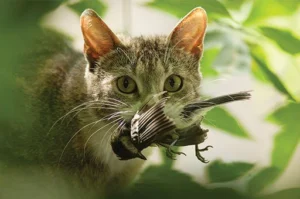
There is no greater human-caused source of direct mortality for birds than domestic cats (Felis catus) that roam outdoors. Cats’ remarkable hunting prowess comes naturally, but their introduction to new environments around the world is unnatural. Once introduced, they spread quickly.
Domestic cats were introduced in the Americas by European colonists. Today, in the U.S. alone, an estimated 100 million cats roam the landscape, including owned and unowned cats. These cats kill an estimated 2.4 billion birds each year in the U.S. This problem is hardly unique to the U.S. — domestic cats are found by the millions on every continent except Antarctica.
Predation from free-roaming cats takes its toll on already struggling species, like the Wood Thrush and the Least Tern. This stunning level of predation is unsustainable for bird species also contending with habitat loss, window collisions, and other dangers.
Cats are far from the only invasive species affecting birds. More than 6,500 invasive species can be found in the U.S. alone, and all can do damage to the ecosystems they enter. The Hawaiian Islands, for example, have suffered the introduction of non-native species like malaria-carrying house mosquitoes, sheep that overgraze and degrade habitats, nest-raiding rats, and fast-growing plants that overtake nesting sites. The result has been devastating for species on the brink, like the Palila, ‘Akikiki, ‘I’iwi, and Mōlī (or Laysan Albatross).
Despite the scale of the threat of invasive species, there is hope. We are finding solutions to effectively protect birds from domestic cats, including encouraging responsible cat ownership and advocating for laws that require we treat cats like we treat dogs. In Hawai‘i, we work through the Birds, Not Mosquitoes initiative to implement innovative techniques to decrease avian malaria and save the state’s 17 remaining honeycreeper species. We join our partners in removing invasive predators from islands and creating predator-proof habitats for nesting seabirds. Across the U.S., we work to restore grassland habitats that have been overrun with invasive plants and overgrazed by cattle, and guide landowners to bird-friendly forestry practices, which often begin with the elimination of invasive plant species.

When it comes to saving Hawai‘i’s native birds, it takes a network of committed partners and innovative strategies.