Overview
About
While some blue birds, such as the Indigo Bunting and Blue Jay, can be fairly easy to find, spotting the Cerulean Warbler high in the forest canopy takes work. Measuring less than 5 inches in length on average, these tiny, nimble birds pick their way through the highest reaches of trees. Cerulean-finding essentials include knowing where to look and what to listen for, and having a flexible set of neck muscles!
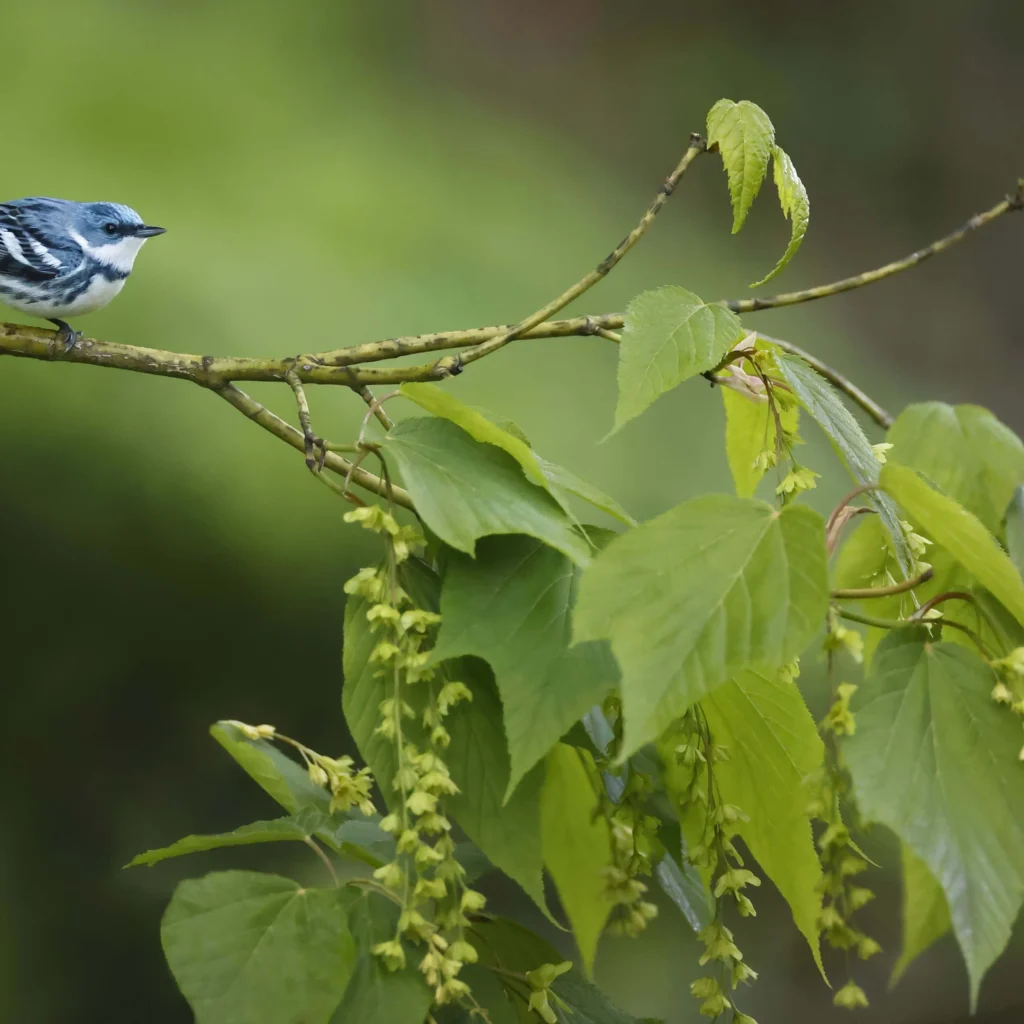
Spotting one of these sky-high songsters is well worth the effort. Males are a dapper blue hue — their species name, cerulea, derives from the Latin word for “sky blue” — and females are every bit as beautiful, sporting bluish-green feathers with light yellow below.
Cerulean Warblers were at one time among the most abundant warblers breeding in the Ohio and Mississippi River valleys, but widespread habitat loss has made them scarce.
Threats
The Cerulean Warbler is one of North America’s most threatened migratory songbirds. Its numbers have declined by about 70 percent over the past 40 years. Habitat loss follows this stunning songbird from its breeding grounds to its nonbreeding territories.
Habitat Loss
The Cerulean Warbler’s decline is driven in large part by the loss and fragmentation of habitat on both the breeding and nonbreeding grounds. On the breeding grounds, large-scale clearing of forests has not only eliminated habitat but has also led to even-aged forests unsuitable for breeding Cerulean Warblers.
Wind Turbines
Like many migratory birds, Cerulean Warblers are the victims of collisions with poorly placed structures, including wind turbines and communication towers.
Conservation Strategies & Projects
At ABC, we can imagine a future where Cerulean Warblers grace the treetops of forests throughout their range, their population once again abundant — though they will always be tricky to spot! We’re committed to reversing the steep decline of this species by restoring habitat and mitigating threats throughout the warbler’s full annual cycle.
Creating & Maintaining Reserves
ABC and our partner Fundación ProAves created the Reinita Cielo Azul, covering about 250 forested acres in Colombia on the western slope of the Eastern Andes. Together, we have protected more than 40,000 acres of habitat at eight reserves in Colombia where Cerulean Warblers spend the nonbreeding season, and thousands of acres more at reserves in Guatemala, Ecuador, and Peru.
Restoring Habitat
In North America, ABC works with the Central Hardwoods and Appalachian Mountains Joint Ventures to engage landowners and enhance habitat for Cerulean Warblers and other birds. Using science-based forest management practices, private landowners can restore and improve their properties to benefit birds and other native wildlife.
Agrofrestry to Support Birds & Communities
ABC’s BirdsPlus program connects companies, local communities, and owners of working lands in Latin America and the Caribbean to finance and markets, unlocking funding streams to enact bird-friendly best management practices on their lands and scale up production of crops like coffee and cacao.
Bird Gallery
The male Cerulean Warbler is an eye-catching bird, named for the lovely blue of its back and head. Other identifying marks include black-streaked white flanks, a bold white eyebrow, white wing bars, and a black “necklace” that separates its white throat and belly. The female is bluish-green above, with a yellowish face, throat, and eyebrow.
Bird Sounds
The Cerulean Warbler’s song, voiced only by the male, is a series of buzzy notes on the same pitch, followed by a higher, drawn-out buzz. This song is somewhat similar to that of the Black-throated Blue Warbler, but faster in tempo. A buzzy zeet call is used by both males and females to maintain contact with their mate.
Credit: Peter Boesman, XC222345. Accessible at www.xeno-canto.org/222345.
Credit: Scott Connop, XC583857. Accessible at www.xeno-canto.org/583857.
Habitats
From Appalachia to the Andes, the Cerulean Warbler is a bird of the forests, nesting in large tracts of tall deciduous trees and spending the nonbreeding season in evergreen forests and even shade coffee plantations.
- Breeds in mature, deciduous forests in two distinct regions: riparian bottomlands and on upper forest slopes and ridge-tops. Common elements for successful breeding include large tracts of mature forest with scattered canopy openings, including white oak and bitternut hickory trees, which Cerulean Warblers appear to prefer for nesting, foraging, and singing
- In the nonbreeding season, found in humid evergreen forests from the lowlands to the foothills of the Andes
- Can also be found in shade-grown coffee plantations
Range & Region
Specific Area
Eastern North America, South America
Range Detail
More than 80 percent of the Cerulean Warbler population breeds in the forests of the Appalachians, inhabiting the canopy of mature forests that include a diverse mix of mid-story and shrub vegetation. Cerulean Warblers breed east of central Minnesota, from extreme southern Quebec and Ontario, south to Tennessee.
The Cerulean Warbler migrates long distances to the forests of the Andean Mountains from Colombia to Bolivia.
Did you know?
Cerulean Warblers are some of the first migratory species to leave their breeding grounds at the end of the season. They often reach their nonbreeding range by late August. Their migratory route takes them across the open ocean.
Life History
Foraging in the upper third of tall trees, the Cerulean Warbler hops along branches in search of insects. In the breeding season, pairs will vigorously defend their territories and chase off intruders, even attacking other birds in mid-air. They are considerably milder on the nonbreeding grounds and will even flock with other species, mostly tanagers.
Diet
Typical of North American wood-warblers, the Cerulean Warbler is insectivorous, gleaning leaves high in the forest canopy for caterpillars, moths, flies, and wasps. Researchers have found that Cerulean Warblers prefer to forage in hickories, eastern white oaks, and chestnut oaks — trees that host a rich diversity of small caterpillars, a favored food.
Courtship
Cerulean Warbler pairs are generally socially monogamous, with pairs staying together for the entire breeding season. Male courtship displays may include tail-flashing and offering food to the female.
Nesting
Both male and female Cerulean Warblers choose the nest site, but the female builds the nest herself, while the male defends their territory. The open-cup nest is made of grasses, moss, and bark strips bound together by spider silk and decorated with lichens and other light-colored material. Cerulean Warblers usually nest only once per season, but if that initial attempt fails, the female may start building again using materials from the old nest.
Eggs & Young
A Cerulean Warbler clutch is usually made up of two to five eggs, incubated exclusively by the female for roughly a week and a half. Both parents help to feed nestlings, which grow very quickly — young fledge after only about 10 to 12 days.
The female Cerulean Warbler uses a strategy known as “bungee-jumping” to hide her nest’s location. Rather than directly flying off, she drops off the side of the nest with wings folded, only flapping away when she is far below.