Arctic Tundra Landscape with Marshland. Photo by Bauwimauwi, Shutterstock.

Hudsonian Godwit

Limosa haemastica

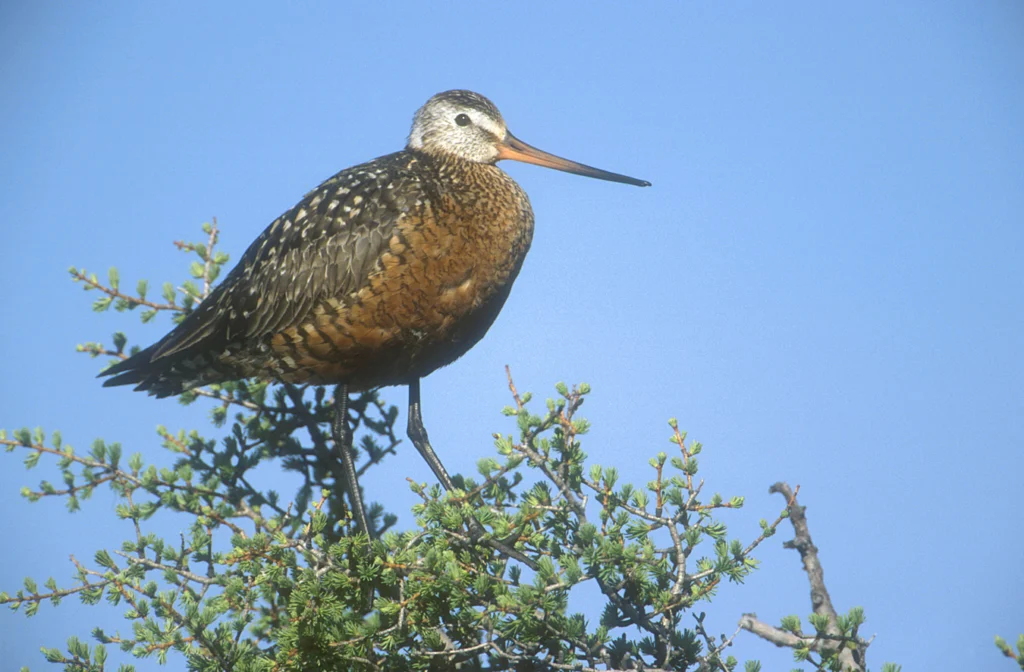
Hudsonian Godwit. Photo by Greg Homel, Natural Elements Productions.

Hudsonian Godwit

Hudsonian Godwit. Photo by Greg Homel, Natural Elements Productions.

Limosa haemastica

Overview

Conservation Status
Population Size
50,000-70,000
Family
Sandpipers
Location
North America
South America
Migration Pattern
Longitudinal
Migration Distance
Long Distance
Also Known As
  • Ring-tailed Marlin
  • Goose-bird
  • Red-breasted Godwit
  • Hudwit

About

The handsome “Hudwit” — the smallest of the world’s four godwit species — is an uncommon sight, spending most of its life at the extreme ends of the Americas. Its English name is a reference to this bird’s remote breeding grounds in Alaska and the Hudson Bay in northeastern Canada, a region explored by Henry Hudson in the 17th century.

Limosa, the Hudsonian Godwit’s genus name, derives from “limus,” the Latin word for mud, hinting at this bird’s feeding habits and habitats: The “Hudwit” prefers wet meadows, bogs, and mudflats. Its species name, haemastica, has its origins in the Ancient Greek word for “bloody,” a nod to its breeding plumage.

Like the Arctic Tern and Blackpoll Warbler, this long-legged shorebird is a master of migration, flying tens of thousands of miles each year between its breeding and nonbreeding grounds, on journeys that include long stretches of nonstop flight over open ocean.

Threats

The Hudsonian Godwit is a Tipping Point species, having lost more than half its population in the past 50 years, bringing its population down to dangerously low numbers. Threats plague this graceful shorebird throughout its annual cycle: Habitat loss and climate change are among the most urgent threats. Hudsonian Godwit numbers were once decimated by market hunting, and though the species is now protected by U.S. law, it may still be hunted in parts of Central and South America.

Habitat Loss

This shorebird’s boreal breeding grounds continue to face threats from unsustainable logging, mining, oil and gas extraction, and hydroelectric development. Loss of wetlands across the Great Plains may take away important stopover sites during this bird’s spring migration. On the wintering grounds, human disturbance and a developing aquaculture industry also threaten essential habitats.

Habitat Loss

Climate Change

Temperature increases, fire risks, and invasive species incursions unbalance and degrade the delicate Arctic ecosystems, which are important carbon sinks and sources of freshwater as well as essential breeding habitat for the Hudsonian Godwit and many other bird species.

Climate Change

Conservation Strategies & Projects

Birds like the Hudsonian Godwit, with perilously low populations that continue to trend downward, need our help to overcome the threats they face. At ABC, we’re inspired by the wonder of birds and driven by our responsibility to find solutions to meet their greatest challenges. With science as our foundation, and with inclusion and partnership at the heart of all we do, we take bold action for birds across the Americas.

Restoring Habitat

ABC works to conserve the habitat that birds need most throughout their migratory journeys, in conjunction with hundreds of partners throughout the Western Hemisphere. In particular, ABC is helping to restore marshes along the Central Flyway in North America, where Hudsonian Godwits stop to refuel during migration.

A Bounty for Birds: Wetlands of North America

Protecting Migration

Many aspects of Hudsonian Godwit breeding biology are understudied, and information on its reproductive and survival rates, dispersal, and population trends remains sparse. ABC is playing a key role in expanding the Motus network in the U.S., building capacity to further study Hudsonian Godwits and other migratory birds.

Protecting Migration

Support Petitions & Advocacy

Policies enacted by the U.S. Congress and federal agencies have a huge impact on shorebirds. You can help shape these rules for the better by telling lawmakers to prioritize birds and bird-friendly measures. To get started, visit ABC’s Action Center.

Take Action

Bird Gallery

The Hudsonian Godwit is a leggy, large-bodied shorebird with a graceful upturned bill. In breeding plumage, the “Hudwit” shows a brick-red chest and underside stippled with darker barring, and upperparts mottled dark-brown and gray. Nonbreeding birds are plain gray-brown above and whitish below.

This bird’s pale supercilium (eyebrow) is noticeable in all seasons; other helpful year-round ID features include black axillaries (wing linings, or “wing pits”) that are visible in flight, a broad white wing stripe, and a black and white tail.

Bird Sounds

The Hudsonian Godwit was likely named for its god-wit or whit calls; it also gives a sharper kerreck call.

Call

Credit: Garrett MacDonald, XC193664. Accessible at www.xeno-canto.org/193664.

Call

Credit: Seth Beaudreault (Toolik Field Station), XC738705. Accessible at www.xeno-canto.org/738705.

Habitats of the Hudsonian Godwit

The well-traveled Hudsonian Godwit uses a range of habitats throughout its annual cycle, with a migratory route that takes them from the wet tundra meadows of the Arctic, over open ocean, to mudflats and marshes.

  • Nests in peaty swamps (muskegs) or wet sedge meadows at forest edges, interspersed with shallow pools, small spruce islands, and hummocks; also uses drier upland areas of sedges, grasses, low shrubs, and dwarf trees, with scattered taller trees that serve as lookouts and display perches
  • Throughout migration and in the nonbreeding season, found on shallow tidal mudflats, deltas, and estuaries
  • Rice fields, sewage lagoons, mangrove swamps, and marshes may also be visited during migration

Range & Region

Specific Area
Boreal and Arctic regions of Alaska and Canada, southern South America, Great Plains, and Atlantic Coast

Range Detail
The Hudsonian Godwit has a broad, but patchy, breeding distribution that stretches from western Alaska to the Hudson Bay. Most spend the nonbreeding season in Tierra del Fuego, where they congregate along separate coasts — Alaskan breeders on the Pacific, and Canadian breeders along the Atlantic.

Most Hudsonian Godwits migrate south off the Atlantic Coast, flying nonstop from James Bay, Ontario, to staging sites in South America before reaching their final winter destinations in southern South America. In the spring, this species migrates back north through the Great Plains.

Small numbers of this species regularly stray to New Zealand, the South Pacific, and Europe.

Did you know?
The Hudsonian Godwit migrates nearly 20,000 miles each year from the boreal and Arctic regions of North America to southern South America, including long stretches of nonstop flight over open ocean.

Range
North America
South America
Migration Pattern
Longitudinal
Migration Distance
Long Distance

Life History

Everything about the Hudsonian Godwit is long: Long legs for wading through mudflats and marshes, a long bill for probing the earth for prey, and long migratory journeys to and from the breeding grounds. The species had previously been assumed to be very rare, and the location of its nonbreeding grounds remained a mystery until the mid-20th century. Much remains to be learned about these migratory marvels.

Diet

Like the Long-billed Curlew, the Hudsonian Godwit uses its long, curved bill to probe deeply into the mud, even submerging its head in the soil in pursuit of prey. For most of the year, the Hudsonian Godwit feeds on invertebrates like snails, worms, clams, and insects. During the summer, their diet expands to include small berries and seeds. They take carbohydrate-rich plant tubers during migration, twisting and pulling them loose from the earth. This godwit also gleans food from the ground, water surfaces, or vegetation.

Courtship

The Hudsonian Godwit is presumed to be socially monogamous. Pair bonds are known to persist through re-nestings during the breeding season, and even from year to year. Courtship behavior begins as soon as both male and female arrive on their breeding grounds among wet bogs and meadows in the boreal and Arctic regions of Alaska and Canada. A courting pair will fly together in “pursuit flights,” the male performing additional solo displays, hovering mid-air with wings held high and swinging his body from side to side.

Nesting

The Hudsonian Godwit nests on the ground in a simple scrape, located on a hummock, grass tussock, or other bit of dry ground. The nest is usually well-concealed by taller nearby vegetation, shrubs, or small trees. Nests are sometimes reused from year to year.

Eggs & Young

The female Hudsonian Godwit lays a clutch of four speckled, buffy-olive eggs, which she and her mate take turns incubating for roughly three weeks. The precocial chicks hatch covered in down, and can walk and even swim almost immediately. Both parents continue to brood the chicks until they fledge. Due to the short northern summer, this species typically raises only one brood per year.