Colorado mountains and forest by Jonathan Ross, Getty Images

Western Warbling Vireo

Vireo swainsoni

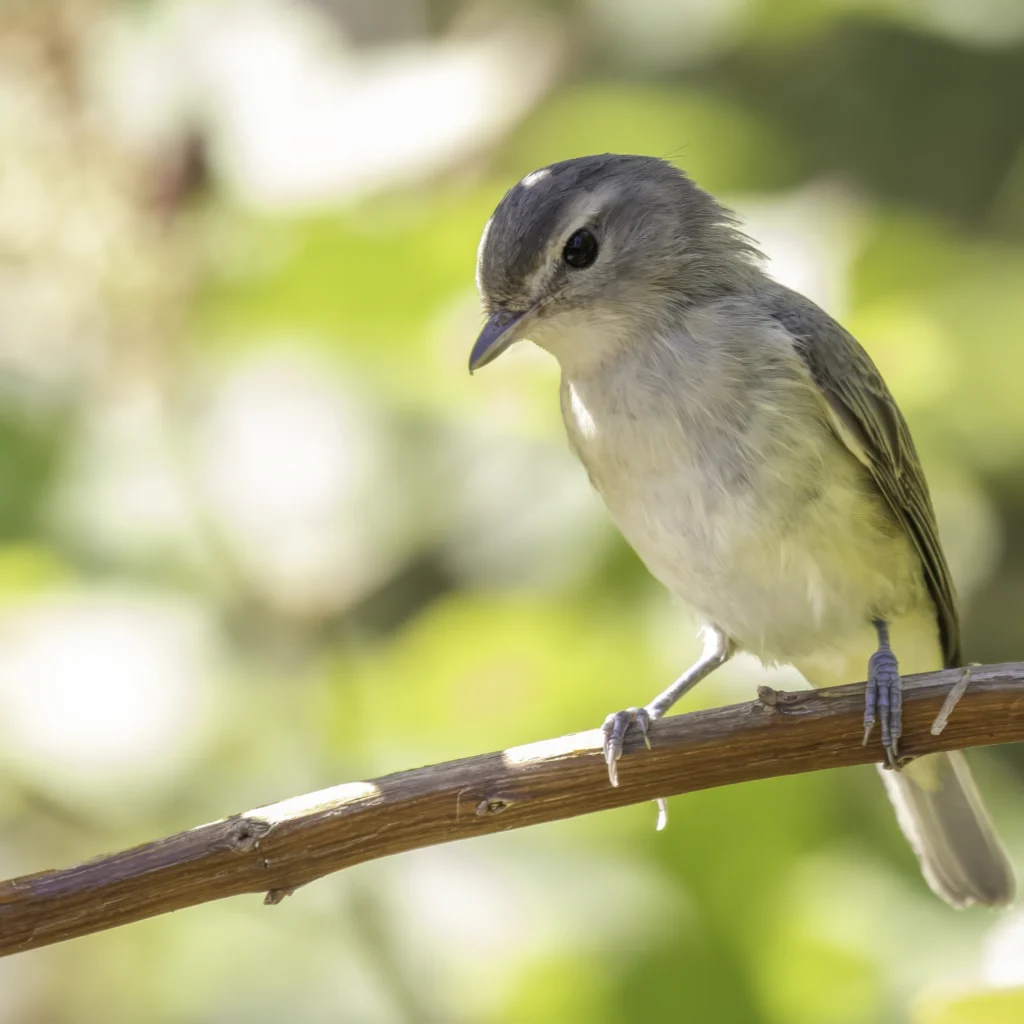
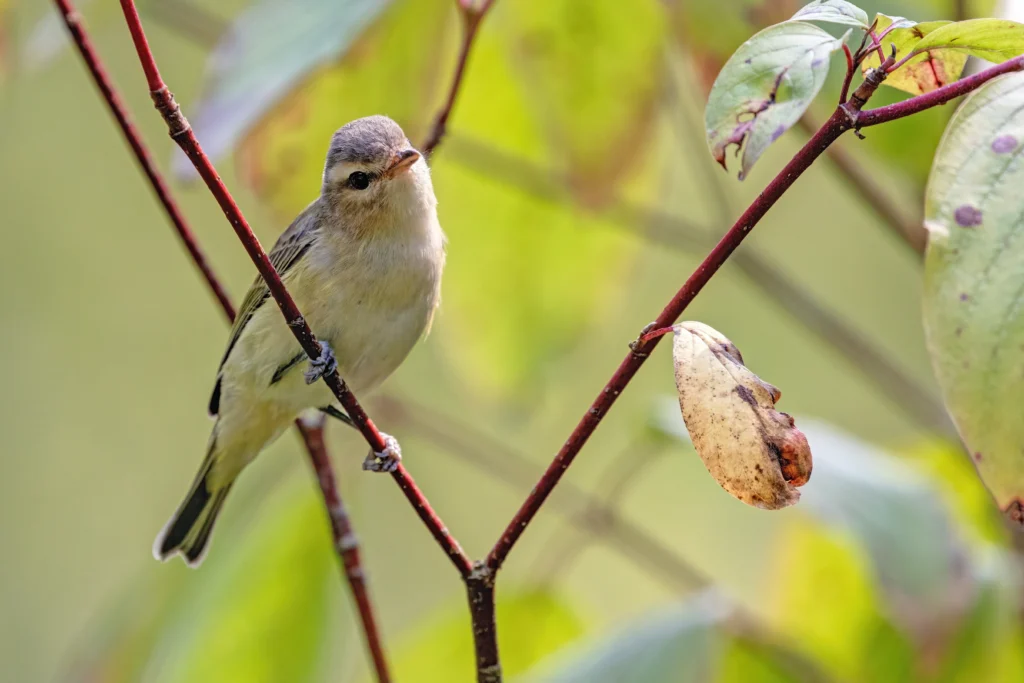
Western Warbling Vireo. Photo by JamesChen, Shutterstock.

Western Warbling Vireo

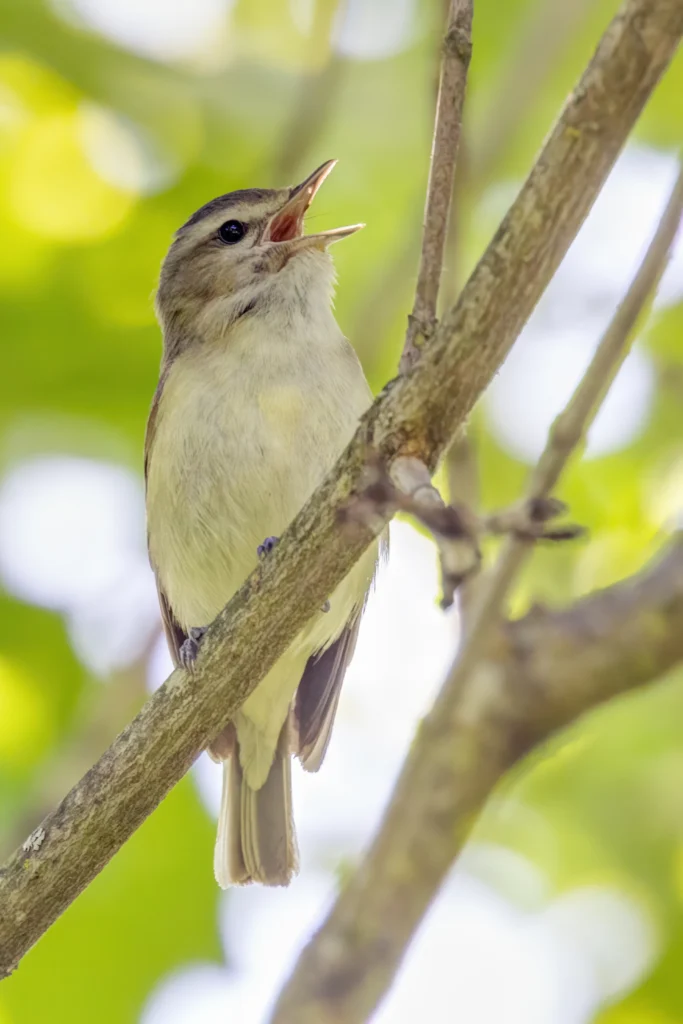
Western Warbling Vireo. Photo by JamesChen, Shutterstock.

Vireo swainsoni

Descripción general

Estado de conservación
Tendencias demográficas
Desconocido
Tamaño de la población
Desconocido
Familia
Vireos
Ubicación
América del norte
Patrón de migración
Latitudinal
Distancia de migración
Media Distancia
También conocido como
  • Vireo Gorjeador Occidental (Spanish)
  • Vireo Cantor (Spanish)

Acerca de

The Western Warbling Vireo is a quintessential species of spring and summer in the western half of North America. It was recently split from the Eastern Warbling Vireo; before 2025, the two were considered a single species: Warbling Vireo. Researchers determined that there were, in fact, two separate species, based on behavioral and genetic differences.

This rather drab bird is often hard to spot, hidden up among the leaves of tall deciduous trees, but its cheerful, energetic song is hard to miss. Males do most of the singing, but females sing as well — an unusual trait among temperate songbirds. Also unusual is this bird’s habit of singing while sitting on the nest, males in particular.

Western Warbling Vireos are frequently parasitized by Brown-headed Cowbirds, which lay their own eggs in the nests of other species, often resulting in the death of some or all of the host’s young. When they lay in a Western Warbling Vireo’s nest, the entire brood is usually lost.

Cowbirds seem to cue in on this vireo’s habit of singing from the nest, as birds that sing more on the nest are more likely to be parasitized. Female cowbirds are quite crafty, even using the movements of parent birds to determine the location of a nest. The more often a parent uses the same paths to and from the nest, the more likely cowbirds are to find it. Unlike the closely related Eastern Warbling Vireo, the Western species does not typically remove cowbird eggs. As a result, local vireo populations can decline when cowbird populations are high. In some areas, ornithologists fear that populations of Western Warbling Vireo may be driven to extinction.

Amenazas

As of March 2026, an overall population trend for the Western Warbling Vireo has not been established. However, these migratory insectivorous birds face a variety of threats, especially resulting from insecticides and hazards during migration.

Pesticides in Trees

The Western Warbling Vireo is fairly adaptable and will forage and nest in non-native trees used in landscaping. However, they run into trouble when trees are sprayed with pesticides, especially when they have built their nests in these trees. In British Columbia, these birds were almost completely eliminated from forests thinned using herbicides.

Pesticidas y toxinas

Cambio de uso del suelo

Brown-headed Cowbird populations may be higher in landscapes fragmented by agriculture and development, resulting in more vireo nests lost to cowbird parasitization. Development and land use changes that remove cottonwoods can also have severe impacts on Western Warbling Vireo populations, particularly in dry regions where these trees may offer the only suitable nesting habitat.

Choques de vidrio

Estrategias y prácticas de conservación

Even common birds like the Western Warbling Vireo need our help to overcome the threats they face. At ABC, we’re inspired by the wonder of birds and driven by our responsibility to find solutions to meet their greatest challenges. With science as our foundation, and with inclusion and partnership at the heart of all we do, we take bold action for birds across the Americas.

Evite los pesticidas y las toxinas.

ABC colabora con socios a nivel estatal y federal en EE. UU. para exigir la regulación o la prohibición de los plaguicidas y toxinas más dañinos para las aves. Desarrollamos programas innovadores, como trabajar directamente con agricultores para que utilicen semillas sin recubrimiento de neonicotinoides, impulsar la investigación sobre el impacto de los plaguicidas en las aves y alentar a millones de personas a dejar de usar plaguicidas dañinos.

Pesticidas y toxinas

Mejorar el hábitat

Habitat is the foundation of any species’ survival. In arid parts of the Western Warbling Vireo’s range, riparian corridors may provide the only breeding habitat for these birds. ABC is working with local conservation organizations in California to improve and restore riparian habitat, particularly in desert areas where this habitat is crucial and often the only areas suitable for this bird.

Restaurando el hábitat

Galería de aves

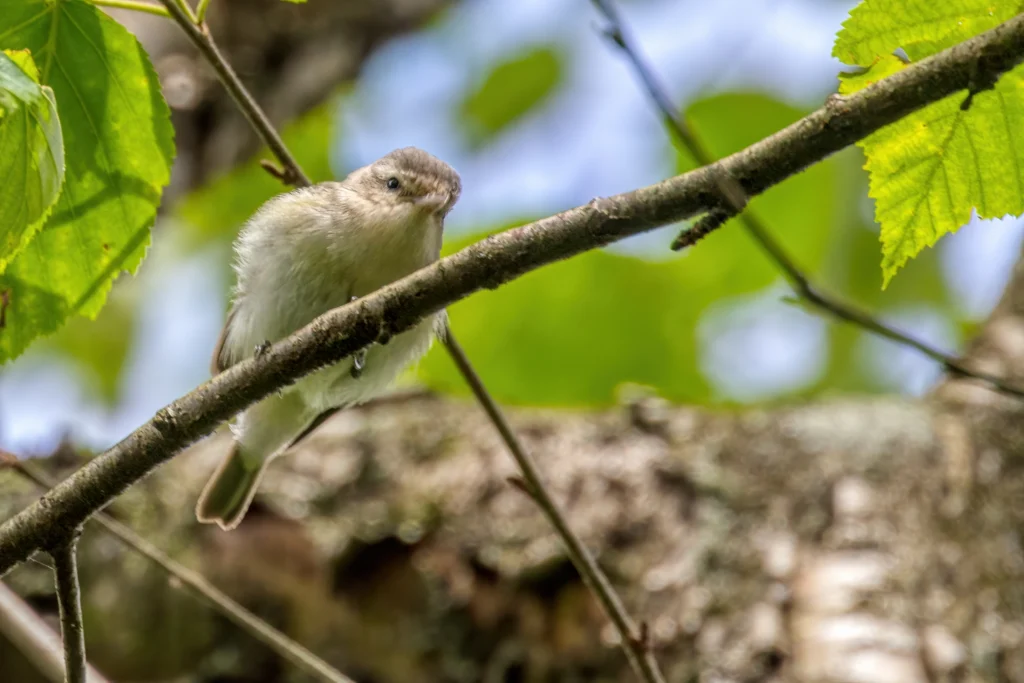
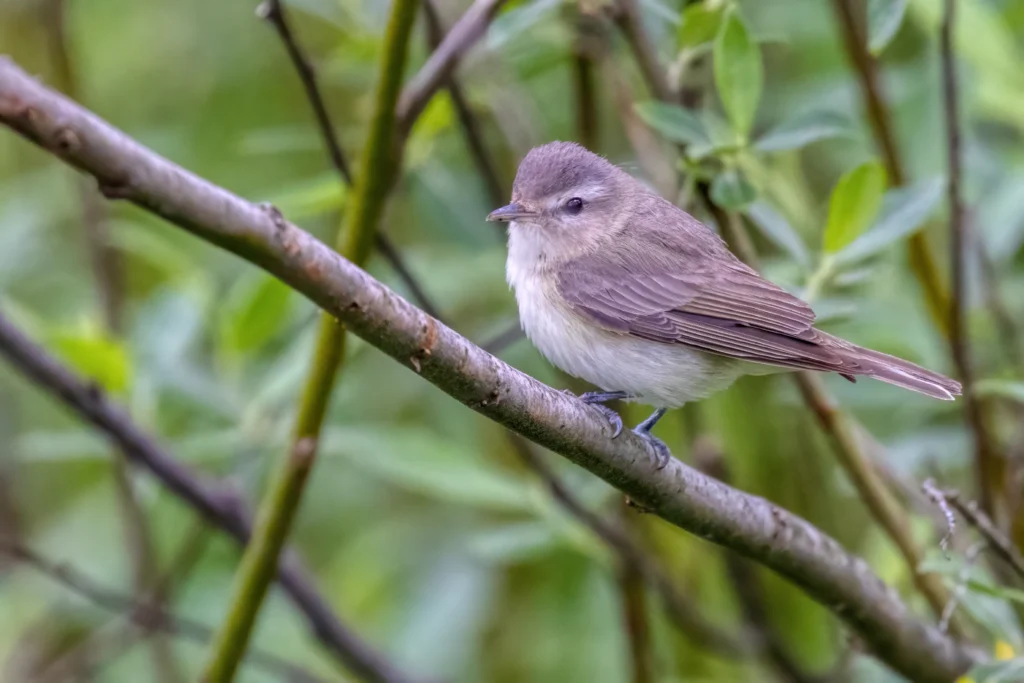
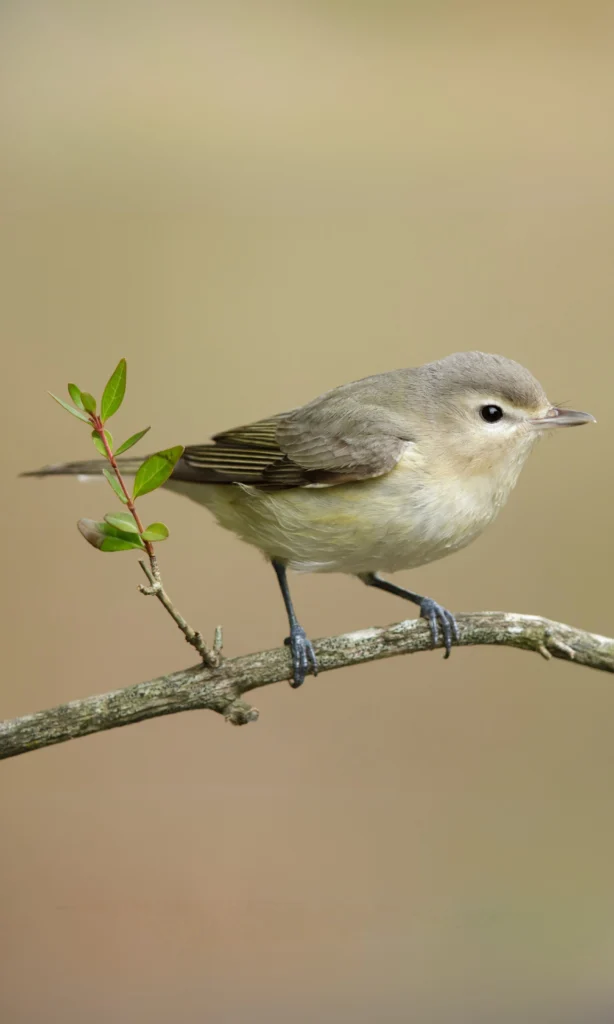
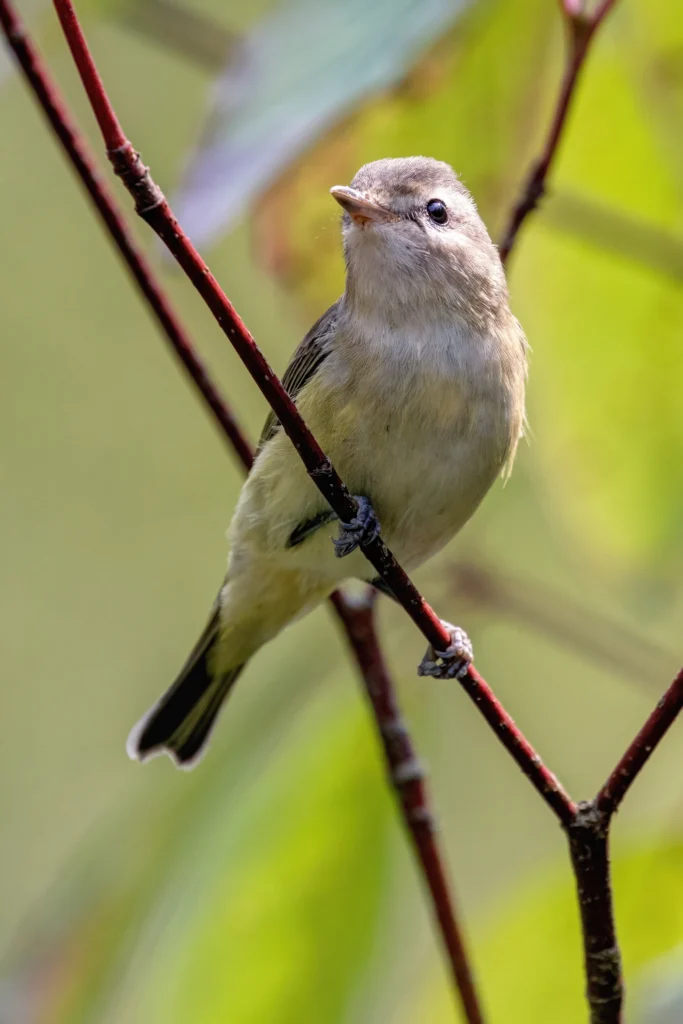
The plumage of the Western Warbling Vireo is drab and cryptic. The upperparts, from crown to tail, are an unornamented gray-brown. The underparts are pale, off-white to very light gray, sometimes with yellowish flanks. Perhaps the most noteworthy feature of this bird’s plumage is the gray-brown stripe running across the head and through the eye. This feature is highlighted by a pale arc above the eye (the “eyebrow” or supercilium) and a similar pale patch below the eye. This bird is extremely similar to the Eastern Warbling Vireo, which may have a slightly thicker and paler bill, a more greenish back, a more yellowish flanks, and a shorter “eyebrow” that doesn’t extend far beyond the eye. However, these differences may be extremely difficult to use for identification in the field, and the two species are best differentiated by their song.

Sonidos

The Western Warbling Vireo’s song is a cheerful and persistent feature of spring and summer in the West. Compared to the Eastern species, the song of the Western Warbling Vireo is more energetic and dynamic, moving quickly between lower and higher frequencies, and with no obvious “question mark” at the end. Both species also give a number of different calls, most of which fall into two categories. Eeah calls are slow and relatively low-pitched, with a harsh or nasal quality. Vit calls are rapid, upslurred notes with a nasal or metallic quality.

Canción

Credit: Paul Marvin, XC745690. Accessible at https://xeno-canto.org/745690.

Eeah Call and Song

Credit: James Link, XC582237. Accessible at https://xeno-canto.org/582237.

Song and Vit Calls

Credit: Richard E. Webster, XC575826. Accessible at https://xeno-canto.org/575826.

Hábitat

The Western Warbling Vireo is a bird of deciduous forest or forests of mixed deciduous and coniferous trees. These birds favor tall trees and an open canopy. However, they will also use shrubby habitats in the nonbreeding season and during migration.

  • In breeding season, prefers riparian trees, such as cottonwood, alder, aspen, and willow
  • Sometimes breeds in developed areas, such as golf courses and wooded areas next to farmland
  • In the nonbreeding season, still prefers open canopy, but will use a range of habitats with trees and shrubs

Rango y región

Rango y región


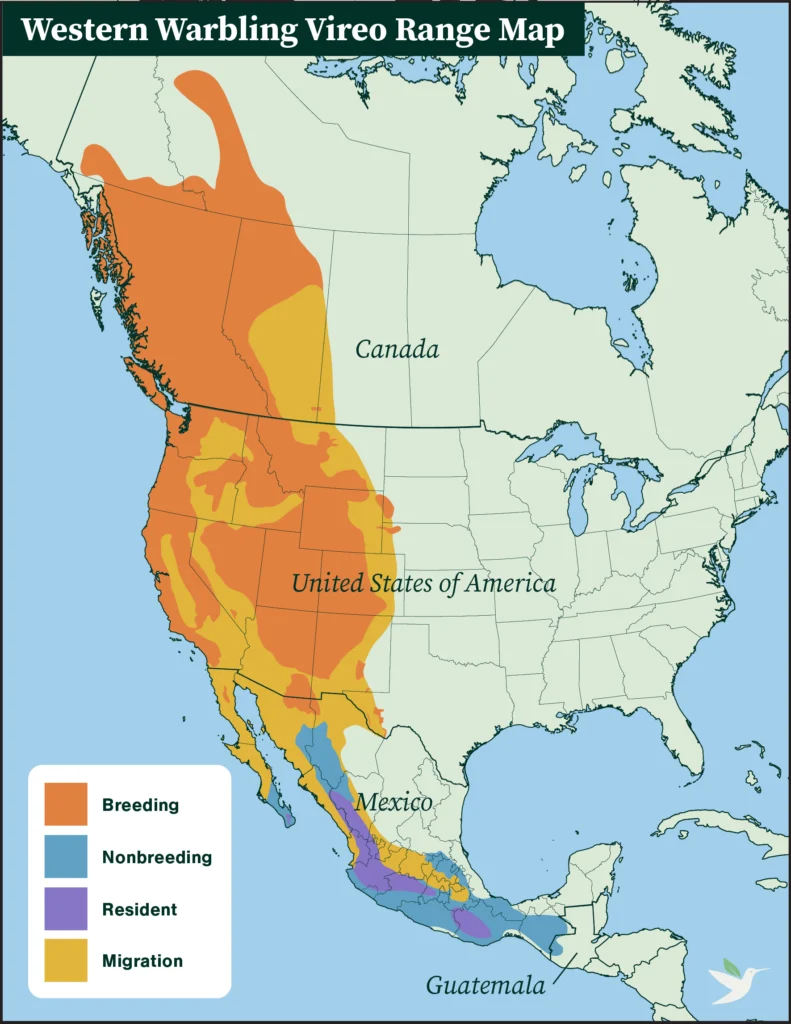
Western Warbling Vireo range map.

Área específica
Western North America; Central America

Detalles de la gama
The Western Warbling Vireo breeds from southern Alaska, Yukon, and the Northwest Territories, south through British Columbia, Vancouver Island, Alberta, and the western United States into northern Baja California, Sonora, and Chihuahua. In addition to nonbreeding grounds in western and southern Mexico (and possibly Central America), there are several resident populations in southern Baja California and in the Sierra Madre.

¿Sabías?
Until 2025, both Eastern and Western Warbling Vireo were considered to be one species — the Warbling Vireo — with a range that extended across the continent. That one species was split into two based on differences in song, plumage, behavior, body measurements, and genetics. Though similar in many ways, the two species are thought to have diverged about 2 million years ago, when they were separated during Pleistocene glaciation and forced into different habitats

Rango
América del norte
Patrón de migración
Latitudinal
Distancia de migración
Media Distancia

Historia de vida

The Western Warbling Vireo is a generous singer, with males broadcasting their song from the day they return to their breeding grounds and well into the summer. Multiple “neighbor” birds on adjacent territories can often be heard locked in countersinging exchanges, something like a heated exchange where each male takes his turn to demonstrate his singing ability, then assesses his rivals as they do the same. Though territorial when nesting, Western Warbling Vireos regularly join mixed-species foraging flocks on their nonbreeding grounds in Mexico.

Dieta

The Western Warbling Vireo eats insects almost exclusively, which they glean from twigs and leaves. Unlike the Eastern Warbling Vireo, this species readily forages from the upper canopy down to low shrubs just above ground level. Caterpillars are their most common prey, but these birds eat a range of insects and occasionally other invertebrates from the foliage of broadleaf trees. They will sometimes eat small fruits, especially in the nonbreeding season.

Noviazgo

Courtship in this species is presumed to be similar to that of the Eastern Warbling Vireo. Pair members often chase each other before the male performs a relatively simple courtship display. This display involves the male spreading his tail and “weaving” his body back and forth as he approaches the female. Females also give a specific courtship call, a type of Eeah call, often in a loose duet with the male as he sings.

Anidación

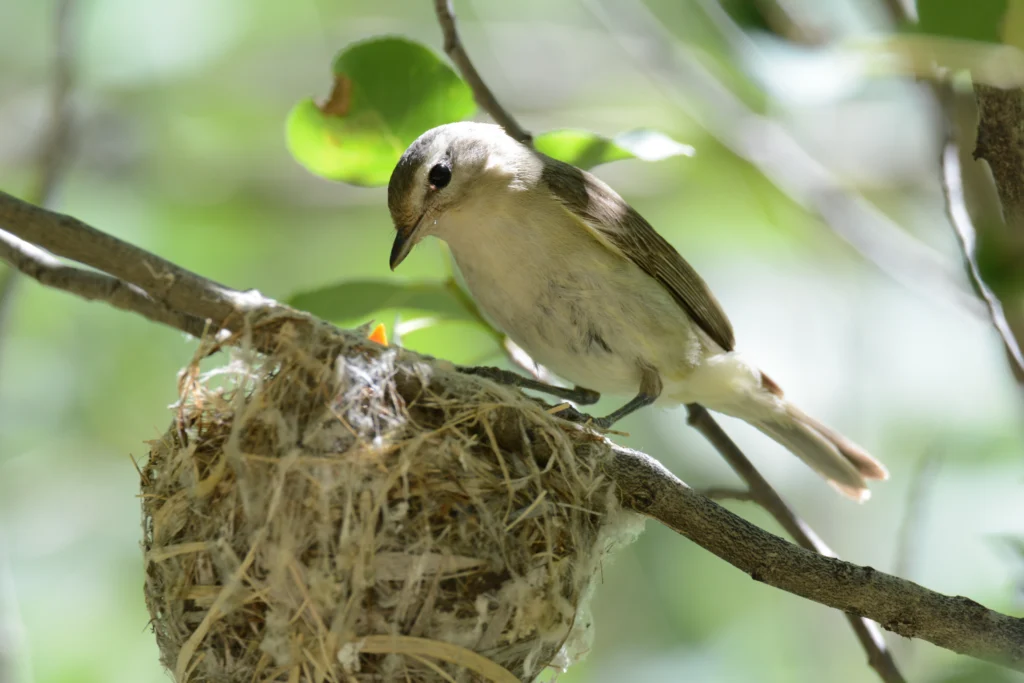
Vireos are well-known for their distinctive nests, suspended from their rim between forked branches, with the nest cup hanging below. Western Warbling Vireos typically build their nests in the small outer twigs of trees or shrubs, especially aspen and cottonwood. Nests are woven from plant fibers, including grasses and bark strips, which the female weaves around the forking twigs before building the hanging cup. Nests are lined with feathers, rootlets, leaves, and grasses, and bound together with insect silk and spiderwebs. Females are usually alone in building the nest, but males may sometimes contribute material.

Huevos y crías

The female lays three or four white, sparsely speckled eggs, which the male and female take turns incubating. The nestlings hatch after two weeks, blind and mostly unfeathered. Both parents help to brood and feed the young. During both incubation and brooding, parents take shifts, coordinating using specific calls. The nestlings grow rapidly and fledge after another two weeks, often to the encouragement of their parents’ eeah llamadas.