Advocating for a Rare Petrel
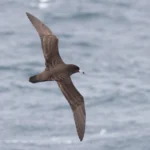
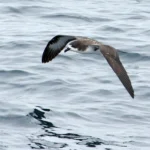
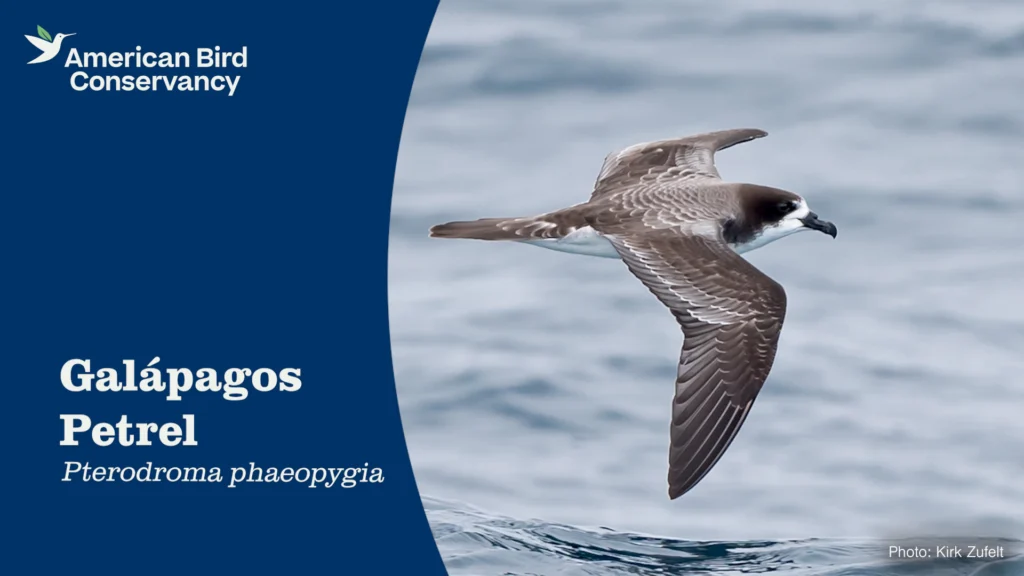
Much of Proaño’s job involves the Critically Endangered Galápagos Petrel, which nests only in the highlands of five Galápagos islands, including Proaño and Cruz’s home island of Santa Cruz.

Tracking Galápagos Seabirds Beyond Marine Reserve Boundaries
The creation of marine protected areas (MPAs) is one important tool for conserving marine ecosystems. These government-defined regions apply many of the same principles used to protect sensitive ecosystems and species on land to ocean habitats. MPAs can reduce fishing pressure, protect critical habitats, and support the recovery of fish populations — outcomes that can benefit an array of marine animals, including seabirds.
The ocean is vast, however, and many marine animals have evolved to range across enormous distances throughout their lives as they search for food, suitable breeding sites, or favorable oceanographic conditions. This tendency to wander creates a conservation challenge: MPAs are drawn with fixed boundaries, but marine organisms do not necessarily remain within those lines.
This challenge is especially relevant in the Galápagos Islands. The archipelago, located some 1,000 kilometers (600 miles) from Ecuador in the Pacific Ocean, is world-famous for its wildlife. The islands that make up the archipelago are rich in biodiversity, as are the surrounding waters, which are covered by two major MPAs: the Galápagos Marine Reserve and the newer Hermandad Marine Reserve. Together, they represent Ecuador’s commitment to marine conservation. But how much protection do they provide for seabirds that breed in the Galápagos?
The Galápagos houses a unique seabird community, including the Critically Endangered Albatros de las Galápagos, the only fully tropical albatross, and the Swallow-tailed Gull, the world’s sole exclusively nocturnal gull. It is also home to familiar and charismatic species such as Blue-footed, Red-footed, and Nazca Boobies, Great Frigatebirds, and the Threatened Galápagos Petrel. Visitors often see these birds at their breeding colonies or along the coast, but much of their lives take place far from land, where they search for food across the tropical eastern Pacific Ocean.
During the breeding season, seabirds leave the colony on land to forage at sea but return to their nests to incubate eggs or feed chicks. For some Galápagos species, these trips are relatively short, and birds remain close to the islands. For others, especially as chicks grow and become more independent, foraging trips can last several days and extend far beyond the Galápagos Islands.
Over the past 15 years, several research groups have tracked Galápagos seabirds’ at-sea movement patterns, discovering, for example, that Great Frigatebirds can travel thousands of kilometers over the tropical Pacific in search of prey during chick rearing. Waved Albatrosses, the largest seabirds in the Galápagos, forage mainly along the coasts of Ecuador and Peru, where overlap with fishing activity exposes them to the risk of bycatch, the accidental capture of nontarget species in fishing gear. The risk is particularly high for seabirds foraging near artisanal longline fisheries.
Until now, however, these tracking datasets had not been combined to ask a broader conservation question: How well do existing marine protected areas in the Galápagos Islands overlap with the at-sea distributions of Galápagos seabirds during the breeding season?
To answer this, I worked with a group of scientists to compile tracking data from seven seabird species breeding in the Galápagos: Blue-footed Booby, Red-footed Booby, Nazca Booby, Swallow-tailed Gull, Great Frigatebird, Galápagos Petrel, and Waved Albatross. We then estimated their breeding season distributions and measured how much of each species’ at-sea range overlapped with the Galápagos Marine Reserve and the Hermandad Marine Reserve.
The results showed a clear pattern. Coastal and nearshore species, such as the Blue-footed Booby, receive nearly complete protection from the Galápagos Marine Reserve. Species with an intermediate range, such as the Swallow-tailed Gull, also showed high overlap, although not all of their movements fell within protected waters. In contrast, wide-ranging species, including Great Frigatebirds, Galápagos Petrels, and Waved Albatrosses, spent much of their time outside the marine protected areas.
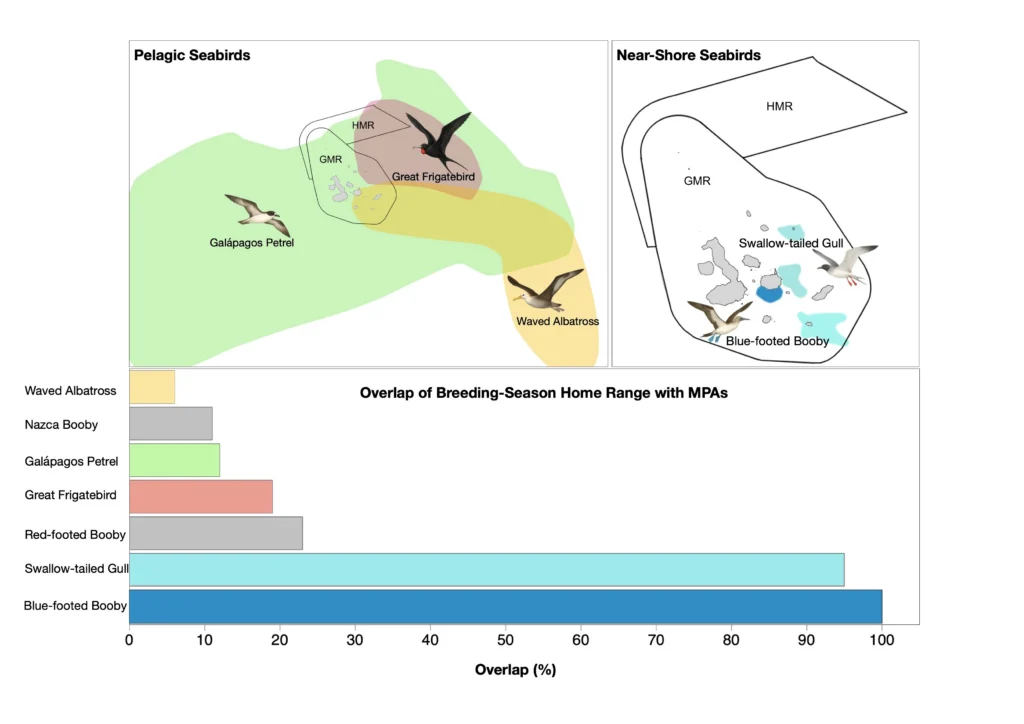
Although the Galápagos Marine Reserve and Hermandad Marine Reserve are essential for many species and habitats, particularly those closely linked to the archipelago, the reserves fall short in protecting the more pelagic species. Our study publicado en Conservación Internacional de Aves revealed that the level of protection provided by a marine reserve depends strongly on how an animal moves. A reserve that is highly effective for coastal species, like Blue-footed Boobies, only provides partial protection for wide-ranging birds like Waved Albatross.
Our study focused on Galápagos seabirds, but this pattern is not unique to seabirds. Sharks, turtles, whales, and many other marine animals also cross national jurisdictions and move beyond protected-area boundaries regularly. For these species, conservation cannot rely only on fixed protected areas. It also requires complementary measures, including fisheries management, bycatch reduction, international cooperation, and the use of tracking data to identify important areas beyond existing reserves.
The Galápagos remains one of the world’s most important places for marine conservation. Our study shows that tracking seabirds can help inform conservation decisions. By following birds beyond the lines we draw on maps, conservationists can better understand where protection is working and where gaps remain.
Read more about the Galápagos seabird tracking study.
Sebastián Cruz is American Bird Conservancy’s Marine Program Coordinator for South America. Cruz is a lead author on the study published in Bird Conservation International.
Noticias e historias relacionadas