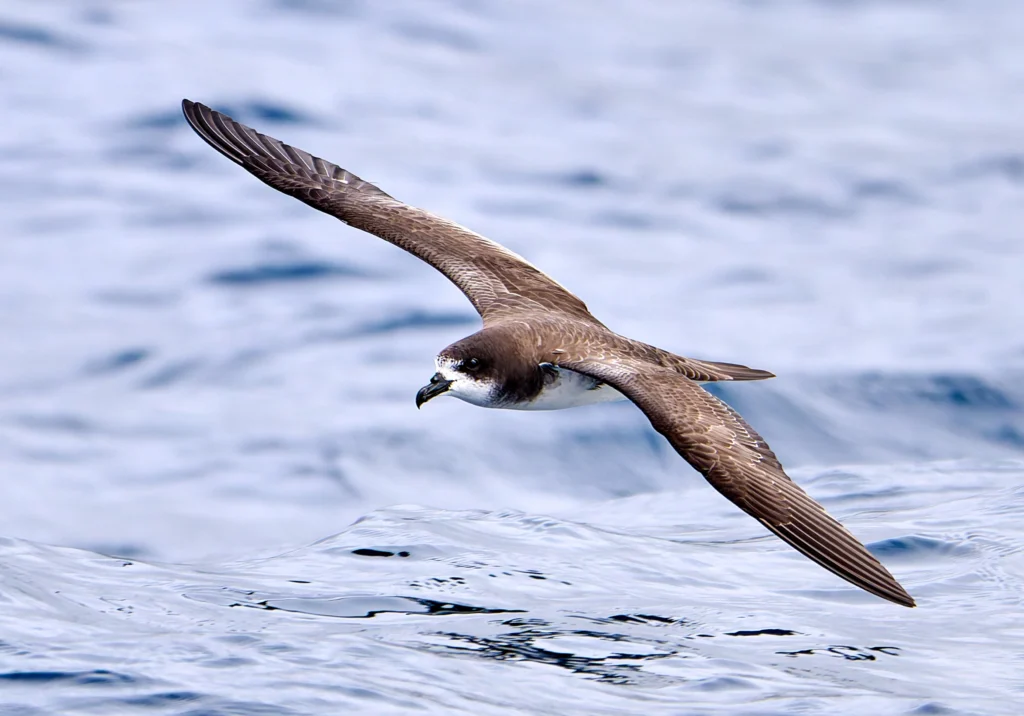
More than two-thirds of our planet is covered by water — and almost every inch is visited by birds. Arctic Terns migrate from the Arctic to the Antarctic Ocean over the course of a year. The great albatrosses may circle the globe in a matter of days, gathering food for their chicks. Seabirds have a capacity for global travel that is only matched by humans. Sharing exquisite adaptations to life on the ocean, most seabirds spend a large part of their lives over, on, and under the open water, far from human populations — and all too often far from human thought.
As a group, seabirds are the world’s most endangered birds, with 70 percent declines in the last 60 years. Even birds we think of as common, like the gulls and terns we see on beaches and piers, are declining, while the island specialists, petrels, shearwaters, albatrosses, and others, are going fast.
These remarkable birds deserve our every effort to conserve them. Seabirds are champions of the bird world, with the largest wingspan, longest migration, and deepest dives among them. The oldest known wild bird is a Laysan Albatross banded in 1956.
ABC’s Marine Program and our partners seek to change the trajectory — to turn the tide for seabirds.
Soluciones a la vista
ABC’s Marine Program protects and restores seabird populations across the Western Hemisphere through innovation, partnerships, conservation planning, and direct action. We work with three central pillars for marine conservation:
Safe Havens for Marine Birds: Finding the last strongholds and securing nesting places.
Sustainable Seascapes: Ensuring marine birds and people have access to marine and terrestrial resources.
Kinship: Increasing marine bird visibility through connections to human culture and activity.
Refugios seguros para aves marinas
The establishment of fenced or protected breeding colonies free of introduced predators is among the most effective of seabird restoration techniques and facilitates and enhances additional conservation measures such as social attraction and translocation. ABC is committed to finding and protecting areas appropriate for the long-term maintenance of communities of seabirds and other compatible species, and to collaborative work in invasive species removal, social attraction, and translocation.
For example, ABC and partners have built a predator-proof fence around seven acres within Kilauea Point National Wildlife Refuge in Hawaiʻi. More than 100 ʻUaʻu (Hawaiian Petrels) and ʻAʻo (Newell’s Shearwaters) have been moved there to establish a new colony.
For Critically Endangered species such as the Black-capped Petrel in the Caribbean, strategic conservation partnerships and resulting actions are essential. ABC has been a key partner in monitoring the few known nesting sites for the species in Haiti and the Dominican Republic. We now seek to restaurar islas en el Caribe a un estado que pueda volver a sustentar la cría de petreles de cabeza negra.
Protecting nesting sites works if you know where the nests are located. For some seabirds, we don’t have this basic information. Working with partners like Red de Observadores de Aves y Vida Silvestre de Chile (ROC), we seek nesting areas of mysterious seabirds like Pincoya Storm-Petrel, Magellanic Diving-Petrel, and Subantarctic Shearwater. We partner with the Búsqueda de aves perdidas to dig into enduring mysteries like the Jamaican Petrel and Guadeloupe Storm-Petrel, seabirds that are so rarely seen they may be extinct.
Paisajes marinos sostenibles
The commitment of fishers to the protection of marine bird populations is dependent on the economic viability of the tools we offer to reduce bycatch, the accidental capture of nontarget species. ABC is committed to the innovation and expansion of bycatch reduction tools and programs that are effective in working seascapes.
ABC has helped to develop techniques that reduce fisheries’ impacts on the Waved Albatross and other birds, for example, by limiting the amount of time fishing lines are exposed in the water, where they attract and hook seabirds. This simple technique is now being used in the small boat long-line fisheries in Ecuador.
Lights on land are beacons for humans at sea, indicating a safe passage or landmark. For marine birds, lights, power lines, and infrastructure are hazards. Large lights disorient the night-flying birds traveling from inland breeding grounds to ocean foraging areas, and power lines are collision hazards to fast-flying birds. We are working to reduce the impacts of night lighting and to establish national policies to protect all wildlife from unnecessary lights.
Other key linkages between seabirds and human use of the sea are the nutrient benefits brought to seabird nesting grounds from the open ocean. For thousands of years, people have used marine bird “guano” to enrich agricultural farmlands. Now we are coming to realize the benefits of the same nutrients in the restoration of islands, atolls, and coral reefs.
Enjoy an ABC webinar featuring Veronica Padula, an Becario de Conservación y Justicia de ABC focused on Multispecies Kinship with Marine Birds. Using a range of media, these storytellers bring awareness to the deep connections between seabirds and humans.
Parentesco
Mientras los marineros recorrían el mundo, las aves marinas siempre estaban cerca. Han formado parte de la exploración humana del océano desde sus inicios, símbolos de la comedia, la gracia y el desafío de la vida en el mar. Nos han enseñado geografía y nos han guiado de vuelta a casa. Nos ayudan a encontrar peces y a interpretar el clima. Y si bien las aves marinas son veneradas desde hace mucho tiempo por los marineros, son casi invisibles para la mayoría de las personas. Las aves marinas necesitan embajadores y narradores que las conozcan y sepan de los problemas que enfrentan.
ABC Marine Program fosters this kinship through art, sport, and human culture. Our work uses humor, adventure, and storytelling to bring the kinship between maritime peoples and seabirds forward as a fundamental part of marine conservation.
Emi Koch, a Marine Kinship Fellow, worked with students in her girls’ surfing camp, Mujeres & Agua in Peru, to create a stop-motion animation about the impact of oil spills on pelicans and other marine birds.
Conozca al equipo
El equipo marino de ABC trabaja en el hábitat más grande del mundo para conservar las aves marinas, el grupo de aves más amenazado. Creamos refugios seguros y paisajes marinos sostenibles para las aves marinas y fomentamos el reencuentro con estas magníficas aves.
Los drones ayudan a prevenir la extinción de aves en Hawái
En una carrera contrarreloj para proteger de la extinción a los mieleros hawaianos, una especie rara, American Bird Conservancy (ABC) y miembros de la alianza interinstitucional Birds, Not Mosquitoes (BNM) han comenzado a usar drones para combatir la malaria aviar, una enfermedad mortal transmitida por mosquitos no autóctonos. Se espera que los drones aceleren...
Celebración de una victoria para Seabirds tras la suspensión de la propuesta para un sitio de pruebas de cohetes
El atolón Johnston es un pequeño punto en el océano Pacífico, a unos 1400 kilómetros al suroeste de Hawái. Para la mayoría, es solo un nombre perdido en la inmensidad azul del mapa. Pero para más de un millón de aves marinas, entre los grupos de aves más amenazados del mundo, el atolón Johnston es algo...
Grupos conservacionistas presentan demanda para proteger a las aves marinas en peligro de extinción y amenazadas de Maui de los peligros que representan las farolas del condado.
American Bird Conservancy (ABC) y Conservation Council for Hawaiʻi, representados por Earthjustice, demandaron hoy al Condado de Maui y a Hawaiian Electric, dando un paso más en los esfuerzos que estas organizaciones llevan años realizando para mejorar la protección de las aves marinas nativas hawaianas en peligro de extinción y amenazadas. La Ley de Especies en Peligro de Extinción...
Se presentan dos proyectos de ley bipartidistas sobre conservación de aves para fortalecer la protección de las aves.
Hoy, los representantes Jared Huffman (demócrata por California) y Brian Fitzpatrick (republicano por Pensilvania) presentaron la Ley de Protección de Aves Migratorias (MBPA) y la Ley de Conservación de Albatros y Petreles. American Bird Conservancy (ABC) celebra la presentación de estos proyectos de ley, que refuerzan la protección de las aves migratorias e impiden...
La pesca puede representar una gran amenaza para las aves marinas, ya sea por sobrepesca o captura incidental. Explore las soluciones de American Bird Conservancy para que la pesca sea más segura para aves como albatros, pardelas y petreles.
American Bird Conservancy apoya una transición inteligente hacia la energía limpia y renovable. Conozca nuestro trabajo para orientar a los planificadores hacia soluciones energéticas al cambio climático que beneficien la biodiversidad.
Los plásticos representan una enorme amenaza para las aves, y las aves acuáticas son especialmente vulnerables. Descubre cómo los programas y la labor de defensa de American Bird Conservancy están reduciendo el uso de plásticos y ayudando a las aves.
El cambio climático está alterando los patrones climáticos, elevando las temperaturas y poniendo en riesgo la biodiversidad, incluidas las aves. Conozca el trabajo de American Bird Conservancy para reducir los impactos climáticos, fortalecer la resiliencia de los hábitats y las aves, y fomentar la adaptación a un mundo en constante cambio.