Overview
About
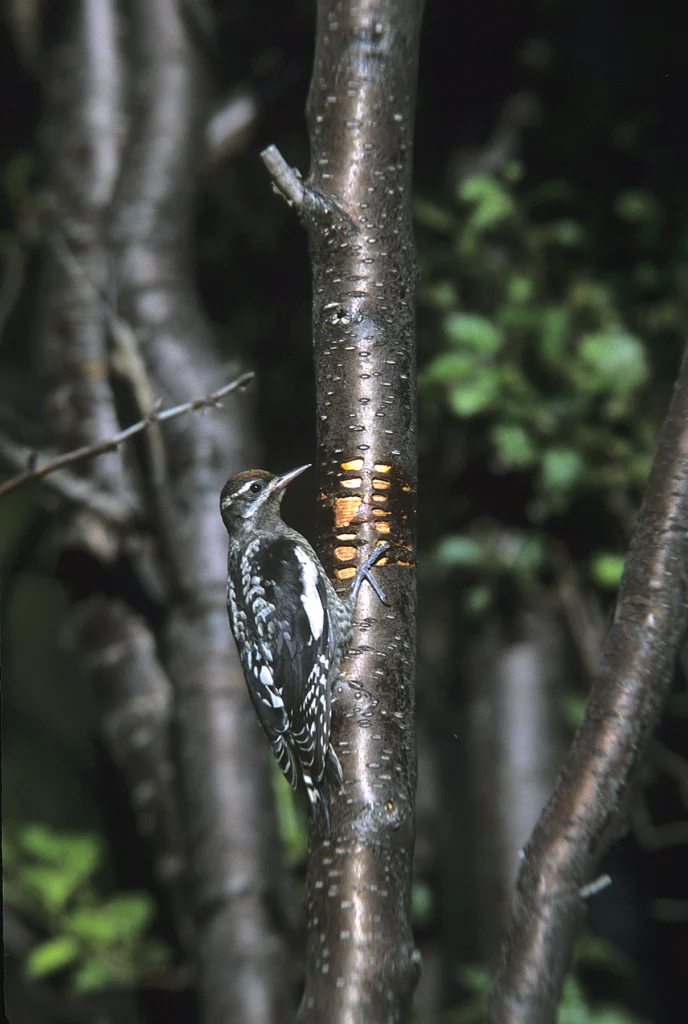
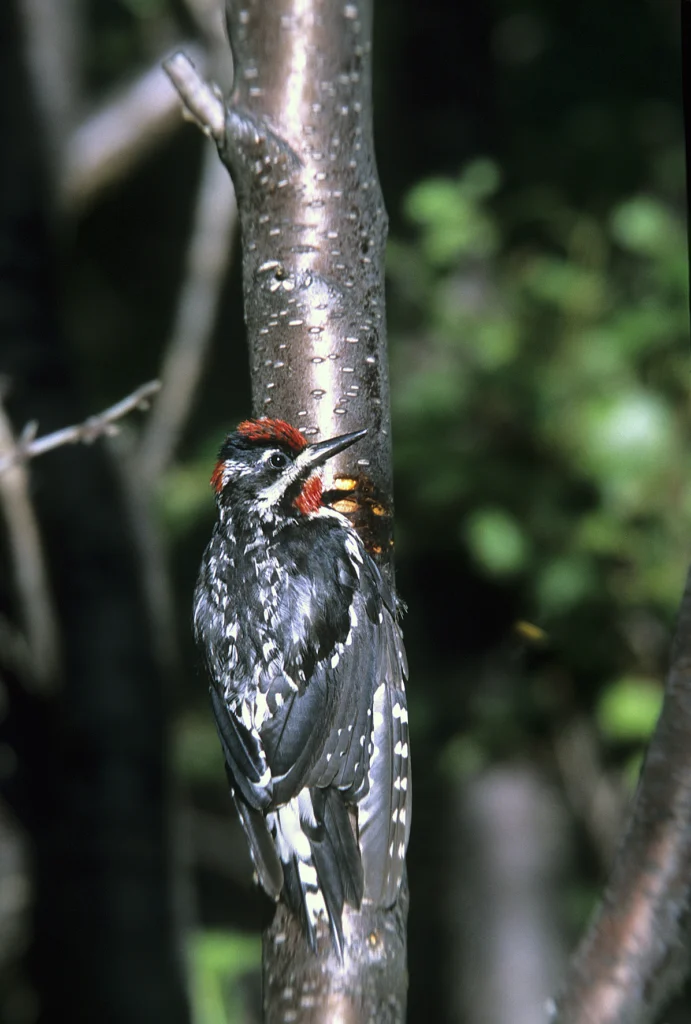
The Red-naped Sapsucker is one of four species in the genus Sphyrapicus, the sapsuckers, which are a distinctive group of North American woodpeckers with a peculiar and unique foraging strategy. The sapsuckers are accurately named in that they do, in fact, drink sap, but not by sucking. Rather, these industrious birds create rows of small openings in the bark of specific trees to allow the sweet, nutritious sap to flow, much like a syrup maker tapping a maple tree. They then drink the sap directly from these wells, lapping it up with their specialized feathery tongues. Sapsuckers maintain these openings or “wells” throughout the breeding season, regularly expanding existing holes and opening new ones to take advantage of changes in sugar flow through the season. Their sign on trees is conspicuous: Neat grids of shallow holes that create rings around the trunks of thin-barked trees such as aspen, willow, alder, birch, lodgepole pine, and young Douglas-fir.
In creating these wells, Red-naped Sapsuckers also open an irresistible opportunity for other animals with a taste for sweets. Many birds, especially warblers and hummingbirds, are drawn to sapsucker wells. Researchers have also reported a range of mammals visiting wells, including chipmunks, squirrels, mice, deer, and even bears. Insects feed at these wells too, especially butterflies, moths, flies, wasps, and ants. In turn, the insect activity can attract additional birds that prey on insects, such as flycatchers.
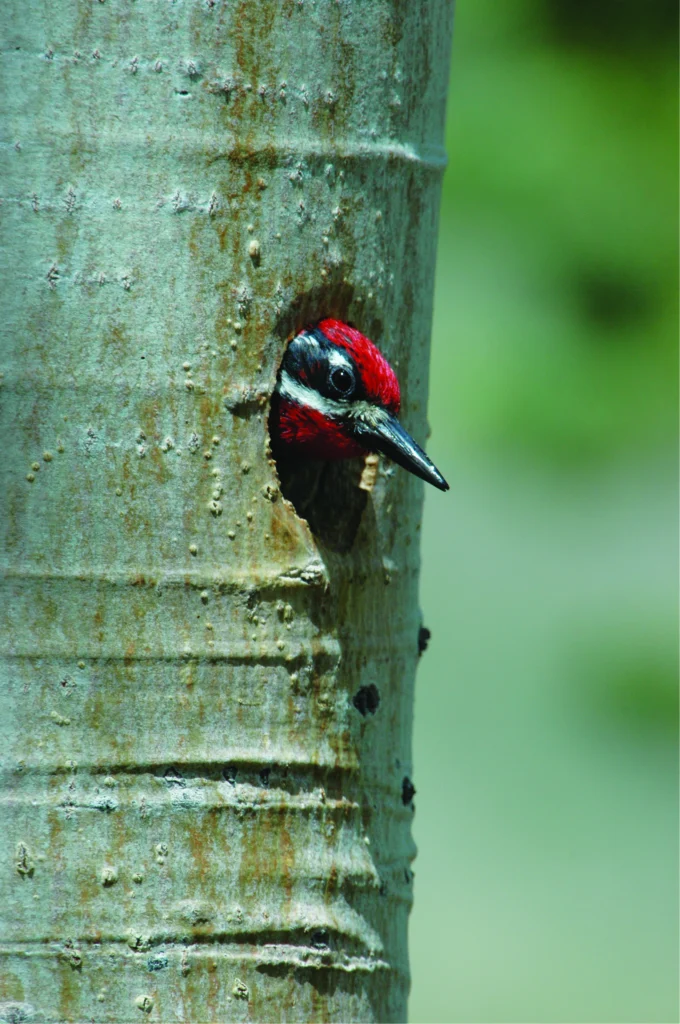
Red-naped Sapsuckers have another important role that they play in the forests of the Intermountain West. Like other woodpeckers, Red-naped Sapsuckers nest in cavities, which they excavate in trees. These birds typically do not reuse nest cavities from year to year, so vacant cavities from previous years can instead be used by any of a huge number of species that require cavities to nest, but can’t excavate them for themselves. There are a number of these secondary cavity-nesting birds that overlap with the Red-naped Sapsucker, including the Mountain Bluebird, Tree Swallow, Northern Pygmy-Owl, and Mountain Chickadee, among many others. Some mammals, such as red squirrels and northern flying squirrels, also use sapsucker cavities. For their outsized ecological roles, both in providing food sources and nesting sites for a broad range of species, the Red-breasted Sapsucker is honored with the uncommon title of “double keystone species.”
Threats
The Red-naped Sapsucker has an appetite for fruit, and was formerly shot at orchards as a result. This species is now protected under the Migratory Bird Treaty Act and is fairly common in appropriate habitat across its range. However, the riparian habitat that these birds prefer is at risk across the West. In arid regions, this may be the only habitat where Red-naped Sapsuckers can survive.
Livestock Grazing in Riparian Zones
Red-naped Sapsuckers prefer riparian habitat in many parts of their range, and in drier areas, especially, this may be the only habitat that can support them. Unfortunately, when livestock like cattle are allowed into riparian zones, they often change the habitat structure by compacting the soil and rubbing against, trampling, and eating riparian plants. Over time, this means fewer plants can grow to replace those that die, and eventually can lead to streams with little vegetation, making them unusable to birds like sapsuckers.
Fire Suppression
The persistence of aspen in many areas depends on periodic disturbance. Historically, fire was used as a management tool by Indigenous land stewards, and this maintained a patchwork of habitats in various stages of regeneration across the continent. In the last century and a half, fires have been suppressed in most areas, allowing woodlands and other habitats to age into more mature forests, without being replaced or compensated for by fire or another disturbance elsewhere. This has led to the loss of aspen stands through ecological succession, leading in turn to the loss of habitat for Red-naped Sapsuckers as well as other cavity-nesting species that depend on them to breed.
Conservation Strategies & Projects
Though they are common in some areas, Red-naped Sapsuckers need our help to overcome the threats they face on a broad scale. At ABC, we’re inspired by the wonder of birds and driven by our responsibility to find solutions to meet their greatest challenges. With science as our foundation, and with inclusion and partnership at the heart of all we do, we take bold action for birds across the Americas.
Support Petitions & Advocacy
Through advocacy, ABC ensures birds like the Red-naped Sapsucker have a seat at the table. We advocate for policies and funding that make a difference for birds and ecosystems. We take on challenging issues when birds are on the line. And we help our supporters become advocates for birds, too.
Bird Gallery
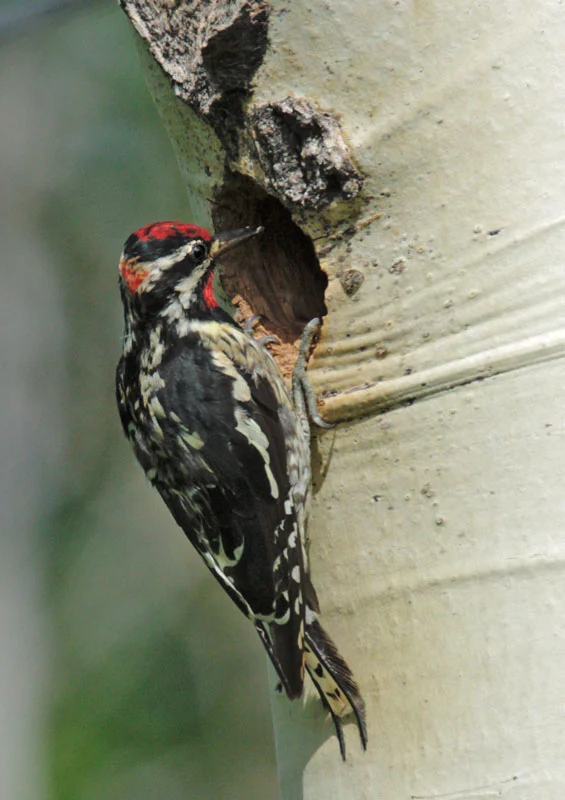
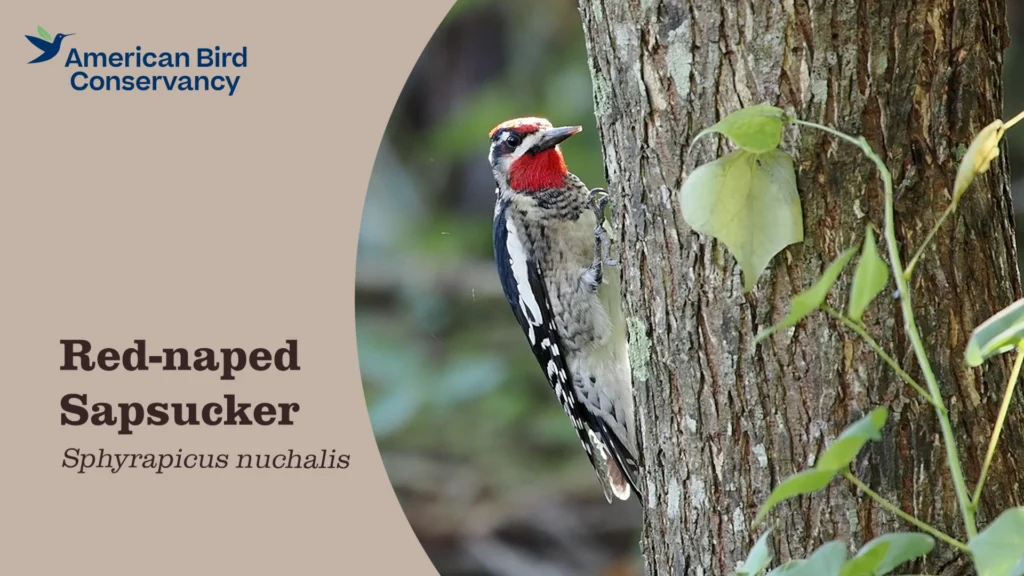
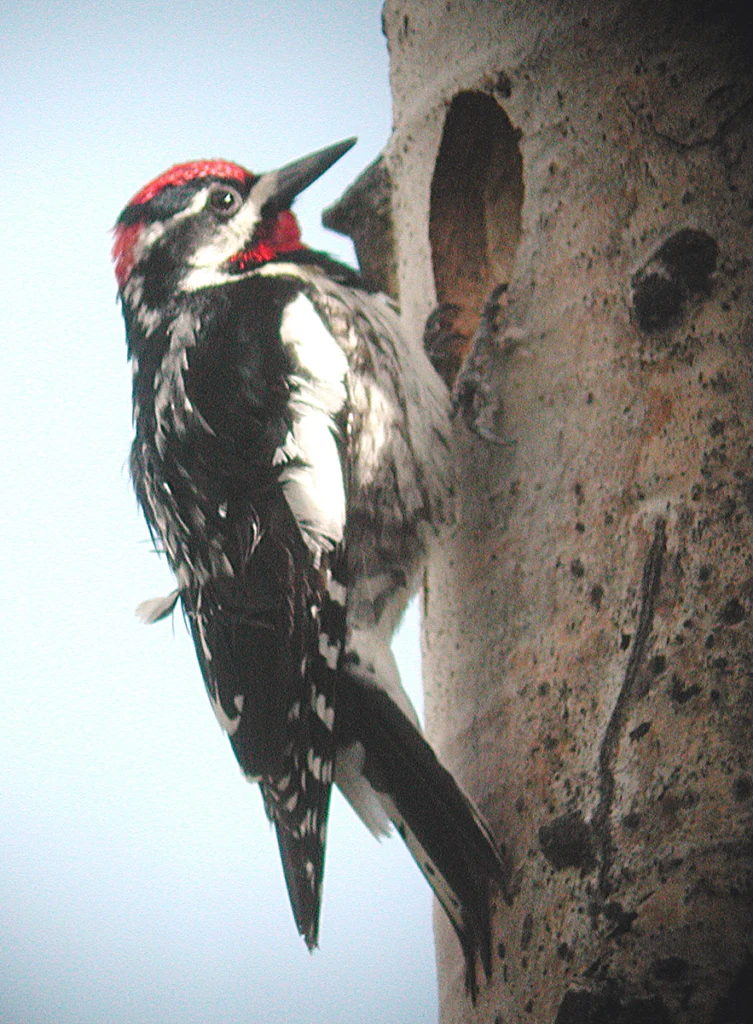
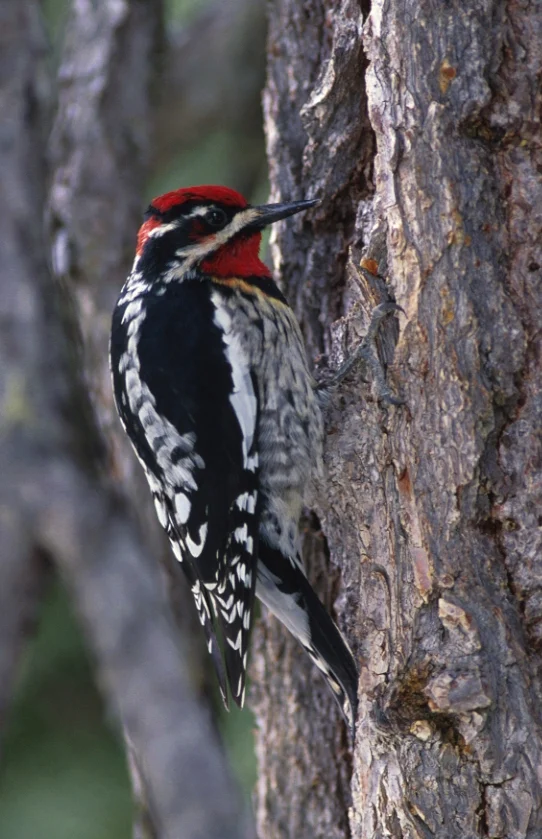
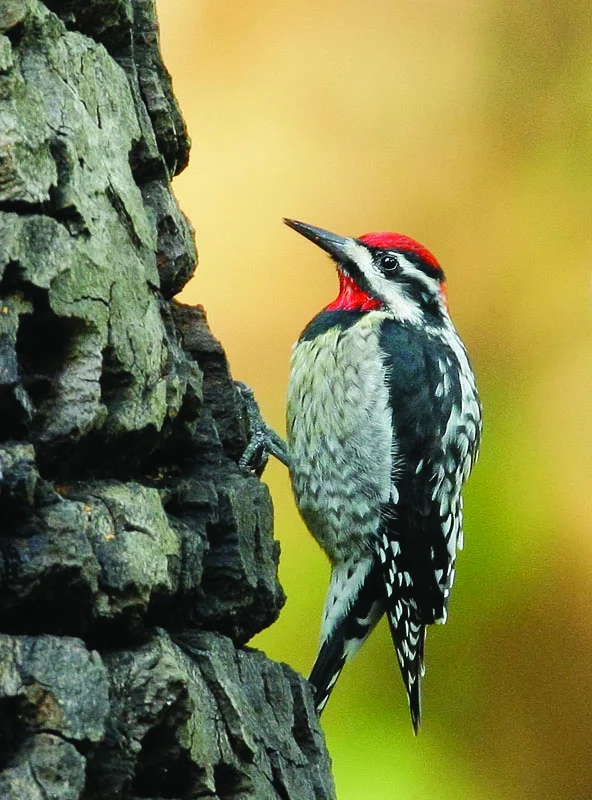
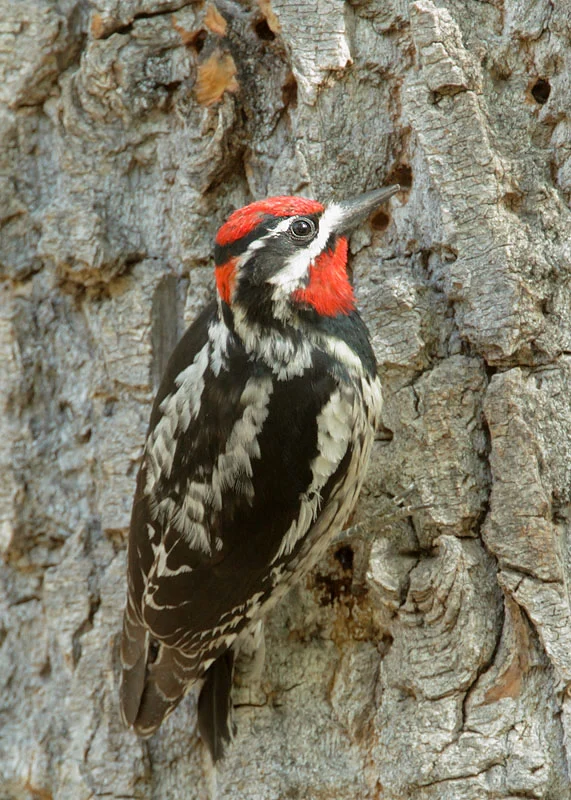
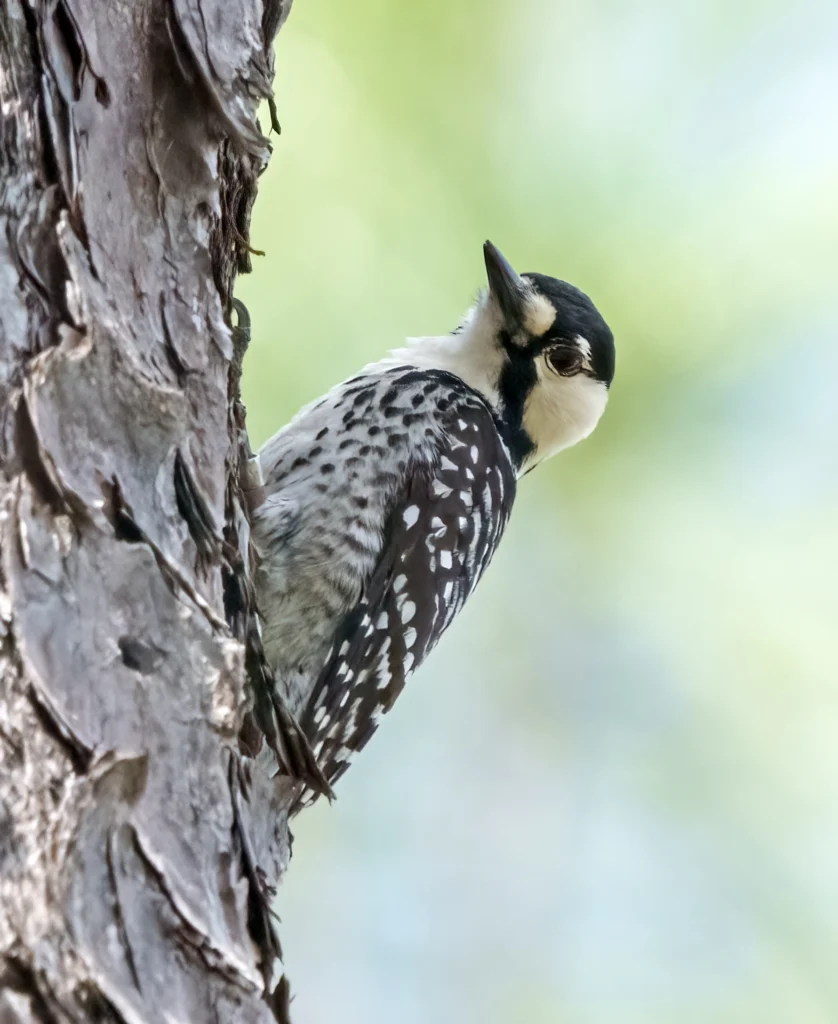
The palette of the Red-naped Sapsucker is similar to that of many other woodpeckers, with largely black upperparts patterned with white markings and mostly white underparts decorated sparingly with black along the flanks. Like its close relatives, the Yellow-bellied and Red-breasted Sapsuckers, the Red-naped has a large white patch on the rump and a mess of white spots on the back between the wings. Males and females are very similar, although females usually have a white or whitish throat, and red on the top of the head may be reduced.
The markings on the head and face of the Red-naped Sapsuckers are also quite similar to those of the Yellow-bellied. Both birds have a bright red crown, a large black bib on the upper breast, and alternating black and white markings over the face, head, and neck. The throat is entirely red in males of both species. In Yellow-bellied females, the throat is entirely white, whereas female Red-naped typically show a variable amount of white extending down from the chin. The two species can be differentiated by the namesake red nape, which is present in both male and female Red-naped, but lacking entirely in Yellow-bellied Sapsuckers. Another notable difference between these two similar species is in the arrangement of white spots on the back. In the Yellow-bellied, they cover the back with no obvious pattern, while the Red-naped’s spots fall into two rows running down either side of the back.
Sounds
Like many other woodpeckers, the Red-naped Sapsucker uses drumming rather than singing as its primary means of long-distance communication, advertising its health and vigor to potential mates and territorial neighbors. The drumming pattern or “tattoo” of the sapsuckers is unmistakable: a slow, irregular series of bill strikes in brief bursts, rather than the regular drumroll of the other woodpeckers north of Mexico. Sapsuckers are quite vocal as well, producing a range of chatters and squeals in various contexts. Both male and female sapsuckers drum, and their call repertoire is shared as well.
Credit: Frank Lambert, XC362013. Accessible at https://xeno-canto.org/362013.
Credit: Andrew Spencer, XC105399. Accessible at https://xeno-canto.org/105399.
Habitat
Largely reliant on sap as a staple food source, the Red-naped Sapsucker lives year-round in wooded areas, preferring deciduous or mixed deciduous-coniferous areas.
- In the nonbreeding season, found in riparian areas and oak woodland and savanna, often mixed with pines or other coniferous trees
- Favored breeding season habitats include aspen groves and riparian habitat with thin-barked deciduous trees
- Will sometimes use orchards in migration or on nonbreeding grounds
Range & Region
Range & Region
Specific Area
Southwestern Canada, western interior of United States, Baja California, and northern Mexico
Range Detail
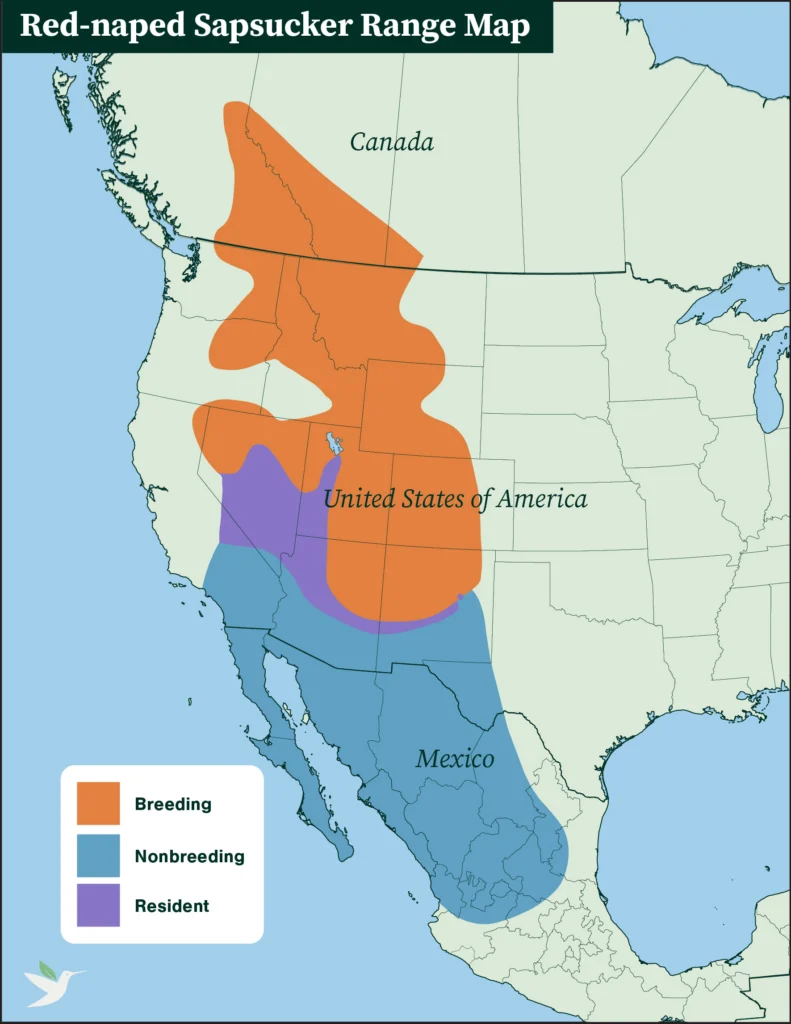
The Red-naped Sapsucker breeds in the Mountain West, from southern British Columbia and Alberta south to southern Nevada, Arizona, and New Mexico. This species is migratory, and can be found in the nonbreeding season from southern California, Arizona, and New Mexico south throughout Baja California and mainland Mexico to Jalisco and Guanajuato.
Did you know?
Among all the species that sapsuckers inadvertently feed, their wells seem to be especially important to hummingbirds. Broad-tailed, Calliope, and Rufous Hummingbirds are all known to drink consistently at sapsucker wells, and may even time their migration to match that of the Red-naped Sapsucker.
Life History
Conspicuous and active, the Red-naped Sapsucker is quite unique in the riparian woodlands and aspen groves of the Mountain States, with its loud cries, distinctive drum pattern, and tell-tale grids of neatly arranged holes circling the trunks of thin-barked trees. This bird is also an agile flyer, with its relatively long and narrow wings closer to those of a flycatcher than most other northern woodpeckers, allowing them to gracefully capture insects midair, an ability reminiscent of the equally distinctive Lewis’s Woodpecker.
Diet
The Red-naped Sapsucker primarily eats sap and insects during the breeding season, but, especially in the nonbreeding season, will also eat a large amount of fruit. Sapsuckers often arrive on their breeding grounds before sap has started to flow, and may first eat bast, the nutritious layer of living tissue under the outer bark of a tree.
Courtship
Red-naped Sapsuckers are socially and sexually monogamous and are thought to mate for life. Whether a pair is new or established in a previous year, males court females at the start of the breeding season. Courtship displays are surprisingly similar to agonistic displays that are typically performed by birds of the same sex to indicate aggression or resolve conflicts. These include raising and lowering of the head, drooping of the wings, and raising the feathers on the crown of the head and throat.
Nesting
Both sexes help to excavate the nest cavity, but males typically do most of the work. Red-naped Sapsuckers prefer to nest in live aspen trees, especially those infected with a heart rot fungus known as aspen bracket (Phellinus tremulae). Many nesting trees will have multiple cavities; as the fungus climbs upward through the heartwood, sapsuckers make successively higher holes. Red-naped Sapsuckers will also nest in other hardwoods, including birch and cottonwood, as well as conifers such as pines and larches.
Eggs & Young
Females lay three to seven white eggs. Both parents incubate, with males roosting in the nest cavity and assumed to incubate overnight. The young hatch after one to two weeks, and both parents help to brood and feed the young. Nestlings are mostly fed insects, especially ants, which parents may dip in sap before feeding to their offspring. Males are typically responsible for removing the feces of the young, which come neatly contained in special fecal sacs. He usually has a specific tree, referred to as his “sanitation post,” where he eats the nutritious sac and dumps the feces onto the ground.