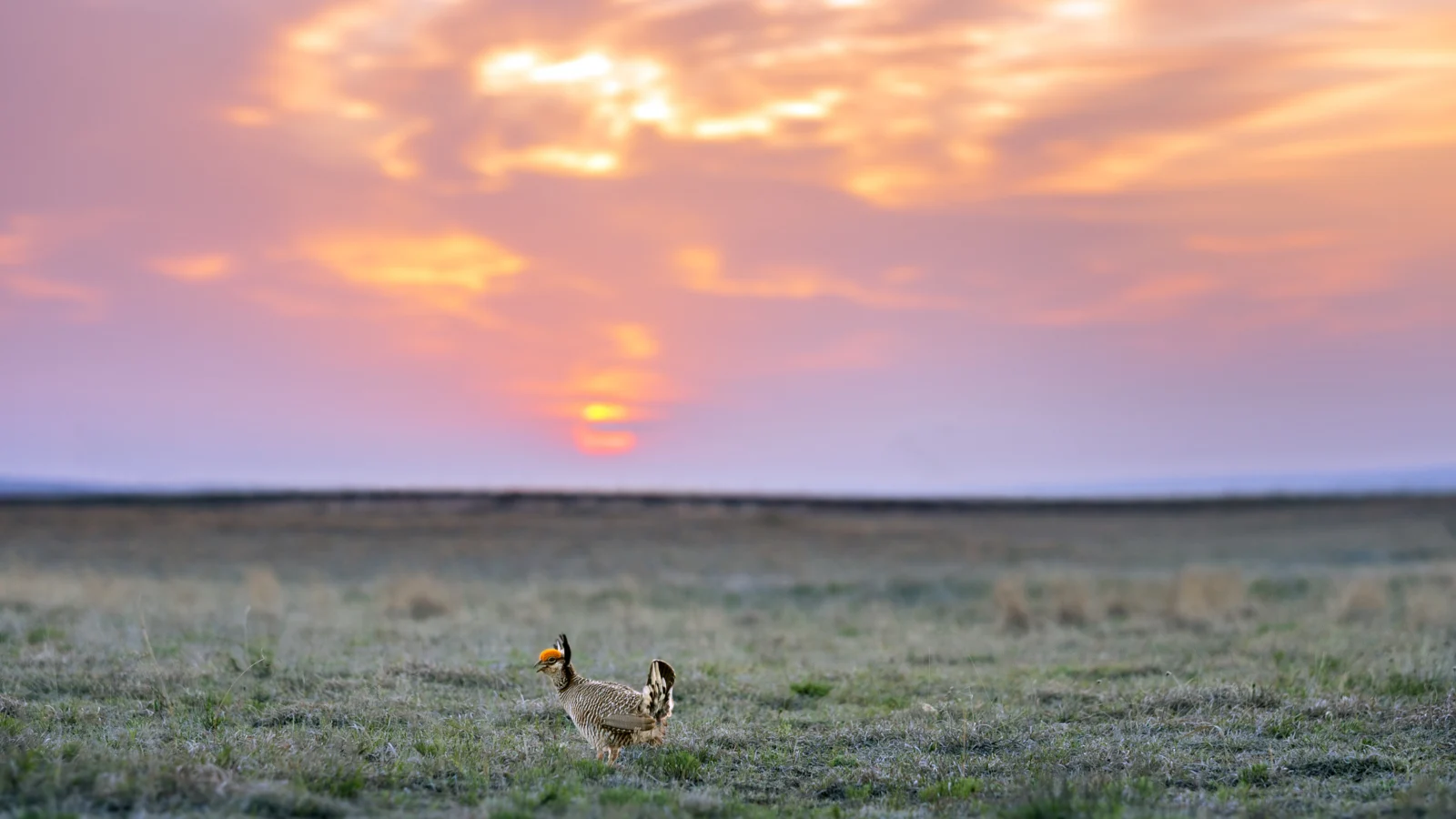
A Lesser Prairie-Chicken stands in a wide field of sagebrush with a pinkish-purple sunrise behind him. The Lesser Prairie-Chicken is experiencing steep declines, and collaboration between private landowners and conservationists may help the struggling species. Photo by Noppadol Paothong.

Finding a Home on the Range

Gallina de las praderas menor. Foto de Noppadol Paothong.

Finding a Home on the Range

Read in English
Actualizaciones del proyecto
Escuchar este articulo
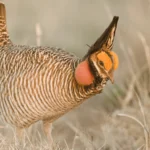
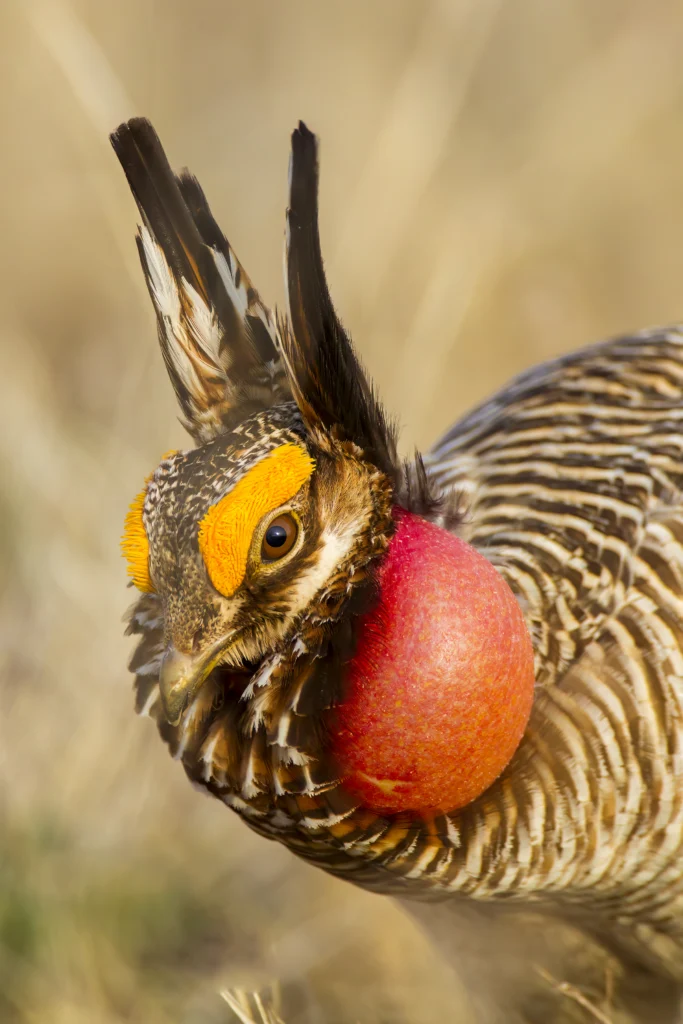
A close-up of a male Lesser Prairie-Chicken showing its raised head feathers, yellow combs over its eyes, and inflated red throat sacs. American Bird Conservancy works with partners to conserve this species. Photo by Noppadol Paothong.
Male Lesser Prairie-Chicken. Photo by Noppadol Paothong.

The four of them were headed west from town — Walt Colvin, his brother Ralph, and two friends, packed into Walt’s Model T with their gear, in search of the bird they called the “lesser prairie hen.” The hunt was a tradition in the Colvin clan. As he jolted along the rutted dirt roads toward the southwest corner of Kansas, Walt remembered other expeditions after Lesser Prairie-Chickens: the fall of 1905 when his brother saw “fifteen to twenty thousand chickens” around a single grain field in Seward County, Kansas, just over the border from the Oklahoma panhandle; the hunt a year later when they moved “3,500 to 4,000 chickens” out of another cornfield.

But the years had gone by. It was the fall of 1913, and, as he drove west through the prairie into country he’d hunted for years, Walt noted “the absence of the chickens from their favorite haunts.” He kept driving until he saw a cornfield that looked promising. He stopped and the four of them grabbed their gear and walked the field. “Several hundred chickens arose,” he wrote later, most of them well out of range, but the hunters managed to take a few stragglers as the flocks escaped to a hilltop a mile or more away. As the evening came on, they collected their birds and loaded back into the T for the long drive home.

As he drove, Walt “realized with a shudder that we were nearing the sunset life of the king of upland game birds.” He said as much to Ralph, who shook his head.

“There will be plenty of chickens here ten years from now,” he said with a grin.

Walt thought differently.

“You’ll be lucky to find a few chickens to shoot five years from now,” he replied.

And he was right.

Lesser Prairie-Chicken YouTube Thumbnail.

Plowed Under

What Walt Colvin recounted in a 1914 issue of Outing magazine was the result of decades of land conversion. In 1870, the U.S. Bureau of the Census reported just shy of two million “improved acres” in Kansas, the vast majority of which lay in well-watered areas of eastern Kansas, east of the Flint Hills. By 1910, nearly 30 million acres carried the designation. “The vast wilderness” of the High Plains had been cut to pieces. The bison were gone, as were the elk. Pronghorns held on by a thread. And the Lesser Prairie-Chicken, the native grouse of the southern grasslands, struggled as waves of farmers carved up the prairie with the plow, lured by a succession of federal inducements, beginning with the Homestead Act and the dream of Manifest Destiny.

The impact of row-crop agriculture on the Great Plains deepened as technology opened access to the Ogallala Aquifer, a natural underground reservoir under parts of the plains states that held more water than Lake Erie. Improvement of pumps after World War II allowed farmers to reach down to the aquifer for the first time, and the advent of a radical new approach to irrigation — the center-pivot system — drove a revolution in farming on the prairie, beginning in the 1960s.

These days, there are about 50,000 center-pivot irrigation systems in the five states of the central and southern plains — the Texas and Oklahoma panhandles, southeastern Colorado, eastern New Mexico, and western Kansas. Something like 2.8 million acres of what was once native grassland lie under those pipes, raising corn, alfalfa, wheat, or sorghum instead of Lesser Prairie-Chickens. Add to that the impact of oil and gas development, extensive wind turbine installations, electrical transmission lines, fences, roads, and the encroachment of invasive trees like the eastern redcedar and mesquite, and, as Steve Riley, Chief Conservation Officer for American Bird Conservancy, notes, not much is left. Equipment, farms, and fields are larger; crops and livestock are less diverse; herbicides, insecticides, and crop hybrids make both farming and the harvest more efficient. These days, farming is more like big business and less like the family enterprises enshrined in the American imagination. That shift has had major effects on prairie-chickens.

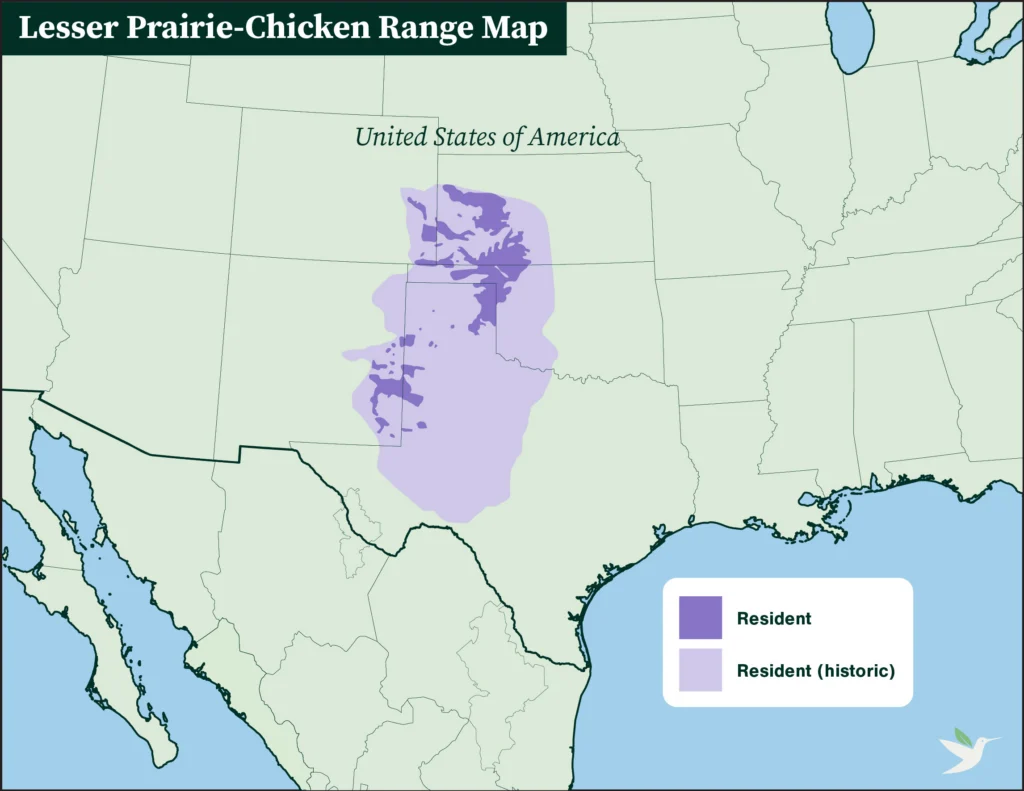
A range map showing current and historical distributions for the Lesser Prairie-Chicken across Colorado, Kansas, Oklahoma, Texas, and New Mexico. Map by American Bird Conservancy.
Range map showing current and historical distributions for Lesser Prairie-Chicken.

“We’ve lost, by some estimates, about 92 percent of their range,” Riley said. “And even within that collapsing range, there are fewer and fewer bits of habitat. Places like Texas or New Mexico, which once made up well over half the range, have hardly any birds left.”

While it’s hard to determine precisely how many Lessers were on the plains before settlement, some scientists estimate that the population has dropped by as much as 97 percent. It’s now believed to number fewer than 28,000.

The long, sad decline of this spectacular bird hasn’t escaped the notice of generations of conservationists and wildlife managers. State wildlife agencies and universities in the region have been tracking the distribution and abundance of Lessers since the 1940s, and the pace of research on the ecology of the species has picked up drastically since the 1980s. In 1973, the U.S. Fish and Wildlife Service (FWS) identified the Lesser Prairie-Chicken as one of 70 bird species it considered to be “threatened,” a designation that carried no legal protections. After decades of conservation advocacy, beginning in 2012, the agency added the Lesser to the official federal list of threatened and endangered species, then removed it in response to a court order, then added and removed it a second time.

Currently, the FWS is yet again determining whether or not the chicken qualifies for Ley de Especies en Peligro de Extinción protections, a conclusion it has reached twice before. The most recently vacated listing decision expressly stated that voluntary programs were important but insufficient to protect the birds. The final status assessment was even delayed by a year so that the voluntary conservationist landowners could properly get their houses in order, exemplifying the deep trust developed between federal regulators and landowners. Despite this, the listing was vacated on a technicality. While debates over the status of the species have raged, efforts to stop the decline have been largely ineffective.

We’ve lost, by some estimates, about 92 percent of their range. And even within that collapsing range, there are fewer and fewer bits of habitat. Places like Texas or New Mexico, which once made up well over half the range, have hardly any birds left.

Steve Riley, Chief Conservation Officer for American Bird Conservancy

Money for Chickens

Until recently, the lone exception to that litany of failure was the impact of the Conservation Reserve Program (CRP), a federally funded effort to retire farmland over 10 years or more with payments from the U.S. Department of Agriculture. Matt Bain, Director of Conservation for the Kansas chapter of La Conservación de la Naturaleza (TNC), and a key player in the effort to help Lesser Prairie-Chickens, points out that CRP gave chickens a boost in the 1990s.

“We’ve had a lot of success with CRP, getting re-establishment of a couple of hundred thousand acres in Lesser Prairie-Chicken habitat with the 1985 Farm Bill,” he said. “That’s what caused the increase in Lesser Prairie-Chicken populations in western Kansas. Now, in that area, we have about two-thirds of all Lesser Prairie-Chickens.”

The fundamental challenge facing Lessers is the ownership of the landscapes they occupy — 84 percent of the bird’s range is owned by farmers and ranchers. CRP worked well because it paid landowners to sow a variety of plants, most of them native prairie species, and leave that cover for 10 years or more. Lessers and the vast majority of other wildlife on the plains have found CRP to be an acceptable substitute for native grasslands. The problem with using CRP as a way to boost populations of prairie-chickens and other wildlife is that its funding isn’t stable. In spite of the popularity of the program, the acreage cap has been cut almost in half since the program began, and the payments per acre have been similarly reduced. In addition, CRP does nothing to protect existing prairie grasslands from the plow, an oil rig, or a giant wind turbine, none of which suit Lesser Prairie-Chickens.

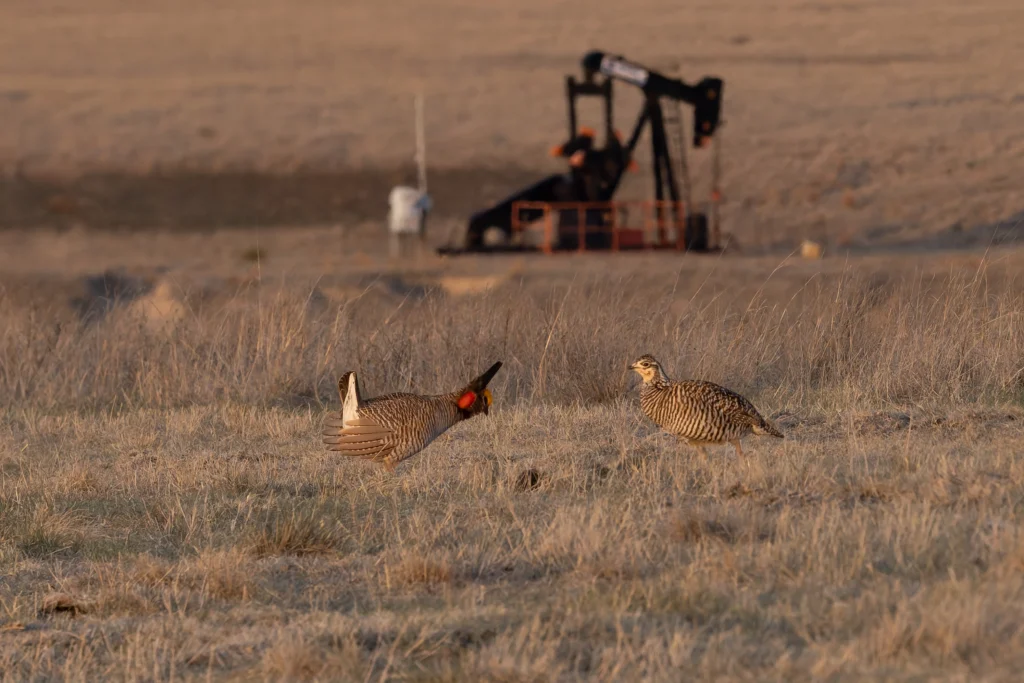
Two Lesser Prairie-Chickens, one male and one female, stand in a field of sagebrush. The male displays for the female while in the background, a pump jack extracts oil from the ground. Fossil fuel infrastructure and other development fragments the species’ grassland habitat, and hybridization with its more common relative depletes its genetic diversity. American Bird Conservancy works with partners to conserve this species. Photo by Raj Lingam.
A male Lesser Prairie-Chicken displays for a female Greater Prairie-Chicken while a pump jack extracts oil in the background. Photo by Raj Lingam.

The success of CRP has demonstrated one important concept — on a privately owned landscape, conservation begins with landowners. The challenge for conservationists has been two-fold: to find more funding to help landowners preserve and restore habitat and, crucially, to focus that funding where it will do the most good. This depends on an understanding between a landowner and a conservationist, a one-on-one relationship that uses science, planning, and financial support to make conservation decisions more robust, durable, and sustainable.

One approach to that challenge is the concept of a “conservation bank.” It takes many forms, but, essentially, it’s a system in which individuals or companies that have an environmental impact donate to an organization that will use the money to offset that impact. In 2014, businessman and rancher Wayne Walker approached the FWS for approval of a conservation bank to preserve and improve grasslands for Lesser Prairie-Chickens.

Walker and his partners, John Preyer and Adam Riggsbee, called their nascent organization LPC Conservation. With the FWS agreement in hand, they set out to raise money from the energy industry to help ranchers maintain habitat for the birds. With degrees in botany and environmental science, Dr. Riggsbee has helped channel investments toward ranches where the potential benefits are greatest. The outfit’s message is simple: “When ranchers prosper, the prairie thrives.” Since its inception, LPC Conservation has raised more than $40 million, which has protected 30,000 acres of rangeland and helped restore habitat on 12,500 acres.

As LPC Conservation hit its stride, Bain took over the management of The Nature Conservancy’s 19,000-acre prairie reserve, Smoky Valley Ranch, along the Smoky Hill River south of Oakley, Kansas. The ranch supported a thriving population of Lesser Prairie-Chickens, but Bain saw the need for a broader approach. In 2021, TNC and the Walmart Foundation gave him a grant to work full-time on a pilot project to add more habitat to the core area the ranch provided. He started with applications to the U.S. Department of Agriculture.

“We had a $2,000,000 Regional Conservation Partnership Program grant [from the federal Natural Resources Conservation Service],” he said, “then a grant from CRP Grasslands [from the Farm Service Agency], an Environmental Quality Incentive Program grant [EQIP, also from the NRCS], then private, state funding. Stacking that all together, focusing it in that pilot area, adding technical assistance with more people on the ground. We want to support producers to find ways to achieve both our goals — the landowner’s goals and the habitat goals. We went from just Smoky Valley to an additional 30,000 acres of conservation easements. We’re about 50,000 acres now in that initial pilot area.”

These days, Bain also oversees work in three other parts of the Lesser’s range in western Kansas. His goal is 200,000 acres of habitat in each of these projects, a total of 800,000 acres of “anchor properties” and surrounding conservation easements in Kansas alone. The progress is heartening, but the cost is staggering.

“We’re going to continue to do our best using the tools we have — Farm Bill, estate programs,” he said. “It’s just complicated for us, for the landowners. How do we piece all this together?

We need to build all those tools; we need to fund robust CRP, robust EQIP. All those things are important, but they’re not going to get us there at scale.”
Protecting Grasslands

Ted Koch has been wrestling with the challenge of the Lesser Prairie-Chicken for more than 30 years, first as an endangered species biologist with the FWS and, recently, as the Executive Director of the Asociación Norteamericana de Urogallo. He recognizes the gravity of the problem.

“We lose 2,000,000 acres of grasslands each year across the Great Plains,” he said. “We’ve lost 50 percent of our grassland birds over the last 50 years.”

And this trend isn’t simply ecological; it’s economic.

“We’ve lost 40 percent of our livestock producers since late last century,” he continued. “The U.S. cattle herd is at its lowest point since 1951. Rural communities continue to decline. The southern Ogallala Aquifer continues to decline. Now, if anybody thinks that’s success, then let’s keep doing what we’re doing. But if that’s not being successful, then let’s do something else.”

Like Bain, Koch sees the potential for a partnership between the farmers and ranchers who work the landscapes that support Lessers and the conservationists who want to preserve the wild ecosystems the bird represents. Past experience in Kansas shows that an aggressive CRP program can increase chicken populations, even where the native prairie has been plowed, but Koch sees an opportunity to protect remaining native grasslands as well. The key, he believes, is stepping back from the focus on a rare bird to consider the broader value of native prairie to the nation at large.

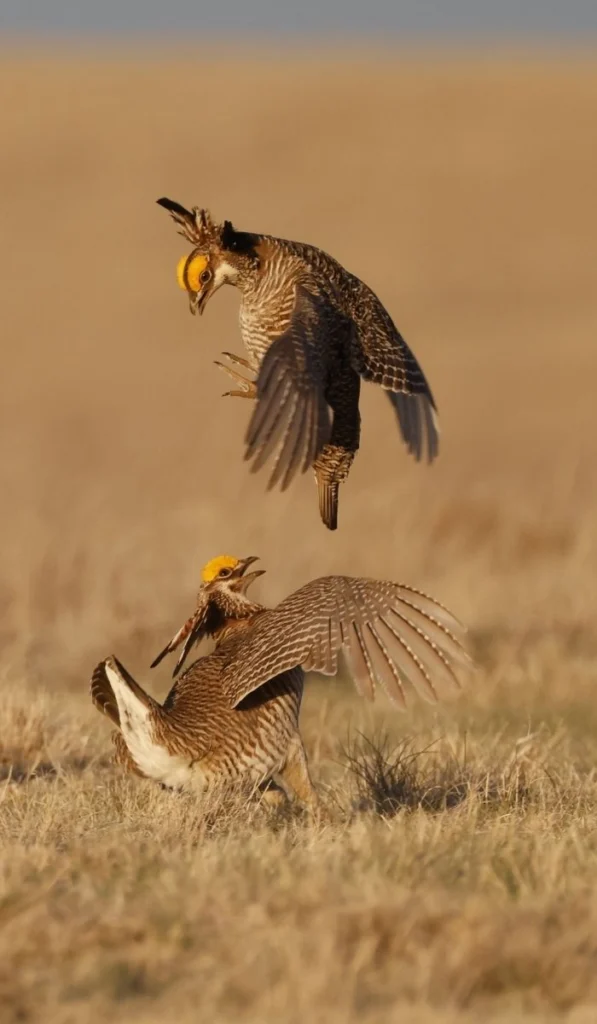
Two male Lesser Prairie-Chickens spar on a wide field, with one prairie-chicken airborne about to strike the other. Males compete for the attention of females and the ability to mate at leks, communal spots used by groups of prairie-chickens, sometimes for years. Habitat loss and fragmentation have limited the species’ range and threaten its existence. Photo by Michael J. Parr.
Two male Lesser Prairie-Chickens spar. Photo by Michael J. Parr.

Well-managed grasslands purify air and water and reduce flooding; they hold soil in place and replenish topsoil fertility over time. They’re one of the world’s most effective carbon sinks, absorbing carbon dioxide, converting it to organic compounds, and storing it deep underground.

“In the southwestern Great Plains,” Koch said, “we get up to $629 per acre per year of ecosystem services from healthy rangelands. Because ranchers care. Some of them are desperate to avoid selling out. But, my God, they need something,” if they’re going to continue  maintaining native prairie. In his view, the government needs to “establish a second income stream for ranchers willing to provide their valuable grassland and conservation services. The government should treat ranchers like business professionals and negotiate to buy measurable conservation services.”

And it wouldn’t require anything like $629 an acre to encourage most ranchers to do just that.

“Our experience shows that paying ranchers from 1.5 to 2.5 times more per acre than existing Farm Bill programs achieves the outcomes of this proposal,” he added. “It’s not that much more to be competitive with alternative uses and add revenue streams.” He plans to use the societal value of ecosystem services to justify broader federal funding for 10 “ranching strongholds” measuring 200,000 acres each in areas that still harbor populations of Lesser Prairie-Chickens.

Koch doesn’t see a new funding stream as a replacement for traditional Farm Bill conservation funding. The new funding will be “the right tool for the job in landscapes where we have endangered species,” he said. Landscapes like the southern plains, species like the Lesser Prairie-Chicken.

Finding the money to protect privately held grasslands at a landscape scale will be a challenge, but the ultimate key to success isn’t funding — it’s partnership. The most recent generations of programs on behalf of Lesser Prairie-Chickens have all started where they must, with conversations between conservationists who want to help the bird and landowners who face the hard day-to-day choices that affect their bottom lines, as well as the wildlife on their property. Such conversations can lead to the recognition that the two groups share a common goal: the health of the land. Understanding is the beginning of cooperation.

As Bain said, “All this moves at the speed of trust.”


Chris Madson holds a master’s degree in wildlife ecology from the University of Wisconsin-Madison. He edited Kansas Wildlife magazine for six years and Wyoming Wildlife magazine for 30 years before retiring in 2014 to write full-time. He is a certified wildlife biologist with The Wildlife Society. 


This story originally appeared in the Summer 2026 issue of Bird Conservation.