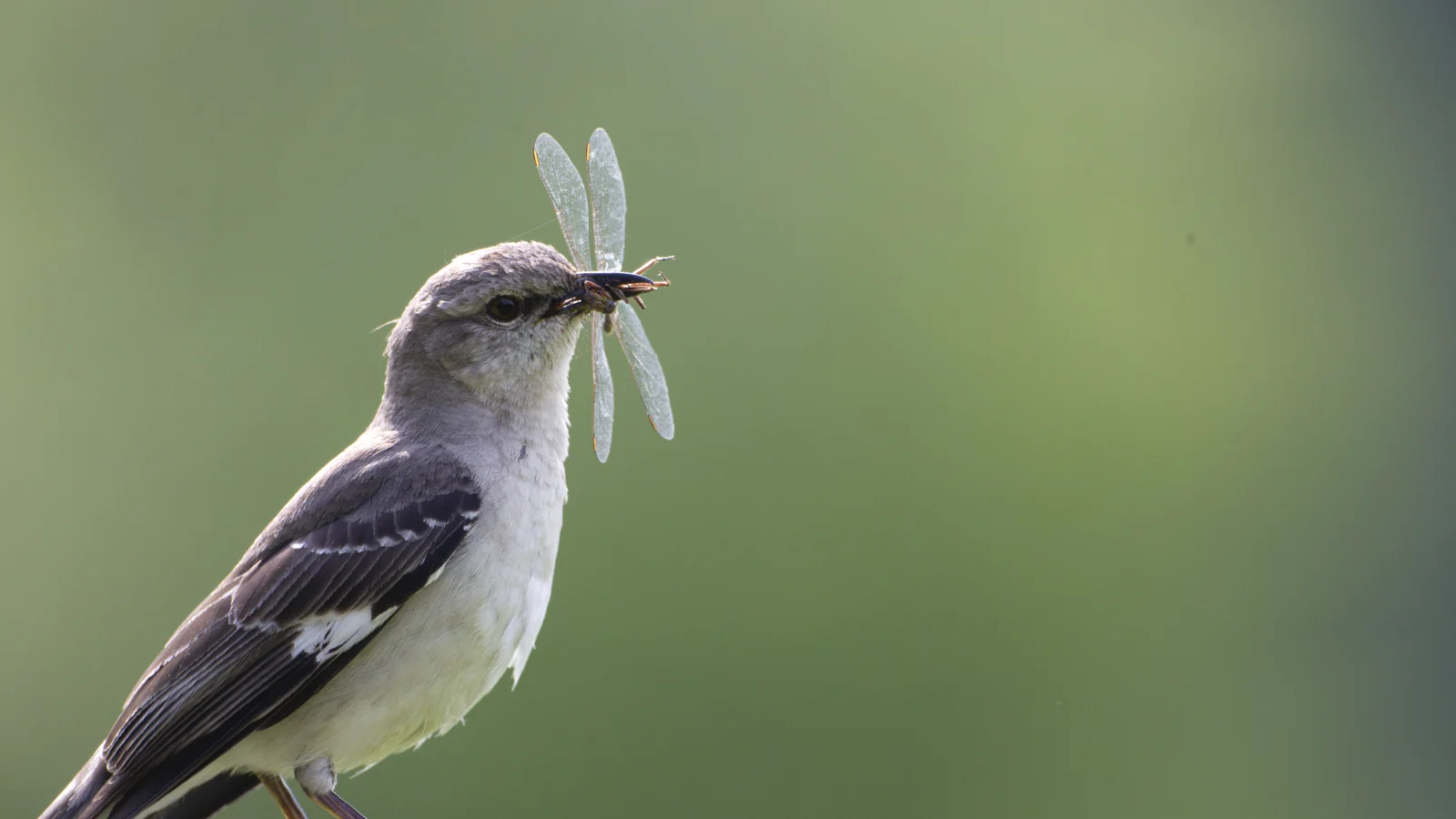
A Northern Mockingbird carries an insect in its beak. New policy efforts championed by American Bird Conservancy in a number of U.S. states seek to reduce the use of harmful chemicals, which can directly poison birds and deplete insects birds need for food. Photo © Michael Stubblefield.

From Coast to Coast, States Take Action to Reduce Harmful Chemicals

Northern Mockingbird. Photo © Michael Stubblefield.

From Coast to Coast, States Take Action to Reduce Harmful Chemicals

Read in English
Noticias
Escuchar este articulo

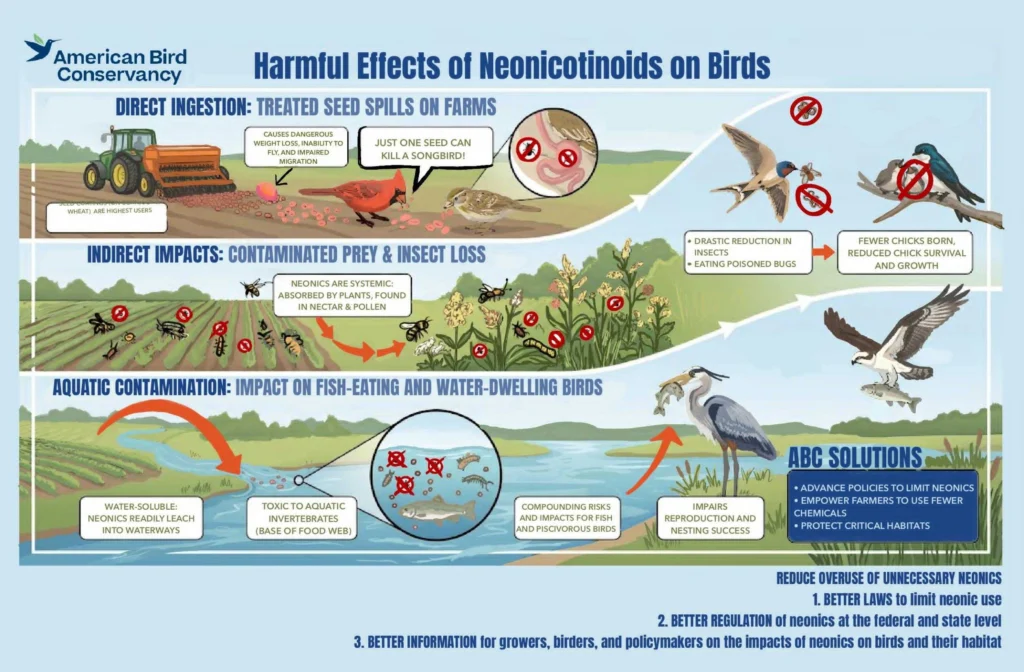
A single crop seed coated with a neonicotinoid pesticide, or neonic, is enough to kill a songbird. Yet, every year, these neurotoxic chemicals are applied to more than 100 million acres in the United States. Neonics are particularly potent and can have detrimental effects on entire ecosystems.

Neonics are systemic pesticides, meaning they don’t just sit on the surface of a plant. Instead, neonics infiltrate the entire plant, from its leaves and pollen down to its roots. Neonics are water-soluble, and they persist in soil, leach into waterways, and travel as dust. They poison the plants and insects birds rely on.

Infographic showing the three ways neonicotinoids can harm birds: direct ingestion, contaminating prey and insect loss, and aquatic contamination.
Neonics and birds. American Bird Conservancy.

While much of American Bird Conservancy’s (ABC) policy work takes place in the halls of Congress, strategic efforts in the states can lead to meaningful action on some of the most pressing issues for bird conservation. Federal policy change can be slow, and when Congress is gridlocked, turning to the states can be an effective way to see more bird-friendly policies enacted.

Along with our partners, we have been advocating for and gaining traction on groundbreaking bills in states across the country to rein in the threat of neonics and other chemicals while putting much-needed guardrails on their use. The record number of pesticide-related bills moving through state houses signals a major shift in how the public and legislators are thinking about these chemicals. Policy change can be slow work, and it can take multiple legislative sessions for a bill to gain traction, but ABC is making steady progress on common-sense policies from New Hampshire to California.

A Greener Green Mountain State and Progress on Neonics in New England

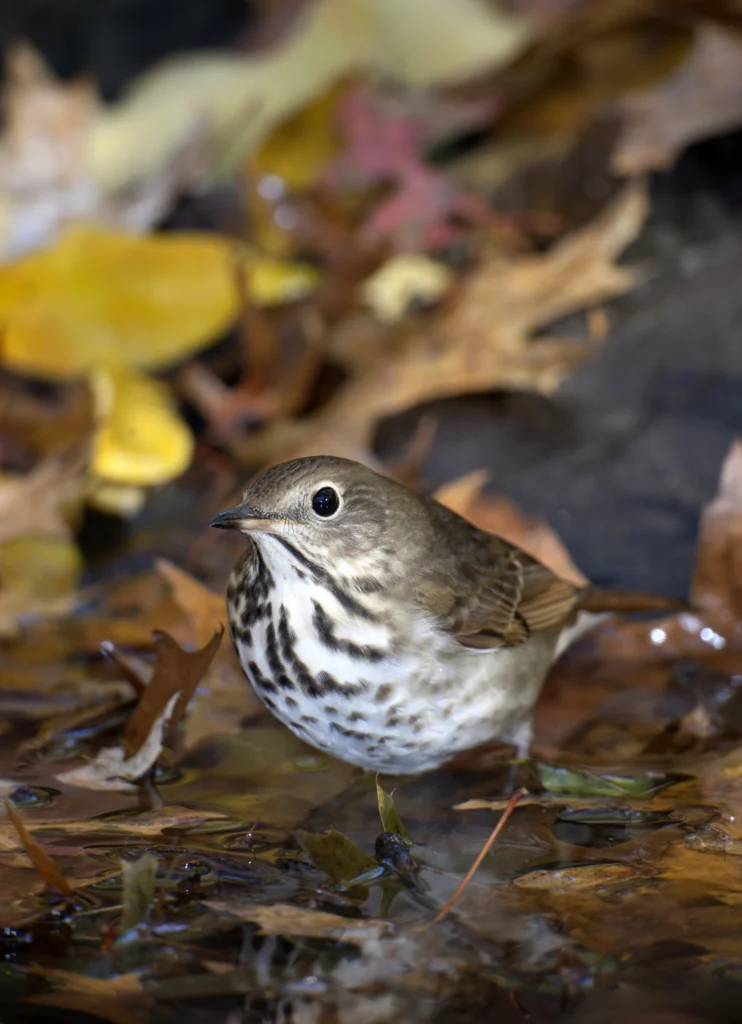
A Hermit Thrush stands in a shallow puddle surrounded by fallen leaves. Vermont recently became the first state in the country to ban the pesticide Paraquat. American Bird Conservancy has supported similar efforts to ban harmful pesticides around the country. Photo © Michael Stubblefield.
Hermit Thrush. Photo © Michael Stubblefield.

This summer, Vermont made history when it became the first state in the country to ban paraquat under H. 739. One of the most common herbicides, paraquat has harmful impacts on birds and is linked to neurological disorders, including Parkinson’s disease. This bill passed with bipartisan support. Vermont’s leadership on this issue can serve as a model for other states.

This is just the latest of several actions the Green Mountain State has taken to reduce the use of toxic chemicals. Vermont recently moved to restrict neonicotinoid use on row crop seeds and prohibit the use of toxic insecticides on grass and turf. The state is also phasing out most anticoagulant rodenticides, reducing the threat these widely used chemicals pose to raptors.

ABC and regional coalitions also championed Bill S.2746 in Massachusetts. The proposed legislation would have outlawed the sale, distribution, or use of agricultural seeds (specifically, corn, wheat, and soybeans) treated with neonics unless the grower obtained a specific department waiver for pest management. The bill’s proactive approach allows the state to seamlessly transition away from preventative chemical coatings without sacrificing crop yields. The bill was reported favorably out of the Environment and Natural Resources Committee earlier this year.

When Legislation Plants the Seeds for Change

Policy wins aren’t always achieved in the legislature — but they often start there. A New Hampshire bill that ABC had advocated and provided supporting testimony for in prior legislative sessions ended up being taken up by the state’s Pesticide Control Board. ABC provided ecological data to the state, demonstrating that urban and suburban neonic runoff disrupts local avian food chains just as severely as agricultural use. The Pesticide Control Board issued a ruling to restrict the use of neonics on lawn and turf in an effort to address non-agricultural threats.

Thanks to a bill championed by ABC in California in 2025, the California Department of Pesticide Regulation (DPR) initiated a process to collect information on all pesticides used throughout the state, including neonicotinoids used as seed coating.

Following the trail blazed by Vermont, California also recently became the second state in the U.S. to ban paraquat, a move that ABC’s Advocacy Coordinator Serena Chenery called “a major victory not only for public health, but for wild birds and the habitats they rely on.” Chenery added, “Because this chemical persists in soil and water for long periods, its impacts ripple up through the food chain, threatening bird populations across California’s Central Valley and beyond.”

Defining the Parameters for Pesticide Use

Like the Massachusetts bill, legislation in Colorado and Minnesota made major strides towards pesticide reform, focusing on eliminating de facto pesticide use and better defining when pesticides may be truly necessary. Massive, widespread use of seed treatments typically provides no economic benefit to farmers, yet it has deleterious effects on birds and native pollinators.

Colorado’s SB26-065, widely known as the SEED Act (Strengthening Economic and Environmental Decisions Act), targeted the elimination of de facto insecticide seed coatings on field crops, ensuring they are only used when a verified pest emergency exists. ABC mobilized advocates to highlight how neonics hollow out local ecosystems, threatening migratory species, game birds, and the state’s multi-billion-dollar outdoor recreation industry. The bill has been reintroduced and needs the support of Coloradans to pass!

In Minnesota, HF 3704 and its companion, SF 4052, proposed a framework for seed buyers to obtain a specialized waiver, complete Integrated Pest Management (IPM) training, and conduct a formal pest risk assessment before using treated seeds. It would also have banned ornamental turf applications. Research has shown high neonic residue levels in Minnesota’s prairie-grouse populations. This bill will be reintroduced, providing another opportunity for Minnesotans to take action to support a common-sense pesticide policy.
Shielding the Chesapeake Bay Watershed

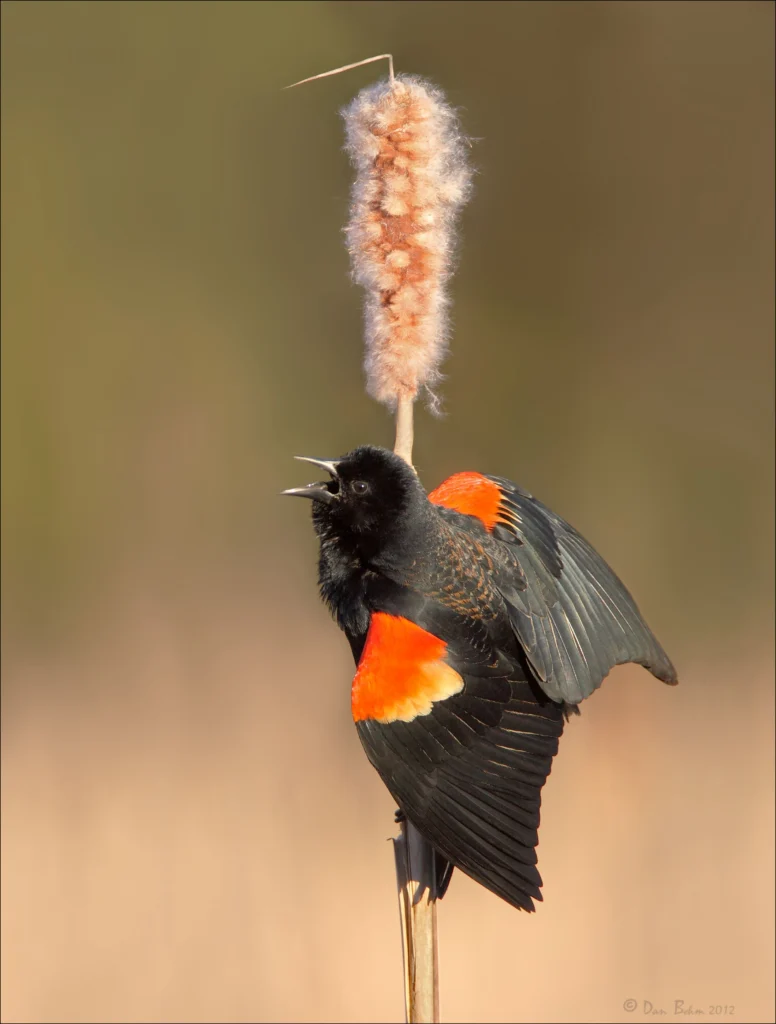
A male Red-winged Blackbird perches on a cattail with his wings spread and beak open. These birds are among the many species that will benefit from efforts in Maryland to prohibit neonicotinoid-treated seeds and applications of neonics on ornamental and turf landscaping. Photo by Dan Behm.
Red-winged Blackbird. Photo by Dan Behm.

In Maryland, ABC and a coalition of local partners threw strong support behind House Bill 0091, a crucial bill to prohibit neonicotinoid-treated corn, soybean, and wheat seeds, along with outdoor ornamental and turf applications of this long-lasting pesticide.

The areas targeted by the bill are frequented by beloved field-foraging species such as the Red-winged Blackbird and Baltimore Oriole. The former, a seed-eating species, faces immediate mortality from consuming even one neonic-treated seed, while insect-eaters like the oriole suffer from the loss of prey due to collapsing insect populations.

ABC testified in favor of the bill, emphasizing that more than 90 percent of the chemical coating applied to seeds washes into the surrounding soil and the groundwater. This runoff severely threatens the aquatic invertebrates forming the biological foundation of the Chesapeake Bay, impacting the migratory waterfowl that rely on the Atlantic Flyway. Expect to see this bill make a comeback in the next legislative session.

The Path Forward: Your Voice Matters

State by state, the tide is turning against neonicotinoid overuse, and the actions of advocates like you can make all the difference. Policy change can be slow. ABC’s work, and the work of supporters who take action on legislation where they live, plants the seeds for change (a neonic-coating-free seed, naturally!), and our sustained action — sometimes over successive years and legislative sessions — leads to germination.

Despite the lobbying efforts of chemical companies and huge agricultural interests, this year, we have seen meaningful neonicotinoid restrictions move further and faster than ever before. It will take more work in states across the country to get more bird-friendly policies signed into law. Visit ABC’s Action Center to find ways to take action today, and learn what you can do to reduce pesticide use in your home and community.

Take Action for Birds

Visit ABC’s Action Center to speak out on important issues impacting birds and their habitats.

Help Reduce Pesticide Impacts at Home

In this webinar, ABC’s Director of Government Relations, Pesticides and Birds Campaign, Hardy Kern, discusses the importance of curbing pesticide use at home and shares tips for how to do it.