Forest Assist
Working in concert with a diverse array of partners that includes American Bird Conservancy, many landowners nationwide are turning their properties into de facto wildlife sanctuaries.
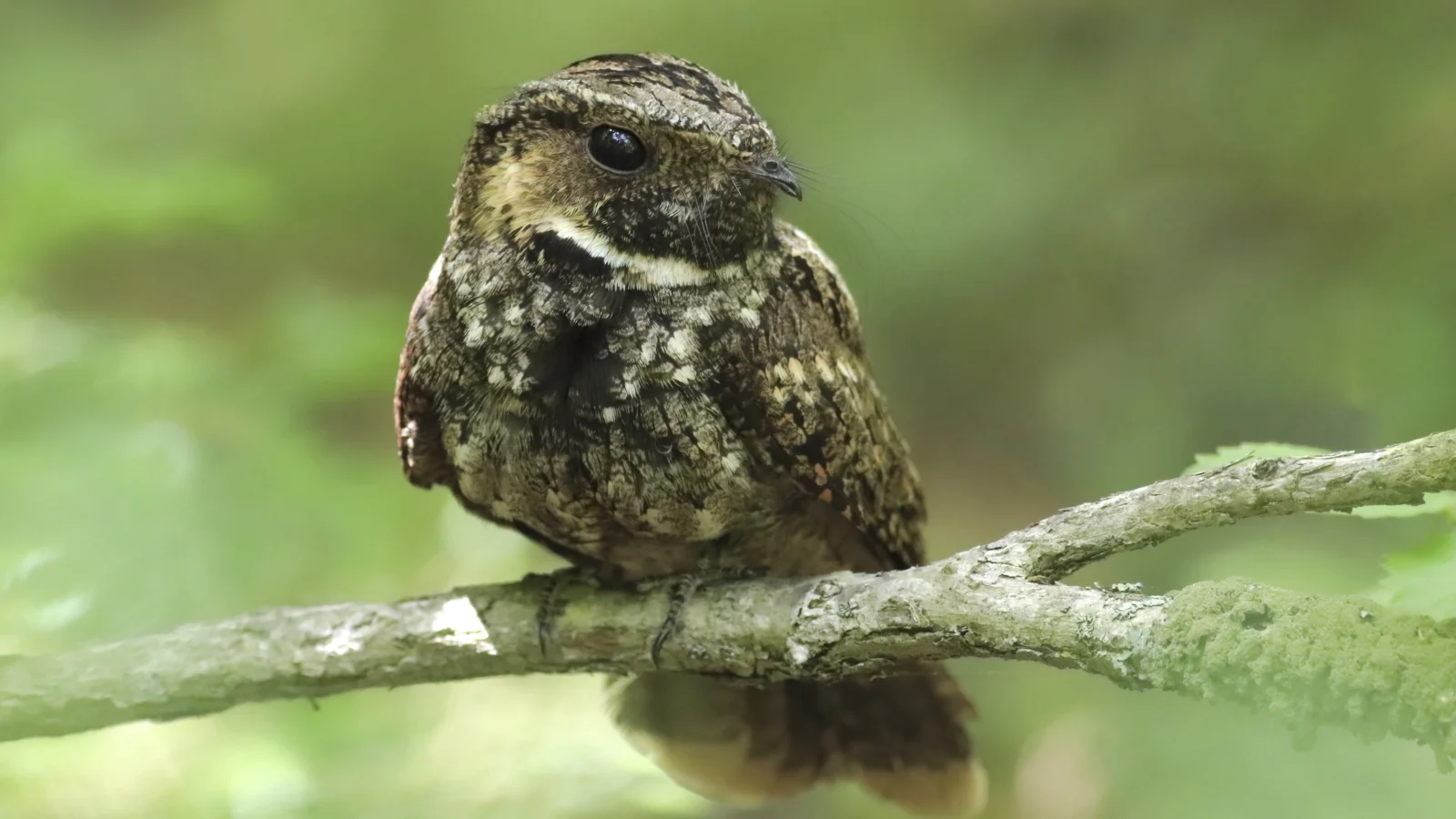
Somewhere in the middle of Pennsylvania, a couple dozen yards from a dusty, rocky dirt road, the stillness of early summer at dusk is suddenly interrupted by a steady, rhythmic round of whip-poor-WILL, whip-poor-WILL, whip-poor-WILL. The call begins suddenly — as though its source, the Eastern Whip-poor-will, has always been broadcasting, but the listener has only just tuned the dial to its station.
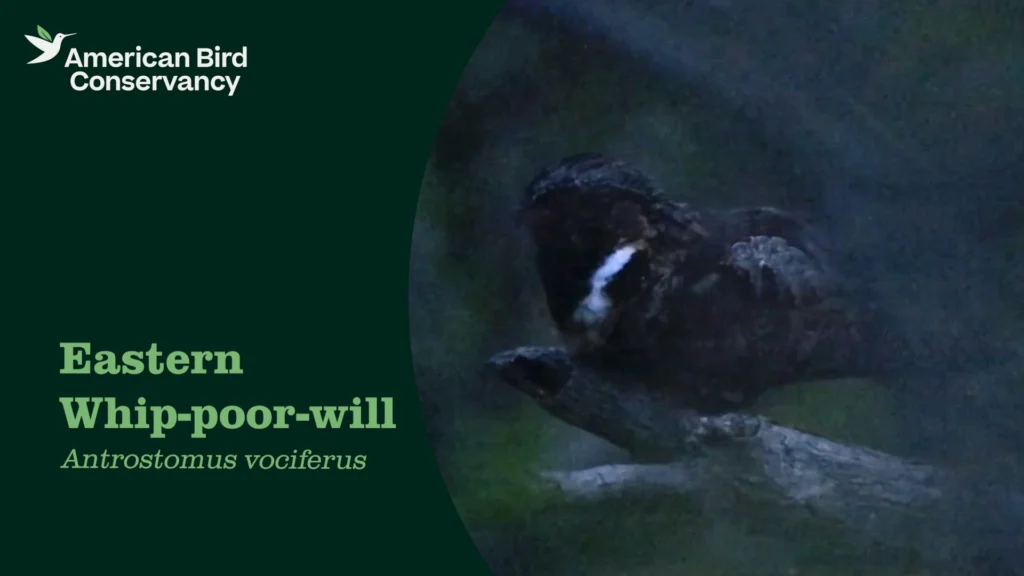
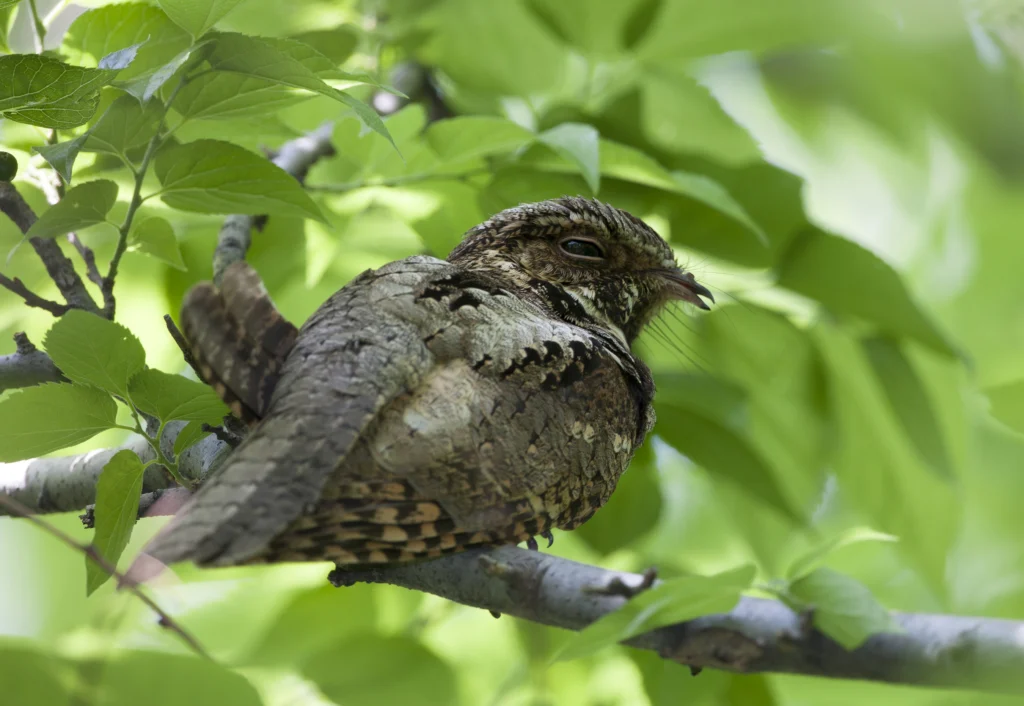
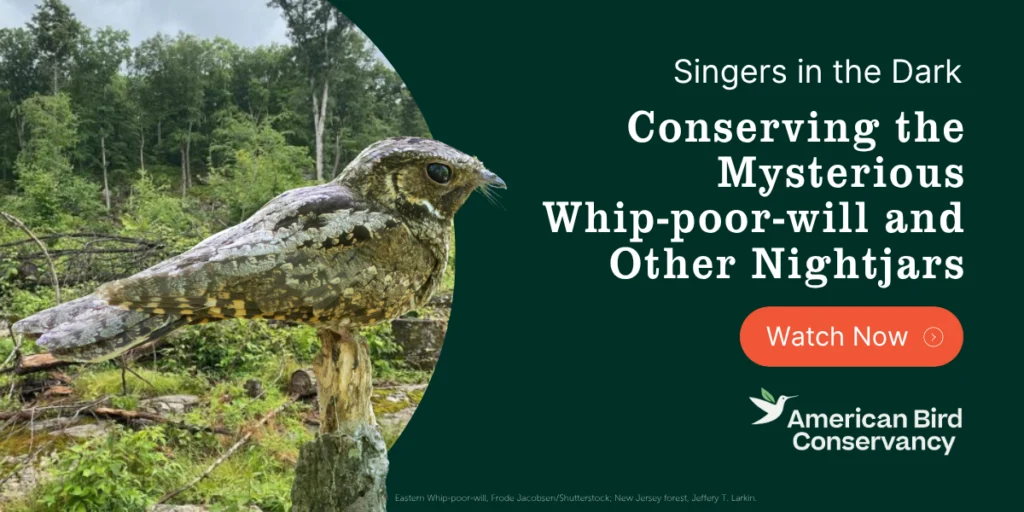
With a round, stout body, deceptively tiny bill, and a long, thin tail, an Eastern Whip-poor-will at rest and in profile almost resembles a comma, suggesting something left hanging — not unlike its insistent, chanted song that ends as abruptly as it begins. That feeling of incompleteness extends to our knowledge of this cryptic species, and it’s one of the reasons Jeff Larkin and a crew of young researchers are deep in central Pennsylvania’s forests at night, attempting to lure elusive whip-poor-wills to waiting mist nets so they can be studied.
Though most people in the eastern half of the United States and Canada have never seen an Eastern Whip-poor-will, many have surely heard them. Their crepuscular song evokes summer evenings in the forests east of the Rockies, but it has gone quiet in many places where forests have been felled and replaced with acres of uniform trees. Larkin has long had a hunch that that sameness is precisely what’s silencing the whip-poor-will and many other species. That’s the second reason he and his team are out at night: Larkin, a professor of Wildlife Ecology and Conservation at Indiana University of Pennsylvania and American Bird Conservancy’s Forest Birds Habitat Advisor, hypothesizes that infusing a little chaos into a landscape of likeness will bring back whip-poor-wills and other birds, and they’re putting that idea — formally called Dynamic Forest Restoration — to the test.
The Eastern Whip-poor-will, like most nightjars, is an odd and poorly understood bird. During the day, its mottled gray and brown plumage provides excellent camouflage — even an earnest observer could be forgiven for mistaking this bird for a bump on a branch. What appears to be a small bill is actually more of a gaping maw, which the whip opens in flight to inhale its flying insect prey. Bristle-like rictal feathers fan out around the bill — their function is debated, but they act, much like a cat’s whiskers, as a kind of sensing device for locating insects, or as eye protection. Its enormous, inky black eyes, equipped with specialized retinal structures for low-light conditions, can spy insects silhouetted against the night sky.
While a Great Horned Owl might call sporadically throughout the night, whips begin their steady, repetitive calls about 10 minutes after sundown and keep going for about an hour, but often less. Their activity is driven by the lunar cycle and increases around the full moon. The window for hearing — and catching — whips narrows as the moon wanes. Nesting, too, is synchronized to the lunar cycle. Eggs hatch as the moon is waxing, about 10 days before its apex, when conditions for foraging are at their best. But much of the Eastern Whip-poor-will’s biology is a black box: Its cryptic coloring, nocturnal nature, and expansive breeding territories in the woodlands of eastern North America make it difficult to study.
“Our first week of the first field season in May 2023, we were coming out here way too late. We weren’t hearing a single bird. But now we’ve got it down to a science,” said Nicole Notarianni, a recent graduate of the Forest and Natural Resource Sciences master’s program at the University of Kentucky. She studied under Darin “DJ” McNeil, a former graduate student of Larkin’s and a partner in the whip-poor-will research, which is also being carried out at field sites in Kentucky. The ABC-led Appalachian Mountains Joint Venture is also conducting research on whips.
“The work in Pennsylvania has served as a springboard for further work in other states — places like eastern Kentucky, where forests also increasingly lack appropriate structure and diversity, are likewise losing their whip-poor-wills,” said McNeil. “Thankfully, our ongoing work in Kentucky to understand birds in that region has benefited enormously from the lessons learned during Pennsylvania fieldwork.”
The project has tagged some 100 whip-poor-wills with lightweight GPS tags over the course of a few field seasons. The GPS tags, which fit over the birds’ hind legs and are so small and light they don’t interfere with their movements, allow the researchers to get a decent approximation of their habitat selection on the breeding grounds in Pennsylvania and Kentucky. The tracking devices have the added benefit of providing insight into the birds’ journeys from their breeding grounds to stopover habitats and nonbreeding areas — migration is just one of many aspects of whip-poor-will life history that is murky at best.
The whips don’t give up their mysteries easily — they have to be recaptured for the team to extract data from the GPS tags the birds were outfitted with the previous breeding season. Thankfully, Larkin noted, the birds are faithful to their breeding grounds. “We go to the GPS coordinates where we first captured the bird last year. They come back to virtually the same territory each year.”
The trick, then, is catching them a second time.
On a given night in April and May when the birds arrive on the breeding grounds, the research team disperses to several locations covering an expanse of central Pennsylvania’s vast forests. Many of the dozens of survey sites are tucked away within State Game Lands and State Forests and are accessed from a dizzying network of old logging roads. At each site, a mix of managed and unmanaged forest stands, the team sets up just before sundown, running lengths of fine mesh netting between poles extending about 7 feet high within sparse stands of trees and along roads and powerline cuts.
With the nets assembled and a narrow window for capturing the birds after sundown, the crew presses play, and the enchanting circular call of whip-poor-WILL bursts forth from a speaker. On a good night, the whips get curious about the interloper singing so boldly on their territory and fly in to investigate. On a really good night, they fly toward the mist nets and bounce into its folded pockets, where they’ll stay for only a moment or two. The researchers and field crew gently extract the birds and place them in breathable cotton bags before heading back to a centralized meeting point a couple of miles up the bumpy roads. Here, in the hands of trained and permitted professionals donning headlamps, each bird is banded with a uniquely numbered aluminum band, weighed, measured, checked for parasites such as ticks, and either fitted with or freed from a GPS tag before being released back into the night. That is how it goes for the field season, though the sites visited by the crew vary from one night to the next.
“It’s important for us to understand their space use and habitat selection on the breeding grounds, especially in areas that have been managed to increase structural diversity,” Larkin said. “And we’re really excited to understand more about where they’re going. Stopover habitats are critical, and this can provide some insight into important areas for these birds. And ABC, of course, has an interest in the nonbreeding grounds,” which range along several Gulf Coast states and through eastern portions of Mexico south to Nicaragua.
By gathering GPS data about the whip-poor-wills’ locations throughout the full annual cycle, the research team is filling gaps in our body of knowledge about the birds. “We know relatively little, especially about their nonbreeding grounds,” Notarianni said. “We know so little about the female’s life history, where the juveniles go. It’s a very understudied species.”
What is known in no uncertain terms is that the Eastern Whip-poor-will is in steep decline and has lost approximately 69 percent of its total population over the last 50 years. The species is now considered Near Threatened by the International Union for Conservation of Nature.
Conservationists also know the main culprit: habitat degradation. Larkin gets even more specific: “We know that we are losing these birds like crazy, that these bird populations have been plummeting in the face of our forests getting older around the same time because they were cleared at the same time.”
Forests are naturally messy, and in that messiness is the story of succession and disturbance: Across the landscape, storms, landslides, tornadoes, periodic wildfires resulting from lightning strikes or set intentionally by Indigenous peoples, and even animals knock down trees, clear understories, and open canopies, creating space for sunlight to reach the forest floor. A natural forest is a mosaic of trees of different species and different ages, of openings and gaps offset by dense stands where little light filters in, of transitional zones, always in flux and ever changing.
Many forests have lost that dynamism, however. The processes that would naturally drive disturbances, such as wildfire in fire-adapted forests, and even floods caused by beavers, have been suppressed, and humans have changed the character of some forests so completely through the landscape-scale clearcutting that took place well into the early 20th century.
Many places have a lot more forest than they did several decades ago, but not all forests are created equal. It is common across eastern North America to see thousands of acres of trees all of the same age, mostly of the same species, with canopies of uniform height. The variations in tree species, canopy height and density, and mid- and understory compositions now skew toward sameness. Most of Pennsylvania’s forests are between 90 and 120 years old, and these millions of acres grown in the wake of clearcutting look very different from what stood there a couple hundred years ago. They sound very different, too. Quieter.
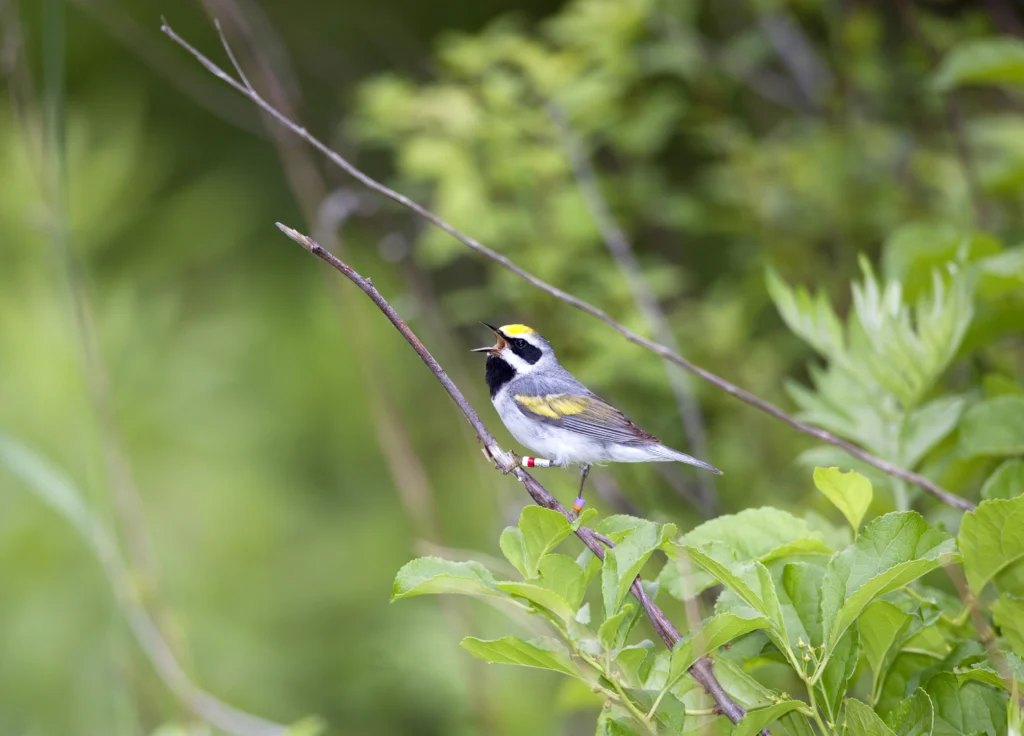
The Keystone State’s forests once rang with the songs of Golden-winged Warblers, Wood Thrushes, and Eastern Whip-poor-wills, but they’re scarcer today. The Golden-winged Warbler nests in the shrubs, grasses, and wildflowers of open areas, such as regenerating clearcuts with scattered residual trees, and it ushers freshly fledged young into the safety of proximal older forests with dense understories. Wood Thrushes prefer mature forests with ample leaf litter for foraging, lots of canopy cover, and complex midstories dense with smaller trees and larger shrubs for nesting, but are known to use younger forests once their young fledge. And Eastern Whip-poor-wills rely on a variety of successional conditions: forest edges and open areas for foraging in the moonlight and mature edge habitats with sparse groundcover and mottled shade to complement their camouflage while nesting. Even-aged forests can serve some, but not all, of the needs for these species throughout their annual cycles.
The shrubby openings within forests that are such a boon to foraging whips and nesting Golden-wings are hard to come by these days. These early successional communities rarely have a chance to occur naturally in even-aged forests: The natural attrition of random trees nearing the limits of their lifespans toppling over in a storm and cracking open the canopy, for example, just doesn’t occur as it once did, and fire suppression has largely eliminated one of the chief means of introducing disturbance — and thus, regeneration — to the landscape.
The research team surveys plenty of such sites for whip-poor-wills in Pennsylvania. In these cookie-cutter forests, they expect the density of birds to be low, and it almost always is. Other sites, where foresters and conservationists have come together to break up the monotony of even-aged forests with prescribed burns and sustainable timber harvests (among other forestry practices), are much more fruitful.
“The Golden-winged Warbler rescued me from med school back in 1993,” Larkin joked. Larkin, who has worked with ABC since 2013, turned away from a potential career in medicine and instead pursued a master of science in forestry and a PhD in animal sciences from the University of Kentucky.
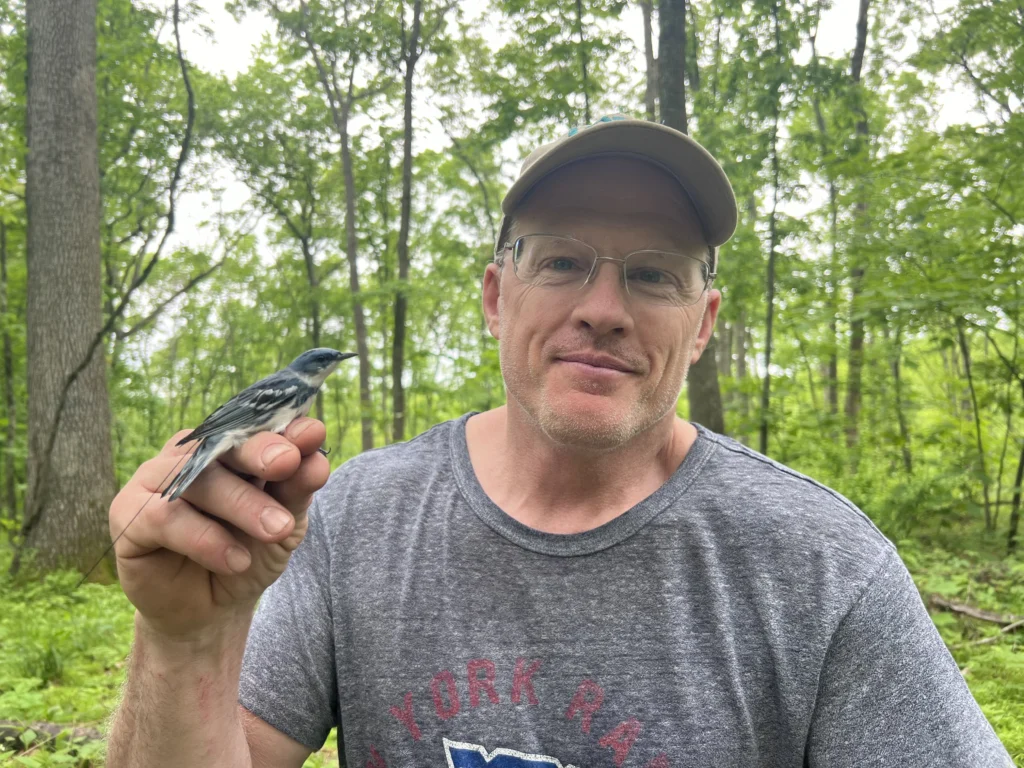
“The niche I have carved for myself is based on a fairly quick realization that these two disciplines of forestry and wildlife ecology, despite being so important to each other, often have a disconnect in communication,” Larkin said. “I think I act like a bridge between the two disciplines. I’m not a practicing forester — I’m an ornithologist — but I sometimes feel more like a forester who does a lot of work with birds.”
Having a foot in both worlds has paid off as Larkin and his colleagues continue to nurture a multi-decade vision-turned-strategy for bird conservation at a landscape scale in eastern forests. Dynamic Forest Restoration, the approach developed by ABC and Larkin, is a marriage of conservation science — decades of research and study pointing to potential causes of bird declines and their potential solutions — and the practice of forest management or stewardship.
“Dynamic Forest Restoration is taking what we know of the ecology of these species that we study and synthesizing it so it can be implemented in our forests,” said Larkin.
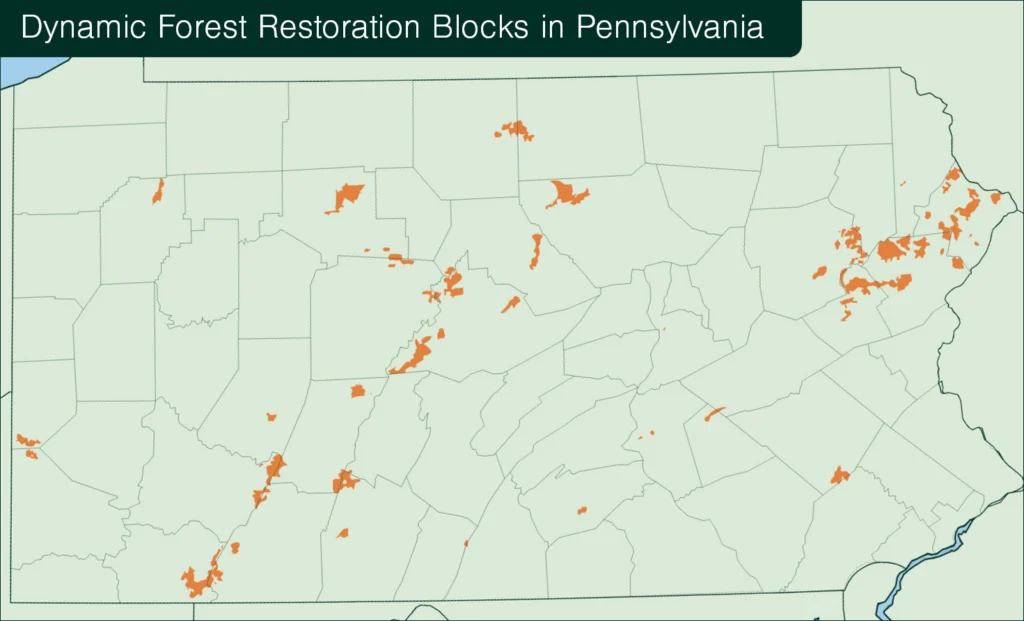
Many of the Pennsylvania study sites for the Eastern Whip-poor-will research are located within Dynamic Forest Restoration Blocks (DFRBs). Each of these units, ranging in size from 3,000 to 30,000 acres and comprising a mix of privately owned and public lands, has its own management plan, and no two DFRBs are the same. The blocks are small enough to be manageable and the effects of conservation actions on them measurable, yet large enough to be ecologically meaningful for species that require different habitat conditions throughout their entire reproductive cycle.
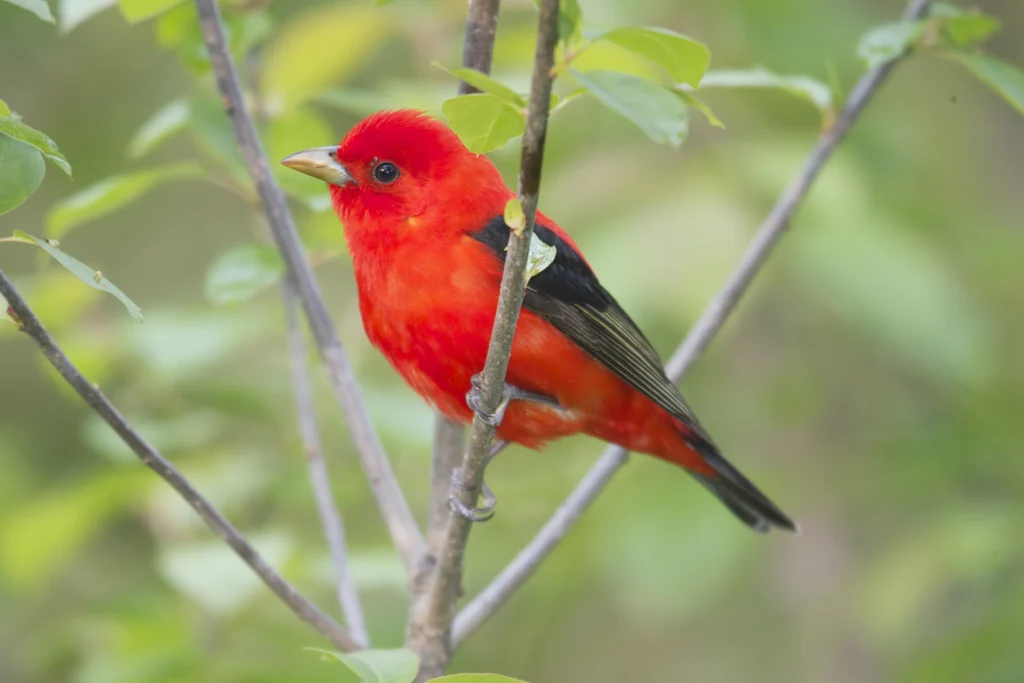
Forested landscapes must be dynamic in structure and composition to meet the dynamic habitat needs of forest birds. So many species show dynamic habitat use patterns when their nesting and post-fledging habitat needs are considered: Wood Thrushes, Ovenbirds, Cerulean and Golden-winged Warblers, and Scarlet Tanagers (to name only a few) seek out conditions in the post-fledging period that differ from where they establish nesting territories. The first few weeks after fledging are a vulnerable time for young birds — their flight feathers are still coming in, and their ability to move is limited — and Dynamic Forest Restoration makes sure the different habitat components they need are in close proximity.
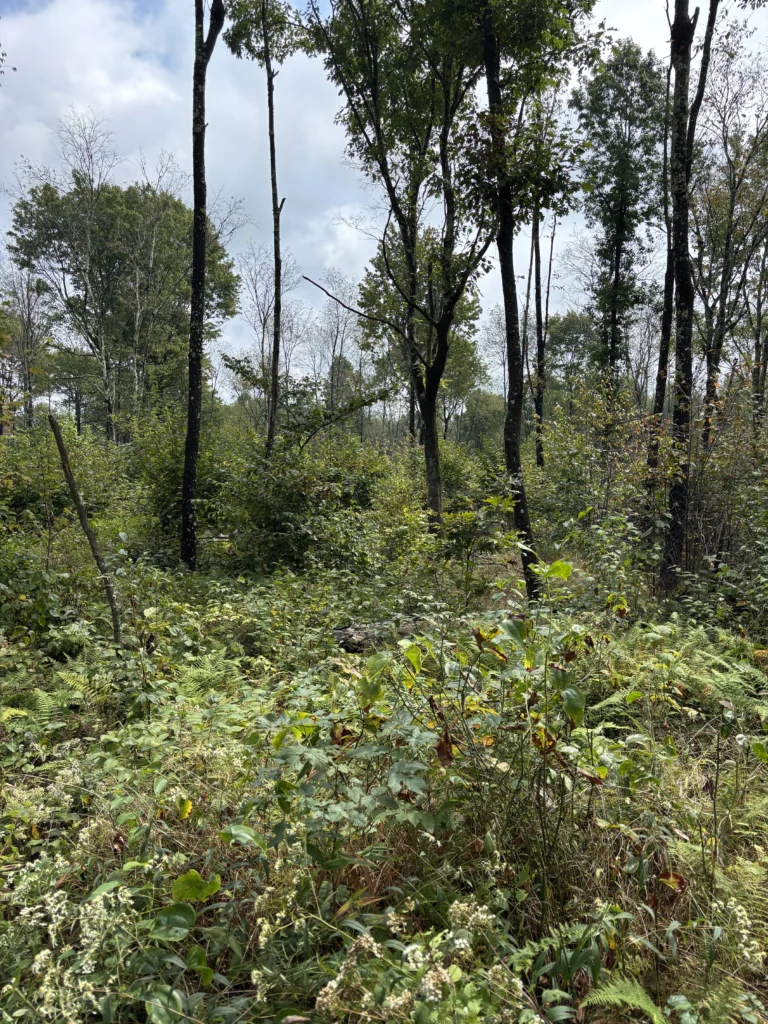
The management activities, or conservation practices, carried out in each unit depend on the conservation needs of the bird species in the area, the condition of the forest, and the wishes of the landowner. One section of a DFRB might be strategically harvested to allow more light to reach the midstory or understory and allow desired tree species such as oaks to regenerate, while elsewhere in the block, prescribed fire might be used to reduce competition and allow for the flourishing of desirable fire-adapted communities, such as pitch pine-scrub oak. Removing invasive or competing plants in the understory of a late-successional stand can give native vegetation a chance to regenerate on the forest floor. Harvesting can create the open, shrubby conditions birds like the Eastern Whip-poor-will and Golden-winged Warbler rely on.
Every management action is deliberate and carried out in the service of creating healthy, resilient, and balanced age classes of forests within a given conservation area. Work within the DFRBs is an opportunity to pool resources and to do more on the ground. The work bridges the gap Larkin observed early in his career — bringing the people studying birds and the people stewarding forests together on the shared goals of healthy forests and ecosystems. The dynamic forest management approach has been used since 2013 in the Great Lakes region, where ABC has been improving habitat for Golden-winged and Kirtland’s Warblers and other species of conservation concern.
Roughly 425,000 acres within 53 individual DFRBs dot the landscape, and each has its own plan and its own partners, ranging from public lands managed by state agencies to private hunting clubs, a water authority, a Boy Scout camp, and conservation foundations. These conservation partners were already doing good work to improve forest health and balance age classes within forests. Still, by collaborating on DFRBs, they can secure more funding, including $8 million in competitive funding from the National Fish and Wildlife Foundation (NFWF). NFWF’s support has been critical to the scaling up of Dynamic Forest Restoration throughout Pennsylvania.
Larkin has found an enthusiastic partner in the Commonwealth of Pennsylvania. The state’s Game Commission, which funded the whip-poor-will research, and its Department of Conservation and Natural Resources’ Bureau of State Parks have supported significant conservation activities carried out by agency foresters, land managers, and biologists in DFRBs across the state.
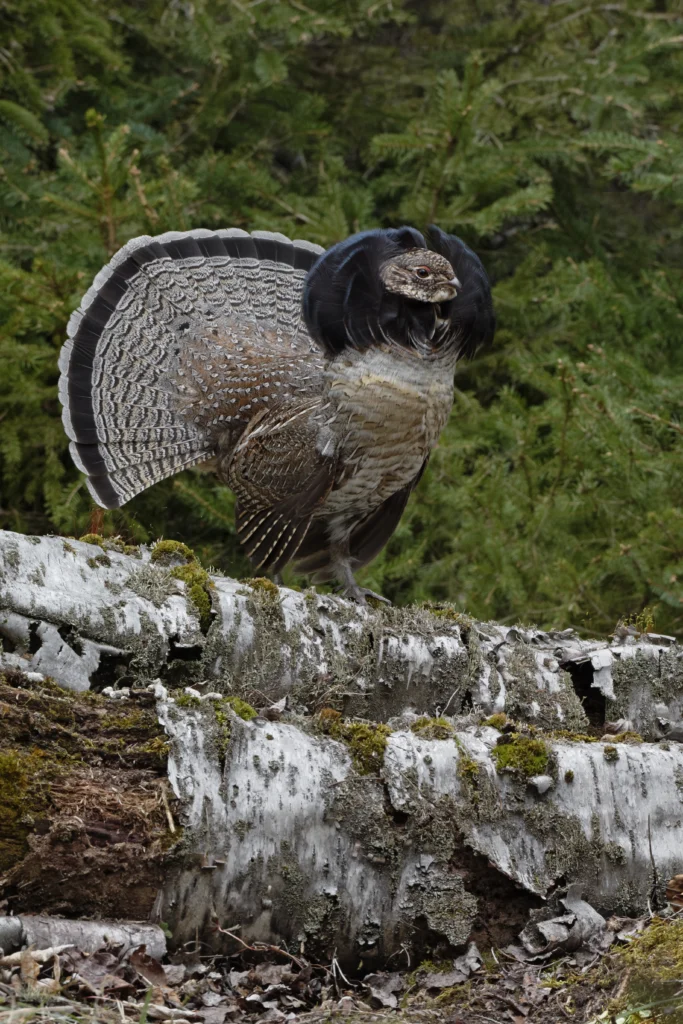
“The DFRB approach has helped us concentrate staff attention and resources on priority landscapes where we know these species are declining,” said Dan Heggenstaller, North Central Regional Forester with the Pennsylvania Game Commission. “Early on, we realized the habitat diversity and arrangement needed by species like whip-poor-will or Wood Thrush would benefit many of the game species pursued by our Game Land users. From Ruffed Grouse and Wild Turkey to elk and black bear, a forested landscape of diverse stand ages and structural conditions meets a lot of habitat needs.”
“Dynamic” here can take on multiple meanings. The conservation practices are intended to restore dynamism in homogeneous forests, but the DFR plan itself is dynamic. These forests and the wildlife they host will benefit from continual and changing management for decades.
Driving that change is ongoing monitoring to understand how birds are responding to conservation practices within DFRBs. Avian point counts conducted by qualified field technicians during the breeding season in the first two years of a DFRB’s entry into the program, before most conservation practices have been implemented, provide the baseline. Then the work on the ground starts.
The goal is for each DFRB to be periodically monitored over a period of 10 to 15 years, and in fact, the researchers collect data from thousands of sites. Ongoing avian point counts are supplemented by the deployment of thousands of autonomous recording units (ARUs), which can each record thousands of hours of sound. Aided by computer programs, researchers analyze ARU data to identify bird calls and songs at each monitoring location and across an entire DFRB.
Though the monitoring of avian communities within DFRBs is ongoing, the data thus far indicate that more diverse forests, especially in terms of variation in canopy height, have higher conservation value to avian communities. In other words, the more a forest resembles a mosaic, the messier it looks, the better it is for a broader range of bird species, especially those most in need of conservation action.
The birds themselves testify to the benefits of a diversified forest landscape.
“What we’re seeing is that the density of whip-poor-wills is so high in managed sites that have had some removal of the tree canopy, where there’s low understory regeneration with small shrubs and very young trees, and one or two mature trees intermixed — the birds just love it so much,” Notarianni said. “They want young forests.”
Changing the character of a forest for the better takes time. Land managers think not just in years and decades, but in centuries. But birds can respond to habitat management quickly, and the stewardship activities we implement today will shape forest structure and composition long into the future.
“Four or five years ago after a fresh harvest here, you might have said, ‘Oh my gosh, what have they done to this forest?’” Larkin said. “But now, we’re mass-producing the trees of the future, and they’re wonderful caterpillar-producing, bird food machines. We’re standing among chest-high, head-high white oak regeneration, and it’s terrific! I hear Prairie Warblers singing their heads off, and Scarlet Tanagers, and Blackburnian Warblers. And yes, we’re hearing whip-poor-wills calling at night.”
Molly Toth is ABC’s Senior Writer/Editor. She has been writing about nature and conservation for a decade and holds a master’s in biology.
A version of this article was first published in the Fall 2026 issue of Bird Conservation, the member magazine of American Bird Conservancy.
Featured News & Stories

Around the Great Lakes, momentum grows to restore and enhance landscapes, brightening the future for birds and people. You may have read that nearly 3 billion birds have been lost since 1970. And you probably know that two culprits suspected in this widespread decline are habitat loss and fragmen...