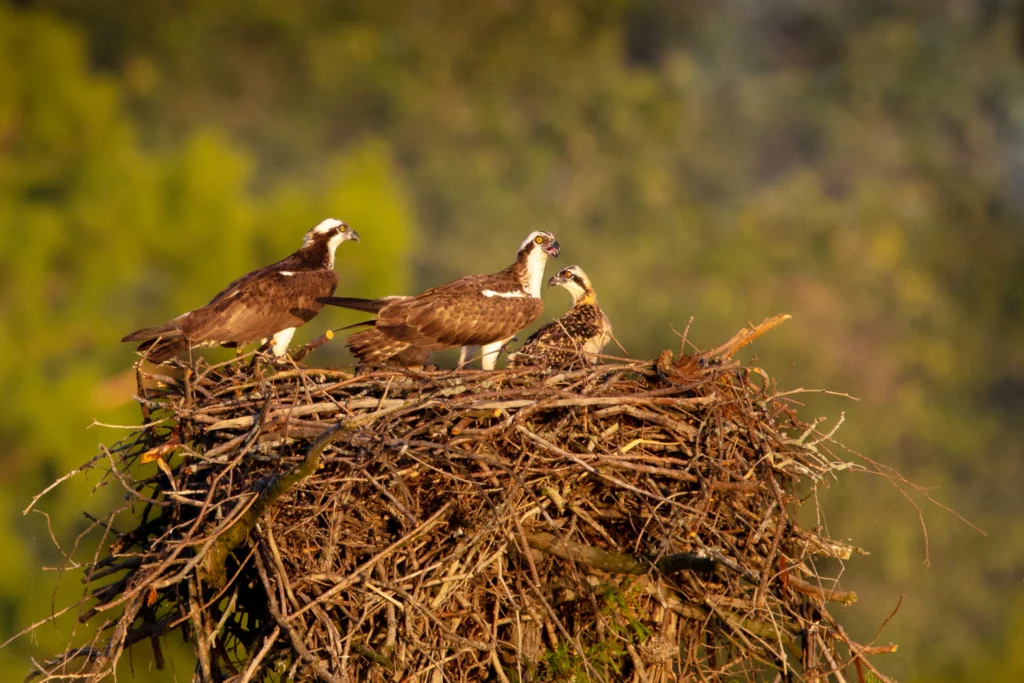
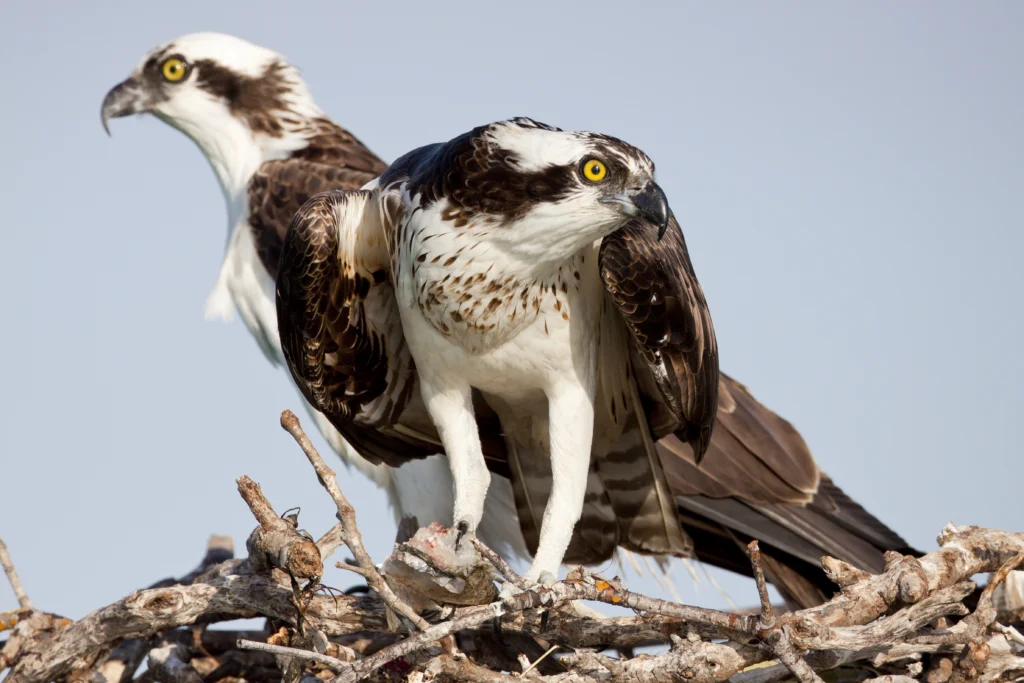
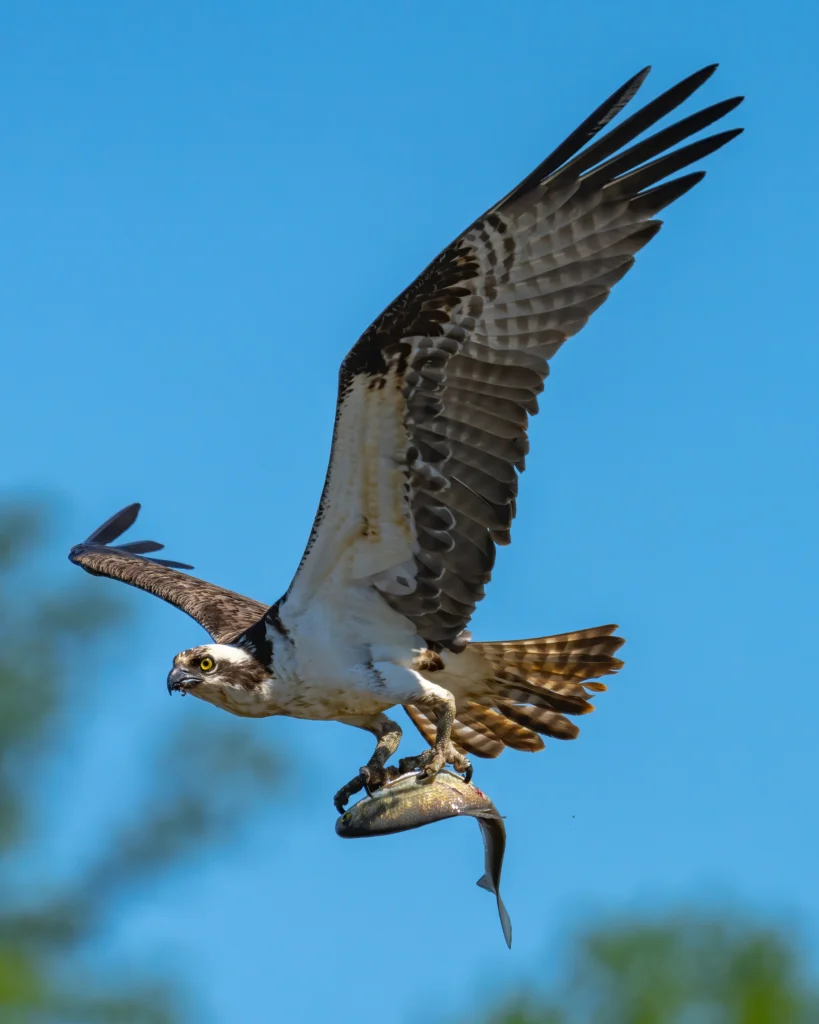
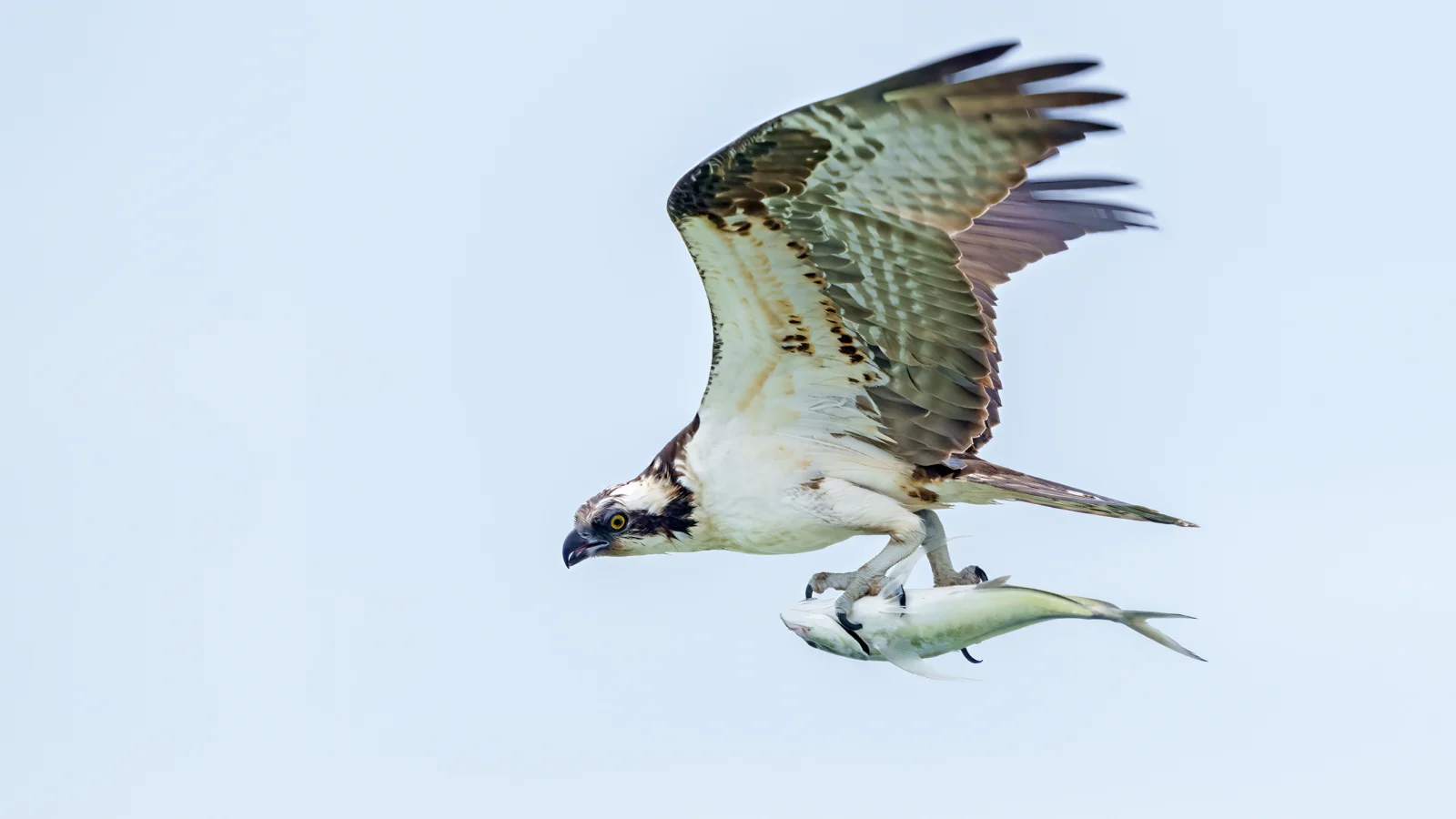
One of the most emblematic birds of the Chesapeake Bay is the cocoa-and-cream-colored, water-soaring Águila pescadora, which arrives each spring from as far away as South America to raise its chicks on nests built atop human-made platforms and docks along the winding shoreline. The Bay hosts an estimated 10,000 breeding pairs of these raptors, sometimes nicknamed “fish hawks,” which hunt the shallow water for fish to feed their young.
However, for the past few years, a growing number of those nests have become graveyards for chicks that weren’t fed enough fish to grow.
In recent years, Osprey researchers and observers have noticed fewer chicks surviving as starvation sets in, due to a lack of Atlantic menhaden, the small and shiny fish the birds rely on. This year, people around the Chesapeake Bay watched chicks starve and nests fail, and the Bay’s Ospreys raised fewer young than in any season in more than 50 years of monitoring.
Researchers project that if nothing changes, the Osprey population in the Bay will shrink by about 14 percent each year, which would cut it roughly in half in a decade.
“Nesting success is plummeting, and it’s now far lower than it was during the DDT crisis,” said Brian Brooks, American Bird Conservancy Vice President for Advocacy and Threats Programs. “That’s a red alarm bell.”
The Chesapeake Bay has long been a stronghold for Ospreys due to its abundance of prey and habitat — and historically, “prey” was synonymous with Atlantic menhaden. The fish once made up more than two-thirds of the Bay Ospreys’ diet because it is packed with nutrients and energy; in fact, it is one of the only fish species with enough nutrients to nourish Osprey chicks. As fewer menhaden reached the nests, that number fell to less than 30 percent by the 2000s. Biologists now watch parent Ospreys hunt for more hours, only to return with few or no fish for their chicks.
New research shows the problem isn’t exclusive to the Chesapeake Bay. An analysis of nearly 3,000 nesting pairs in 10 East Coast states found that Ospreys nesting in salt water averaged only 0.59 young per pair, below the roughly 0.8 to 1.3 needed to keep a population stable, while pairs in freshwater averaged 1.15. The gap suggests the shortage of fish is affecting other coastal populations.
American Bird Conservancy, scientists, anglers, and other community members are advocating for an end to the overfishing of menhaden to conserve the Bay’s Ospreys and protect its ecosystem. Brooks said the timeline is urgent.
“If we snapped our fingers now and stopped fishing for menhaden, it would still take a long time for Ospreys to rebound,” Brooks said. “We need to act now before we get to a critical level here.”
The Atlantic States Marine Fisheries Commission (ASMFC), the body that oversees fish in the region, is weighing a proposal to cut the cap on the Bay’s menhaden reduction fishery by up to 50 percent. The Commission is scheduled to consider final action at its meeting November 9 to 12, 2026. The proposal follows the Commission’s latest stock assessment, released in October 2025, which found there are fewer menhaden along the coast than regulators had believed.
“The most immediate action we can take right now is leaving more menhaden in the water,” Brooks said.
What Scientists Are Seeing in Nests
Bryan Watts, director of William & Mary’s Center for Conservation Biology, the organization leading much of the Chesapeake Osprey research, has watched the number of chicks these birds can raise shrink dramatically over the past five decades he has been studying them.
“They have never had a year when productivity was this low,” he told the American Birding Association in July.
What is happening is a death spiral within nests. When there isn’t enough food coming into a nest for every chick to grow, a pecking order forms within the brood, Watts said. This means that the oldest chick is fed first. The smallest, which can weigh just a fifth as much as its oldest sibling, is fed last, and a chick left with an empty crop typically dies within about a week.
It’s an adaptation that helps the birds make the most of scarce food. If parents split a small catch evenly, Watts said, every chick in the nest could die. However, despite this adaptation, chick mortality is still happening.
Mobjack Bay, a sub-estuary of the Chesapeake, shows how far survival rates have fallen. Watts’s team has monitored Ospreys there since 1970. Over 45 years, the share of nests that succeed has dropped about 60 percent, and the typical successful nest now raises one chick instead of two. In 2023, out of 81 pairs in Mobjack Bay, just three chicks survived to fledging age.
A Coast-wide Issue
Other researchers throughout the Bay are seeing the same pattern. In freshwater areas, where Osprey rely on a different mix of fish, such as catfish, reproduction is still healthy. In saltier waters, where the birds depend more heavily on menhaden and other brackish-water fish, it has fallen to extraordinarily low levels.
Across 23 study areas and roughly 1,000 pairs monitored by the Center for Conservation Biology in 2026, Ospreys in tidal-freshwater areas raised about one chick per pair. In areas where salinity exceeded 5 parts per thousand, that fell to about 0.2 chicks per pair. In some of the worst-performing areas in 2026, researchers recorded roughly just one surviving chick for every 40 or 50 pairs.
For Watts, that means the saltier waters are no longer producing enough young Osprey to replace the adults that die — and the healthier freshwater areas can’t make up the difference. To offset the losses, the Bay would need nearly three pairs in thriving areas for every pair in struggling ones, he said. Instead, it has about seven and a half pairs in struggling areas for every pair in thriving ones.
This past summer, farther north along the coast in New Jersey, wildlife biologist Ben Wurst witnessed dozens of Osprey nests fail, chicks starve, and some adult females fail to lay eggs at all.
On Sedge Island, New Jersey’s only marine conservation zone, Ospreys typically fill the summer skies, Wurst said. The island is home to the state’s most densely populated Osprey colony. Here, birds can forage in both the bay and the ocean, making it a place where Wurst said the abundance of life has made the recent decline especially salient.
This year, he said, just two chicks survived among 18 nesting pairs.
“It’s a very amazing place to go and visit,” Wurst said. “But the last two years, it’s been devoid of life.”
He has watched Osprey parents spending more time searching for fish and returning with less. In some nests, both parents have to leave the nest to search for food, leaving their chicks vulnerable to predators. In one nest Wurst was monitoring this past season, he found a dead chick beside its surviving sibling, whose stomach was so hollowed out that it had begun feeding on the dead chick.
“What we’re seeing is exactly what’s being observed on the Chesapeake Bay,” Wurst said, adding that the same problems are emerging in coastal Delaware, Maryland, New York, Connecticut, and Rhode Island.
Why Are Menhaden So Scarce?
Will Poston, the forage campaign manager at the Chesapeake Bay Foundation, said recreational anglers have been trying to raise the alarm on the lack of menhaden in Bay waters in recent years. He said this group depends on these fish being left in the water to support the bigger fish that they rely on catching, including striped bass and bluefish.
“Folks who have been fishing the Bay for 40 years tell stories of menhaden schools that were acres in size,” Poston said. “What we’ve seen more and more of the past few years is smaller schools that are no longer an acre, but maybe a couple hundred feet. Those schools are increasingly full of smaller menhaden, too. We’ve seen the size of these menhaden schools and the overall abundance of menhaden in the Bay declining. And then the menhaden we are seeing are mostly these smaller, immature ‘peanut bunkers.’”
Bunker is a commonly used name for menhaden. These small but extremely energy-rich fish feed on plankton and turn it into food for larger animals, which is why fisheries scientists call forage fish like menhaden “energy changers.” Few other fish deliver as many calories per catch to a nest full of hungry Osprey chicks.
This fish species supports the largest fishery on the Atlantic Coast by volume. Most of the menhaden is cooked and pressed into oil and fishmeal, which is used in pet food, livestock feed, and aquaculture—a process known as reduction. One company, Omega Protein, a Canadian-owned company based in Reedville, Virginia, runs the only remaining reduction fishery on the coast.
Each year, ASMFC sets a coast-wide limit on how many menhaden can be caught, then divides that limit among the states. Right now, Virginia gets about three-quarters of the entire coast-wide limit, and gives about 90 percent of its share to a single fishery, the “reduction” fleet run by Ocean Harvesters, which sells its catch to Omega Protein’s plant in Reedville. This means roughly two-thirds of all the menhaden allowed to be caught along the Atlantic Coast go to one operation.
If we snapped our fingers now and stopped fishing for menhaden, it would still take a long time for Ospreys to rebound. We need to act now before we get to a critical level here.
Catch limits are determined based on a “stock assessment,” a scientific estimate of how many fish are in the water and how healthy the population is. In October 2025, scientists on the ASMFC’s Atlantic Menhaden Technical Committee released the 2025 Atlantic menhaden stock assessment update. The update set fishing targets meant to leave enough menhaden in the water for predators such as striped bass and Ospreys. These new assessments made use of a University of Miami analysis of old tagging data, which resulted in a lower estimate of how many menhaden die of natural causes each year. As a result, the 2025 estimate of how many menhaden are in the water dropped 37 percent on average — meaning there are far fewer of these fish in the sea than scientists had assumed.
Conservation and recreational fishing groups say the new analysis called for cutting the catch limit by 50 percent or more. But at its October 28, 2025 meeting in Dewey Beach, Delaware, the Commission’s menhaden board instead cut the 2026 limit by 20 percent, to about 186,800 metric tons. That’s still not enough.
Poston, the CBF campaign manager, grew up fishing up and down the Chesapeake Bay. He said that it is important to improve the menhaden fishery, because everything in the Atlantic Coast ecosystem eats fish that depend on menhaden, not just Ospreys. Poston adds that the warning signs facing the Chesapeake Bay are mounting and demand action.
“Leaving more menhaden in the water is one of the most surefire ways to improve the resilience of the Chesapeake Bay and support this entire ecosystem, this estuary, and the countless communities that depend on a thriving, healthy Chesapeake Bay,” Poston said.
What’s Being Decided Now
The ASMFC is considering changes to the Chesapeake Bay reduction fishery in a document called Draft Addendum II. ABC and other conservation and recreational fishing groups are advocating for the Commission to approve these options:
- Reducing the Bay cap on menhaden catch by up to 50 percent. This would cut it by half and tie it to 13.6 percent of the coast-wide catch limit (the cap is now about 27 percent), so it shrinks if the coast-wide limit does.
- Spreading out the harvest. In each of the past three years, a delayed menhaden migration meant little early fishing, followed by a rush that took about half the cap in a short window. This option would split the season into three quota periods.
- Payback for overages, limits on rolling over unused quota, and a review of the cap every three years.
The Commission is scheduled to consider final action at its November meeting in Newport, Rhode Island, which runs November 9 to 12. American Bird Conservancy is not counting on the ASMFC alone, said Brooks.
“We need elected officials who are accountable to the people,” he said. Governors appoint a commissioner to the ASMFC, and states can take steps in their own waters. Brooks said menhaden are found up and down the coast, so the effects of Virginia’s harvest are felt in every state, and the states most affected include ones that get little economic benefit from the fishery.
What You Can Do
- Show decision-makers that the public is watching. If you live in an Atlantic Coast state, contact your governor and state legislators, whether or not you live near the Bay. Ask them to support stronger menhaden protections and to direct their ASMFC representatives to do the same.
- Fifteen states are represented on the Commission. Submit a separate comment on the coast-wide catch limit. The Commission is preparing to set the Total Allowable Catch (TAC) for 2027–2029, meaning the total amount of menhaden that can be harvested along the Atlantic Coast. This is a separate decision from the Chesapeake Bay cap proposal, and comments must be submitted separately. The deadline for comments is October 19. Send comments to comments@asmfc.org with the subject line “Atlantic Menhaden 2027-2028 TAC.”
- Report and monitor nests. Visit osprey-watch.org to find nests near you. Nests with no recent reports need a watcher. Local monitoring groups along the coast welcome volunteers.
- Support ABC and other conservation groups working toward a better future for Ospreys. American Bird Conservancy supports work that conserves habitat for Ospreys outside of the breeding season, when some journey as far south as South America — including to ABC-supported protected areas.
It’s critical that stakeholders and community members reach out to the ASMFC and their elected officials to let them know they are concerned for menhaden and the future of Ospreys.
“Whether you’re in Virginia, Connecticut, Florida, you can advocate for conservation of menhaden,” said CBF campaign manager Will Poston. “Not only in Chesapeake Bay but along the entire Atlantic Coast. Because menhaden are so integral to a healthy marine ecosystem, this is one of the few opportunities as conservationists that we can achieve lasting positive impacts that will benefit and support the entire Atlantic Coast ecosystem.”
“We need to show that there is massive American support for drastic change here,” said Brooks.